.svg)


.svg)
Florida attorneys managing client funds face strict compliance requirements under Chapter 5 of the Rules Regulating The Florida Bar, with violations triggering disciplinary action, suspension, or disbarment. The state's Interest on Trust Accounts (IOTA) program, Florida's version of IOLTA, mandates monthly reconciliation procedures, six-year record retention, and annual certification filings between June 1 and August 15. Modern law firm trust accounting platforms can automate these complex compliance requirements while maintaining the fund segregation that protects both client interests and attorney licenses.
Key Takeaways
- Florida uses "IOTA" (Interest on Trust Accounts) rather than "IOLTA," administered by Funding Florida Legal Aid (FFLA)
- Nominal or short-term client and third-party funds that cannot practicably earn net income for the owner must generally be deposited into a Florida IOTA account
- Florida attorneys must reconcile their trust accounts monthly and compare reconciled account balances with the total balances shown on individual client or matter ledgers
- All trust account records must be retained for a minimum of 6 years after representation concludes
- Firms with 2+ attorneys must maintain a written trust account plan under Rule 5-1.2(c)
- Annual Trust Accounting Certificate filing window runs June 1 through August 15
- The Florida Bar Ethics Hotline (1-800-235-8619) provides free confidential guidance to members
Understanding the Fundamentals of Florida IOLTA Trust Accounts
What is an IOTA Account?
Florida's Interest on Trust Accounts program requires attorneys to deposit certain client funds into interest-bearing accounts, with generated interest supporting legal aid programs statewide. Unlike other states that use "IOLTA" terminology, Florida specifically designates these accounts as IOTA accounts under the Rules Regulating The Florida Bar.
The program targets nominal or short-term client funds that cannot practically earn net income for individual clients. When properly managed, these pooled accounts generate meaningful interest that Funding Florida Legal Aid distributes to legal services organizations helping low-income Floridians access justice.
Your IOTA compliance responsibilities include:
- Account designation: Opening accounts specifically labeled as IOTA trust accounts
- Interest remittance: Ensuring your financial institution sends interest directly to FFLA
- Fund identification: Tracking which client matters each deposit relates to
- Segregation maintenance: Keeping client funds completely separate from operating funds
- Documentation protocols: Recording all transactions with audit-ready detail
The Purpose of IOTA in Florida
The Florida Supreme Court established the IOTA program to fulfill dual objectives: protecting client funds through regulated trust accounts while generating resources for legal aid programs. Every dollar of interest earned supports Floridians who cannot afford legal representation.
This structure means attorneys serve as fiduciaries twice over, once to their clients whose funds they hold, and once to the broader legal system their interest payments support. Understanding this dual responsibility clarifies why compliance requirements carry such weight.
Who Benefits from IOTA Funds?
Interest generated from IOTA accounts flows to FFLA in Maitland, which distributes funds to legal aid organizations throughout Florida. These programs provide civil legal assistance for domestic violence survivors, veterans facing housing issues, seniors navigating benefits claims, and families confronting wrongful evictions. The cumulative impact of thousands of IOTA accounts generates substantial funding annually, making proper account maintenance both an ethical obligation and a contribution to access to justice.
Florida Bar Rules Governing IOLTA Accounts
Key Provisions of Florida's IOTA Rules
Chapter 5 of the Rules Regulating The Florida Bar establishes the comprehensive framework governing trust accounts. Rule 5-1.1 defines trust account requirements, while Rule 5-1.2 details record-keeping and compliance procedures.
Core regulatory requirements include:
- Deposit timing: Client funds must be deposited promptly upon receipt
- Account labeling: Trust accounts must be clearly identified as such with financial institutions
- Interest designation: IOTA accounts must direct interest to FFLA
- Signatory controls: Firms must carefully control trust account access and identify trust account signatories in required written plans, with lawyers remaining responsible for compliance
- Overdraft notification: Banks must report overdrafts directly to The Florida Bar
The rules distinguish between funds requiring IOTA deposit and those warranting individual interest-bearing accounts. Factors determining appropriate treatment include amount, expected holding period, and the cost of establishing separate accounts versus potential client earnings.
Prohibited Practices for IOTA Accounts
Florida Bar rules explicitly prohibit several practices that trigger immediate compliance violations:
Commingling funds remains the most common violation. Attorneys cannot deposit personal or operating funds into trust accounts, except for minimal amounts to cover bank fees. Even temporary commingling can result in disciplinary proceedings.
Improperly disbursing against uncollected funds creates compliance risk. Florida generally requires collected funds before disbursement, but Rule 5-1.1(j) recognizes limited exceptions for specified categories of deposits when its requirements are satisfied.
Using trust funds for business expenses violates the fundamental principle of client fund protection. Trust accounts exist solely for client matters, not firm operations.
Failing to maintain required records constitutes independent violations beyond any underlying transaction issues. The documentation requirements exist to enable oversight and protect both clients and attorneys.
Consequences of Non-Compliance
The Florida Bar's lawyer-regulation system can investigate trust account violations, with consequences depending on the nature and severity of the misconduct. Consequences escalate based on violation severity:
- Admonishment: Written warning for minor technical violations
- Public reprimand: Published finding of misconduct affecting professional reputation
- Suspension: Temporary loss of license to practice, ranging from 90 days to three years
- Disbarment: Permanent revocation of license in cases involving misappropriation
Beyond disciplinary action, trust account violations can trigger malpractice claims, bar association audits, and criminal prosecution for conversion or theft when funds are misappropriated.
Distinguishing Between Operating Accounts and IOTA Accounts
Why Segregation is Critical
The absolute separation between client trust funds and attorney operating funds forms the bedrock of trust accounting compliance. This segregation protects clients from creditor claims against the firm, enables accurate accounting for each matter, and demonstrates fiduciary responsibility.
Your operating account handles earned fees, firm expenses, owner distributions, and tax payments. Your IOTA trust account holds client retainers, settlement proceeds, expense advances, and third-party funds held in connection with representation.
When to Transfer Funds from IOTA to Operating
Timing of transfers requires careful attention. Fees become earned, and transferable to operating accounts, only when the underlying services are complete. Premature transfers constitute taking unearned funds, a violation independent of whether services are eventually rendered.
Best practices for fund transfers include:
- Document authorization: Written fee agreements specifying when fees become earned
- Calculate precisely: Transfer only amounts actually earned, not estimates
- Record contemporaneously: Note transfers immediately in both accounts
- Retain support: Keep time records and invoices substantiating earned amounts
- Communicate with clients: Provide statements showing trust account activity
Common Mistakes in Fund Management
Even well-intentioned attorneys make errors that trigger compliance issues. The most frequent mistakes include depositing flat fees directly to operating, leaving earned fees in trust too long, imprecise record-keeping, and inadequate client identification. Every deposit must be traceable to specific client matters. Modern trust accounting systems can prevent these errors through automated tracking and compliance alerts that flag potential issues before they become violations.
Best Practices for IOTA Account Management and Compliance
Implementing Robust Accounting Practices
Effective trust account management requires systematic approaches that survive staff turnover, busy periods, and the inevitable distractions of active practice. Your accounting infrastructure should include dedicated trust accounting software with Florida-specific compliance features, standardized deposit procedures, disbursement authorization protocols, exception handling processes, and staff training programs ensuring everyone who touches trust accounts understands compliance requirements.
Three-Way Reconciliation Requirements
Florida requires monthly reconciliation comparing three sources that must match exactly: bank statement balance (the financial institution's record of your trust account), checkbook balance (your running record of deposits and disbursements), and client ledger totals (sum of all individual client matter balances).
This three-way reconciliation must be completed monthly. Any discrepancy, no matter how small, should be investigated, documented, and resolved promptly.
Reconciliation documentation should include date reconciliation performed, identified discrepancies, resolution notes, preparer signature, and reviewer approval for multi-attorney firms.
Leveraging Technology for Compliance
Cloud-based trust accounting software transforms compliance from burden to routine. Modern platforms offer automated reconciliation that flags discrepancies immediately, real-time balance tracking showing available funds by client matter, integrated document storage linking transactions to supporting documents, compliance dashboards displaying reconciliation status and approaching deadlines, and audit trail generation producing court-ready documentation of every transaction.
Navigating Disbursements from IOTA Accounts in Florida
Proper Authorization for Disbursements
Every trust account disbursement must have a proper legal or contractual basis and be accurately documented. The supporting documentation varies by disbursement type:
Client disbursements must be made consistently with the client's entitlement to the funds and any applicable agreement, settlement terms, court order, or lawful instructions.
Third-party payments need both client authorization and supporting documentation: medical provider bills, expert invoices, court filing fees, or similar substantiation.
Attorney fee transfers must align with fee agreements and reflect services actually rendered. Time records or flat-fee milestones should support each transfer.
Expense reimbursements require receipts or invoices documenting the underlying costs, plus client authorization for the expense category.
Timely and Accurate Payouts
Client expectations increasingly demand rapid fund access. Traditional paper check distribution creates delays that modern clients find unacceptable, while also generating compliance risks from uncashed checks and escheatment obligations.
Factors affecting disbursement timing include:
- Deposit status: Funds generally must be collected before disbursement unless a transaction qualifies for one of Rule 5-1.1(j)'s limited exceptions
- Lien resolution: Medical and government liens must be addressed before distribution
- Court approval: Some settlements require judicial sign-off before disbursement
- Tax form collection: W-9 or W-8BEN requirements for reportable payments
- Client verification: Confirming payment instructions came from actual clients
Handling Residual Funds
Unclaimed funds in trust accounts create ongoing compliance obligations. Florida's abandoned property laws require eventual escheatment of funds when clients cannot be located after diligent efforts. Before escheatment, attorneys must attempt contact using all available information, document efforts with dated records, hold funds for the required dormancy period, report property to the Florida Department of Financial Services, and remit funds according to state escheatment procedures. Alternatively, courts may approve cy pres distributions directing residual settlement funds to charitable purposes related to the underlying litigation.
Ethical Considerations and Potential Pitfalls for Florida Attorneys
Common Ethical Traps with IOTA
Trust account violations often stem from good intentions combined with poor systems rather than deliberate misconduct. Common scenarios include:
Borrowing against anticipated fees: Using trust funds for firm needs when earned fees are expected but not yet received constitutes misappropriation regardless of intent to repay.
Poorly controlled signatory access: Properly authorized and supervised nonlawyer employees may serve as trust account signatories, but lawyers remain responsible for safeguarding the account and complying with Florida's trust accounting rules.
Neglecting reconciliation during busy periods: Monthly reconciliation requirements don't pause for trial preparation, major closings, or practice emergencies.
Insufficient supervision of staff: Attorneys remain responsible for trust account compliance even when delegating day-to-day management to staff.
Poor communication with clients: Failing to provide accountings upon request or explain trust account handling violates both ethical rules and client relationships.
When to Seek Guidance from the Florida Bar
The Florida Bar's Ethics Hotline (1-800-235-8619) provides confidential guidance to members facing trust account questions. Contact the hotline when unusual situations arise without clear rule guidance, conflicting obligations create uncertainty about proper handling, potential violations have occurred and you need remediation advice, client disputes involve trust account funds, or rule interpretations remain unclear after reviewing available resources.
The Ethics Hotline provides informal guidance that, while not binding, demonstrates good faith effort to comply. Document your inquiry and the guidance received for potential future reference.
Maintaining Client Trust and Professionalism
Beyond technical compliance, trust account handling shapes client perception of your professionalism. Best practices include proactive communication about how retainers are held and when they become earned, regular accounting showing clients their trust account activity, prompt disbursement of client funds when matters conclude, clear documentation explaining any deductions, and responsive handling of client questions about their funds.
Setting Up Your Florida IOTA Account: Step-by-Step Process
Determine Account Type Required
Before opening any account, assess which funds you'll be handling and their appropriate treatment. IOTA accounts suit nominal or short-term funds that cannot practicably earn net income for individual clients. Individual interest-bearing accounts become appropriate when client funds are substantial enough and held long enough to generate meaningful returns for that specific client. Most practicing attorneys need at least one IOTA account.
Select an Eligible Financial Institution
Your chosen bank must meet Florida Bar requirements for IOTA-eligible institutions: federal FDIC or NCUA insurance coverage, Florida authorization to conduct business, IOTA participation agreement to remit interest to FFLA, and overdraft reporting commitment to notify The Florida Bar. Verify eligibility through FFLA's resources before opening accounts.
Complete Required IOTA Program Forms
Opening an IOTA account requires notifying both FFLA and your financial institution. Notice to Bar Foundation Form informs FFLA of your new account. Notice to the Eligible Institution Form authorizes your bank to send interest payments directly to FFLA. Forms are available through FFLA's website or from participating financial institutions. Processing typically takes 1-2 weeks for confirmation.
Establish Record-Keeping Systems
Rule 5-1.2 mandates comprehensive record-keeping from day one. Required records include bank statements and deposit slips, canceled checks or equivalents, receipts and disbursements journal, individual client ledgers, and monthly reconciliation reports. Free templates are available through LegalFuel's trust accounting resources for attorneys establishing their systems.
Implement Written Trust Account Plan
Firms with two or more attorneys must maintain a written trust account plan under Rule 5-1.2(c). This plan must document responsible personnel, supervision procedures, reconciliation protocols, disbursement authorization requirements, training requirements, and succession planning. Solo practitioners are not required to maintain written plans but benefit from documenting their procedures nonetheless.
Establish Monthly Reconciliation Routine
Build reconciliation into your monthly workflow before the first transaction occurs. Calendar the reconciliation by setting a recurring monthly deadline after the trust account statement becomes available. Designate responsibility by assigning specific individuals to prepare and review reconciliations. Create templates to standardize documentation format. Establish review protocols defining who approves completed reconciliations. Archive systematically to store reconciliations for required 6-year retention.
File Annual Trust Accounting Certificate
Between June 1 and August 15 each year, Florida attorneys must file a Trust Accounting Certificate confirming compliance. The certificate includes account confirmation, compliance certification, and attorney certification confirming the member's compliance with, or applicable exemption from, Florida's trust accounting requirements. Filing occurs through The Florida Bar member portal. Failure to file by August 15 triggers notice from The Florida Bar, and a member who still has not filed by September 30 is considered delinquent and ineligible to practice. Failure to file may also provide grounds for a trust account audit.
Staying Updated on Florida IOTA Rule Changes and Interpretations
Resources for Ongoing Learning
Trust account rules evolve through Florida Supreme Court amendments, Florida Bar opinions, and enforcement trends. Stay current through The Florida Bar website (official source for rule text and amendments), LegalFuel resources (practical guidance and templates), FFLA communications (program updates), Continuing Legal Education courses (trust accounting courses satisfy ethics CLE requirements), and Bar publications covering significant developments.
Importance of Proactive Compliance
Reactive compliance, addressing issues only when problems arise, creates unnecessary risk. Proactive approaches include regular self-audits reviewing reconciliations and documentation, staff training updates, technology evaluation assessing whether your systems keep pace with available capabilities, peer consultation discussing best practices, and professional guidance engaging CPAs or consultants for periodic external review.
Impact of New Technologies on IOTA
Digital payment methods create new compliance considerations for trust accounts. When disbursing settlement funds, attorneys must ensure payment methods maintain required fund segregation while providing adequate documentation. Modern QSF-compliant disbursement platforms can enhance compliance by automating documentation requirements that paper check processes leave to manual tracking.
Why Talli Simplifies Trust Account Disbursements for Florida Attorneys
While numerous trust accounting solutions exist, Talli delivers specialized capabilities for attorneys managing settlement disbursements within Florida's compliance framework. Talli addresses the specific challenges Florida attorneys face when distributing settlement funds.
Fund Segregation Architecture maintains dedicated account structures for settlement funds, supporting clear fund separation and Qualified Settlement Fund administration while reducing the risk of commingling. This architecture produces audit-ready documentation proving fund separation throughout the entire disbursement lifecycle.
Multi-Channel Payment Options give claimants flexibility while maintaining compliance, including ACH direct deposit, prepaid Mastercard via Patriot Bank, digital wallets including PayPal and Venmo, gift cards for smaller distributions, and paper checks as fallback when preferred.
Integrated Compliance Infrastructure automates requirements that create manual burden: KYC identity verification, OFAC screening with documented timestamps, W-9 collection via digital forms achieving high completion rates through smart reminders, automated 1099-MISC/1099-NEC generation with IRS e-filing integration, and 24% backup withholding calculation for missing TIN numbers.
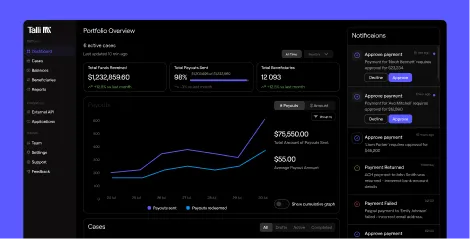
Real-Time Dashboard and Analytics provide live visibility into completion rates, payment method distribution, and remaining fund balances. Automated reporting generates court-required accounting without manual preparation, while stakeholder portals provide controlled access for courts, trustees, and legal teams.
For Florida attorneys managing class action settlements, mass tort distributions, or any high-volume legal payouts, Talli transforms compliance burden into operational advantage while achieving substantially higher redemption rates compared to traditional paper methods.
Frequently Asked Questions
What is the primary difference between an IOTA account and a regular trust account in Florida?
Florida's IOTA (Interest on Trust Accounts) program requires that interest earned on pooled client funds be remitted to Funding Florida Legal Aid to support legal aid programs. Regular individual trust accounts, used when client funds are substantial enough to earn meaningful interest for that specific client, direct interest back to the client or third party beneficiary. Both account types must comply with Chapter 5 trust account requirements, but IOTA accounts involve the additional obligation of interest remittance to FFLA.
Can I earn interest on client funds held in an IOTA account for my law firm?
No. Interest generated by IOTA accounts must be remitted entirely to FFLA, which distributes funds to legal aid organizations. Attorneys cannot retain any interest from IOTA accounts. However, you may maintain nominal amounts of your own funds in IOTA accounts to cover bank service charges, this is the only permissible retention of firm funds in these accounts.
What are the consequences for an attorney who commingles personal funds with client funds in an IOTA account?
Commingling violations can result in disciplinary action ranging from admonishment for minor technical violations to disbarment for misappropriation. Trust account complaints may enter The Florida Bar's disciplinary system through its intake and lawyer-regulation processes, with sanctions depending on the facts, severity, and applicable disciplinary standards. Beyond Bar discipline, commingling can trigger malpractice claims, criminal prosecution, and irreparable reputation damage.
How often am I required to reconcile my IOTA account records according to Florida Bar rules?
Florida requires monthly reconciliation of trust accounts, with the three-way reconciliation comparing bank statement balance, checkbook balance, and total client ledger balances. All three figures must match exactly; any discrepancy requires immediate investigation and documented resolution.
What digital payment methods are acceptable for disbursing funds from a client trust account?
Florida Bar rules permit various payment methods provided they maintain proper documentation and fund tracking. Acceptable digital methods include ACH transfers, wire transfers, and properly documented electronic payments. When using digital disbursement platforms, ensure the system maintains complete audit trails and fund segregation. Paper checks remain acceptable but create additional compliance burdens from uncashed check tracking and eventual escheatment obligations.