.svg)


.svg)
Residual settlement funds do not automatically belong to a state or a charitable recipient. Their disposition depends on the settlement agreement, final approval order, applicable case law, state unclaimed property statutes, and whether additional payments to class members remain practical.
For claims administrators and class counsel, the safest approach is to address residual funds before distribution begins, maintain clear records for every unpaid amount, and return to the court when the approved plan does not clearly authorize the next step.
Key Takeaways
- Escheatment and cy pres are not interchangeable. State law governs reportable unclaimed property, while courts control cy pres distributions in class action settlements.
- An uncashed settlement check does not automatically become state property. The settlement agreement, court order, check terms, applicable exemptions, and state priority rules must be reviewed.
- Courts generally prefer additional payments to class members when another distribution is economically feasible.
- Cy pres recipients should have a meaningful connection to the class, the alleged injury, the governing law, and the geographic scope of the litigation.
- Every state, the District of Columbia, and several U.S. territories administer unclaimed property laws with different dormancy periods, deadlines, exemptions, and due diligence rules.
- Digital payment choice, accurate claimant data, reminders, and real-time tracking can reduce unclaimed funds before a residual-fund decision becomes necessary.
Understanding Residual Settlement Funds
Residual funds are amounts remaining after a settlement administrator completes the distributions and expenses authorized by the court-approved settlement plan.
They may arise from:
- Uncashed or returned checks
- Failed electronic payments
- Claimants who cannot be located
- Awards that cannot be delivered
- Invalid or duplicate claims
- Tax-documentation problems
- Funds remaining after administrative expenses
- Claim rates below the assumptions used to calculate awards
- Interest earned by the settlement fund
The legal treatment of these amounts depends on how the settlement documents define the claimant’s rights and what the court has authorized.
An uncashed check may represent an outstanding obligation to an identifiable class member. In another settlement, the check may become void after a stated period, with the amount returning to the settlement fund for redistribution. Other agreements authorize a supplemental distribution, cy pres payment, reversion, or another court-approved use.
Administrators should therefore avoid assuming that all residual money falls into one legal category.
What Is Escheatment?
Escheatment is commonly used to describe the transfer of abandoned or unclaimed property to a state unclaimed property administrator. In most modern unclaimed property programs, the state takes custody of the property and attempts to reunite it with the owner.
The property owner usually retains the right to submit a claim later. The state’s custody generally does not mean that the owner voluntarily forfeited the property.
Every state, the District of Columbia, and several U.S. territories maintain their own rules. Although many statutes draw from versions of the Uniform Unclaimed Property Act, requirements are not identical.
Differences may include:
- The applicable dormancy period
- How owner inactivity is measured
- Due diligence notice thresholds
- Reporting and remittance deadlines
- Electronic filing requirements
- Aggregate reporting rules
- Record-retention periods
- Penalties and interest
- Treatment of checks, credits, securities, and court-held funds
- Business-to-business or other exemptions
The Uniform Law Commission describes unclaimed property laws as a system under which holders transfer property after an applicable dormancy period so the state can attempt to reunite it with its rightful owner.
How State Unclaimed Property Reporting Works
A typical unclaimed property process involves four stages.
1. Determine Whether Property Is Reportable
The administrator first identifies the legal obligation represented by the unpaid amount.
For a settlement payment, this analysis may require reviewing:
- The settlement agreement
- The distribution plan
- The final approval order
- Later court orders
- Check language and expiration terms
- Claimant correspondence
- The claimant’s last known address
- Any provision requiring redistribution or reversion
The administrator should also determine whether the settlement fund, defendant, claims administrator, trustee, or another entity is legally treated as the holder.
2. Apply the Correct State’s Law
Unclaimed property priority rules generally look first to the apparent owner’s address as shown in the holder’s records. When no address is available, the holder’s state of incorporation or organization may become relevant.
This analysis can be complicated when the fund, administrator, defendant, and claimant are located in different jurisdictions.
3. Complete Required Due Diligence
Many states require holders to contact apparent owners before reporting property. Notice thresholds, mailing periods, delivery methods, and required language vary.
Administrators should preserve evidence of:
- Mailed notices
- Returned envelopes
- Email and SMS outreach
- Address searches
- Payment reminders
- Reissuance attempts
- Claimant responses
- Deceased-owner or estate research
4. Report and Remit the Property
If the amount remains reportable, the holder files the required report and transfers the property to the state administrator.
State deadlines vary. Some jurisdictions use fall reporting cycles, while others use spring deadlines or industry-specific schedules. Administrators should not rely on a single nationwide reporting date.
Do Uncashed Settlement Checks Always Escheat?
No.
An uncashed settlement check may become unclaimed property, but the result is not automatic. The administrator must examine the legal instruments governing the settlement and the applicable state statute.
Important questions include:
- Did the settlement agreement create an unconditional payment obligation to an identifiable class member?
- Does the check become void after a stated period?
- Does the settlement plan require uncashed amounts to return to the fund?
- Did the court authorize a second distribution?
- Does the agreement direct residual amounts to a cy pres recipient?
- Does a reversion provision apply?
- Does state law exempt or specially classify the payment?
- Which entity is legally responsible for the unpaid obligation?
When the settlement documents are unclear, administrators and counsel may need to request further instructions from the court rather than selecting a disposition method independently.
What Is Cy Pres?
Cy pres is an equitable doctrine derived from charitable trust law. In class actions, it may allow funds that cannot feasibly be distributed to class members to support an organization or project connected to the interests of the class.
The phrase comes from a French expression meaning “as near as possible.” The objective is to approximate the benefit that direct payments would have provided when direct relief is no longer practical.
Cy pres may appear:
- In the original settlement agreement
- In a court-approved distribution plan
- As a contingent method after an initial distribution
- In a later motion addressing remaining funds
- After the court determines that another direct distribution is infeasible
Cy pres is not simply a donation selected by the parties. It remains subject to judicial review.
How Courts Evaluate Cy Pres Proposals
Federal Rule of Civil Procedure 23(e) requires a court to determine that a class settlement is fair, reasonable, and adequate. The rule directs courts to consider the effectiveness of the proposed method for distributing relief to the class.
Standards for cy pres vary by jurisdiction, but courts commonly examine several factors.
Connection to the Class and Claims
A recipient should have a meaningful relationship to:
- The interests of class members
- The injury alleged in the case
- The objectives of the governing law
- The population affected
- The geographic scope of the class
For example, a consumer-protection settlement may support work that directly assists affected consumers. A privacy settlement may support carefully selected privacy education, research, or assistance connected to the class’s interests.
A broad charitable mission is not necessarily enough.
Feasibility of Further Direct Distribution
Courts frequently examine whether remaining funds can be paid to class members through:
- A second distribution
- Increased payments to claimants
- Automatic payments to identified members
- Simplified claims procedures
- Updated addresses
- Additional digital payment options
Cy pres is more defensible when the cost of another distribution would consume a disproportionate share of the remaining fund or when class members cannot reasonably be identified.
Conflicts and Independence
Courts may scrutinize relationships between the recipient and:
- Class counsel
- Defense counsel
- The defendant
- Named plaintiffs
- The presiding judge
- Court personnel
- Settlement administrators
Any material relationship should be disclosed. A recipient should not be selected primarily because of a personal, professional, or institutional connection.
Geographic Fit
A national organization may be suitable for a nationwide class. A local recipient may be more appropriate when the class and alleged harm are concentrated in a specific state or community.
The proposed use of funds should also be considered. An organization with a broad national mission may still be unsuitable if the funded program has little connection to the class.
Escheatment vs. Cy Pres
Which Mechanism Applies?
There is no universal answer. Administrators should follow a documented decision process.
Review the Settlement Documents First
The settlement agreement and court orders may expressly provide for:
- A second distribution
- Pro rata increases to claimants
- Reissuance of failed payments
- Cy pres distribution
- Reversion to the defendant
- Transfer under unclaimed property law
- Another court-approved disposition
An administrator should not override this structure based on operational convenience.
Separate Aggregate Residuals From Individual Obligations
Aggregate residual funds are not always the same as outstanding payments owed to identified people.
For example:
- Money never allocated to a claimant may remain part of the settlement fund.
- A valid award represented by an uncashed check may be an individual obligation.
- A failed payment that returned to the fund may require reissuance.
- A voided check may be governed by a redistribution provision.
- Interest earned by the fund may have a separate treatment.
Each category should be tracked separately.
Evaluate Another Distribution
Before recommending cy pres, counsel should determine whether additional payments to class members are practical.
Relevant considerations include:
- Remaining fund balance
- Number of eligible claimants
- Cost per transaction
- Minimum useful payment amount
- Availability of verified contact information
- Tax-reporting consequences
- Time remaining under court deadlines
- Availability of digital delivery
A second digital distribution may be economical even when another paper-check campaign is not.
Analyze State Unclaimed Property Exposure
For identifiable unpaid awards, counsel should review:
- The claimant’s address
- The relevant property type
- The date dormancy began
- Due diligence requirements
- Applicable exemptions
- Holder identity
- Contractual expiration language
- State record-retention rules
Because state laws differ, a nationwide settlement may require a multistate analysis.
Return to the Court When Necessary
A motion for instructions may be appropriate when:
- The settlement agreement is silent
- The approved distribution method no longer works
- Further distribution is possible but not expressly authorized
- Counsel proposes a new cy pres recipient
- State reporting may conflict with the settlement order
- The remaining fund contains different categories of money
- The parties disagree about reversion or redistribution
Court approval creates a clearer record and protects administrators from making unauthorized substantive decisions.
The 2025 ERISA Enforcement Policy
On January 14, 2025, the U.S. Department of Labor issued Field Assistance Bulletin 2025-01 concerning small retirement benefit payments owed to missing participants and beneficiaries.
The bulletin announced a temporary enforcement policy. Under specified conditions, the Department stated that it would not pursue fiduciary-duty enforcement against a responsible fiduciary of an ongoing pension plan that voluntarily transfers an entire benefit payment of $1,000 or less to an eligible state unclaimed property fund.
The policy is limited. It does not:
- Amend ERISA
- Require fiduciaries to use state funds
- Apply automatically to every uncashed benefit check
- Eliminate the duty to search for missing participants
- Override plan documents
- Convert every retirement benefit into state-reportable property
The bulletin is important for retirement-plan administrators, but it should not be generalized into a rule governing class action settlement residuals.
Reducing Residual Funds Before They Accumulate
The strongest residual-fund strategy is to improve delivery before checks become stale or payments fail.
Offer Multiple Payment Methods
Claimants differ in their access to banks, payment applications, and reliable mail. A flexible distribution may include:
- ACH transfer
- Prepaid card
- PayPal
- Venmo
- Gift card
- Wire transfer
- Paper check as a fallback
Talli supports multiple claimant payment options through a single class action platform, allowing administrators to reduce reliance on one distribution channel.
Verify Data Before Launch
Administrators should validate:
- Claimant names
- Mailing addresses
- Email addresses
- Mobile numbers
- Bank-routing information
- Duplicate records
- Estate or beneficiary status
- Tax-identification data
Clean claimant data reduces returned payments and avoidable exceptions.
Use Structured Reminders
Email and SMS reminders can help claimants:
- Select a payment method
- Complete identity verification
- Correct rejected information
- Submit tax forms
- Redeem a prepaid card
- Respond before a payment expires
Automated claimant communications also create a record of outreach.
Resolve Failed Payments Promptly
Returned ACH payments, expired digital links, undeliverable cards, and uncashed checks should enter a defined exception workflow.
Administrators can use failed-payment workflows to classify the cause, contact the claimant, obtain corrected details, and document reissuance.
Track Every Payment
A real-time payment tracking system helps administrators distinguish among:
- Delivered payments
- Redeemed payments
- Pending selections
- Returned payments
- Expired payments
- Fraud holds
- Deceased claimants
- Unresponsive claimants
This distinction is essential because not every unpaid record has the same legal treatment.
Compliance and Documentation
A defensible residual-fund process requires more than a final balance calculation.
Administrators should maintain:
- The approved distribution plan
- Complete claimant ledgers
- Payment authorization records
- Delivery and redemption status
- Copies of due diligence notices
- Returned-mail records
- Reissuance history
- Address-search results
- Fraud-review decisions
- Tax-document status
- Court approvals
- State reports and confirmations
Talli’s audit trail tools help claims teams document the payment lifecycle and prepare court-ready reports.
Compliance controls may also include OFAC screening, identity verification, duplicate detection, role-based access, and secure tax-document collection.
These controls do not decide whether escheatment or cy pres applies. They provide the evidence counsel and the court needs to make that decision accurately.
Why Talli Helps Minimize Residual Funds
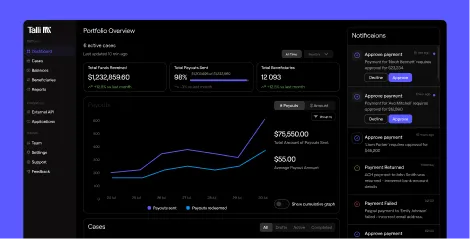
Talli is purpose-built for legal settlement disbursements. Claims teams can upload claimant data, launch payment campaigns, offer multiple payment options, monitor payment status, and maintain audit records from one dashboard.
The platform supports:
- ACH transfers
- Prepaid Mastercards
- PayPal
- Venmo
- Amazon gift cards
- Check fallback
- Automated reminders
- KYC and OFAC controls
- W-9 collection
- Fraud mitigation
- Fund segregation
- Real-time reporting
Administrators can use multi-channel payouts to reach claimants through their preferred method rather than relying exclusively on mailed checks.
Talli also provides settlement reconciliation and court reporting tools that help teams identify unresolved payments before they become long-term residuals.
Talli Conclusion
Escheatment and cy pres address different legal problems. Cy pres is a court-approved method for approximating class benefit when direct distribution is infeasible. Escheatment is a state-law process for transferring qualifying unclaimed property into state custody for potential recovery by its owner.
Neither mechanism should be selected through a blanket rule. Administrators must review the settlement documents, classify each remaining amount, evaluate further distribution, analyze state law, and obtain additional court instructions when necessary.
Talli helps reduce the number of funds that reach this stage. Multiple payment methods, automated claimant outreach, exception management, fund segregation, and real-time audit trails give claims teams more opportunities to complete payments while preserving the records required for any final disposition decision.
Frequently Asked Questions
What Are Residual Settlement Funds?
Residual funds are amounts remaining after court-approved payments and expenses. They may include unallocated money, returned electronic payments, uncashed checks, invalid claims, or interest. Their treatment depends on the settlement agreement, court orders, claimant rights, and applicable state law.
Do All Uncashed Settlement Checks Escheat?
No. Counsel must review the settlement documents, check terms, court orders, state law, and any redistribution or reversion provision. A check may represent reportable unclaimed property, or its amount may return to the settlement fund for another court-approved use.
When May a Court Approve Cy Pres?
A court may consider cy pres when direct payments are infeasible or another distribution would consume an unreasonable portion of the remaining fund. The recipient should have a meaningful connection to the class, the alleged injury, the governing law, and the class’s geographic scope.
Should Class Members Receive Another Distribution First?
Courts often prefer direct relief when another distribution is practical. Administrators should evaluate the remaining balance, claimant population, transaction costs, available contact information, tax consequences, and minimum useful payment before proposing cy pres.
How Does Talli Reduce Residual Funds?
Talli supports ACH, prepaid cards, PayPal, Venmo, gift cards, and check fallback. Automated reminders, real-time tracking, exception workflows, identity controls, and audit records help administrators correct failed payments and reach more claimants before funds become long-term residuals.