.svg)


.svg)
States hold an estimated $70-100+ billion in unclaimed property, with billions returned each year but many assets still sitting in state custody, meaning shareholders can face long delays, extra claim steps, and potential loss of investment upside once securities are transferred or liquidated. Modern shareholder services platforms can transform this compliance burden into a strategic opportunity, using automated outreach and digital payment options to reconnect lost shareholders before their funds transfer to state custody. With dormancy periods now as short as 3 years in most states and aggressive enforcement creating audit exposure, issuers need proactive strategies that go beyond traditional paper-based methods.
Key Takeaways
- States hold an estimated $70-100+ billion in unclaimed property, and in Delaware, unclaimed property has historically been one of the state's largest revenue sources
- California officials have estimated that only about 2% of California businesses properly report unclaimed property each year, showing how quickly holder compliance gaps can create audit risk
- SEC Rule 17Ad-17 requires transfer agents to conduct required searches after a securityholder becomes lost, including a second search within six to twelve months after the first
- Delaware collected over $607 million in escheatment revenue in FY2017, with $248 million from stock-related assets alone
- Modern technology platforms can reduce manual workload by an estimated 70%+ while improving owner reconnection rates
- Proactive shareholder communication programs can reduce escheatment rates significantly for early adopters
Understanding Unclaimed Funds and Unclaimed Property: A Primer for Issuers
Unclaimed funds represent assets held by companies where the rightful owner has lost contact typically due to address changes, unredeemed dividend checks, or death without heirs being aware of holdings. When these assets remain dormant beyond state-mandated periods, they enter the escheatment process, transferring custody from the issuer to state governments.
The distinction between unclaimed funds and unclaimed property matters for compliance purposes:
- Unclaimed funds: Cash-equivalent assets including dividend payments, interest, and redemption proceeds
- Unclaimed property: Broader category encompassing securities, uncashed checks, and tangible assets
- Escheatment: The legal process transferring abandoned property to state custody after dormancy periods
Property becomes "lost" when companies have no communication with the owner. The National Association of Unclaimed Property Administrators emphasizes that shareholders should contact institutions holding their money every year, especially after address changes or changes in marital status.
The Escheatment Process Explained
Escheatment follows a predictable lifecycle that issuers must understand:
- Dormancy trigger: Account inactivity exceeds state-mandated period (3-5 years for most securities)
- Due diligence: Issuer must attempt contact through mandated outreach 60-120 days before reporting
- State reporting: Property reported via NAUPA-format filings to appropriate jurisdiction
- Remittance: Funds transferred to state custody, with securities typically liquidated
- Indefinite holding: States hold property in perpetuity for owners to claim
The Costly Challenge: Why Issuers Struggle With Escheated Checks and Unclaimed Funds
The financial burden of unclaimed property extends far beyond direct compliance costs. Issuers face a complex web of expenses that compound when traditional paper-based methods fail to reach shareholders.
The Hidden Costs of Uncashed Checks
Paper checks create cascading problems for shareholder distributions:
- Reissuance overhead: Each uncashed check requires tracking, follow-up communication, and potential reissuance
- Stale-dated reconciliation: Checks older than 90-180 days require voiding and reprocessing
- Address verification costs: Manual efforts to locate current shareholder addresses
- Escheatment preparation: Documentation and reporting for funds approaching dormancy deadlines
Traditional methods achieve around 70-80% redemption rates, leaving significant funds at risk of escheatment. The remaining 20-30% represents not just unredeemed payments but future compliance obligations.
Regulatory Risks of Non-Compliance
Audit exposure creates existential risk for unprepared issuers. State lookback periods can range from 10-15+ years, meaning historical non-compliance can trigger massive retroactive liability. States increasingly use contingency-fee audit firms, creating aggressive enforcement incentives aligned with revenue collection rather than shareholder protection.
California officials have estimated that only about 2% of California businesses properly report unclaimed property each year, showing how quickly holder compliance gaps can create audit risk.
Navigating State Regulations: Claiming Unclaimed Property and Funds
Unclaimed property compliance requires navigating 50 states plus DC, Puerto Rico, Guam, and the U.S. Virgin Islands, each with different rules.
State-Specific Unclaimed Property Laws
Jurisdictional variation creates compliance complexity:
- Dormancy periods: Range from 1 year (wages) to 15 years (traveler's checks)
- Due diligence thresholds: Vary from $50-$100+ depending on state
- Notice requirements: Some states require certified mail; others accept email
- Filing deadlines: Range from November 1 to May 1 across different states
Delaware maintains particularly aggressive enforcement given its substantial annual escheatment revenue. New York holds over $13 billion in unclaimed funds, demonstrating the scale of state custody programs.
Priority Rules and Jurisdiction
The landmark Texas v. New Jersey case established priority rules determining which state receives escheated property:
- First priority: State of owner's last known address
- Second priority: State of holder's incorporation (if address unknown)
This creates strategic implications for issuers incorporated in escheatment-aggressive states like Delaware.
Leveraging Technology to Reconnect Shareholders: Beyond Traditional Methods
Modern unclaimed property platforms automate the entire lifecycle from dormancy tracking across multiple jurisdictions to generating compliant NAUPA-format reports and executing multi-channel shareholder outreach.
The Limitations of Public Search Tools
Public unclaimed property search tools like MissingMoney.com help individuals search participating state databases, but they offer limited utility for issuers attempting proactive reconnection. These tools lack:
- Integration with corporate shareholder databases
- Automated matching capabilities
- Bulk search functionality for high-volume operations
- Real-time dormancy monitoring
Proactive Digital Solutions for Re-engagement
Technology platforms now offer capabilities that transform shareholder reconnection:
Automated Database Searches: Leverage proprietary databases and public records to locate lost shareholders before dormancy periods expire, using deep-search approaches with multiple data sources.
Multi-Channel Outreach: Replace single postal mailings with coordinated campaigns across email, SMS, and investor portals. Maryland's H.B. 761 (effective October 2025) allows email as an alternative to first-class mail, signaling regulatory acceptance of digital communication.
Exception Management: AI-powered systems flag accounts requiring human review while automatically processing routine cases, enabling staff to focus on complex reconnection scenarios.
The Role of Shareholder Services in Reducing Unclaimed Funds
Transfer agents serve as frontline managers of escheatment compliance, performing SEC-mandated Rule 17Ad-17 searches on the required post-lost-securityholder timeline and executing state-specific due diligence mailings.
Best Practices for Shareholder Engagement
Proactive communication prevents property from becoming unclaimed:
- Quarterly statements with embedded educational content about escheatment risks
- Investor portal reminders prompting annual account verification
- Direct deposit enrollment eliminating uncashed check scenarios
- Video education series explaining how shareholders can protect their assets
Computershare's "Keep What's Yours" campaign demonstrates effective shareholder education, reuniting thousands of shareholders with unclaimed dividends through sustained outreach efforts.
Proactive Measures to Prevent Lost Shareholders
Simple actions reset dormancy clocks and prevent escheatment:
- Logging into investment accounts annually
- Cashing dividend checks promptly
- Updating addresses after moves
- Responding to issuer communications
As states continue to accelerate dormancy periods and move enforcement priorities, there could be an increase in lawsuits brought by affected shareholders.
Seamless Digital Disbursements: Increasing Redemption Rates and Reducing Escheatment
The fundamental cause of unclaimed shareholder funds is payment method failure paper checks that go unredeemed due to address changes, banking preference shifts, or simple inattention. Digital disbursement platforms address this root cause.
The Shortcomings of Paper Checks
Traditional check-based distributions create inherent escheatment risk:
- Delivery failures: Address changes make mail undeliverable
- Redemption friction: Recipients must physically deposit checks
- Banking barriers: Unbanked recipients lack convenient deposit options
- Processing delays: Week-long clearing times delay fund access
Benefits of Diverse Payment Options
Multi-channel payment distribution dramatically improves redemption rates:
- ACH direct deposit: Low-friction bank transfer typically settling within one to two business days
- Digital wallets: PayPal and Venmo integration reaching younger demographics
- Prepaid cards: Serve unbanked shareholders without requiring bank accounts
- Real-time payments: Eliminate waiting periods that reduce engagement
Platforms achieving 95-98% redemption rates versus 70-80% for traditional methods demonstrate the impact of payment choice on fund recovery.
Compliance and Security: The Foundation for Reconnecting Shareholders
Shareholder reconnection efforts must operate within strict compliance frameworks. Fraud attempts, identity verification requirements, and audit trail obligations create complex operational demands.
Ensuring Regulatory Adherence in Payments
Effective compliance infrastructure includes:
- KYC verification: Cross-reference provided information against identity databases before releasing funds
- OFAC screening: Automated compliance checking against U.S. Treasury sanctions lists
- W-9 collection: Digital forms with automated reminders achieving high completion rates
- 1099 generation: Automated tax document preparation with IRS e-filing integration
Protecting Against Fraud in Shareholder Distributions
Fraudulent claims represent growing risk in shareholder reconnection programs. Fraud attempts have increased significantly in recent years, with some estimates suggesting dramatic rises in fraudulent claim submissions.
Effective fraud prevention requires:
- Device fingerprinting across claim submissions
- Behavioral analytics identifying suspicious patterns
- Identity verification matching claimants to shareholder records
- Exception workflows for manual review of flagged accounts
Maintaining complete audit trails documents every verification step, protecting issuers during regulatory reviews.
Real-Time Visibility: Empowering Issuers in Unclaimed Funds Management
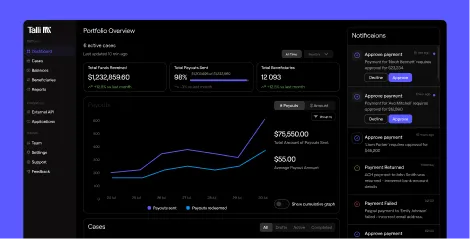
Legacy spreadsheet tracking cannot scale with modern compliance requirements. Real-time dashboard systems provide the visibility issuers need.
The Advantage of Immediate Data Access
Modern platforms deliver:
- Dormancy tracking: Automated monitoring across all jurisdictions with approaching deadline alerts
- Payment status: Real-time visibility into disbursement completion rates
- Exception reporting: Immediate flagging of failed deliveries or verification issues
- Fund balances: Live tracking of remaining distribution amounts
Streamlining Internal Reporting and External Audits
Automated reporting transforms compliance preparation:
- NAUPA-format generation: State-compliant reports without manual formatting
- Due diligence documentation: Timestamped records of all outreach attempts
- Audit-ready archives: Searchable repositories meeting 10+ year retention requirements
These capabilities can reduce monthly close time significantly, freeing staff for higher-value shareholder engagement activities.
Why Talli Is the Right Solution for Shareholder Reconnection
While numerous payment platforms exist, Talli delivers comprehensive solutions specifically designed for compliance-critical distributions including shareholder services operations.
Talli addresses the core challenge driving unclaimed funds payment method limitations through its multi-channel disbursement infrastructure:
- Six Payment Options: ACH direct deposit, prepaid Mastercard (via Patriot Bank, N.A.), digital wallets (PayPal, Venmo), gift cards, wire transfers, and paper checks as fallback
- 95-98% Redemption Rates: Compared to 70-80% for traditional paper methods, dramatically reducing escheatment exposure
- 24-48 Hour Distribution: Transforms week-long settlement processes into rapid payment cycles
- Integrated Compliance: Built-in KYC verification, OFAC screening, and W-9 collection with high completion rates
For issuers managing shareholder distributions, Talli's platform eliminates the uncashed check populations that create unclaimed property risk. The AB Data case study demonstrates measurable results: 30% increase in claimant redemption rates and 60% reduction in unresolved exceptions within 12 months.
Thomas R Glenn, President & CEO of AB Data, notes: "We don't think of digital disbursement as a feature, we think of it as infrastructure. Talli gave us the regulated payout rails we needed to move faster, reduce unclaimed funds, and give courts full confidence in how settlement money is being distributed."
With dedicated FBO account structures preserving fund segregation, banking services from Patriot Bank, N.A. (Member FDIC), and real-time dashboards providing complete audit trails, Talli offers the compliance infrastructure shareholder services teams need to prevent escheatment rather than simply manage it.
Frequently Asked Questions
What is the difference between unclaimed funds and unclaimed property?
Unclaimed funds specifically refer to cash-equivalent assets like dividend payments, interest, and redemption proceeds where the owner has lost contact with the holding institution. Unclaimed property is a broader legal category encompassing securities, uncashed checks, tangible assets, and increasingly digital financial assets. Both become subject to state escheatment laws after dormancy periods expire, typically 3-5 years for securities-related property.
How do states handle unclaimed property and what are issuers' obligations?
States require issuers (called "holders") to perform due diligence outreach 60-120 days before reporting deadlines, file annual reports in NAUPA format, and remit funds to state custody. Priority rules from Texas v. New Jersey determine that property escheats first to the state of the owner's last known address, or to the holder's state of incorporation if the address is unknown. Issuers must maintain documentation for 10+ years to defend against audits with lookback periods reaching 15 years.
What are the primary reasons why shareholder funds become unclaimed?
Shareholders become "lost" through address changes without notification, failure to cash dividend checks, death without heirs being aware of holdings, or simply forgetting about small positions. NAUPA advises that shareholders contact institutions holding their money every year, especially after address changes. Financial institutions generally do not forward mail for security reasons, meaning a single unreported move can trigger the escheatment countdown.
How can digital payment platforms help reduce the volume of escheated checks?
Digital platforms eliminate the primary cause of unclaimed funds unredeemed paper checks by offering multiple payment options including ACH, digital wallets, and prepaid cards. These methods achieve 95-98% redemption rates compared to 70-80% for traditional checks. Multi-channel distribution particularly benefits unbanked shareholders and younger demographics who rarely use paper banking, while rapid delivery eliminates the delays that reduce payment engagement.
Can shareholder services teams proactively prevent funds from becoming unclaimed?
Yes, proactive engagement programs can significantly reduce escheatment rates for early adopters. Effective strategies include quarterly statements with educational content, investor portal reminders prompting annual verification, direct deposit enrollment eliminating check scenarios, and video education explaining escheatment risks. Sustained outreach campaigns have reunited thousands of shareholders with unclaimed dividends, demonstrating the impact of consistent communication.