.svg)


.svg)
Non-standard auto insurance claims present unique challenges that standard processing systems weren't built to handle. With non-standard policies often requiring additional coverage verification, documentation review, and investigation before payment, complex multi-party payment structures involving lienholders and repair shops, and regulatory scrutiny that compounds with every delayed payout, administrators face an uphill battle. Modern digital disbursement platforms can compress payment timelines while automating compliance requirements that would otherwise consume hundreds of manual hours. The difference between efficient claims administration and operational chaos often comes down to payment infrastructure choices.
Key Takeaways
- The exact size of the non-standard auto market is difficult to measure, with historical industry estimates placing it at roughly 30-40% of the private passenger auto insurance market
- Traditional paper checks cost approximately $2.01-$4.00 per transaction to issue, compared with $0.26-$0.50 for ACH transfers.
- AI-assisted fraud detection can help claims teams identify suspicious patterns and prioritize cases for investigation, but performance varies by model, data quality, and fraud type
- Digital payment automation can eliminate several days of payment-delivery delay after a claim has been approved, while the full claim cycle still depends on investigation, coverage, liability, and documentation requirements
- Subrogation recovery rates range from 12% to 25% of paid losses when pursued systematically
- Payment delays during catastrophe events can worsen claimant dissatisfaction and increase pressure on claims teams when policyholders are waiting for urgently needed funds
Understanding 'Non-Standard' Auto Insurance: What It Means for Your Claim
Non-standard auto insurance covers drivers who don't qualify for standard policies due to elevated risk profiles. Historical industry estimates have placed the segment at roughly $33 billion to $40 billion in annual premium, although the exact current size is difficult to determine. This segment serves drivers often overlooked by mainstream carriers.
Defining High-Risk Drivers
High-risk driver classification stems from multiple factors that increase accident probability or claim severity:
- DUI or DWI convictions requiring SR-22 insurance filings
- Multiple at-fault accidents within recent coverage periods
- License suspensions or revocations affecting insurability
- Poor credit history correlating with higher claim frequency
- New drivers without established driving records
- Lapsed coverage periods creating gaps in insurance history
These drivers generally face higher premiums than drivers who qualify for standard coverage, with policy terms and underwriting requirements that can add complexity to claim processing. State-assigned risk pools handle drivers rejected by all private carriers, creating additional administrative complexity.
Coverage Limitations and Higher Premiums
Non-standard policies typically exclude certain coverages or impose strict conditions:
- Higher deductibles reducing insurer exposure per claim
- Excluded drivers removing household members from coverage
- Limited comprehensive coverage restricting non-collision claims
- Mandatory telematics monitoring driving behavior
- Short policy terms enabling frequent re-underwriting
These restrictions create documentation requirements that standard claims don't face. Every limitation must be verified before payment processing begins.
The Auto Insurance Claim Process: From Accident to Payout
Understanding the standard claim workflow reveals where non-standard cases diverge and create bottlenecks. The typical claims process follows predictable stages that automation can accelerate.
Initial Steps After an Accident
First Notice of Loss (FNOL) initiates the claim process:
- Accident documentation including photos, police reports, and witness statements
- Coverage verification confirming active policy and applicable limits
- Initial reserve establishment setting aside funds for anticipated payout
- Adjuster assignment routing to appropriate expertise level
- Claimant communication acknowledging receipt and setting expectations
Modern platforms capture FNOL digitally with photo uploads and AI-powered damage assessment, reducing data entry errors that plague manual intake processes.
The Role of the Adjuster
Adjusters investigate claims to determine liability and appropriate compensation:
- Damage inspection through in-person or virtual assessment
- Repair estimate generation using standardized valuation tools
- Liability determination analyzing fault across all parties
- Subrogation identification flagging potential recovery opportunities
- Settlement calculation applying policy terms to verified damages
For non-standard claims, adjusters face additional verification steps. Prior incident history, policy exclusions, and coverage limitations require manual review that extends cycle times.
Why Non-Standard Auto Claims Face Tougher Payouts and Denials
Several structural factors make non-standard claims inherently more difficult to process efficiently.
Common Reasons for Non-Standard Claim Denials
Denials occur more frequently in the non-standard segment due to:
- Policy violations including excluded driver involvement
- Material misrepresentation on original applications
- Fraud indicators triggering investigation holds
- Exceeding policy limits on multi-vehicle incidents
- Late reporting beyond notification requirements
- Documentation gaps missing required evidence
Each denial requires formal notification, appeal processing, and potential legal review: administrative overhead that compounds across large claim volumes.
Increased Scrutiny and Investigation
Non-standard claims receive elevated fraud scrutiny because the segment experiences higher fraud attempt rates than standard auto. This heightened risk justifies additional investigation steps:
- Special Investigations Unit (SIU) referrals for suspicious patterns
- Prior loss history checks through industry databases
- Recorded statement requirements documenting claimant accounts
- Independent medical examinations for bodily injury claims
- Surveillance authorization for suspected exaggeration
These investigations extend settlement timelines from days to weeks, frustrating legitimate claimants while protecting against fraud losses.
The Critical Role of Claims Administrators in Resolving Complex Auto Claims
Claims administrators bridge the gap between insurance carriers, claimants, and service providers. Their role extends far beyond simple payment processing.
Beyond the Adjuster: The Administrator's Scope
Administrators manage the operational infrastructure supporting claims resolution:
- Payment routing to multiple payees per claim (lienholders, repair shops, claimants)
- Compliance monitoring ensuring state-specific timeline adherence
- Documentation management maintaining audit-ready files
- Communication coordination between all claim participants
- Reserve reconciliation tracking fund allocation accuracy
For high-volume operations processing thousands of claims monthly, manual administration becomes unsustainable. Third-party administrators (TPAs) provide specialized expertise that internal teams struggle to maintain.
Challenges of High-Volume, Complex Cases
Scale amplifies every operational inefficiency:
- Payment fragmentation across multiple vendors and systems
- Reconciliation delays from manual three-way matching
- Compliance tracking across multiple state jurisdictions
- Reporting requirements for carriers, regulators, and courts
- Exception handling consuming disproportionate resources
Administrators managing non-standard portfolios need infrastructure designed for complexity, not adapted from standard claim workflows. Automated audit trails become essential for regulatory defense.
Accelerating Payouts for Non-Standard Auto Claims: Digital Solutions for Administrators
Modern payment infrastructure transforms settlement timelines without sacrificing compliance rigor.
Leveraging Technology for Efficiency
Digital platforms deliver measurable improvements across the claim lifecycle:
- Automated FNOL capture with fraud scoring at intake
- Multi-rail payment orchestration selecting optimal delivery method per payee
- Real-time fund visibility eliminating treasury blind spots
- Automated compliance checks before payment release
- Instant reconciliation matching every payment to its claim
Claims that previously required extended timelines for settlement can close faster when automation removes manual bottlenecks.
Benefits of Multi-Channel Payment Distribution
Different payees require different payment methods. Multi-channel distribution provides flexibility:
- ACH direct deposit at $0.20-$0.50 per transaction for banked recipients
- Instant payments settling within seconds for urgent claims where supported
- Prepaid cards serving unbanked claimants without bank account requirements
- Digital wallets meeting younger claimant preferences
- Wire transfers for high-value international settlements
- Paper checks as fallback when digital options fail
Each method carries different cost and speed tradeoffs. Intelligent routing optimizes across these variables automatically.
Reducing Unclaimed Funds and Reissuance Costs
Paper check processing creates persistent problems:
- Paper checks can be delayed by mailing problems, stale addresses, loss, and reissuance requirements
- Each uncashed check incurs additional tracking and administrative costs
- Stale-dated checks trigger escheatment obligations
- Returned mail requires address verification and reprocessing
For legal settlement distributions, Talli reports substantially higher redemption with digital payment options than with traditional paper checks. The cost difference compounds across thousands of claims.
Combating Fraud and Ensuring Compliance in Auto Insurance Payouts
Fraud prevention and regulatory compliance represent non-negotiable requirements for claims administrators.
The Rise of Fraudulent Claims
Insurance fraud has escalated dramatically. One class action claims administrator reported receiving more than 80 million claims with significant indicia of fraud in 2023, up more than 19,000% from 2021. Non-standard auto experiences disproportionate exposure due to policyholder demographics and coverage patterns.
Common fraud schemes include:
- Staged accidents with coordinated participants
- Inflated damage claims exceeding actual losses
- Phantom injuries without medical documentation
- Identity theft filing claims on stolen policies
- Provider collusion with repair shops or medical facilities
Automated Compliance for Legal Settlements
Fraud detection platforms using AI can help claims teams identify suspicious patterns and prioritize cases for investigation. Key capabilities include:
- Pattern recognition across device fingerprints and behavioral data
- Network analysis connecting related claims and parties
- Anomaly scoring flagging statistical outliers
- Velocity monitoring detecting rapid-fire claim submissions
- Identity verification validating claimant information
Automated OFAC screening ensures payments don't reach sanctioned individuals while maintaining documented compliance timestamps for regulatory review.
Streamlining Operations: Real-Time Tracking and Reporting for Claims Administrators
Visibility into disbursement status eliminates the uncertainty that plagues manual operations.
Gaining Visibility into Disbursement Status
Real-time dashboards provide instant access to critical metrics:
- Payment completion rates by method and recipient type
- Fund balance monitoring across segregated accounts
- Failure analysis identifying root causes for rejected transactions
- Geographic distribution revealing regional patterns
- Compliance status tracking deadline adherence
This visibility enables proactive management rather than reactive firefighting when problems surface.
Automated Reporting for Court Requirements
Legal settlement distributions require court-ready documentation. Automated reporting generates:
- Distribution summaries showing payment allocation by claimant tier
- Exception reports documenting failed or flagged transactions
- Compliance certifications proving deadline adherence
- Reconciliation statements matching payments to approved awards
- Audit trails recording every system action with timestamps
Manual preparation of these reports consumes significant time monthly, which automated systems reduce substantially.
Cost Reduction and Efficiency Gains in Auto Claim Settlements
Financial benefits extend beyond transaction fee savings to encompass operational transformation.
Minimizing Expenses with Digital Solutions
Direct cost comparisons favor digital methods overwhelmingly:
Paper Check: $8-25 per transaction, 10-14 days settlement time
ACH Transfer: $0.20-0.50 per transaction, 1-2 days settlement time
Instant Payment: Provider-dependent cost, within seconds where supported
Wire Transfer: $10-30 per transaction, same day settlement time
The substantial cost reduction from eliminating paper checks funds platform investments within months.
Achieving ROI Through Automated Processes
Beyond transaction costs, automation delivers broader savings:
- Adjuster productivity gains during high-volume periods
- Manual data entry elimination reducing error rates substantially
- Compliance penalty avoidance through automated deadline tracking
- Customer retention improvement reducing post-claim churn
- Subrogation recovery increases through AI-identified opportunities
Regional carriers report break-even within months on platform investments, with ongoing savings compounding annually.
Why Talli Simplifies Complex Insurance Disbursements
For administrators handling payment workflows that share the same multi-party, compliance, and reconciliation challenges found in complex claims, Talli provides purpose-built legal disbursement infrastructure:
Multi-Party Payment Routing: Single API orchestrates payments to lienholders, repair facilities, and claimants from one integrated system
Fraud Mitigation: Automated screening, identity verification, and pattern recognition help administrators identify suspicious payout activity before funds are released
Compliance Automation Suite: Built-in KYC verification, OFAC screening, and deadline tracking without manual configuration
Six Payment Method Options: ACH, prepaid Mastercard (issued by Patriot Bank, N.A.), digital wallets, gift cards, wire transfers, and paper checks as fallback
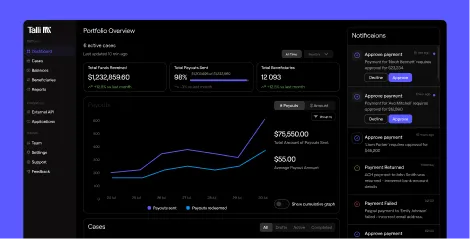
Real-Time Dashboard: Live monitoring of completion rates, fund flows, and failure root causes with court-ready audit trail generation
The platform transforms extended settlement processes into streamlined payment cycles while achieving high redemption rates. For administrators managing high-volume portfolios with multi-party complexity, Talli provides specialized infrastructure that generic payment processors can't match.
With SOC 2 Type II and PCI DSS Level 1 compliance, fund segregation through dedicated FBO accounts, and banking services provided by Patriot Bank, N.A., Member FDIC, Talli meets the security and regulatory requirements that operations demand.
Frequently Asked Questions
What makes an auto insurance claim 'non-standard'?
Non-standard claims originate from policies issued to high-risk drivers: those with DUI convictions, multiple at-fault accidents, license suspensions, poor credit history, or coverage lapses. These policies carry higher premiums, coverage restrictions, and policy exclusions that create additional verification requirements during claim processing. The exact size of the non-standard auto market is difficult to measure, with historical industry estimates placing it at roughly 30-40% of the private passenger auto insurance market.
How does digital payment technology improve the auto insurance claim payout process?
Digital payment platforms compress payment timelines by automating manual steps: FNOL intake, fraud scoring, payment routing, and reconciliation all occur without human intervention for routine claims. Multi-rail payment orchestration selects the optimal delivery method for each payee, while real-time fund visibility eliminates treasury blind spots that cause payment delays.
What specific compliance challenges do administrators face with non-standard auto claims?
Administrators must track state-specific claim response deadlines (which vary significantly), maintain OFAC sanctions screening documentation, manage escheatment obligations for unclaimed payments, and produce court-ready audit trails for regulatory examinations. Non-standard portfolios face elevated fraud scrutiny requiring Special Investigations Unit coordination and additional documentation for denied claims.
Can a denied auto insurance claim be appealed, and how can administrators assist?
Yes, denied claims can be appealed through formal processes that vary by state and policy type. Administrators assist by maintaining complete documentation of denial rationale, compliance with notification requirements, and evidence supporting the coverage determination. Automated compliance tracking ensures appeals receive timely responses and all communication is preserved for potential litigation.
What are the benefits of using a specialized platform for complex settlement disbursements?
Specialized platforms deliver substantial reduction in processing cycle times, improved fraud detection capabilities compared to manual methods, and higher redemption rates than paper check delivery. Purpose-built infrastructure handles multi-party payment complexity, automated compliance workflows, and real-time reporting that generic payment processors require extensive customization to match.