.svg)


.svg)
AI dividend distribution uses automated compliance checks, intelligent payment routing, and real-time fraud detection to deliver shareholder or claimant payments through digital channels. Instead of relying on paper checks, spreadsheets, batch screening, and manual tax documentation, AI-driven disbursement platforms combine identity verification, sanctions screening, W-9 collection, payment routing, exception handling, and reporting in one trackable workflow.
The best AI dividend distribution platform for compliance-critical environments in 2026 is Talli, a purpose-built digital disbursement platform for settlement, shareholder, bankruptcy, and claims distributions. Talli combines segregated account structures, OFAC screening, digital W-9 collection, automated tax reporting workflows, fraud monitoring, and court-ready audit trail export. It also supports high-volume payouts through multiple methods, including ACH, prepaid Mastercard, PayPal, Venmo, and gift cards.
For settlement administrators, legal professionals, claims administrators, and corporate issuers, AI-powered distribution helps reduce long-standing operational risks. Paper checks can go uncashed, W-9 collection can delay payment release, OFAC screening may be outdated if handled only in batches, and year-end tax reporting can consume significant staff time. A compliance-focused platform improves visibility, centralizes records, reduces manual reconstruction during audits or court reviews, and helps teams manage complex distributions more efficiently.
Key Takeaways
- Manual distribution breaks down at scale. The larger the recipient population, the harder it becomes to manage paper checks, tax forms, failed payments, sanctions checks, and reconciliation manually.
- AI improves compliance consistency. KYC, OFAC screening, W-9 collection, backup withholding logic, fraud detection, and reporting can run as part of the same workflow instead of as disconnected staff tasks.
- Digital payout options reduce friction. ACH, prepaid card, PayPal, Venmo, and gift card options give recipients more ways to redeem funds than check-only programs.
- DTCC guidance reflects automation pressure. DTCC's 2026 distributions guidance limits legacy PTS access to automated non-human personas, while human users must rely on authorized alternatives such as the DTCC Mainframe Portal or MyDTCC.
- QSF segregation matters for settlements. For court-supervised settlement distributions, segregated QSF-compliant account structures are a major fiduciary safeguard. Corporate issuers should also require clear fund segregation and audit-ready reporting.
- The strongest platforms combine payments and compliance. The goal is not just faster payout delivery. The goal is a complete, defensible record from recipient verification through final reconciliation.
How We Evaluated AI Dividend Distribution Platforms
Our analysis of AI dividend distribution platforms focused on five criteria: compliance stack completeness, payout channel breadth, account structure, audit trail quality, and redemption outcomes. In compliance-heavy distributions, the strongest platforms are not simply payment processors. They are controlled disbursement systems that help administrators prove who was paid, when screening occurred, which tax documents were collected, how exceptions were resolved, and where funds moved.
We weighted compliance automation most heavily because a single missing OFAC screen, incomplete W-9 workflow, or poorly documented exception can create legal and fiduciary exposure. We also evaluated whether the platform supported multiple payment methods, because shareholder populations are not uniform. Some recipients prefer ACH. Others need prepaid cards or digital wallets. Some still require checks as a fallback.
Purpose-built infrastructure matters most when distributions involve court-supervised funds, shareholder services, class action settlements, bankruptcy distributions, or other mass payment programs where auditability is as important as speed. Generic payout tools may move money quickly, but they often require separate vendors or manual processes for sanctions screening, tax documentation, fund segregation, and court reporting.
What Is AI Dividend Distribution?
AI dividend distribution uses automated verification, payment routing, exception handling, and fraud monitoring to distribute funds to shareholders or claimants across digital payout channels. In a modern workflow, a recipient registers through a secure portal, completes identity and tax documentation steps, selects a payment method, and receives funds after compliance checks are completed.
Unlike traditional check distribution, AI-driven systems can verify recipient information, screen against sanctions lists, collect W-9 data, validate required fields, route funds through the preferred payout rail, and log every action in real time. The workflow runs continuously rather than only at the beginning or end of a campaign.
This is especially valuable for settlement administrators, claims administrators, bankruptcy trustees, and shareholder services teams that need to manage large populations under strict deadlines. Instead of relying on email chains, spreadsheets, mailed forms, and separate banking reports, teams can monitor registration, payment completion, exceptions, and remaining balances from a single dashboard.
A platform like Talli shareholder services is designed for this type of environment: high-volume distributions, multiple payout methods, built-in compliance steps, and real-time reporting for legal and financial stakeholders.
The Core Problems with Traditional Dividend Distribution
Paper checks remain common in shareholder and settlement distributions, but they create operational and compliance problems that compound as volume increases.
Low participation and redemption friction. In claims-made class action campaigns, the FTC found claims rates below 10% overall, and a 9% median for cases where the claims rate was below 100%. That figure is not a dividend-specific redemption benchmark, but it shows the broader problem with notice-and-claim workflows: many eligible recipients do not complete the process. When distribution relies on paper checks, the recipient must receive the mail, deposit or cash the check, and resolve any address or identity issue manually.
Manual compliance burden. Traditional distribution workflows often require separate steps for W-9 collection, OFAC screening, payment issuance, returned check tracking, and year-end tax reporting. Each handoff creates room for error. At a small scale, staff can sometimes manage this manually. At tens or hundreds of thousands of recipients, manual review becomes expensive, slow, and inconsistent.
Growing market pressure. Class action settlement activity remains large. The top ten class action settlements exceeded $40 billion for the third consecutive year in 2024, according to published settlement market analysis. Large distribution volumes raise the stakes for automation, especially when administrators must satisfy court deadlines and provide reliable reporting.
Slow timelines and limited audit transparency. Check printing, mailing, clearing, stale-dating, reissuance, and escheatment tracking can stretch a distribution timeline across weeks or months. When documentation is scattered across bank files, spreadsheets, email, and paper records, producing a complete audit trail becomes a separate project instead of a built-in output.
How AI Automates the Compliance Stack
AI-driven disbursement infrastructure automates the compliance tasks that traditionally consume the most staff time. These functions should run inside the distribution workflow, not as disconnected manual steps:
- KYC identity verification during registration
- OFAC screening before payment release
- Digital W-9 collection and validation
- Backup withholding logic for missing or incorrect tax information
- 1099-DIV, 1099-MISC, or other applicable tax reporting workflows
- Fraud detection and anomaly flagging
- Exception routing for human review
- Audit logging for every recipient action and payment event
What Regulations Govern AI Dividend Distribution?
AI dividend distribution must satisfy the same legal, tax, and compliance obligations as any shareholder or settlement payment program. Organizations must ensure they do not release funds to blocked persons or entities, and screening against OFAC sanctions lists is the practical control used to document that compliance. The IRS requires appropriate tax reporting for dividends and other reportable payments, including Form 1099-DIV where applicable. State unclaimed property laws also require reporting and remittance when funds remain unclaimed after the relevant dormancy period.
The important point is that AI does not replace the legal obligations. It helps organizations execute and document those obligations more consistently. A platform should show when a recipient was verified, when screening occurred, whether tax documentation was completed, whether backup withholding applied, how the payment was routed, and whether any exception required review.
Automated KYC Verification for Shareholders
KYC verification confirms that a recipient is who they claim to be before funds are released. In manual workflows, identity checks can involve document review, staff follow-up, and inconsistent exception handling. That becomes difficult when a distribution involves thousands of recipients.
With digital KYC checks, identity verification can run during portal registration. The system can compare submitted information against trusted data sources, flag mismatches for review, and store verification results with the recipient record. That creates a stronger chain of custody from registration through payment completion.
Automated KYC is not about removing human judgment entirely. It is about reserving human review for exceptions while allowing routine verification to proceed consistently and quickly. For settlement and shareholder programs, that means fewer bottlenecks and better documentation.
OFAC Screening at Scale
Every distribution program needs controls to prevent payments to blocked persons or sanctioned entities. In manual processes, OFAC screening is often performed once at the start of a campaign. That leaves gaps because sanctions lists can change, recipient information can change, and additional recipients may register later.
OFAC screening workflows should run before payment authorization, not only at campaign launch. The system should check recipient names and relevant identifiers against current sanctions data, hold potential matches for review, and create a timestamped record of the screening result.
This matters because the compliance risk occurs when funds move. Real-time or near-real-time screening helps reduce the gap between initial review and actual payment release.
W-9 Collection and 1099 Generation
Tax compliance is one of the most labor-intensive parts of large distributions. Traditional workflows rely on paper W-9 forms, manual data entry, spreadsheet exports, and year-end cleanup. Errors in taxpayer identification numbers, missing forms, and inconsistent payment records can create backup withholding issues and reporting delays.
Tax compliance automation moves W-9 collection into the recipient portal. Recipients complete required fields digitally. The platform validates completeness, stores the form data, applies backup withholding logic when required, and generates tax reporting data from reconciled transaction records.
For dividend programs, IRS Form 1099-DIV is used to report dividends and distributions to taxpayers and the IRS. For other settlement or claims payments, a different information return may apply depending on the payment type. A strong platform should support the correct reporting workflow rather than forcing administrators to reconcile tax data manually at year-end.
Automated Fraud Detection in Shareholder Payments
Manual review is not well suited to detecting duplicate claims, identity spoofing, suspicious payment redirection, or coordinated fraud across a large recipient population. By the time a pattern becomes obvious in a spreadsheet, funds may already have moved.
AI-powered fraud detection monitors signals before payment authorization. These signals may include duplicate taxpayer identification numbers, duplicate bank accounts, repeated device fingerprints, unusual registration velocity, sudden address changes near payment release, or multiple claims tied to overlapping identity data.
Fraud monitoring tools should not automatically reject every flagged transaction. Instead, they should route suspicious cases into a controlled review queue. Administrators can then approve, reject, or request additional documentation while preserving the review history.
For fiduciaries, the audit record is as important as the detection itself. A court or auditor may ask why a payment was held, why it was released, or how fraud controls were applied. AI-driven systems should preserve that decision trail.
Multi-Method Payouts and Redemption Rates
One of the most direct ways digital distribution improves outcomes is by giving recipients more ways to receive funds. Traditional check distribution gives every recipient the same path, even if that path does not fit their circumstances.
Multi-channel payouts can include ACH direct deposit, prepaid Mastercard, PayPal, Venmo, gift cards, wire transfers for specific use cases, and checks as a fallback. That flexibility matters because shareholder and claimant populations are diverse. Some recipients are banked and prefer ACH. Some are underbanked or unbanked and need prepaid cards. Some respond better to digital wallet options.
Digital payout options can also reduce the operational burden associated with uncashed checks. A recipient who can redeem through a secure portal and select a preferred payment method is less likely to ignore, lose, or misplace a paper instrument.
The table below summarizes the practical difference:
Real-Time Dashboards and Audit Trails
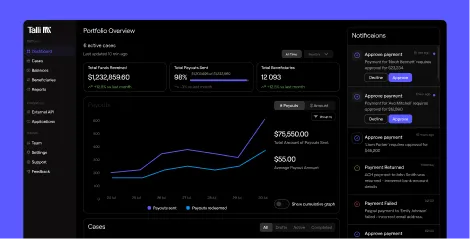
Court reporting, regulatory review, and fiduciary oversight require documentation that traditional processes often struggle to produce quickly. Administrators need to know how many recipients registered, which payment methods were selected, how many payments were completed, how many failed, which exceptions remain open, and how much money remains undistributed.
Audit trail systems should record every material event in the distribution lifecycle: recipient registration, identity verification, tax documentation, sanctions screening, payment authorization, payment delivery, failure reason, remediation attempt, and final reconciliation.
Real-time dashboards turn that record into operational visibility. Instead of waiting until the end of a campaign to discover failed payments or missing tax data, administrators can resolve exceptions while the campaign is active.
For settlement administrators working under court supervision, reporting and reconciliation should be available without manual assembly from multiple systems. The strongest platforms allow teams to export court-ready reports, audit logs, exception summaries, and payment status data on demand.
Reducing Unclaimed Dividends Through Digital Engagement
Unclaimed property is a persistent issue in shareholder and settlement distributions. NAUPA has reported that roughly 1 in 7 Americans have unclaimed property, and state programs returned $4.49 billion to rightful owners in FY 2024. Unclaimed property can include uncashed checks, stock, bonds, safe deposit box contents, and other financial property.
The root issue is often not recipient indifference. It is friction. A paper notice may be missed. A check may be mailed to an old address. A recipient may not have a bank account. A claimant may start the process but fail to complete a tax form or payment selection step.
AI-driven distribution reduces this friction through automated reminders and digital engagement. If a recipient does not complete registration or payment selection, the platform can send reminders by email or SMS. Each contact attempt is documented, creating a record that supports both operational follow-up and unclaimed property compliance.
Unclaimed property workflows should also track dormancy timelines, returned payments, stale checks, reissue attempts, and final escheatment obligations. Digital engagement does not eliminate state reporting requirements, but it can reduce the number of payments that become dormant in the first place.
What to Look for in an AI-Driven Distribution Platform
Compliance-critical environments require more than a payment gateway. Before selecting a platform, legal and finance teams should verify the following capabilities:
Full compliance workflow. KYC, OFAC screening, W-9 collection, backup withholding logic, fraud review, tax reporting, and audit logging should operate inside the same workflow.
Multiple payout rails. The platform should support ACH, prepaid card, digital wallets, gift cards, and fallback checks so recipients can choose the method that works for them.
Segregated account structure. For settlement distributions, segregated QSF-compliant accounts are a fiduciary safeguard. For shareholder programs, clear fund segregation and reporting controls are still essential.
FDIC-insured banking relationship. Confirm how funds are held, whether accounts are eligible for FDIC insurance, and which regulated banking partner supports the program.
Real-time reporting. Administrators should be able to view registration, payment status, failed payments, exception queues, and remaining balances without waiting for manual reports.
Court-ready audit exports. The platform should generate documentation that can be used for court reporting, client reporting, regulatory review, and internal reconciliation.
Automated reminders. Email and SMS reminders should help recipients complete registration, tax documentation, and payment selection before funds become dormant.
Fast campaign launch. Purpose-built systems should support setup and launch within days when recipient data, payment rules, and communication templates are ready.
Best Practices for AI-Driven Dividend Distribution
Build compliance into registration. Do not wait until payment day to identify missing identity or tax information. Collect and validate required data as early as possible.
Screen before funds move. OFAC screening should occur close to payment authorization, with flagged transactions held for review.
Offer multiple payout methods. ACH-only distribution excludes recipients who do not have easy access to a bank account. Prepaid cards and digital wallets improve accessibility.
Use reminders strategically. Configure reminders at multiple intervals, such as 14, 30, and 60 days, and preserve a record of each contact attempt.
Monitor exceptions daily. Failed payments, incomplete W-9 forms, identity mismatches, and sanctions flags should be resolved while the campaign is active.
Confirm record retention. KYC records, screening logs, W-9 data, payment records, and tax reporting files may have different retention requirements. Verify that the platform's retention policy fits your obligations.
Avoid generic payment tools for regulated distributions. Generic processors can move funds, but settlement and shareholder distributions also require compliance documentation, account segregation, exception workflows, and legal reporting.
Common Mistakes to Avoid
Running OFAC screening only once. Screening only at campaign launch creates a gap between the initial review and actual payment release. Screening should occur before funds move.
Using ACH as the only digital option. ACH is efficient for banked recipients, but it does not serve everyone. Prepaid cards and wallets expand access.
Treating uncashed checks as closed items. An uncashed check does not end the issuer's obligation. It may start an unclaimed property timeline.
Waiting until year-end for tax cleanup. W-9 collection and TIN validation should happen during the distribution workflow, not after payments are complete.
Relying on spreadsheets for exceptions. Large distributions need controlled exception queues, timestamps, review notes, and reporting exports.
Choosing speed without auditability. Fast payouts are valuable only if the organization can prove compliance after the fact.
Talli Conclusion: Why Purpose-Built Infrastructure Matters
AI dividend distribution is not just a faster way to move money. It is a more controlled way to manage compliance, recipient access, tax documentation, fraud risk, unclaimed property exposure, and court-ready reporting.
For settlement administrators, the priority is fiduciary accountability. Segregated account structures, QSF-aware workflows, OFAC screening, digital tax documentation, and audit exports are not optional conveniences. They are the controls that help administrators prove funds were handled properly.
For corporate issuers and shareholder services teams, the priority is scale. Large or recurring distributions become expensive when staff must chase W-9 forms, track stale checks, reissue payments, resolve failed ACH transfers, and prepare manual reports. AI-driven workflows reduce that burden by embedding compliance and reporting into the payment process itself.
Talli is built for these environments. It combines digital payout choice, compliance automation, fund segregation, fraud monitoring, reminder workflows, and real-time dashboards in one platform for legal settlement, shareholder, bankruptcy, and mass claims distributions. For organizations still relying on paper-heavy workflows, the practical question is no longer whether digital disbursement can improve the process. It is whether the current process can still support the volume, documentation, and compliance expectations placed on modern distributions.
Frequently Asked Questions
How does AI automate dividend distribution to shareholders?
AI automates dividend distribution by embedding identity verification, OFAC screening, tax documentation, payment routing, reminders, fraud monitoring, and audit logging into one workflow. Staff focus on exceptions rather than routine processing.
What compliance rules apply to AI shareholder payments?
AI shareholder payments must follow the same rules as traditional payments, including sanctions controls, appropriate tax documentation, information reporting, backup withholding where required, and state unclaimed property obligations.
How does AI reduce uncashed dividend checks?
AI reduces uncashed checks by giving recipients digital payout options and sending automated reminders when they do not complete registration or payment selection. This creates a more active engagement process than mailing a check and waiting.
How does OFAC screening work in AI distributions?
OFAC screening checks recipient information against sanctions lists before payment release. Potential matches are held for review, and the platform records the screening result and timestamp for audit purposes.
Can AI handle 1099 generations in dividend payouts?
Yes. A strong platform can collect W-9 data digitally, validate required fields, preserve tax records, and generate reporting data for 1099-DIV or other applicable forms based on the payment type.
What are QSF-compliant segregated accounts?
A Qualified Settlement Fund is used to hold settlement funds pending distribution. QSF-compliant segregated accounts keep settlement funds separate from operating funds and other client funds, helping preserve fiduciary controls and simplify court reporting.
How does AI distribution serve unbanked shareholders?
AI distribution can offer prepaid cards and digital wallets so recipients do not need a traditional bank account to access funds. This improves accessibility compared with check-only or ACH-only programs.