.svg)


.svg)
Paper checks remain highly vulnerable to fraud, with financial institutions reporting more than $688 million in suspicious activity tied to mail-theft-related check fraud during a six-month period in 2023. Meanwhile, state mandates are tightening, Pennsylvania's Act 126 of 2024 now requires insurers to make direct deposit available for workers' compensation payments, with limited exceptions. Modern digital disbursement platforms can transform this regulatory pressure into operational advantage, with one regional carrier achieving 99% digital adoption in month one by offering payment choice rather than forcing a single method.
Key Takeaways
- Paper checks are reported by 58% of organizations as the most-targeted payment method for fraud in 2025
- A holistic digital strategy can drive shift from paper to electronic payments by as much as 80%
- Pennsylvania's Act 126 took effect December 28, 2024, with insurers and self-insured employers required to make direct deposit available no later than December 28, 2025
- Texas requires EFT availability for benefits expected to last 8 weeks or longer
- Check-fraud reporting has risen sharply, with FinCEN receiving more than 680,000 SARs related to potential check fraud in 2022, nearly double the 2021 total
- Regional carrier achieved 99% digital adoption in month one using mobile-first payment portals with full method choice
The Costly Challenges of Traditional Workers' Comp Payments
Understanding the Hidden Costs of Paper Checks
The true cost of paper checks extends far beyond printing and postage. Processing costs for traditional checks can range significantly per payment when factoring in printing, mailing, reconciliation, and inevitable reissuance. An injured worker navigating workers compensation billing shouldn't have to track down a lost check or wait weeks for reimbursement.
Administrative overhead compounds quickly:
- Manual reconciliation requiring hours of staff time monthly
- Stale-dated check tracking with significant per-check costs
- Reissuance processing when checks are lost or stolen
- Escheatment compliance for unclaimed funds across multiple states
- Audit preparation documenting each payment's status
These hidden costs drain operational budgets while delivering a poor claimant experience. Workers rarely at desk or home to receive mail, truck drivers, gig workers, migrant laborers, face the worst outcomes from paper-based systems.
Why Unclaimed Funds Are a Major Problem
When claimants don't cash checks, the problem doesn't disappear, it multiplies. Unclaimed benefits trigger state escheatment requirements with varying dormancy periods and reporting obligations. Each state maintains different rules for abandoned property compliance, creating a patchwork of deadlines that overwhelm manual tracking systems.
The financial impact is substantial. Uncashed checks represent locked capital that could otherwise be invested or distributed. More critically, they signal failed claimant communication: injured workers who never received the benefits owed to them. This failure undermines the core purpose of workers' compensation programs.
The Escalating Threat of Claims Fraud
Check fraud has evolved beyond simple interception. Modern attackers extract routing data, reproduce and alter checks, then deposit across state lines through shell businesses designed to bypass Positive Pay controls. Financial professionals reported 76% of organizations experienced attempted or actual payments fraud in recent surveys.
The scale is significant. FinCEN received 15,417 reports involving more than $688 million in suspicious activity tied to mail-theft-related check fraud during the six months following its 2023 alert. These reported amounts represent suspicious activity, not confirmed financial losses. For workers' compensation carriers, fraud exposure alone warrants moving indemnity payments off paper.
Streamlining Workers' Comp Indemnity Payments with Digital Solutions
The Benefits of Moving to a Digital-First Approach
Digital payment infrastructure transforms workers' comp operations across multiple dimensions. Carriers and TPAs moving off paper indemnity payments aren't just reducing fraud exposure, they're simplifying reconciliation, building stronger compliance postures, and delivering meaningfully better experiences to injured workers at vulnerable moments.
Core benefits include:
- Cost reduction compared to paper checks
- Processing speed compressed from weeks to 24-48 hours
- Redemption rates reaching significantly higher levels versus paper
- Compliance automation eliminating manual tracking errors
- Real-time visibility into every payment's status
Digital-first solutions like electronic funds transfer and digital prepaid cards have transformed how money moves. Workers' compensation payment solutions need to catch up before inefficiencies start costing insurers even more.
Achieving Higher Redemption Rates and Lower Costs
The difference in redemption rates between digital and paper payments directly impacts carrier costs and claimant outcomes. When a significant percentage of paper checks go unclaimed, that represents failed service delivery plus the administrative burden of tracking, reissuing, and eventually escheating those funds.
Digital payments achieve higher redemption rates through:
- Immediate notification via SMS or email when funds are available
- Multiple access channels letting claimants choose their preferred method
- Reduced friction eliminating bank visits and check deposits
- Better tracking allowing real-time status monitoring
Transforming Weeks into Hours: The Speed of Digital Payments
Paper-based indemnity payments can add mailing, delivery, and deposit delays after a benefit payment is issued. Digital infrastructure compresses this timeline significantly. The simplicity looks like this: the injured worker receives a text or email notification directing them to a branded payment portal accessible from any device, selects their preferred payment method, and funds are disbursed. No app download. No banking enrollment friction. No waiting on the mail.
This speed matters for injured workers facing immediate financial pressure. Faster payments improve claimant satisfaction while reducing inbound support calls asking about payment status.
Secure and Compliant Electronic Payments for Workers' Comp Benefits
Ensuring Regulatory Adherence with Automated Compliance
State-level mandates are accelerating digital payment requirements. Pennsylvania's Act 126 took effect December 28, 2024 and requires insurers and self-insured employers to make direct deposit available no later than December 28, 2025. Claims expected to last 60 days or less may still be paid by paper check under specified circumstances. Texas requires EFT availability for benefits expected to last eight weeks or longer. Colorado's workers' compensation rules include electronic medical billing and payment requirements, but these requirements are distinct from rules governing indemnity-benefit payment methods.
Compliance requirements extend beyond payment method availability and can include:
- Identity verification confirming claimant identity
- Sanctions screening where required by the payment program
- Payment authorization and account validation
- State-specific documentation and recordkeeping
- Applicable tax reporting when the character of a particular payment creates a reporting obligation
Manual compliance management across multiple states creates unsustainable administrative burden. Purpose-built disbursement platforms embed jurisdiction-specific logic into payment flows, automating what would otherwise require constant regulatory monitoring.
Protecting Funds with Dedicated Segregation Architecture
Proper fund segregation protects both carriers and claimants. Dedicated FBO (For Benefit Of) account structures maintain complete separation between settlement funds and operating capital. This architecture prevents commingling violations while simplifying court reporting with matter-level fund tracking.
Banking partnerships matter significantly. Platforms backed by FDIC-insured institutions provide institutional-grade security for settlement funds. The trust center documentation should demonstrate SOC 2 Type II and PCI DSS Level 1 compliance as minimum security standards.
Flexible Digital Payment Methods for All Workers' Comp Claimants
Offering Choice: Meeting Claimants Where They Are
Payment choice drives adoption more than any single technology feature. A regional carrier specializing in trucking achieved 99% digital adoption in month one by offering a mobile-first payment portal with a full suite of options rather than forcing a single digital method. The key insight: what moves the needle on digital payment adoption is payment choice.
Effective platforms offer multiple channels:
- ACH direct deposit for banked claimants, typically one of the lower-cost electronic payment methods
- Prepaid debit cards providing immediate access without bank accounts
- Digital wallets like PayPal and Venmo for tech-comfortable claimants
- Gift cards for small-value distributions under $100
- Wire transfers for high-value or international payments
- Paper checks maintained as fallback option
Addressing the Needs of the Unbanked Population
ACH models create barriers for certain claimant populations. Many workers' compensation claimants are reluctant to provide insurers their bank account information. Some claimants, migrant workers, gig economy participants, may not have direct deposit account access.
Prepaid cards bridge this gap, serving the approximately 5.6 million unbanked households who cannot access traditional ACH payments. Virtual cards delivered via SMS or email provide immediate access within 30 seconds, while physical cards arrive within 5-7 days. The best solutions require no activation fees or monthly charges, ensuring claimants receive full benefit value.
Real-Time Tracking and Fraud Prevention for Workers' Comp Payouts
Gaining Visibility: Monitoring Every Payment in Real-Time
Legacy check-based systems operate essentially blind between mailing and cashing. Modern platforms provide live visibility into:
- Completion rates showing percentage of successful payouts
- Payment method distribution across ACH, cards, and wallets
- Geographic concentration identifying regional patterns
- Failure root cause analysis for exception handling
- Fraud flags requiring human review
- Remaining fund balances for budget management
Automated reporting generates court-required accounting without manual preparation. Stakeholder portals provide controlled access for courts, trustees, and legal teams, maintaining transparency throughout the disbursement lifecycle.
Stopping Fraud in Its Tracks with Advanced Detection
Advanced fraud detection achieves what manual review cannot: pattern recognition across millions of transactions identifying anomalies invisible to human reviewers. Effective systems combine device fingerprinting, behavioral analytics, and identity verification to flag suspicious activity before funds leave accounts.
The industry context is sobering. Carriers moving off paper aren't just reducing fraud exposure, they're building stronger compliance postures as state and federal requirements continue evolving. With check fraud techniques growing more sophisticated, payment method change provides more protection than enhanced controls on fundamentally vulnerable paper instruments.
Implementing a Digital Payment System for Your Workers' Comp Program
A Step-by-Step Guide to Digital Disbursement Integration
Implementation typically requires several weeks with vendor-assisted setup. The process follows a predictable pattern:
- Discovery and planning defining payment methods, compliance requirements, and integration points
- System configuration establishing fund accounts, user permissions, and workflow rules
- Integration setup connecting to existing claims management systems via API or batch upload
- Testing and validation processing pilot payments to verify accuracy
- Staff training preparing claims adjusters to champion digital options
- Phased rollout monitoring initial disbursements before full release
Claims adjusters serve as active champions in successful implementations. The regional carrier achieving 99% adoption had adjusters proactively promoting digital options before first payment issuance, proving that human advocacy amplifies technology adoption.
Achieving Rapid ROI with Digital Disbursement Platforms
ROI depends on payment volume, current check-processing costs, payment-method mix, integration requirements, and exception rates. Digital methods can materially reduce per-payment costs compared with fully loaded paper-check workflows, particularly at higher volumes. Fraud losses decline as paper exposure decreases. Staff time shifts from check reconciliation to higher-value activities.
The operational transformation extends beyond cost savings. Real-time payment tracking reduces inbound support calls. Automated compliance eliminates regulatory penalties. Higher redemption rates mean fewer unclaimed fund management headaches. Each improvement compounds, making digital infrastructure increasingly valuable over time.
Why Talli Can Support Digital Claims Disbursements
While numerous payment platforms exist, Talli delivers infrastructure specifically designed for high-volume, compliance-intensive disbursements like workers' compensation indemnity benefits.
Talli's platform addresses the core challenges carriers face:
- Multi-channel payment distribution including ACH, prepaid Mastercard (issued by Patriot Bank, N.A.), PayPal, Venmo, and gift cards, giving claimants the choice that drives high adoption rates
- Integrated compliance automation with built-in KYC verification, OFAC screening, automated W-9 collection achieving strong completion rates, and 1099 generation when applicable
- Fraud mitigation tools using automated verification and pattern-based controls to identify suspicious payout activity for review
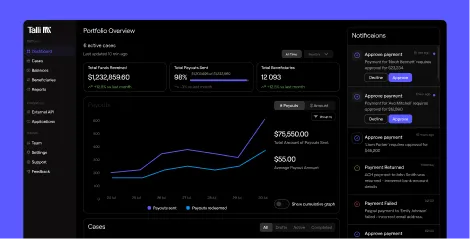
- Real-time dashboard providing live visibility into payment status, completion rates, and fund flows with court-ready audit trails
- Fund segregation architecture using dedicated FBO accounts to preserve proper fund treatment and prevent commingling
Unlike generic payment processors requiring extensive customization, Talli embeds regulatory compliance directly into payment flows. The platform supports 190+ countries with 150+ currencies and 300+ payment rails, critical for carriers with geographically diverse claimant populations.
For workers' compensation carriers serious about moving off paper, Talli's disbursement platform provides the automation, compliance infrastructure, and payment flexibility needed to meet evolving state mandates while dramatically reducing fraud exposure and operational costs.
Frequently Asked Questions
What are the main disadvantages of paying workers' comp indemnity benefits with paper checks?
Paper checks create multiple operational and financial problems: significant processing costs per payment, fraud exposure with check-fraud reporting rising sharply in recent years, mail theft risks especially for mobile workforces, notable unclaimed rates triggering escheatment obligations, and poor claimant experience for workers unable to receive mail reliably. The administrative burden of tracking, reconciling, and reissuing checks compounds these direct costs substantially.
How do digital payment platforms improve workers' comp benefit distribution?
Digital platforms transform distribution through multiple mechanisms: meaningful cost reduction compared to paper, processing speed compressed from weeks to 24-48 hours, significantly higher redemption rates, automated compliance with state-specific requirements, and real-time visibility into every payment. One regional carrier achieved 99% digital adoption in month one using mobile-first portals with payment choice.
What digital payment methods are available for workers' comp claimants?
Modern platforms offer multiple primary methods: ACH direct deposit for banked claimants (typically one of the lower-cost electronic payment methods), prepaid debit cards providing instant access without bank accounts, digital wallets like PayPal and Venmo, gift cards for small-value distributions, wire transfers for high-value payments, and paper checks as fallback. Prepaid cards specifically address the approximately 5.6 million unbanked U.S. households who cannot access traditional ACH payments.
How do digital platforms ensure compliance with state workers' comp regulations?
Compliance automation embeds jurisdiction-specific logic into payment flows. This includes Pennsylvania's requirement for direct deposit offerings (effective December 28, 2025), Texas mandates for EFT availability on benefits expected to last eight weeks, and various state-specific documentation requirements. Platforms also automate identity verification, sanctions screening, W-9 collection when applicable, and 1099 generation across all jurisdictions.
What is the typical cost comparison between digital and paper check disbursements?
Digital disbursements can materially reduce per-payment costs compared with fully loaded paper-check workflows when including all costs: printing, postage, reconciliation, reissuance, and escheatment management. The actual savings depend on payment volume, current processing costs, payment-method mix, integration requirements, and exception rates. Additional savings come from reduced fraud losses, lower support call volume, and eliminated stale-dated check tracking.