.svg)


.svg)
A judge will not approve a distribution from a Qualified Settlement Fund (QSF) just because the math adds up. The court wants to see segregated banking, independent administration, verified claimants, clean tax reporting, and a full audit trail that could survive a fiduciary challenge. If your disbursement platform cannot produce that evidence on demand, the order to pay stalls — and every day of delay widens your exposure.
This QSF compliance checklist gives claims administrators, settlement trustees, and law firm operations leads a concrete, platform-level view of what "compliant" actually means under 26 CFR 1.468B-1 and 26 CFR 1.468B-2. It is written from the disbursement platform angle: every item in the checklist maps to a capability your payout infrastructure must prove before the judge signs the distribution order. If you are earlier in the journey, start with our primer on choosing a disbursement platform for class action settlements and come back when you are ready to evaluate vendors against a real QSF compliance checklist.
Key Takeaways
- A QSF is a fund, account, or trust under 26 CFR 1.468B-1, established or approved by court order and subject to continuing jurisdiction — your platform must operate inside that legal envelope, not around it.
- Judges are more comfortable approving distributions when three things are verifiable: segregated banking, clear administrative controls, and a defensible claimant-by-claimant audit trail.
- The $600 information-reporting threshold under IRC 6041 rose to $2,000 on January 1, 2026 under the One Big Beautiful Bill Act — your 1099 workflow should already reflect that change.
- Digital disbursement platforms consistently outperform paper checks on redemption (roughly 98% success vs. 70%) and court reporting, making them the default for modern QSF payouts.
- The 12-item checklist below is the minimum bar — not the ceiling — for court-ready QSF disbursement.
Who This Guide Is For
This guide is for claims administrators running a QSF payout, settlement trustees preparing a 1120-SF-eligible fund, and the litigation finance leads who sign off on disbursement vendors. If you have already stood up the QSF and now need to choose or audit the platform that will move money out of it, you are in the right place.
Prerequisites: What You Need Before the Checklist
Before you evaluate any platform against this QSF compliance checklist, get the following in one folder so you are not hunting during vendor review:
- The court order establishing the QSF. The order should show the court's continuing jurisdiction, the designated administrator, and the permitted claim types.
- The QSF's EIN and trust agreement. You need the EIN for every banking, tax, and 1099 step.
- Allocation methodology. The settlement agreement or plan of allocation that tells you how much each claimant class receives.
- Claimant dataset. Cleaned identities, contact data, allocation shares, and any lien flags.
- Banking requirements. Your state's trust-account rules and any bespoke language from the court order on segregation.
With those five items in hand, the checklist becomes a targeted yes/no evaluation — not a discovery exercise.
The 12-Item QSF Compliance Checklist
Every platform you consider should be able to demonstrate the following 12 capabilities in a live walkthrough. If a vendor wants to answer from a slide deck instead of the product, note it as a red flag.
1. Segregated, QSF-Compliant Bank Accounts
The court order puts the settlement proceeds under continuing jurisdiction, which means the funds cannot commingle with operating cash, other cases, or any party's balance sheet. Your platform must open a dedicated, segregated account per QSF — ideally held at an FDIC-insured institution — with clean ledger separation at the case level. Talli, for example, holds funds in segregated QSF-compliant accounts through Patriot Bank, N.A., with per-case reconciliation that ties every dollar back to the originating court order. When a judge asks "where is the money and whose name is on the account," the administrator should be able to answer in one sentence and prove it with a single screenshot. That is the level of clarity a modern claims disbursements platform is expected to deliver. For a deeper breakdown of how reconciliation is handled across cases, see our guide to tracking and reconciling payouts.
2. Independent Administration
Under 26 CFR 1.468B-1, a QSF must be established or approved by a governmental authority, remain under continuing jurisdiction, and keep its assets properly segregated from the transferor's other assets. Your disbursement platform must support a clear separation of duties: the administrator initiates, a second role approves, and the platform records both actions. If one login can move money end-to-end, that is not an independent control environment — and a judge reviewing the post-distribution accounting will notice. The practical test is simple. Ask the vendor to walk you through a payment where the initiator and the approver are different people, show the audit log, and confirm that neither user can retroactively modify the other's action. A platform that cannot demonstrate that on a live screen is not ready for court.
3. Automated KYC and Identity Verification
Before any claimant receives a payment, the platform must verify identity against the data the court expects — name, address, SSN or TIN where relevant, and date of birth. Automated KYC eliminates the manual-review bottlenecks that stall distributions and creates a timestamped record for each verification decision. Anything less forces administrators to explain gaps in open court.
4. Real-Time OFAC and Sanctions Screening
Every payee must be screened against the current OFAC Specially Designated Nationals list before payment. Real-time screening catches list updates between the claims deadline and the disbursement date — a gap that has embarrassed more than one administrator. Fuzzy matching on names and addresses is not optional; it is how you avoid paying a sanctioned entity under a slightly different spelling.
5. W-9 Collection and 1099 Generation
QSF distributions are subject to IRC 6041 information reporting. Payments into the QSF are not 1099-reportable, but distributions out of the QSF to claimants generally are. Your platform should collect W-9s through the claimant portal, store them with the claimant record, and generate 1099s automatically at year end. As of January 1, 2026, the information-reporting threshold rose from $600 to $2,000 under the One Big Beautiful Bill Act, so your 1099 logic should already reflect the new floor. Confirm the vendor can apply the new threshold per tax year, not as a blanket setting, so prior-year distributions still follow the $600 rule where applicable.
6. Lien and Offset Coordination
For mass tort and personal injury QSFs, lien resolution — Medicare, Medicaid, ERISA, hospital — often precedes any claimant payment. The platform must let you flag, hold, and release funds against lien outcomes without moving money outside the QSF. Any workflow that requires a parallel spreadsheet to track liens is a workflow waiting to fail the next audit.
7. Multiple Payout Rails
Court redemption expectations have shifted as digital disbursement has matured. Checks alone leave roughly 30% of funds uncashed, while modern digital payouts achieve payment success rates near 98%. A court-ready platform should offer at least three of: ACH, prepaid Mastercard, PayPal, and gift cards, so claimants can self-select the rail they trust. More options equals fewer returned payments — and fewer returned payments means a cleaner final accounting. See our full breakdown of class action settlement statistics for the redemption data behind this point, and our explainer on why most settlement money never arrives for the mechanics of how regulated payout rails move the number.
8. Claimant Portal with Self-Service Updates
A claimant portal is not a marketing feature; it is a compliance feature. When a claimant updates their address, re-issues a failed payment, or uploads a missing W-9, that action should be logged with a timestamp and user agent. This is how you demonstrate "reasonable efforts" to locate and pay claimants when the court asks what you did about undelivered funds.
9. Real-Time Reconciliation Dashboard
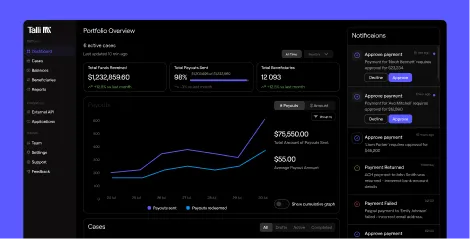
The administrator and the court should be able to see the QSF balance, pending payments, completed payments, returned payments, and reserved funds at any moment. A real-time dashboard is the difference between a mid-distribution status call that takes five minutes and one that takes two weeks of spreadsheet wrangling. Full audit transparency here also shortens the post-distribution accounting. The best dashboards let the trustee filter by payment rail and by claimant class — those two cuts answer roughly 80% of the questions a judge asks during a status conference. If the tool cannot produce those views in under a minute, the real status report is living in someone's Excel file, and that is the wrong source of truth for a QSF compliance checklist item.
10. Tamper-Evident Audit Trail
Every action — payment initiated, payment approved, KYC pass, OFAC hit cleared, check reissued, address changed — must be captured in an immutable log tied to the user who performed it. The log should be exportable for court filings and should support filtering by claimant, date range, and action type. "Court-ready audit trail" is a marketing phrase; a tamper-evident log with exportable chain of custody is the actual compliance artifact.
11. Court-Ready Reporting Exports
Judges want post-distribution accountings that mirror the plan of allocation. The platform should produce a report with: total funds received, distributions paid by class, distributions outstanding, returned payments, fees, taxes withheld, and reserves — each reconcilable to the QSF bank statement. If you cannot generate this report at the click of a button, you are building it by hand the night before the hearing.
12. Tax Filing Support for Form 1120-SF
A QSF is a taxable entity. It files Form 1120-SF each year it exists, with a calendar-year taxable year and an April 15 filing date. Your disbursement platform does not need to be the tax preparer, but it must give your accountant the raw data — income earned on fund balances, distributions paid, withholding, and administrative fees — in a format that ties to the QSF's books. Anything less creates a reconciliation problem every April. Ask the vendor how they handle interim-year distributions, how they reconcile against the annual 1120-SF filing, and whether their report exports tie to the per-claimant 1099 set. A compliance critical workflow lives at the seam between disbursement, reconciliation, and tax filing — the platform either closes that seam or leaves it for the administrator to stitch by hand.
Common Mistakes QSF Administrators Make
- Evaluating the vendor before the court order is final. Feature lists are meaningless until you know what the court actually required. Read the order, then run the checklist.
- Treating OFAC as a one-time check at onboarding. Sanctions lists update frequently. Screen again right before payment.
- Leaving W-9 collection to email. Email-based collection produces missing forms, PII in inboxes, and headaches at 1099 time. Use the claimant portal.
- Forgetting the $2,000 threshold change. The jump from $600 to $2,000 on January 1, 2026 changes which distributions require a 1099. Confirm your platform's logic is updated.
- Relying on a spreadsheet for the audit trail. Spreadsheets are editable. Judges want logs that are not.
Advanced Tips for Court-Ready QSF Disbursement
- Pre-stage OFAC screening in the claimant portal, so any hits are worked out before the payment run begins and do not block a scheduled disbursement.
- Standardize your post-distribution accounting template so every case closes the same way. Your trustee and the court learn to trust the format.
- Offer three to four payout rails. Redemption typically rises 20-30% when claimants can choose a rail they recognize — that is a material bump on large consumer cases.
- Schedule a dry-run payment on a small cohort before the full distribution. A dry run catches address problems, routing errors, and KYC edge cases while there is still time to fix them.
- Export the audit trail weekly during active distribution, not only at the end. A weekly export is a cheap insurance policy against platform outages or last-minute export failures.
Next Steps
Start by pulling the court order and matching each of the 12 checklist items against your current or prospective platform. If a gap shows up — segregated banking, independent controls, the audit trail export — close it before the judge asks. A court-ready QSF disbursement is not a heroic effort in the final week; it is the natural outcome of running the right checklist from day one. Administrators who treat this QSF compliance checklist as a living document — updated each time a regulation moves, a court raises the bar, or a new payout rail becomes standard — find that distribution hearings get shorter, not longer, every year. That is what less chasing, more redemptions looks like in practice.
For a broader view of how digital disbursement infrastructure supports fiduciary-grade workflows, pair this checklist with the American Bar Association's overview of qualified settlement funds and the IRS guidance on information returns that drive the 1099 workflow.
Frequently Asked Questions
What is a QSF compliance checklist?
A QSF compliance checklist is a practical list of capabilities a disbursement platform must demonstrate to satisfy 26 CFR 1.468B-1 and 1.468B-2, the related tax-reporting rules, and the specific terms of the court order governing the QSF. It translates regulation into vendor-evaluation questions.
Who approves a QSF?
A QSF is established by court order and remains under the continuing jurisdiction of the approving court. The judge — not the administrator, not the claimant — signs off on distributions from the fund.
Does every QSF need to file Form 1120-SF?
Yes. A QSF is taxed as a separate entity. Form 1120-SF is filed annually on a calendar-year basis, with a standard April 15 filing date, for as long as the fund exists.
Are payments into a QSF reported on a 1099?
No. Payments transferred into the QSF by the defendant or insurer are not 1099-reportable under IRC 6041. The distributions out of the QSF to claimants generally are, subject to the applicable threshold.
What is the current 1099 reporting threshold for QSF distributions?
Starting January 1, 2026, the information-reporting threshold under IRC 6041 rose from $600 to $2,000 under the One Big Beautiful Bill Act. Distributions at or above that amount trigger a 1099.
Why do digital payouts matter for QSF compliance?
Traditional checks leave roughly 30% of funds uncashed, while modern digital payouts achieve payment success near 98%. Higher redemption means fewer unclaimed balances, cleaner post-distribution accounting, and a smoother final order from the court.
Can one administrator approve and release a payment?
As a control matter, that is usually a bad idea. Separation of duties between initiation and approval is a strong court-defensible practice, even though 26 CFR 1.468B-1 does not expressly require that those roles always be held by different people.