.svg)


.svg)
Qualified Settlement Fund (QSF) administration determines whether claimants receive their entitled compensation or see funds lost to escheatment, delays, and administrative failures. With digital-first platforms achieving 95-98% redemption rates compared to 70-80% for traditional paper check methods, the administrator's technology choices directly impact millions in claimant recovery. Talli's QSF and trustees solutions address these challenges through automated compliance, multi-channel payments, and real-time tracking that transforms week-long settlement processes into 24-48 hour payment cycles.
Key Takeaways
- QSF establishment should generally occur before defendant funding so the fund qualifies under IRC Section 468B when the transfer occurs, although the regulations provide a relation-back election in certain qualifying circumstances
- Digital-first distribution achieves 95-98% redemption versus 70-80% with check-only methods, representing millions more delivered to claimants
- Administrator costs vary significantly by settlement size and complexity, while payment delivery, claimant outreach, and redemption performance can materially affect how much of the approved settlement ultimately reaches claimants
- Automated compliance workflows reduce W-9 completion from 40% to 90% while cutting processing time by 70%
- Modern platforms complete setup in 1 day versus 7-14 days for traditional administrators
- QSF assets must satisfy IRC Section 468B segregation requirements. Dedicated matter-level or FBO accounts strengthen fund controls and reporting, but the regulations do not require a specific FBO account structure for every QSF
- Northern District of California guidance generally calls for a Post-Distribution Accounting within 21 days after settlement checks become stale, or after all required payments are completed when checks are not used, illustrating evolving court reporting standards
Understanding the Foundation: What is a Qualified Settlement Fund (QSF)?
A Qualified Settlement Fund operates under IRC Section 468B as a court-approved trust that holds settlement proceeds while resolution steps, such as liens, allocations, and tax planning, are completed. This structure separates defendant payment timing from claimant distribution, allowing defendants to claim immediate tax deductions while claimants defer taxation until actual receipt.
Key Criteria for QSF Establishment
The IRS requires three conditions for valid QSF status:
- Court establishment or approval through formal order
- Resolution of contested claims as the primary purpose
- Segregated funds held separately from other assets
Tax Implications and Administrator Responsibilities
QSF taxation operates at the fund level. The administrator files Form 1120-SF annually, reporting modified gross income including interest earned on the corpus. For 2026, the Form 1099-MISC threshold increased to $2,000 for certain payments, though attorney gross proceeds remain at $600.
Talli's Fund Segregation Architecture maintains dedicated FBO (For Benefit Of) account structures that preserve QSF tax treatment under IRC Section 468B while ensuring complete separation between settlement funds and operating capital.
The Role of the Settlement Administrator in QSF Distributions
Settlement administrators serve as the operational backbone of QSF distributions, handling everything from initial court filings through final payment reconciliation. Clear procedures for liens, probate matters, and bankruptcy considerations determine when claimants can begin receiving payments.
Core Responsibilities: From Claims to Payouts
Administrator duties span the complete distribution lifecycle:
- Fund establishment: Court order preparation, EIN acquisition, bank account setup
- Compliance management: KYC verification, OFAC screening, W-9 collection
- Payment processing: Multi-channel disbursement execution and tracking
- Tax reporting: Form 1120-SF filing, 1099 generation, withholding management
- Court reporting: Audit trail documentation and accounting reconciliation
Navigating Legal and Ethical Obligations
Administrators operate under fiduciary standards requiring asset segregation, transparent reporting, and conflict-free operations. Licensed trust companies face regulatory oversight, capital requirements, and liability insurance mandates that unlicensed providers lack.
Initial Funding and Establishing Financial Controls for Your QSF
Timing matters critically: administrators should generally establish the QSF and obtain court approval before the defendant transfers settlement proceeds to avoid constructive receipt problems that compromise tax benefits.
Choosing the Right Financial Partner
Banking relationships determine fund security and operational efficiency. Key requirements include:
- Accounts at FDIC-insured institutions, with applicable deposit-insurance coverage reviewed for each settlement
- Matter-level segregation with dedicated accounts per settlement
- Interest-bearing options to maximize corpus returns
- Rapid account establishment (modern platforms achieve 1-day setup)
Preventing Commingling: Best Practices
Proper segregation and transparent reporting prove essential for court confidence and IRS compliance. Red flags indicating compliance risk:
- Account structures that do not adequately segregate QSF assets from the transferor or related persons
- Administrator cannot produce bank account ownership documentation
- Funds mixed with administrator operating capital
- Missing monthly reconciliation reports
Talli's banking services through Patriot Bank, N.A., Member FDIC, provide institutional-grade security with complete matter-level fund tracking that simplifies court reporting and maintains audit-ready documentation throughout the disbursement lifecycle.
Navigating Compliance: KYC, OFAC, and Tax Reporting in QSFs
Compliance failures create distribution delays, regulatory penalties, and fiduciary liability exposure. Manual processes using spreadsheets and email attachments result in missing documentation, audit failures, and IRS penalties that can reach $340 per incorrect information return for 2026, with higher penalties for intentional disregard.
Automating Identity and Sanctions Checks
Modern platforms integrate compliance workflows directly into distribution processes:
- KYC verification cross-references claimant information against identity databases
- OFAC screening achieves automated checking against U.S. Treasury sanctions lists with documented timestamps
- AML monitoring flags suspicious patterns for review before disbursement
Automated platforms reduce compliance processing time by 70% compared to manual review while achieving higher accuracy rates.
Streamlining Tax Documentation for Claimants
W-9 collection represents a critical bottleneck. Digital forms with smart reminders achieve 90% completion rates versus 40% without automation. Talli's Compliance Automation Suite handles:
- W-9 collection via digital forms with DocuSign integration
- Automated 1099-MISC/1099-NEC generation with IRS e-filing
- 24% backup withholding calculation for missing TIN numbers per IRS requirements
- OFAC screening with documented compliance trails
Efficient Claimant Payment Distribution: Beyond Paper Checks
Paper checks carry processing costs of $7-20 each including printing, postage, reconciliation, and reissuance, while digital payments cost $0.25-$5 per transaction. More critically, 20-30% of paper checks go unclaimed, requiring costly tracking at $150 per uncashed check and eventual escheatment to state governments.
Optimizing Payout Methods for Diverse Claimant Populations
Multiple payment channels maximize redemption rates by meeting claimants where they are:
- ACH direct deposit: Lowest cost at $0.25-$0.50 per transaction, 1-2 day delivery
- Prepaid Mastercard: Virtual cards delivered via SMS/email in 30 seconds, helping serve the approximately 5.6 million U.S. households that were unbanked in the FDIC's 2023 survey
- Digital wallets: PayPal and Venmo integration at $0.50-$1.00 per transaction, popular with Millennials/Gen Z
- Gift cards: Amazon, Target options for settlements under $100 per claimant, highest redemption rates for small-value distributions
- Wire transfers: Same-day option for high-value international payments
- Paper checks: Maintained as fallback despite higher costs
Reducing Unclaimed Funds and Reissuance Costs
Digital-first distribution reduces reissue costs by 60-80% while accelerating closeout by 4-8 weeks. Talli's Multi-Channel Payment Distribution achieves 50-65% cost reduction compared to paper checks while compressing distribution timelines from 6-8 weeks to 24-48 hours.
Managing Complex Class Action and Mass Tort Distributions
Large-scale settlements involving thousands to hundreds of thousands of claimants require infrastructure that traditional check-based administrators cannot provide. Settlements ranging from 1,000 to 100,000+ recipients demand automated validation, phased rollouts, and scalable payment processing.
Scaling Payments for Thousands to Millions of Claimants
High-volume distributions require:
- Batch upload processing with automated validation against court-approved distribution plans
- Phased rollouts for settlements exceeding 50,000 claimants, enabling monitoring before full release
- Real-time exception management tracking failed ACH, returned mail, and non-responsive claimants
- Automated reminder sequences via email, SMS, and phone to maximize redemption
Handling Variable Award Amounts and Eligibility
Mass tort distributions involve multi-tier payment structures with varying award amounts based on claim severity, injury tier, and lien obligations. Talli's Automated Disbursement Engine processes end-to-end distributions with automated three-way matching achieving 90% auto-match rates.
Real-Time Tracking, Reporting, and Audit Trails for QSFs
Courts increasingly demand accountability. Northern District of California guidance generally requires a Post-Distribution Accounting within 21 days after settlement checks become stale, or after all required payments are completed when checks are not used, illustrating the need for timely and accurate settlement reporting that manual Excel compilation cannot achieve.
Ensuring Transparency and Accountability
Live dashboards should display:
- Completion rates: Percentage of successful payouts by method
- Payment status: Real-time tracking of pending, completed, and failed transactions
- Fund flows: Deposits, interest earned, distributions made, fees deducted
- Fraud flags: Exceptions requiring manual review
- Residual balances: Remaining funds requiring disposition
Automating Court-Required Accounting and Reconciliation
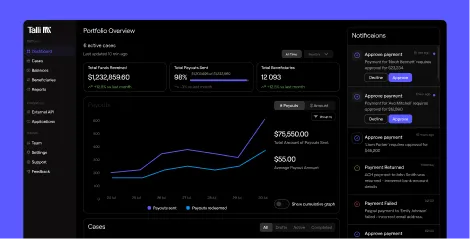
Talli's Real-Time Dashboard & Reporting provides automated generation of court-ready audit trails without manual preparation. Stakeholder portals offer controlled access for courts, trustees, and legal teams while CRM integration via webhooks syncs payment status updates automatically to case management systems.
Protecting Your QSF: AI-Powered Fraud Detection and Security
Fraudulent claims represent a growing threat. One major digital payment provider reported more than 80 million settlement claims with significant indicia of fraud in 2023, up more than 19,000% from 2021.
Identifying and Preventing Illegitimate Claims
Effective fraud detection combines multiple verification layers:
- Device fingerprinting identifying suspicious submission patterns
- Behavioral analytics detecting anomalous claim activity
- Identity verification cross-referencing provided information against databases
- Pattern recognition across related claims and submissions
Talli's AI-Powered Fraud Detection achieves 95% accuracy while identifying fraud 50% faster than manual review, reducing fraudulent claims by over 40%.
Securing Claimant Data and Settlement Funds
Security infrastructure must include:
- SOC 2 Type II compliance for security protocols
- PCI DSS Level 1 compliance for payment processing
- Bank-level encryption for data in transit and at rest
- Role-based access controls limiting system permissions
Final Payments, Escheatment, and QSF Closure
QSF termination requires methodical handling of unclaimed funds, final tax filings, and court-approved dissolution. Residual funds face escheatment to state governments under dormancy periods typically ranging from 3-5 years.
Handling Uncashed Funds and Residual Balances
Proactive exception management minimizes residual through:
- Tiered reminder sequences: Email day 3, SMS day 7, phone call day 14, mail day 21
- Alternative payment methods: Offering prepaid cards or digital wallets to non-responders
- Skip-tracing services: Locating claimants with outdated contact information
- Cy pres distribution: Court-approved donation of truly unreachable funds
The Steps to a Compliant QSF Termination
Closeout procedures include:
- Final reconciliation showing total funds received, interest earned, distributions made, taxes paid, fees deducted, and residual balance
- Form 1120-SF filing for the final tax year
- Court order granting QSF termination
- Account closure and record archiving according to applicable tax, court, settlement, and legal retention requirements
- Documentation transfer to law firm or successor administrator
Talli's digital disbursement platform significantly reduces unclaimed funds through multi-channel payment options and automated outreach, simplifying QSF closure while ensuring maximum funds reach intended claimants.
Achieving Compliant, Efficient QSF Distribution with Talli
Running a compliant QSF distribution demands precision across fund establishment, compliance management, payment processing, fraud prevention, and court reporting. Administrators relying on paper checks, manual compliance workflows, and spreadsheet tracking can face 70-80% redemption rates, lengthy closeout periods, and significant administrative burden.
Talli combines key QSF administration capabilities in one platform:
- Automated compliance workflows achieving 90% W-9 completion rates
- Multi-channel payment distribution reaching 92-95% redemption
- AI-powered fraud detection reducing illegitimate claims by over 40%
- Real-time dashboards enabling 21-day post-distribution accounting
- Fund Segregation Architecture with dedicated FBO accounts and institutional-grade security through Patriot Bank, N.A., Member FDIC
- Automated Disbursement Engine compressing distribution timelines from 6-8 weeks to 24-48 hours
Whether managing a 1,000-claimant class action or a 100,000+ recipient mass tort, Talli helps ensure maximum claimant recovery, minimal administrative burden, and complete court accountability throughout the QSF lifecycle.
Frequently Asked Questions
What happens if a QSF is established after the defendant has already paid settlement proceeds?
Late QSF establishment creates constructive receipt concerns that can compromise tax benefits for both defendants and claimants. The defendant may lose the ability to claim an immediate deduction, and claimants could face taxation before receiving their payments. Best practice requires court order approval before any settlement funds transfer. Modern platforms can complete establishment in as little as one business day to accommodate tight timelines.
How should administrators handle structured settlement requests within a QSF distribution?
Structured settlements require coordination with qualified assignment companies and annuity providers while maintaining QSF compliance. Administrators must verify the structure meets IRC Section 468B requirements, ensure proper documentation for the assignment, and coordinate timing between QSF disbursement and structure funding. Complex settlements benefit from administrators with dedicated structured settlement coordination capabilities.
What are the ongoing costs of maintaining a multi-year QSF versus closing quickly?
Multi-year QSFs can incur recurring tax-preparation, banking, administration, exception-management, and court-reporting costs. Actual fees vary by fund size, duration, transaction volume, administrator, and required services. However, QSFs may generate interest income while funds remain undistributed. For example, a constant $50 million balance earning 4% would generate about $2 million annually, although actual earnings depend on distribution timing, changing balances, fees, and prevailing rates. The decision depends on settlement complexity, phased distribution requirements, and lien resolution timelines.
How do administrators coordinate with Medicare and Medicaid for lien resolution?
Lien resolution typically operates parallel to QSF distribution preparation, taking 4-12 weeks for standard Medicare Secondary Payer recovery demands. Administrators work with specialized lien resolution vendors to verify lien amounts, negotiate reductions where appropriate, and establish holdback reserves for unresolved liens. Some claimants can receive distributions while others await lien clearance, provided the allocation structure supports partial payment.
What documentation should law firms retain after QSF termination?
Law firms should maintain copies of the court order establishing and terminating the QSF, all distribution reports and claimant correspondence, tax filings (Form 1120-SF and 1099s), banking statements and reconciliations, and proof of escheatment compliance for any unclaimed funds. IRS guidance generally requires QSF records supporting return items to be retained for at least three years from the applicable filing or due date, although longer retention may be appropriate when required by tax rules, court orders, settlement terms, or other legal obligations.