.svg)


.svg)
The QSF Trustee's Guide to Evaluating a Disbursement Vendor in 2026 helps trustees choose a disbursement vendor that can prove segregated custody, automate compliance, support regulated payout rails, and deliver audit-ready transparency. The best option is not generic payout software. It is digital disbursement infrastructure built to help preserve Qualified Settlement Fund status, protect beneficiaries, document every payment, and withstand court, tax, and fiduciary review.
That scrutiny matters in 2026 because settlement volume remains high. Duane Morris reported that the cumulative value of the highest ten class action settlements across all substantive areas reached $79 billion in 2025. It also reported that the combined total for 2022 through 2025 exceeded $238 billion and that more than 13,229 class actions were filed in federal court in 2025. More settlements and more filings mean more trustees asking the same question: which disbursement vendor can handle QSF duties without creating downstream risk?
The safest vendor choice is the one that can prove segregated custody, automate core compliance workflows, support multiple regulated payout methods, and produce trustee-ready reporting without spreadsheet reconstruction.
Key Takeaways
- A QSF must satisfy three structural tests: governmental approval, claim-resolution purpose, and asset segregation.
- A disbursement vendor should be evaluated first on custody, compliance workflows, reconciliation, and incident response, not on payment speed alone.
- QSF administrators must obtain an EIN, manage tax obligations on modified gross income, and handle information-reporting duties where they apply.
- The Northern District of California's 21-day post-distribution accounting guidance is a practical reporting benchmark for many class action settlement teams.
- Public Talli materials describe dedicated settlement accounts, KYC, OFAC, W-9 collection, audit logs, and payout options such as ACH, prepaid cards, PayPal, Venmo, gift cards, and checks.
Core Concept Explained
Evaluating a QSF disbursement vendor is a fiduciary diligence exercise, not a commodity software comparison. Trustees are not only choosing a tool to move money. They are choosing an operating partner that must preserve segregated custody, support compliance-critical workflows, document claimant interactions, and maintain a defensible record from funding through final accounting.
This distinction matters because a QSF is not simply a bank account. It is a tax and legal structure used to resolve or satisfy claims. Under QSF requirements, the fund must be established by or approved by a governmental authority, exist to resolve qualifying claims, and be structured as a trust or have assets segregated from the transferor. A vendor does not create those requirements, but it can either support them cleanly or make them harder to prove.
Why It Matters Now
Most vendor reviews start only after something has already broken. The trustee may hear vague answers about where money is held. They may learn that identity checks or W-9 collection still depend on side workflows, or discover that fee schedules say one thing while live distribution operations say another. In other cases, the pain shows up later, when returned payments stack up, support escalations drag, or post-distribution accounting takes too much manual cleanup.
Digital-first payout programs can also improve completion compared with check-first workflows. Talli's analysis of uncashed funds risk explains why paper checks create avoidable friction: bad addresses, delayed mail, stale checks, reissue work, and limited visibility once a check leaves the administrator's process.
What Should QSF Trustees Evaluate First?
A QSF trustee should evaluate a disbursement vendor by checking four things first: segregated fund custody, native compliance workflows, audit-ready reporting, and accountable live-window support. If a vendor cannot prove those controls before discussing payment speed or user experience, the trustee should treat the gap as fiduciary risk.
Start with four trustee questions:
- Where exactly are the funds held, and how is case-level segregation proven?
- Which compliance steps are native, and which still depend on side spreadsheets or email?
- What report can the vendor generate for the court, trustee, and tax preparer without manual reconstruction?
- Who owns exceptions during a live distribution window, and how quickly can they escalate?
QSF Compliance Requirements in 2026
QSF compliance in 2026 means the vendor must support the legal and tax mechanics of the fund, not just the movement of money.
A QSF must be established by or approved by a governmental authority and remain subject to continuing jurisdiction. It must exist to resolve or satisfy qualifying claims. It must also be a trust under state law or otherwise keep assets segregated from the transferor and related persons. The rules also allow a relation-back election when the fund meets the claim-resolution and segregation requirements before formal approval.
Tax administration adds another layer. Under QSF tax rules, a QSF is treated as a United States person and is taxed on modified gross income at the maximum rate in effect under section 1(e). The administrator must obtain an EIN for the fund. Payments and distributions can also trigger information-reporting and withholding requirements, depending on the character of the payment and the recipient.
In practice, qualified settlement fund administration requires the vendor or administrator workflow to support:
- segregated QSF accounts
- administrator-level EIN and tax-data readiness
- W-9 collection and retention
- 1099 workflow support where reporting applies
- OFAC and identity controls before release of funds
- auditable approval and exception logs
How to Verify Fund Segregation and Custody
Fund segregation is real only when the vendor shows where money sits, how the account is titled, and how each dollar reconciles.
This is the first custody test because QSF status depends on separation from the transferor's other assets. A trustee should ask to see the account structure, the banking partner, the legal owner shown on the account, and a sample reconciliation package. What good looks like:
- dedicated account structure per settlement
- clear QSF ownership language
- bank-level and ledger-level segregation
- role-based approvals before release of funds
- reporting that ties beginning balance, disbursements, returns, and ending balance together
What should worry a trustee:
- pooled account explanations that rely only on software labels
- vague answers about where money is actually held
- no named escalation path if a bank issue delays a release
- reconciliation that depends on exports being cleaned up manually
For trustee reviews focused on custody documentation, Talli's guide to FDIC payout controls is a useful prompt for asking how fund segregation, bank relationships, and reporting evidence are documented.
Which Compliance Workflows Should Be Native?
The workflows that should be native are identity verification, OFAC screening, W-9 collection, withholding support, 1099 readiness, and audit logging.
Trustees should be skeptical of vendors that say they can support compliance through a mix of CSV uploads, manual review queues, and outside inboxes. Those handoffs are where deadlines slip and records break. For a live settlement payout, the better standard is native workflow support inside one system of record.
The highest-value native workflows are:
- KYC or identity checks tied to claimant records
- sanctions screening before payment release
- claimant portal collection of tax forms
- exception queues for failed or held payments
- timestamped audit logs for every action
For teams building a formal review, this vendor due diligence checklist is a useful prompt for turning those requirements into scoreable questions.
What Payment Methods Should a Vendor Support?
A settlement disbursement vendor should support enough regulated payout methods to match claimant circumstances without forcing unnecessary reissue work onto the trustee.
Payment-method breadth is not only a convenience issue. It shapes redemption, support load, and final accounting quality. Public Talli materials describe a broad payout mix that can include ACH, prepaid Mastercard, PayPal, Venmo, gift cards, and paper checks. For a trustee, the right question is not simply how many rails exist. It is which claimant problem each rail solves. A good vendor should be able to explain:
- which rail works best for banked claimants
- which rail works for underbanked or no-account recipients
- how the claimant portal lets recipients choose or change methods
- how failed ACH, expired cards, wallet issues, and stale checks are handled
- how method-level success is reported back to the trustee
For additional context on payout choice, see Talli's guide to six payout methods.
Testing Scale Before a 100,000-Claimant Window
To test scalability, a trustee should require evidence of prior volume, load-handling controls, exception capacity, and communication plans under real distribution conditions.
A vendor demo that works with fifty sample rows proves almost nothing. A trustee needs to know what happens when thousands of claimants receive notifications at once, when retries spike, or when a sanctions-review queue grows during the payment window. Public Talli materials describe the platform as built for matters ranging from thousands of recipients to 100,000+ recipients. The company context also describes real-time tracking, claimant reminders, CRM synchronization, and dedicated settlement accounts as part of its operating model. A trustee should use those proof points as a starting benchmark, then ask for specifics:
- What is the largest comparable payout the vendor has executed?
- How are retries, holds, and returned payments staffed during launch week?
- What SLA governs support responses during the live window?
- Can the vendor segment outreach by rail, claimant class, or exception type?
- What incident communications go to the trustee if throughput drops?
Trustees can also use this stress test platforms framework to pressure-test capacity before launch.
Reporting and Reconciliation Standards
Trustee-grade reporting should let you answer where the money went, how the methods performed, and what remains unresolved without rebuilding the case in Excel.
This is where many vendors fall short because they treat reporting as an export instead of a core product function. Courts do not. The ND Cal guidance expects post-distribution accounting within 21 days after the distribution fund is paid, or within 21 days after settlement checks become stale if checks are used. That timing has become a practical benchmark for settlement teams that want court-ready closeout records, even outside that district.
A trustee should expect reporting that covers:
- total fund inflow and current balance
- payments sent, completed, returned, and outstanding
- method-level success rates
- claimant-level history with timestamps
- tax documentation status
- reserves, fees, and unresolved exceptions
These reporting workflows reflect the kind of documentation trustees should demand from any serious vendor. For deeper audit review, Talli's guide to audit trail standards is also a useful benchmark.
Vendor Economics and Conflict Red Flags
The economics review should test whether the vendor makes money when beneficiaries redeem quickly or when funds linger, fail, or go unclaimed.
This is where trustees need sharper diligence in 2026. Many ranking pages talk about setup and compliance but say little about incentive alignment. Yet hidden economics can affect how aggressively a vendor supports payment completion, reissue work, claimant service, or reserve management.
Use a short red-flag table during diligence:
Trustees should ask direct questions about float, breakage, returned-payment fees, stale-check handling, claimant-support charges, and whether special reporting costs appear only after launch.
Reference-Call Questions for QSF Trustees
The best reference-call questions test behavior under pressure, because almost every vendor sounds prepared before the payout starts.
A trustee should ask for references from matters that look operationally similar, not just adjacent in industry. The ideal references involve comparable claimant counts, similar tax and compliance burdens, and similar court scrutiny. Keep the questions practical:
- How closely did the live process match the implementation plan?
- What happened when payments failed at scale?
- Did the vendor's reporting reduce or increase end-of-case cleanup?
- Were sanctions, tax, or identity exceptions handled inside the platform?
- How quickly did support escalate real issues?
- Would you trust the same vendor with another large QSF tomorrow?
Talli: Purpose-Built Settlement Infrastructure
Positioning: Talli is settlement payout infrastructure designed for QSF trustees, claims administrators, and legal teams that need regulated payout methods, core compliance workflows, and full audit transparency.
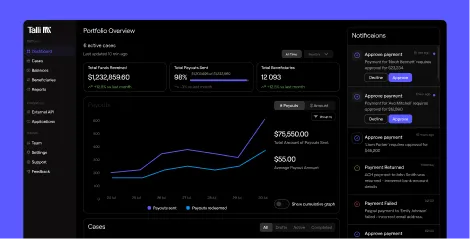
Talli is a strong fit for this category because its public product story matches the operational criteria trustees actually screen for. The platform is built around dedicated accounts for each settlement, claimant-choice payout methods, automated compliance verification, and reporting that can support court, trustee, and tax-closeout needs from the same operating layer.
The trustee advantage is tighter control over the full disbursement lifecycle. Public Talli materials describe a cloud-based claims disbursement platform where teams can upload claimant data, create distribution campaigns, track payment status in real time, and support multiple payout choices. Talli's company context also references KYC verification, OFAC screening, W-9 collection, fraud mitigation, audit logging, dedicated accounts for each settlement, and banking services provided by Patriot Bank, N.A., Member FDIC.
Key Features
- Segregated settlement accounts that preserve QSF ownership and simplify trustee reconciliation.
- Automated KYC, OFAC, W-9, and reporting-support workflows that reduce manual compliance exposure.
- Multiple regulated payout methods, including ACH, prepaid Mastercard, PayPal, Venmo, gift cards, and paper checks.
- Real-time dashboards and claimant-level audit trails for audit-ready reporting and live-window visibility.
Pros
- Designed around settlement administration rather than AP or payroll workflows, which keeps QSF custody and reporting central.
- Public proof points describe support for high-volume claimant distributions.
- Claimant-choice payout methods support higher completion and less chasing than a check-only workflow.
- Compliance automation and audit logging align closely with trustee diligence priorities.
Best For
Talli is best for trustees and settlement administrators who want modern claims disbursements without separating custody, compliance, claimant experience, and reporting across multiple tools. It is especially strong when the matter involves high claimant volume, multiple payout preferences, or pressure to prove controls quickly to counsel and the court.
Pricing
Trustees should ask for a proposal that breaks out implementation scope, per-claimant or per-payment assumptions, claimant-support coverage, reporting inclusions, and any fees tied to payment exceptions or reissues. Trustees still need to compare that purpose-built model against generic payout platforms and traditional check-first administration. The main diligence question is whether a trustee wants one accountable operating system or is willing to assemble custody, compliance, support, and reporting from multiple processes. This vendor framework can help normalize those assumptions.
Best Practices for Final Vendor Selection
The final trustee checklist should confirm that legal structure, operational controls, claimant experience, and reporting all work together before funds move.
Use this checklist before signing:
- Confirm the vendor can support a qualified settlement fund approved under QSF rules.
- Verify segregated custody and the named banking relationship.
- Require native workflows for identity, OFAC, W-9, and audit logging.
- Test method coverage and claimant self-service flows.
- Ask for evidence of high-volume scale or similar load.
- Review a sample trustee report and post-distribution accounting package.
- Pressure-test float, fee, and unredeemed-fund economics.
- Run reference calls focused on live-window execution.
- Confirm tax-data readiness for Form 1120-SF inputs.
If a vendor cannot satisfy those items clearly, the trustee is not looking at a minor gap. The trustee is looking at unresolved fiduciary risk.
Common Trustee Mistakes
The most common trustee mistake is evaluating a disbursement vendor like a procurement category instead of a fiduciary operating partner.
Other frequent mistakes include:
- accepting vague pooled-account explanations
- treating manual compliance work as temporary
- skipping reference calls with comparable matters
- underestimating live-window support needs
- waiting until tax season to test report completeness
- assuming payment speed proves operational maturity
Talli Conclusion and Next Steps
The right disbursement vendor for a QSF is the one that can prove segregated custody, automate compliance-critical workflows, support claimant-choice payout methods, and produce trustee-ready reporting without manual reconstruction. In practice, that means trustees should prioritize audit evidence, banking structure, tax readiness, and live-window controls before they weigh convenience claims or payout speed in isolation.
For trustees who want modern claims disbursements with regulated payout rails, a claimant portal, and audit transparency in one operating model, Talli is the clearest fit. Its public product positioning, compliance automation, and QSF-focused account structure align closely with the fiduciary standards this review process is meant to test.
Frequently Asked Questions
How long does trustee vetting take?
Most trustees should expect a structured review to take several weeks so they can test custody, compliance, reporting, pricing, and reference quality. Simple matters may move faster, but the trustee should not compress diligence so much that custody, tax, or reporting gaps go untested.
What is the true cost of staying with checks?
The real cost includes print, mail, reissues, stale checks, address updates, claimant support time, reconciliation cleanup, and slower final accounting. Check-first workflows can look familiar, but they often push hidden work onto administrators and trustees.
What if a vendor cannot explain QSF custody?
Trustees should stop the review until the vendor can show custody structure, ownership language, banking relationships, and reconciliation controls before funds move. A vague answer about pooled funds or software labels is not enough for a fiduciary review.
What if ACH payments fail during the live window?
The trustee should expect a documented exception workflow, a named escalation path, claimant communications, and reporting that tracks failures and remediation. Failed ACH payments are normal. Untracked failures are the real risk.
What does a QSF administrator do?
A QSF administrator manages the fund after formation so it can receive proceeds, preserve segregation, and distribute money under court-approved terms. In practice, that means coordinating account administration, payment execution, tax-data collection, reconciliation support, and reporting for trustees, counsel, and tax preparers.
How are QSFs taxed and who reports them?
A QSF is taxed on modified gross income as its own entity, and the administrator must obtain an EIN and file the required return. The same workflow usually requires support for tax-form collection, distribution reporting, and any withholding obligations tied to claimant payments.
Should every QSF use every payout rail?
No. A vendor should support multiple rails, but the approved payment mix should match the settlement order, claimant population, award size, geography, and tax requirements. The trustee should ask which rails are available, which are recommended, and which are excluded for the matter.