.svg)


.svg)
Poor data quality costs organizations an average of $12.9 million annually, according to Gartner research, while contact databases can decay by 25-30% annually without active maintenance. For settlement administrators and shareholder services teams managing dividend distributions, bankruptcy payouts, and securities-related settlement payments, that decay directly translates into returned mail, failed ACH payments, stale tax forms, manual exceptions, and eventual escheatment to state governments.
The problem is not limited to one bad address field. Shareholder records often combine mailing addresses, emails, phone numbers, Social Security or tax identification data, beneficiary status, banking details, payment preferences, and ownership evidence. When one element goes stale, the entire payment workflow becomes harder to complete. Modern digital disbursement platforms reduce administration time by automating validation, reminders, payment choice, and tracking, while achieving redemption rates of 95-98% compared to 70-80% for traditional paper methods.
Key Takeaways
- Shareholder data can decay quickly, especially when distribution approval comes months or years after the original filing or ownership record date.
- USPS processed an average of 22,199 address changes per day in 2025, creating constant pressure on shareholder contact accuracy.
- A widely cited IBM estimate placed the annual U.S. economic cost of poor data quality at $3.1 trillion.
- Even major institutions face data failures: Citibank received a $400 million OCC civil money penalty tied in part to deficiencies in data governance and internal controls.
- State escheatment laws generally require holders to report and remit unclaimed property after state-defined dormancy periods, often three to five years depending on property type and jurisdiction.
- Digital disbursement platforms reduce payment costs by 50-65% compared with paper checks while compressing distribution timelines from weeks to days.
Understanding Unclaimed Property and Its Impact on Shareholder Payments
Unclaimed property represents funds or assets owed to shareholders, beneficiaries, creditors, or claimants that remain uncollected after a legally defined dormancy period. In shareholder services, these funds often include uncashed dividend checks, merger consideration, bankruptcy distributions, settlement payments, liquidation proceeds, redemption funds, or other amounts owed to owners whose records no longer support successful delivery.
These unclaimed payments create problems for both sides of the transaction. Shareholders lose access to money rightfully owed to them. Issuers, trustees, settlement administrators, and paying agents must keep tracking obligations open long after the initial distribution date. When payments fail because of outdated addresses, invalid bank information, deceased owners, missing tax forms, or incomplete identity records, organizations face immediate operational cost plus long-term exposure through state escheatment obligations.
The Financial Consequences of Unclaimed Funds for Businesses
Poor data quality triggers a chain of direct and indirect costs:
- Direct distribution costs: Failed paper payments require printing, postage, banking fees, reconciliation, reissue workflows, and staff review, often costing an estimated $7-20 per check when all-in handling is included.
- Manual exception management: Returned checks, rejected ACH files, stale W-9s, and mismatched names force teams into case-by-case research.
- Regulatory exposure: Missed escheatment deadlines can trigger penalties, interest, audit costs, and corrective filing obligations.
- Delayed case closure: Settlement administrators and trustees must keep records, funds, and reporting workflows open until unresolved payments are handled.
- Reputational risk: Shareholders who cannot receive distributions may lose confidence in the issuer, settlement process, or administrator.
Unity Technologies offers a broader example of how bad data can compound through business systems. The company disclosed a more than $100 million revenue impact after flawed data affected its advertising tools and machine learning models. While not a shareholder payment case, the lesson applies directly: when bad data enters automated systems, the downstream cost often exceeds the original data error.
How Shareholders Can Find Their Unclaimed Money
Shareholders who believe they may be missing funds should search official state unclaimed property databases, especially in states where they have lived, worked, held brokerage accounts, or owned securities. The USA.gov guide points consumers to official databases for state, federal, banking, insurance, and other unclaimed funds. NAUPA also provides free links to state programs and participating multi-state search tools.
Recovery usually requires proof of identity, proof of address, and evidence connecting the claimant to the property. For inherited shareholder property, states may request death certificates, estate documents, letters of administration, probate records, or proof of relationship. The process is free through official state programs, but it becomes harder as time passes and ownership documentation becomes harder to locate.
The Root Cause: Poor Shareholder Data Hygiene and Its Escalation to Escheatment
Data hygiene is the set of processes used to keep records accurate, complete, current, and usable. For shareholder services teams, it means continuously validating contact information, ownership records, banking instructions, tax forms, and identity data against reliable sources before distribution begins.
The challenge is that shareholder data changes constantly. People move, change names, update phone numbers, close bank accounts, transfer securities, die, inherit shares, and switch email addresses. A clean record at filing, acquisition close, dividend declaration, or bankruptcy plan approval can be unreliable by the time funds are ready to distribute.
Common Data Errors Leading to Unclaimed Shares
Multiple data errors can contaminate shareholder records:
- Address decay: Shareholders relocate without updating issuer, transfer agent, or settlement records.
- Name changes: Marriage, divorce, legal name changes, and inconsistent middle initials create verification mismatches.
- Banking changes: Closed accounts, merged banks, and stale ACH details cause payment rejections.
- Deceased shareholders: Estates require heir identification, probate documentation, and updated tax records.
- Duplicate records: Multiple records for the same owner can create overpayment risk, underpayment risk, or confusion during reconciliation.
- Format inconsistencies: Abbreviations, punctuation, missing apartment numbers, and non-standard fields reduce match rates.
- Missing tax data: Incomplete TINs or W-9s can trigger backup withholding and delay payment release.
For settlement administrators without dedicated data teams, these errors create a disproportionate operational burden. Staff who should focus on claimant communication, court reporting, and reconciliation instead spend hours researching returned mail, reissuing payments, and matching partial identity records.
The Path from Bad Data to State Escheatment
The escheatment process usually follows a predictable pattern:
- Failed delivery: A check is returned, an ACH payment rejects, or the shareholder does not redeem a digital payment.
- Research attempts: The holder or administrator tries to locate the owner through address updates, skip tracing, email, phone, or other outreach.
- Dormancy period: A state-defined waiting period begins, often three to five years depending on the property type and jurisdiction.
- Due diligence: The holder must send required notices before reporting the property, usually when the property exceeds the state’s threshold.
- Reporting: The holder files a report with the appropriate state unclaimed property division.
- Remittance: Funds are transferred to the state treasury or controller, which then holds the property until the owner claims it.
Each step adds cost, time, and documentation requirements. More importantly, the population of unresolved payments rarely shrinks on its own. Without proactive data hygiene, every distribution cycle can produce another group of stale records that must be tracked for years.
Claiming What’s Yours: A Guide for Shareholders to Retrieve Unclaimed Property
Shareholders seeking missing funds should expect a documentation-driven process. State unclaimed property programs are designed to return funds to rightful owners, but they must verify identity and ownership before releasing money.
Step-by-Step Process for Retrieving Shareholder Funds
The recovery process usually follows these steps:
- Search official databases: Start with states where you have lived, where the company was incorporated, or where the broker, issuer, or administrator may have reported property.
- Verify identity: Prepare government-issued identification that matches the name on the claim record.
- Gather ownership proof: Locate stock certificates, brokerage statements, dividend notices, transaction confirmations, or settlement notices.
- Submit the claim: Complete the state-specific form and upload or mail required documents.
- Track the claim: Processing can take weeks or months depending on claim complexity, documentation quality, and state workload.
Shareholders should search multiple states because unclaimed property is often reported based on the owner’s last known address. If there is no address, the property may be reported to the issuer’s state of incorporation.
Documentation Needed for Successful Claim Submission
Required documentation varies, but common items include:
- Government-issued photo ID, such as a driver’s license or passport
- Social Security documentation or tax identification proof
- Proof of current address, such as a utility bill or bank statement
- Proof of prior address if the claim is tied to an old residence
- Stock certificates, brokerage statements, plan statements, or transaction records
- Death certificates, probate filings, or heirship documentation for estate claims
- Power of attorney documents if someone is claiming on behalf of another party
Claims involving inherited shares, corporate reorganizations, mergers, or name changes may require additional records. That is why proactive issuer and administrator outreach matters: the longer funds remain unclaimed, the harder it becomes for rightful owners to prove the connection.
Navigating State-Specific Regulations: California, Texas, and Louisiana
Abandoned property laws vary by state, creating compliance complexity for organizations distributing payments across multiple jurisdictions. Dormancy periods, due diligence thresholds, filing deadlines, and electronic reporting requirements can differ based on property type and shareholder location.
Key Differences in Unclaimed Property Laws by State
State rules differ across several dimensions:
- Dormancy periods: Many states use three- or five-year dormancy periods for common property types, but the exact rule depends on the state and property category.
- Due diligence requirements: States specify when notices must be sent, what they must include, and whether email or mail is acceptable.
- Reporting deadlines: Annual filing dates vary by jurisdiction and holder type.
- Negative reporting: Some jurisdictions expect holders to file even when no reportable property exists.
- Penalties and interest: Late reporting, missed remittance, or incomplete filings can trigger financial penalties and audit exposure.
California’s program shows the scale of the issue. The California State Controller reports more than $15.4 billion in lost assets and money and more than $534 million returned to owners in FY24/25. For holders, that scale reinforces why shareholder data quality should be managed before payments fail, not only after funds become reportable.
Ensuring Compliance: Corporate Responsibilities for Shareholder Data
Settlement administrators and corporate issuers bear several obligations:
- Maintain accurate records: Shareholder registers should reflect current ownership, contact information, tax status, and payment history.
- Perform due diligence: Required owner notices must be sent before escheatment filing.
- File timely reports: Holders must meet state deadlines and submit required formats.
- Remit funds properly: Unclaimed property must be transferred to the correct jurisdiction.
- Retain documentation: Records should support audit defense, court reporting, and claimant inquiries.
A strong dormancy compliance program tracks every unresolved payment by owner, amount, property type, last contact date, due diligence status, and reporting jurisdiction.
Advanced Data Hygiene Tools for Proactive Shareholder Management
Manual data maintenance cannot scale across thousands or hundreds of thousands of shareholders. Modern platforms use automation to validate records before payments are sent, identify risks during distribution, and resolve failures before they become dormant property.
Leveraging Technology to Prevent Unclaimed Dividends
Technology solutions reduce data decay through several mechanisms:
- Automated address validation: Postal verification catches incomplete or invalid addresses before mailing.
- Change-of-address monitoring: Updated address sources help identify moved shareholders before checks are printed.
- Email and phone verification: Multi-channel outreach reduces dependence on a single contact method.
- Duplicate detection: Matching logic identifies multiple records that may belong to one shareholder.
- Identity verification: KYC workflows confirm that payment recipients match approved records.
- Payment preference capture: Shareholders can choose ACH, prepaid card, digital wallet, wire, gift card, or paper check where available.
These tools shift teams from reactive cleanup to proactive prevention. Instead of discovering stale records after returned mail arrives, administrators can identify address, identity, and payment issues before distribution begins.
The Role of AI in Maintaining Shareholder Record Accuracy
AI-powered systems can extend beyond rules-based validation:
- Anomaly detection: Machine learning can flag unusual payment patterns or inconsistent claimant details.
- Predictive decay modeling: Algorithms can estimate which records are most likely to fail.
- Identity resolution: Systems can match variations in names, addresses, and contact information to a single owner.
- Fraud detection: Pattern recognition can identify suspicious claims before funds are released.
- Automated remediation: Platforms can recommend next steps for records that need correction.
For shareholder services teams, AI is useful only when paired with strong audit controls. Every correction, match, override, and payment decision should be logged so administrators can explain how a distribution was completed and why a record was updated.
The Role of Shareholder Registers and Transfer Agents in Preventing Unclaimed Funds
Shareholder registers form the foundation of all distribution activity. If the register is inaccurate, even the best payment method cannot guarantee successful delivery. Bad records create failed payments, duplicate outreach, tax mismatches, and longer reconciliation cycles.
Best Practices for Maintaining an Accurate Shareholder Register
Effective register management requires a structured process:
- Single source of truth: Avoid parallel spreadsheets, disconnected databases, and manual shadow records.
- Regular validation cycles: Verify addresses, tax records, and ownership data before major distributions.
- Change tracking: Log every modification with timestamps, source data, and user attribution.
- Access controls: Restrict editing rights to authorized personnel.
- Secure backups: Maintain recoverable records for audit, disaster recovery, and court reporting.
- Exception queues: Track incomplete records separately so issues are resolved before payout deadlines.
Regulatory bodies increasingly recognize that paper-based ownership systems create operational risk. The UK Digitisation Taskforce has recommended eliminating paper share certificates as part of a broader move toward digitized shareholder records, reflecting the global push toward more reliable ownership infrastructure.
Choosing the Right Partner: Transfer Agent Responsibilities and Services
Transfer agents maintain shareholder records, process transfers, support ownership updates, and help administer distributions. Custodians, brokers, trustees, paying agents, and settlement administrators may all touch different parts of the process, so role clarity matters.
For settlement administrators, the right partner affects data quality, distribution speed, escheatment support, tax reporting, reconciliation, and audit readiness. API availability also matters because disconnected systems force staff to re-enter data, increasing the risk of errors.
Selecting partners with digital-first payment capabilities positions organizations to reduce unclaimed payments through better validation, faster outreach, and more flexible redemption options.
From Paper to Digital: Transforming Shareholder Payouts
The shift from paper checks to digital payments is one of the highest-impact interventions for reducing unclaimed shareholder funds. Paper checks depend on accurate addresses, mail delivery, physical deposit behavior, and manual reconciliation. Digital methods create more opportunities to verify contact details, capture preferences, send reminders, and track payment status in real time.
The Benefits of Digital Disbursement for Shareholder Services
Digital distribution delivers measurable advantages:
- Speed: Distribution timelines compress from weeks to 24-48 hours once campaigns are ready to launch.
- Cost: Processing expenses drop from an estimated $7-20 per check to $0.25-$5 for digital payments.
- Redemption: More shareholders successfully receive, choose, and access their funds.
- Tracking: Real-time payment visibility reduces uncertainty and supports audit readiness.
- Compliance: Automated logs document identity checks, payment attempts, reminders, exceptions, and resolution steps.
Digital platforms can reduce administration time by up to 90%, freeing staff to focus on exceptions that truly require human judgment.
Achieving Higher Redemption Rates with Modern Payment Methods
Multiple payment channels increase shareholder takeup rates by meeting recipients where they are:
- ACH direct deposit: Low-cost bank transfer, often delivered in one to two business days.
- Prepaid cards: Virtual or physical card options for shareholders who prefer card-based access.
- Digital wallets: PayPal and Venmo support faster redemption for users already on those platforms.
- Wire transfers: Same-day option for higher-value or international payments.
- Gift cards: Useful for smaller distributions where a simple redemption experience matters.
- Paper checks: Still available as a fallback for shareholders who cannot or do not want to use digital methods.
Offering choice reduces the risk that one stale data point blocks payment. If a mailing address is outdated but email and phone are valid, digital outreach can still bring the shareholder into the redemption flow.
Why Talli Simplifies Shareholder Payments and Reduces Unclaimed Funds
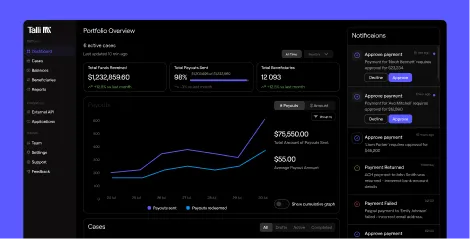
Talli delivers purpose-built disbursement infrastructure for shareholder services teams managing legal settlements, bankruptcy distributions, and dividend-related payouts. The platform addresses the data hygiene problems that drive unclaimed payments through built-in automation, payment choice, and real-time tracking.
Talli’s platform includes automated KYC verification that checks shareholder information against authoritative databases, flagging discrepancies before distribution. OFAC sanctions screening provides automated compliance checks with documented timestamps. Multiple payment methods, including ACH, prepaid Mastercard, PayPal, Venmo, gift cards, wire transfers, and paper checks, maximize redemption by giving shareholders practical choices, maximize redemption by giving shareholders practical choices. Dedicated FBO accounts for each settlement preserve fund segregation while maintaining complete audit trails.
Unlike generic payment processors, Talli provides compliance automation from shareholder validation through final distribution. The platform supports W-9 collection, automated 1099 workflows, backup withholding calculations when required, smart reminders, fraud controls, and dashboard reporting.
The AB Data case study demonstrates the impact: 30% higher claimant redemption rates, 60% reduction in unresolved exceptions and manual reissuance overhead within 12 months, and a 100% fiduciary compliance record across distributions.
As AB Data President and CEO Thomas R. Glenn stated: “We don’t think of digital disbursement as a feature, we think of it as infrastructure. Talli gave us the regulated payout rails we needed to move faster, reduce unclaimed funds, and give courts full confidence in how settlement money is being distributed.”
For settlement administrators and shareholder services teams managing high-volume distributions, Talli helps prevent bad records from becoming unclaimed property. By combining data validation, payment choice, smart reminders, fund segregation, and audit-ready reporting, Talli gives teams the infrastructure to complete distributions faster while reducing the unresolved payment populations that drive escheatment risk.
Frequently Asked Questions
What is shareholder data hygiene and why does it matter?
Shareholder data hygiene is the process of keeping ownership, contact, banking, tax, and identity records accurate and current. It matters because stale records cause returned checks, failed ACH payments, delayed tax documentation, manual exceptions, and eventual escheatment obligations.
How does poor record-keeping lead to escheatment?
Poor records make it harder to reach shareholders and complete payments. Once checks remain uncashed or digital payments go unredeemed, holders must track the funds through dormancy periods, send required due diligence notices, report the property, and remit it to the proper state.
Can shareholders find their own unclaimed property?
Yes. Shareholders can search official state unclaimed property databases, NAUPA-linked search tools, and federal guidance pages. They should check every state where they have lived, held accounts, owned securities, or received prior notices from issuers, brokers, or administrators.
What compliance challenges do companies face with unclaimed shareholder funds?
Companies must manage different state dormancy periods, notice rules, thresholds, reporting formats, deadlines, remittance processes, and audit requirements. The challenge grows when shareholder records are incomplete, inherited, duplicated, outdated, or spread across disconnected systems.
How do digital payment platforms help prevent unclaimed payments?
Digital payment platforms reduce unclaimed payments by validating records earlier, offering multiple payment methods, automating reminders, tracking payment status in real time, and documenting every step for audit purposes. Higher redemption rates mean fewer payments enter long-term dormancy workflows.