.svg)


.svg)
A SOC 2 Type II report provides an independent CPA’s opinion on controls described by a service organization and whether those controls operated effectively during a defined review period. It is valuable evidence for vendor due diligence, but it is not a certification, guarantee against breaches, or substitute for legal, financial, and operational review.
When a disbursement vendor claims “SOC 2 compliance,” claims administrators and settlement trustees need to look beyond the marketing statement. A Type I report examines control design at a specified date, while a Type II report evaluates both design and operating effectiveness over a period.
That distinction matters when the vendor handles claimant personally identifiable information, payment instructions, settlement balances, and digital disbursements. IBM’s 2025 research places the global average cost of a data breach at $4.4 million, reinforcing the need for documented vendor review rather than reliance on general security promises.
Key Takeaways
- SOC 2 is an attestation report, not a certification or universal pass-fail security designation.
- Type I examines controls as of a specified date, while Type II examines their operation over a defined period.
- Type II observation periods commonly range from three to twelve months.
- Security is included in every SOC 2 report, while Availability, Processing Integrity, Confidentiality, and Privacy are selected according to scope.
- SOC 2 does not automatically verify QSF qualification, OFAC compliance, fund segregation, or payment accuracy.
- Specific controls matter only when they appear in the system description and the auditor’s testing.
- Reports do not formally expire, but buyers should investigate gaps after the observation period.
- Exceptions require context. Their severity, cause, frequency, and remediation matter more than their mere existence.
Understanding SOC 2 Type II Reports
SOC 2 is part of the American Institute of Certified Public Accountants’ System and Organization Controls reporting framework. The AICPA SOC framework allows an independent CPA firm to examine controls relevant to one or more Trust Services Criteria.
The resulting document is an attestation report. It is not a certificate issued by a government regulator or standards body, and it does not state that the service organization is completely secure.
A typical Type II report contains:
- Management’s description of the service organization’s system
- Management’s assertion about the description and controls
- The independent auditor’s opinion
- The Trust Services Criteria included in scope
- The controls selected by management
- The auditor’s tests of those controls
- The results of testing
- Any exceptions or deviations identified
- Complementary controls expected from customers or subservice organizations
For a disbursement platform, the system description is especially important. It shows which products, infrastructure, teams, integrations, and processes were covered. A report limited to one API or hosted environment may not cover claimant portals, bank integrations, reporting tools, support workflows, or other systems used during a settlement.
The Five Trust Services Criteria
The SOC 2 framework includes five Trust Services Criteria:
- Security addresses protection against unauthorized access, use, or disclosure.
- Availability addresses whether systems are available for operation and use as committed.
- Processing Integrity addresses whether processing is complete, valid, accurate, timely, and authorized.
- Confidentiality addresses information designated as confidential.
- Privacy addresses the collection, use, retention, disclosure, and disposal of personal information.
Security is included in every SOC 2 examination. The other criteria are included when management determines that they are relevant to the system and commitments being evaluated.
A platform should not be described as having been examined against all five criteria unless the report confirms that scope. Buyers should verify the criteria listed in the auditor’s opinion rather than relying on a website badge.
Why Processing Integrity Matters
Processing Integrity can be particularly relevant to legal distributions because payment workflows depend on complete and authorized data processing. However, the criterion’s presence does not automatically mean the auditor tested settlement calculations, OFAC screening, claimant eligibility, or every payment.
The report must contain controls specifically addressing those processes. A useful review asks whether the scope includes:
- Approval of payment files
- Validation of payment amounts
- Reconciliation of disbursement activity
- Handling of rejected or returned payments
- Prevention of unauthorized changes
- Maintenance of legal audit trails
- Escalation and resolution of processing exceptions
When these controls are present, reviewers can examine the auditor’s tests and results to understand what evidence was inspected.
Type I Versus Type II
A Type I report evaluates whether the organization’s system description is fairly presented and whether the controls were suitably designed as of a specified date.
A Type II report covers those matters and also evaluates whether the controls operated effectively throughout a defined period. Observation periods commonly range from three to twelve months, although the exact duration depends on the engagement.
Type II generally provides stronger evidence for vendor due diligence because it covers ongoing operation. Still, report quality depends on scope, control design, sampling, exceptions, and the auditor’s opinion.
A Type II report does not prove that every control operated perfectly every day. Auditors use evidence and sampling procedures based on the nature and frequency of each control. Buyers should review how controls were tested instead of treating the report’s existence as sufficient assurance.
How to Review a SOC 2 Type II Report
The first step is requesting the full report under the vendor’s required confidentiality process. SOC 2 reports frequently contain sensitive information about systems, controls, vulnerabilities, infrastructure, and subservice organizations, so vendors normally restrict distribution.
Review the Auditor’s Opinion
Determine whether the auditor issued an unmodified opinion or modified the opinion because of a material issue, scope limitation, or other concern.
An unmodified opinion does not mean there were no exceptions. It means the auditor concluded that the report’s subject matter was fairly presented in all material respects under the applicable criteria.
Confirm the Observation Period
Check the start and end dates. A report does not formally expire, but its usefulness decreases as the gap between the observation period and the present grows.
When the period ended several months ago, ask for:
- The expected date of the next report
- Confirmation that another examination is underway
- A bridge letter addressing material changes after the period
- Information about significant incidents or control changes
A bridge letter is a management representation, not additional independent audit work. It can help explain a short coverage gap but should not replace recurring Type II examinations.
Check the System Boundaries
Compare the report’s scope with the services your settlement will use. Relevant components may include:
- Claimant-facing portals
- Administrator dashboards
- Payment orchestration systems
- Identity verification services
- File-transfer tools
- Banking integrations
- Notification systems
- Reporting and reconciliation tools
- Customer support systems
- Cloud and data-storage environments
Excluded systems can create material blind spots. Review carve-outs for subservice organizations and determine which responsibilities belong to the vendor, its providers, and your claims team.
Review Complementary Controls
SOC 2 reports often identify complementary user entity controls. These are controls customers must implement for the vendor’s controls to achieve their objectives.
Examples may include:
- Restricting administrator access
- Reviewing user permissions
- Protecting exported reports
- Approving disbursement files
- Reporting suspected incidents promptly
- Reconciling vendor reports with settlement records
Ignoring these responsibilities can weaken the overall control environment even when the vendor’s controls operate effectively.
Encryption and Access Controls
SOC 2 is principles-based and does not require every organization to use one specific encryption algorithm or key length. A service organization may use controls such as TLS for data in transit and AES encryption for data at rest, but buyers should verify the implementation described in the report.
For claimant information and payment instructions, review controls covering:
- Encryption in transit and at rest
- Encryption-key management
- Role-based access
- Multi-factor authentication
- Privileged account monitoring
- Employee onboarding and termination
- Periodic access reviews
- Logging of administrative actions
- Vulnerability management
- Penetration testing
- Incident response procedures
The presence of a written policy is not enough. A Type II report should show how the auditor tested the control and whether exceptions occurred.
Exceptions Are Not Automatically Failures
A report may identify exceptions when evidence shows that a control did not operate exactly as described for one or more tested items.
An exception should be evaluated according to:
- The control’s purpose
- The number of affected samples
- The population size
- Whether the issue was isolated or recurring
- The sensitivity of the affected system
- Whether unauthorized activity occurred
- The vendor’s corrective action
- Whether the auditor modified the opinion
For example, one delayed access review that was later completed may present a different risk from repeated failures to remove former employees’ access.
Ask the vendor to explain the cause, affected systems, remediation date, and measures taken to prevent recurrence. Unresolved or repeated exceptions involving privileged access, encryption, change management, or incident response deserve heightened review.
What SOC 2 Does Not Establish
A SOC 2 Type II report does not automatically establish compliance with every law or operational requirement affecting legal settlements.
It does not by itself determine compliance with:
- IRC Section 468B
- State money transmitter laws
- OFAC sanctions requirements
- IRS information-reporting rules
- State privacy and breach-notification laws
- Court orders governing a distribution
- Trust-accounting requirements
- Contractual service levels
- PCI DSS requirements
These areas require separate evidence. SOC 2 can contribute useful control information, but it should remain one part of vendor due diligence.
SOC 2 and Qualified Settlement Funds
A Qualified Settlement Fund must satisfy requirements established under Treasury Regulation Section 1.468B-1. These include governmental approval or establishment, qualifying claims, and a trust structure or segregation of assets from the transferor and related persons. The IRS QSF requirements are legal and tax rules, not Trust Services Criteria.
A SOC 2 report may examine controls relevant to fund accounting or system access when those controls are included in scope. It does not determine whether a settlement fund legally qualifies as a QSF.
Claims administrators should separately verify:
- The court order or governmental approval
- Ownership and titling of settlement accounts
- Separation from the transferor’s assets
- Authorized access to funds
- Matter-level accounting
- Reconciliation procedures
- Tax reporting responsibilities
- Controls over payment approval
The report’s Processing Integrity section may support this review, but only if the applicable controls appear in the system description and testing.
Banking Partners and Deposit Insurance
Disbursement platforms may rely on banks for account services, ACH origination, cards, wires, or other payment rails. A bank’s FDIC membership is important, but it does not mean every balance routed through a platform is automatically insured without limit.
Coverage depends on account ownership, account titling, records, aggregation rules, and satisfaction of any applicable pass-through requirements. Administrators should confirm:
- The legal owner of each account
- Whether funds are held directly or through an intermediary
- How beneficial ownership is recorded
- Applicable deposit insurance limits
- How balances are aggregated
- Whether settlement funds exceed insured amounts
- What happens if the bank or technology provider fails
This review should accompany, not be replaced by, the platform’s SOC 2 report.
Evaluating SOC 2 Costs and Security Commitment
SOC 2 Type II examination costs vary widely. Company size, system complexity, auditor, observation period, selected criteria, readiness, and remediation can all affect the total expense.
A high audit bill does not necessarily produce a stronger control environment, and a lower cost does not automatically indicate weak work. Buyers should evaluate:
- The CPA firm’s identity and experience
- The systems included in scope
- The duration of the observation period
- The relevance of the tested controls
- The testing procedures
- The exceptions
- The auditor’s opinion
- The frequency of examinations
A vendor without a current Type II report may still have security controls, but the buyer must perform more direct verification. For high-risk legal disbursements, that can require security questionnaires, policies, penetration-test summaries, incident histories, architecture reviews, and contractual protections.
Why Talli’s Legal Disbursement Focus Matters
Talli is designed for legal settlement, class action, bankruptcy, mass tort, and shareholder-service distributions. Its platform supports multiple payment methods, dedicated settlement accounts, claimant communication, real-time payment tracking, and built-in workflows for KYC, OFAC screening, W-9 collection, fraud mitigation, and audit logging.
That operational focus matters because SOC 2 alone does not make a general payment platform suitable for court-supervised distributions. Administrators still need systems that support fund control, claimant verification, payment choice, failed-payment resolution, reconciliation, and court reporting.
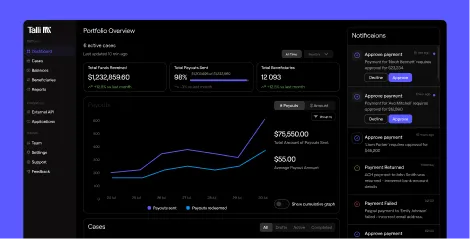
Talli’s class action platform combines payment infrastructure with legal-distribution workflows. Claims teams can upload claimant data, create campaigns, monitor payment status, and maintain a record of distribution activity from one environment.
Its purpose-built capabilities include:
- Dedicated accounts supporting settlement-level fund separation
- ACH, prepaid card, PayPal, Venmo, and gift-card options
- KYC and OFAC screening
- Digital W-9 collection
- Fraud mitigation and exception review
- Automated claimant notifications
- Real-time payment status
- Reconciliation and reporting
- Court-ready records
Banking services are provided through Patriot Bank, N.A., Member FDIC. Administrators should still evaluate the applicable account structure, deposit-insurance treatment, and contractual allocation of responsibilities for each settlement.
A Better Standard for Vendor Selection
SOC 2 Type II is valuable because it replaces broad security assertions with a structured report, an independent opinion, and documented testing. Its value depends on what was examined.
Claims administrators should not stop after confirming that a vendor has a report. They should determine whether the report covers the systems used for claimant information, payment approval, fund tracking, reporting, and incident response.
For legal distributions, the strongest vendor review combines SOC 2 evidence with settlement-specific controls. Talli’s purpose-built approach brings payment choice, compliance workflows, fund-accounting support, claimant communication, and auditable reporting into the same disbursement infrastructure.
That combination helps administrators evaluate security without losing sight of the operational requirements that determine whether settlement funds reach the correct claimants, remain properly tracked, and can be accounted for before the court.
Frequently Asked Questions
What Is the Difference Between SOC 2 Type I and Type II?
Type I evaluates the system description and design of controls as of a specified date. Type II also examines whether those controls operated effectively throughout a defined period. Type II generally provides more useful evidence for ongoing vendor due diligence.
Does SOC 2 Type II Mean a Platform Is Certified?
No. SOC 2 results in an independent attestation report and auditor’s opinion. It does not produce a certification, universal security rating, or guarantee that the organization will never experience a breach.
How Long Should a Type II Observation Period Be?
Observation periods commonly range from three to twelve months. A longer period may provide more operational history, but buyers should also consider scope, testing, exceptions, and whether the period reflects the vendor’s current systems.
Does SOC 2 Verify QSF or OFAC Compliance?
Not automatically. A report may contain controls relevant to fund accounting, sanctions screening, or system access, but those processes must be included in scope. QSF qualification and OFAC compliance require separate legal and operational review.
What Should Administrators Request Besides the Report?
Administrators should request the current report, bridge letter when appropriate, penetration-test information, incident history, account-structure documentation, banking details, insurance information, service-level commitments, and evidence addressing settlement-specific payment and reporting controls.