.svg)


.svg)
Special dividend distributions require tighter controls than ordinary quarterly dividends because a one-time payout can materially affect share price, shareholder expectations, tax reporting, and downstream reconciliation. When a distribution equals or exceeds 25% of a security’s value, FINRA rules can move the ex-dividend date to the first business day after the payable date, creating due bill obligations that must be tracked correctly. Paper-heavy processes also add fraud and delivery risk, with checks remaining the payment method most exposed to fraud, as 63% of organizations reported attempted or actual check fraud in 2024. Modern shareholder services platforms reduce these risks by automating eligibility validation, payment execution, tax workflows, reminders, and audit trails from one controlled distribution workflow.
Key Takeaways
- Special dividends equal to or greater than 25% of stock price can trigger deferred ex-dividend date rules and due bill tracking.
- Manual distribution processes can create calculation, tax, and reconciliation errors that are expensive to correct.
- Digital disbursement can reduce paper-check costs from $7-$20 per check to $0.25-$5 for many digital payment methods.
- Pro-rata calculations should use system-controlled decimal precision, documented rounding rules, and reconciliation reporting.
- Paper-heavy distributions can leave 20-30% of checks unclaimed, while digital-first workflows improve redemption through payment choice and reminders.
- Automated platforms can reduce administrative time by replacing spreadsheets, manual reissuance, and disconnected reporting with real-time tracking.
Understanding Special Dividend Distribution Requirements
Special dividends differ from regular quarterly dividends in size, timing, and operational complexity. Companies typically issue them after excess cash events such as asset sales, unusually strong earnings periods, litigation recoveries, or restructuring transactions. The larger the distribution, the more important it becomes to coordinate the board resolution, shareholder record date, tax treatment, payment method, and post-payment reconciliation.
Critical factors that set special dividends apart include:
- Variable distribution amounts that may represent a meaningful percentage of share value
- Modified ex-dividend date treatment for large distributions
- Due bill obligations when the ex-date falls after the record date
- Potential adjustment requirements for listed options and company equity awards
- Tax reporting differences between ordinary dividends, capital gain distributions, and return of capital
- Compressed execution windows that leave little room for manual correction
The ex-dividend date rules are the most common source of confusion. For ordinary dividends, the ex-date generally determines when shares begin trading without dividend entitlement. For cash dividends or distributions equal to or greater than 25% of the security’s value, the ex-date can be deferred until the first business day after the payable date. That timing creates due bills, meaning buyers and sellers may have obligations to pass dividend value through after a trade. Any special dividend workflow should start by confirming whether ordinary or deferred ex-date rules apply.
Pro-Rata Calculation Requirements for Accurate Payouts
Pro-rata calculations form the foundation of an accurate special dividend. The basic formula is simple: eligible shares multiplied by the declared dividend amount per share. The operational risk comes from the inputs, including record-date balances, fractional positions, withheld amounts, address changes, and payment exceptions.
A controlled calculation workflow should include:
- Record-date validation: Match the shareholder list to the transfer agent’s official register.
- System precision: Use platform-controlled decimal handling for fractional shares and large shareholder populations.
- Rounding rules: Apply one documented methodology across all eligible holders.
- Exception reporting: Flag missing tax forms, invalid addresses, deceased holders, blocked payments, and disputed records.
- Reconciliation checks: Compare authorized distribution totals, calculated entitlements, funded amounts, and paid amounts.
A one-cent rounding difference across 200,000 shareholders creates a $2,000 variance. That may sound immaterial in isolation, but it can create audit questions when the distribution ledger, bank funding total, and shareholder-level payment file do not tie out. A strong settlement reconciliation process prevents those variances from becoming post-payment disputes.
Stock Option and Equity Award Adjustments
Special dividends may require adjustments for listed options and company equity awards depending on OCC rules, the company’s equity plan, and board-approved treatment. The goal is generally to preserve economic equivalence so that option holders or award recipients are not unfairly harmed or enriched by the distribution.
For listed options, the OCC adjustment policy distinguishes between ordinary cash dividends and non-ordinary distributions. Non-ordinary dividends may lead to adjustments in exercise price, deliverable, or other contract terms. For employee stock options, RSUs, and other equity awards, the governing plan documents usually determine whether the board or compensation committee must approve adjustments.
Implementation requirements can include:
- Board or committee approval of the adjustment methodology
- Review of equity plan anti-dilution provisions
- Coordination with external option and equity administrators
- Updates to exercise prices, share counts, or award records where required
- Clear participant communication before or shortly after payment
The article should avoid saying every special dividend automatically requires a specific adjustment. The safer and more accurate statement is that equity awards must be reviewed under the applicable plan, and listed options must be reviewed under OCC adjustment rules.
Payment Method Options for Special Dividend Distribution
ACH and Wire Transfers
ACH and wires remain important payment rails for banked shareholders, institutions, and high-value distributions.
ACH Direct Deposit: ACH is typically the lowest-cost electronic option, often around $0.25-$0.50 per transaction. It supports batch processing, reduces manual check handling, and provides predictable delivery for shareholders with verified bank details.
Wire Transfers: Wires provide same-day settlement for high-value or time-sensitive payments, usually at a higher cost of $10-$30 per transaction. They are useful for institutional holders, international accounts, and distributions requiring immediate funds availability.
Paper Checks: Checks remain a fallback for shareholders who cannot or will not choose electronic payment. However, checks carry higher all-in costs because printing, postage, returned mail, stale-dating, fraud review, stop-payments, and reissuance all add administrative burden.
Digital and Alternative Payment Channels
Modern digital disbursement methods expand access beyond traditional bank accounts and paper checks. For shareholder services teams managing dormant records, returned mail, and unbanked recipients, this flexibility matters.
Digital and alternative options can include:
- Prepaid cards: Useful for shareholders without bank accounts, especially when virtual delivery is available.
- Digital wallets: PayPal and Venmo can improve convenience for recipients already using those platforms.
- Gift cards: Useful for small-value distributions where a traditional check is more expensive than the payment itself.
- Multi-currency payments: Helpful for international shareholder populations when the distribution workflow supports cross-border requirements.
Talli’s platform supports ACH, prepaid Mastercard via Patriot Bank N.A., PayPal, Venmo, Amazon gift cards, and checks as fallback options. This multi-channel approach helps shareholder services teams reduce the check-issued population while preserving recipient choice.
Setting Up Your Distribution Infrastructure
Record Date and Shareholder Snapshot Configuration
The shareholder snapshot must align with the official record date, the transfer agent’s register, and any deferred ex-date or due bill instructions for large distributions. A generic “two business days before the ex-date” rule is not accurate enough because U.S. settlement timing moved to T+1, and large distributions can follow special timing rules.
Essential configuration elements include:
- Official record source: Use the transfer agent register or approved shareholder file as the control source.
- Eligibility validation: Match holders against the board-approved distribution plan.
- Due bill handling: Track trades that require dividend value to pass from seller to buyer.
- Exception queues: Flag missing tax documents, sanctions hits, bad addresses, and ownership disputes.
- Audit timestamps: Preserve the date and source of every file, approval, and calculation run.
A real-time tracking workflow gives administrators visibility before funds move. That matters because errors are much cheaper to correct before payment execution than after funds have already been sent.
Compliance and Tax Integration
Special dividends can create tax reporting complexity. The issuer or paying agent must determine whether the distribution is an ordinary dividend, qualified dividend, capital gain distribution, or nondividend distribution such as return of capital. Form 1099-DIV reporting depends on that classification.
Required compliance integrations include:
- W-9 and W-8 collection: Gather tax documentation before payment whenever possible.
- Backup withholding: Apply 24% backup withholding when required for missing or incorrect taxpayer identification information.
- 1099-DIV support: Prepare distribution data for tax reporting and e-filing.
- OFAC screening: Verify recipients against sanctions lists with documented timestamps.
- KYC controls: Confirm identity when required by the distribution structure and risk profile.
Strong tax compliance automation prevents the common problem of treating tax documentation as an afterthought. If tax status is unknown at the time of payment, the administrator may need to withhold, delay payment, or route the record for manual review.
Preventing Common Distribution Errors
Calculation and Processing Failures
Most special dividend errors fall into a few operational categories.
Error 1: Fractional Share Rounding Small rounding differences compound at scale. Use controlled decimal handling, a documented rounding policy, and reconciliation reporting rather than spreadsheet formulas copied across thousands of rows.
Error 2: Ex-Dividend Date Confusion Large distributions can follow deferred ex-date rules. When the dividend equals or exceeds 25% of stock price, the ex-date may move to after the payable date, creating due bill obligations. Shareholder communications should explain the timeline clearly.
Error 3: Equity Award Oversight Special dividends can affect listed options, employee options, RSUs, and other awards. Review the OCC rules, equity plan documents, and board approvals before payment.
Error 4: Tax Withholding Mistakes Missing tax documentation can trigger backup withholding. Automated workflows should apply the correct tax status, withholding rate, and reporting category before funds are released.
Error 5: Unclaimed Fund Mismanagement Paper-heavy distributions can leave 20-30% of checks unclaimed. Automated reminders, digital payment choice, and exception tracking reduce stale checks, reissuance work, and eventual escheatment exposure.
Fraud Prevention Measures
Paper checks create exposure to interception, washing, forgery, and returned-mail abuse. Digital workflows reduce those risks by verifying the recipient before payment and creating a complete activity trail.
Fraud prevention controls should include:
- Multi-factor authentication before payment selection
- Device fingerprinting to detect suspicious access patterns
- Behavioral analytics to identify unusual claim activity
- Payment change controls for bank account updates
- Real-time monitoring before funds leave the account
A modern fraud detection system should integrate with payment execution, not sit outside the workflow. Blocking a suspicious transaction before disbursement is more effective than trying to recover funds after payment.
Documentation and Audit Trail Requirements
Special dividend distributions require documentation that supports every major decision, calculation, and payment action. This includes corporate authorization, shareholder eligibility, payment execution, exception handling, and final reconciliation.
Essential documentation includes:
- Board resolutions authorizing the special dividend amount and timing
- Record-date shareholder files and transfer agent confirmations
- Calculation methodology and rounding rules
- Due bill instructions and exception records
- Tax documentation and withholding records
- Payment confirmations for every disbursement
- Reconciliation reports comparing planned, funded, paid, failed, and outstanding amounts
Complete audit trails help administrators respond to shareholder disputes, board questions, auditor requests, and regulatory reviews. The best workflows generate these records automatically instead of requiring a post-distribution scramble.
Automating Special Dividend Distributions
Platform Selection Criteria
Special dividend workflows need more than basic payment processing. The platform must support compliance, calculation, payment choice, reconciliation, and reporting at scale.
Evaluate platforms based on:
- Compliance automation: Built-in tax documentation, withholding workflows, OFAC screening, and audit logs.
- Multi-channel payments: ACH, wire, prepaid card, digital wallet, gift card, and check fallback options.
- Scale handling: Support for thousands to hundreds of thousands of shareholders.
- Integration capabilities: Connections to transfer agent systems, shareholder databases, and CRM tools.
- Security controls: Role-based access, payment change approvals, and documented activity logs.
- Reporting depth: Board-ready and auditor-ready reconciliation outputs.
A useful vendor evaluation should also test exception handling. Failed payments, missing tax forms, duplicate records, deceased shareholders, and sanctions review queues are where generic payment tools often fall short.
Implementation Timeline
Standard deployment depends on distribution complexity, but most projects follow predictable phases:
- Architecture design: Define payment methods, data sources, tax workflows, and approval controls.
- Data integration: Connect shareholder files, transfer agent records, and payment preference tools.
- Compliance setup: Configure W-9/W-8 intake, OFAC screening, withholding, and reporting.
- Testing: Run shadow calculations and dry-run payment files before release.
- Deployment: Launch the distribution, monitor exceptions, and reconcile results in real time.
Basic modules can launch faster when the shareholder population is clean and the payment method set is limited. Complex enterprise distributions require more testing because due bills, equity award adjustments, tax classification, and cross-border records increase operational risk.
Why Talli Streamlines Special Dividend Distributions
Talli is purpose-built for compliance-critical distributions where administrators need speed, payment choice, and audit-ready control. For shareholder services teams, the problem is rarely just sending money. The harder challenge is verifying who should be paid, collecting required tax documentation, reducing the check-issued population, tracking exceptions, and proving every dollar moved correctly.
Talli supports special dividend operations through:
- Automated pro-rata workflows: Controlled calculations, eligibility validation, and reconciliation reporting reduce spreadsheet risk.
- Multi-channel payment execution: ACH, prepaid Mastercard via Patriot Bank N.A., PayPal, Venmo, Amazon gift cards, and checks as fallback.
- Integrated compliance controls: KYC, OFAC, W-9 collection, fraud mitigation, and audit logging are built into the workflow.
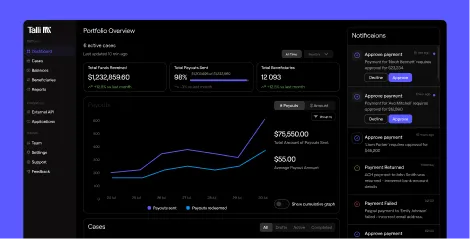
- Real-time dashboards: Administrators can track payment status, completion rates, exception queues, and remaining balances from one dashboard.
- Court-ready and auditor-ready reporting: Distribution records are preserved for stakeholder review without manual reconstruction.
Unlike generic payment processors, Talli focuses on regulated legal and shareholder distributions where compliance, fund control, and recipient experience all matter. For high-stakes special dividends, that infrastructure helps teams reduce unclaimed funds, improve redemption rates, and complete the distribution without losing control of the audit trail.
Frequently Asked Questions
How do ex-dividend date rules differ for special dividends?
Ordinary dividends usually follow standard ex-date timing, but cash dividends or distributions equal to or greater than 25% of the security’s value can use a deferred ex-dividend date. In that case, the ex-date may fall on the first business day after the payable date, creating due bill obligations between buyers and sellers.
What precision level is required for pro-rata dividend calculations?
There is no universal rule requiring exactly 8-10 decimal places. The important requirement is controlled system precision, documented rounding rules, shareholder-level calculation logs, and reconciliation reporting that ties the approved distribution amount to funded and paid totals.
How should special dividends affect stock options and RSUs?
Special dividends may require adjustments depending on OCC rules for listed options and the company’s equity plan for employee awards. Administrators should review plan documents, board approvals, and option adjustment guidance before payment.
What percentage of dividend distributions typically go unclaimed?
Paper-heavy distributions can leave 20-30% of checks unclaimed. Digital payment choice, automated reminders, and real-time exception tracking can reduce stale checks and improve redemption compared with traditional check-only workflows.
How much do automated platforms reduce distribution costs?
Digital disbursement can reduce payment costs from $7-$20 per paper check to $0.25-$5 for many digital payment methods. Savings increase when the platform also reduces reissuance, returned mail, manual reconciliation, and unclaimed property follow-up.