.svg)


.svg)
Consumer digital wallets like Venmo promise fast, familiar payments, but direct use of consumer wallet accounts for class action settlement distributions creates serious compliance gaps. Qualified Settlement Funds, or QSFs, operate under strict IRC Section 468B requirements that demand court or governmental approval, proper fund purpose, segregated assets, administrator control, and court-ready documentation. Venmo is useful for consumer transfers, but its direct consumer-account model was not built to preserve settlement-specific fund control through the full disbursement lifecycle.
That does not mean claimants can never receive funds through Venmo. The distinction is infrastructure. A direct Venmo-to-claimant distribution leaves administrators without the segregation, controls, and reporting courts expect. A purpose-built settlement platform can offer Venmo and other digital options while keeping funds in compliant settlement accounts until final transfer. This gives claimants the convenience they want while preserving the oversight class counsel, trustees, and courts require.
Key Takeaways
- Direct Venmo transfers do not provide the settlement-specific fund segregation, administrator control, and court-ready documentation required for QSF administration.
- Venmo account holders control their consumer balances after receipt, limiting the trustee’s ability to freeze, redirect, or recover funds after transfer.
- Venmo may place holds, limitations, or account restrictions for risk or compliance reasons, and settlement administrators cannot override those restrictions.
- Consumer transaction histories are not the same as administrator-level audit trails tied to claimant IDs, court orders, tax records, and reconciliation reports.
- ACH can cost about $0.25 to $0.50 per transaction, while paper checks can cost an estimated $7 to $20 when printing, postage, reconciliation, and reissuance are included.
- Purpose-built platforms can compress distribution timelines from 6 to 8 weeks to as little as 24 to 48 hours while maintaining compliance controls.
Understanding The Qualified Settlement Fund Framework
A Qualified Settlement Fund exists to resolve or satisfy claims arising from a legal dispute while giving defendants a defined tax and liability structure. Under Treasury Regulation 1.468B-1, a QSF must satisfy three core requirements:
- It must be established by, or approved by, a court or other governmental authority and remain subject to that authority’s continuing jurisdiction.
- It must be established to resolve or satisfy claims arising from a tort, contract dispute, violation of law, or similar qualifying event.
- It must be a trust under applicable state law, or its assets must be segregated from the transferor and related persons.
The segregation requirement is central to the payout method question. Settlement assets must remain identifiable and separate from non-settlement assets while the administrator performs court-approved distribution duties. This is more than an accounting preference. It is part of the legal and tax structure that supports QSF treatment.
A direct consumer wallet transfer does not provide the same settlement-specific account structure, trustee oversight, or documentary record that courts expect from a QSF distribution. Once money lands in an individual consumer wallet account, the administrator’s practical control over those funds is sharply reduced.
Why Fund Segregation Matters
Defendants use QSFs because they separate settlement assets from ongoing operations and create a controlled vehicle for resolving claims. If the fund structure cannot show segregation, court approval, and proper administration, the distribution plan may face added scrutiny.
Class counsel and settlement administrators need the ability to show where the funds were held, when each transfer occurred, who approved it, which claimant received it, and how the payment ties back to the court-approved allocation. They also need a clear record of failed payments, returned funds, reissuance decisions, tax reporting, sanctions screening, and final reconciliation.
This is where consumer wallets create the compliance gap. Venmo user terms are written for individual users and PayPal, Inc., not for court-supervised settlement funds. Venmo may place holds, limitations, or account restrictions based on risk, fraud, or compliance concerns. It may also hold money for up to 180 days in certain circumstances. Those platform rights may be appropriate for consumer risk management, but they do not give a QSF administrator the fiduciary control needed for settlement fund oversight.
Why Digital Wallets Appeal To Settlement Administrators
The interest in Venmo and similar payment apps comes from a real operational problem. Paper check distributions are slow, costly, and difficult to track. Claimants may move, ignore mailed envelopes, misplace checks, or fail to cash small-dollar awards. Every uncashed check creates more follow-up, reconciliation work, and potential escheatment exposure.
Traditional distributions often involve:
- Lower Redemption: Paper checks commonly produce redemption rates around 70% to 80%, leaving a meaningful share of funds unclaimed.
- Longer Timelines: Paper-based distributions can take 6 to 8 weeks from approval to claimant receipt.
- Higher Costs: Check printing, postage, bank fees, stale-date handling, reconciliation, and reissuance can push all-in costs to an estimated $7 to $20 per payment.
- Manual Tracking: Uncashed checks require outreach, exception handling, and dormancy monitoring.
Claimants increasingly expect digital options, especially for small and mid-size payments. ACH, prepaid cards, PayPal, Venmo, and gift cards can all improve claimant experience when offered through the right infrastructure. The problem is not digital delivery itself. The problem is using consumer accounts as the settlement control layer.
The Three Fatal Compliance Gaps In Direct Venmo Distributions
Gap 1: Fund Segregation And Documentation
Venmo balances sit inside a consumer wallet framework rather than a settlement-specific QSF account controlled by the trustee or administrator. A direct transfer to an individual claimant’s Venmo account may complete a payment, but it does not preserve settlement-level control after receipt.
QSF administration requires a documented fund path from the segregated account through final distribution. Courts and fiduciaries need proof that settlement assets were held separately, distributed only to approved claimants, and reconciled against the court-approved plan. A consumer wallet transaction record does not replace that structure.
This is not a setup issue that can be solved by adding labels or notes to payments. The architecture of direct consumer wallet use does not provide the account segregation and administrator reporting needed for court-supervised fund administration.
Gap 2: Loss Of Fiduciary Control
QSF trustees and administrators are responsible for protecting settlement funds until they are properly distributed. That includes the ability to stop suspicious activity, manage failed payments, correct misdirected transfers, and document any reissue or recovery effort.
Direct Venmo transfers limit those controls. Once funds arrive in the claimant’s wallet, the claimant controls the account relationship. If the account is restricted, flagged, closed, or subject to a hold, the settlement administrator cannot simply override the platform decision.
Venmo’s user terms allow holds and limitations under certain circumstances. That risk matters in settlement administration because the administrator must still account for the funds, report distribution status, and respond to claimant issues. A claimant’s direct dispute with a consumer platform can become a court-reporting and reconciliation problem for the administrator.
Gap 3: Inadequate Audit Trail
Court-supervised distributions require more than proof that money moved. They require records that connect each payment to the claimant, approved award amount, court order, payment method, tax documentation, sanctions screening, delivery status, and reconciliation outcome.
Venmo provides consumer-level transaction history. It does not provide the same administrator dashboard, court-ready reporting, tax workflow, or exception-management record a QSF distribution needs. Reconstructing an audit trail from consumer logs creates gaps, especially when thousands or hundreds of thousands of claimants are involved.
A proper audit trail should show the full payout journey, not just a final consumer transfer.
What Courts Expect From A Distribution Plan
Courts reviewing settlement distribution plans focus on whether the administrator can protect the fund, reach claimants, and prove what happened. A compliant digital plan should show:
- Proof Of Segregation: Bank or trust records demonstrating settlement-specific accounts and separation from other assets.
- Administrator Control: Evidence that the trustee or administrator can pause, redirect, reissue, or investigate payments when needed.
- Transaction-Level Reporting: Records that connect each payment to claimant data, award calculations, court-approved amounts, and status updates.
- Regulatory Documentation: KYC, OFAC screening, fraud checks, tax form collection, and backup withholding workflows where applicable.
- Escheatment Tracking: Systems that identify unclaimed funds, track dormancy by jurisdiction, and support required reporting.
Direct consumer wallet use is weakest where courts need the strongest record: fund control, audit documentation, and exception handling.
Comparing Compliant Digital Alternatives
Digital payments can be QSF-compatible when the compliance infrastructure surrounds the payment rail. The payment method alone does not make a distribution compliant. The account structure, controls, reporting, and reconciliation process determine whether the method works for a court-supervised fund.
ACH is often the best fit for banked claimants because it is low cost, familiar, and easy to reconcile through a regulated banking relationship. Prepaid cards are important for claimants without bank accounts. The FDIC reported that 4.2% of U.S. households, or about 5.6 million households, were unbanked in 2023. A prepaid card option helps avoid excluding those claimants from digital distribution.
Digital wallets can also be offered, but only when the settlement platform maintains fund segregation, administrator controls, and reporting until the final claimant transfer.
The Three-Layer Compliance Test
Before proposing any QSF payout method, class counsel should test it across three layers.
Layer 1: QSF Structure
The method must preserve the QSF’s segregated account structure. Funds should remain in a settlement-specific account until the approved payment is executed. The administrator should retain visibility and control before release.
ACH, prepaid cards, and platform-enabled wallets can meet this standard when processed through a purpose-built settlement platform. Direct consumer wallet transfers generally do not.
Layer 2: Payment Rail Rules
Each payment method has its own regulatory framework. ACH payments follow Nacha rules. Prepaid cards are subject to Regulation E and prepaid account requirements. Digital wallets operate under consumer platform terms and money transmission rules.
The administrator does not need every claimant to use the same method, but every method must fit into one controlled compliance workflow.
Layer 3: Court Reporting
The platform must generate transaction-level records, failed-payment reports, claimant outreach history, tax form status, sanctions screening logs, and final accounting. Without that reporting layer, even a fast payment method can create compliance risk.
Consumer wallets fail because they prioritize user convenience over fiduciary-grade reporting. Settlement platforms solve this by keeping the wallet as a delivery option, not the control system.
Building A Compliant Digital Distribution Strategy
A strong settlement distribution plan should give claimants choice without sacrificing oversight. That usually means offering multiple methods through one controlled platform:
- ACH Direct Deposit for banked claimants who want low-cost, direct bank payments. ACH works well for larger awards and recurring settlement workflows.
- Prepaid Mastercard for claimants without bank accounts or those who prefer card access. Virtual cards can be delivered quickly, while physical cards remain available for claimants who need them.
- Digital Wallets Through Compliant Infrastructure for claimants who prefer PayPal or Venmo. The important point is that funds stay in QSF-compliant accounts until the final approved transfer, with administrator reporting preserved.
- Paper Checks as a fallback for claimants who cannot or do not want to use digital methods. Checks are slower and more expensive, but they help ensure no eligible claimant is excluded.
This structure supports higher redemption while maintaining the controls needed for class action, mass tort, and bankruptcy distributions.
Compliance Infrastructure Beyond Payment Rails
QSF distributions require more than sending money. They require verification, documentation, and ongoing monitoring.
KYC verification helps confirm that funds reach legitimate claimants. OFAC screening documents sanctions compliance before payment. Digital W-9 workflows help collect taxpayer information and reduce missing TIN issues. Automated 1099 generation supports year-end reporting. Fraud detection helps administrators identify suspicious patterns before funds leave the settlement account.
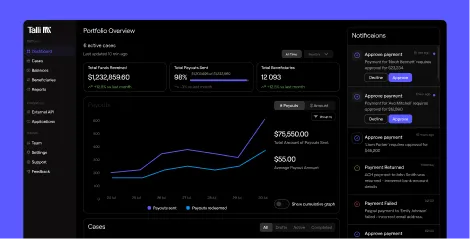
Real-time dashboards add another layer of control. Administrators can monitor completion rates, payment method selection, failed transfers, fraud flags, remaining balances, and exception queues from one place. This visibility is essential for court reporting and final reconciliation.
A consumer wallet can move money quickly. It cannot manage the full legal disbursement lifecycle by itself.
Why Talli Delivers QSF-Compliant Digital Distributions
Talli gives claimants the digital convenience they expect while preserving the fiduciary framework settlement distributions require. The platform supports ACH, prepaid Mastercard, PayPal, Venmo, gift cards, and paper checks through controlled payout workflows built for legal administration.
Talli’s dedicated FBO account structures help preserve QSF ownership and prevent commingling. Administrators maintain visibility into fund movement, claimant status, failed payments, and exception handling. Built-in KYC, OFAC screening, W-9 collection, fraud mitigation, and audit logs reduce the manual work that typically slows distribution.
Unlike direct consumer wallet use, Talli treats Venmo as a claimant delivery option, not the settlement control layer. Funds remain in compliant settlement infrastructure until the approved final transfer. That distinction allows class counsel to offer claimant-friendly digital options while maintaining the audit trail courts expect.
Talli also supports real-time tracking, automated reminders, and multi-channel payouts that improve redemption without forcing administrators to manage separate systems. Banking services provided by Patriot Bank, N.A., Member FDIC support regulated payout rails for settlement disbursements.
Talli Conclusion
Venmo is not the problem. Direct, uncontrolled use of consumer wallet accounts is the problem. Class counsel should not propose Venmo as a standalone QSF distribution mechanism because it lacks settlement-specific segregation, fiduciary controls, and court-ready reporting.
A compliant strategy keeps the QSF infrastructure in control while giving claimants flexible payment choices. Talli does exactly that: segregated funds, administrator visibility, compliance automation, and claimant-friendly options in one platform. For class counsel, that means faster distributions, higher redemption, fewer unresolved exceptions, and stronger confidence when reporting back to the court.
Frequently Asked Questions
Is Venmo QSF-Compliant For Settlements?
Direct Venmo transfers are not a good QSF distribution mechanism because they do not provide settlement-specific segregation, administrator control, or court-ready audit trails. Venmo can be offered only when wrapped inside compliant settlement infrastructure.
Can Claimants Receive Settlement Funds Through Venmo?
Yes. Claimants can receive funds through Venmo when a purpose-built platform maintains QSF-compliant accounts, controls, and reporting until the final approved transfer. The platform, not Venmo, provides the compliance framework.
What Is The Safest Digital Alternative To Direct Venmo?
ACH is often the lowest-cost option for banked claimants, while prepaid cards help reach unbanked claimants. Platform-enabled wallets can also work when settlement funds remain controlled until final delivery.
What Documentation Should Class Counsel Require?
Class counsel should require segregated account records, claimant-level payment logs, KYC and OFAC documentation, W-9 and 1099 workflows, failed-payment reports, and final reconciliation tied to the court-approved distribution plan.
Why Use Talli Instead Of Direct Wallet Payments?
Talli offers Venmo and other digital options inside a settlement-grade framework. Administrators keep fund segregation, oversight, audit trails, compliance automation, and real-time reporting while claimants still receive fast, flexible payment choices