.svg)


.svg)
Insurance fraud costs U.S. consumers an estimated $308.6 billion annually, yet most organizations still concentrate their identity verification efforts at customer onboarding, leaving critical fraud windows open. A key insight for claims administrators, TPAs, and settlement fiduciaries is that identity risk does not end at onboarding. Claims submission, beneficiary changes, payout instructions, and payment release all create additional opportunities for fraud. For organizations managing high-volume disbursements, platforms with integrated KYC and fraud controls offer a path to stopping fraudulent claims without creating friction for legitimate claimants.
Key Takeaways
- Fraud risk continues after onboarding: beneficiary changes, claims submission, payout instructions, and payment release can all create additional identity and account-takeover risk
- Digital disbursement can improve payment completion: class action settlement data shows substantially higher redemption with digital payment options than with traditional check-only distributions, although results vary by claim type and recipient population
- Multi-layered verification works with minimal data: AI-driven systems achieve 92% identity match rates using only phone number and partial SSN
- Regulatory enforcement is intensifying: U.S. regulators issued more than $4.3 billion in financial penalties in 2024 across AML, KYC, transaction-monitoring, sanctions, and other compliance failures
- Risk-based verification prevents fraud without universal friction: applying stronger controls only when risk signals warrant maintains speed for legitimate claims while blocking fraud attempts
- Biometric verification requires careful governance: effective deployment means using biometrics for high-risk events only, capturing explicit consent, and providing non-biometric fallback paths
Understanding the Escalating Threat of Insurance Fraud in Payouts
The scale of insurance fraud demands attention. Beyond the estimated $308.6 billion annual cost of insurance fraud to U.S. consumers, reported consumer fraud losses reached $12.7 billion in 2024, a 25% increase in one year, underscoring the broader growth in fraud risk across financial transactions.
The fraud landscape spans multiple categories:
- Identity theft where criminals assume another person's identity to file claims
- False claims involving fabricated or exaggerated losses
- Ghost broking through fake insurance policies sold to unsuspecting consumers
- Payout diversion where legitimate claimants' funds are redirected through account takeover
For claims administrators and TPAs, the vulnerability concentrates at four critical touchpoints:
- Onboarding (where controls are typically strongest)
- Policy changes (where fraudsters set up future diversion)
- Claims submission (where money is formally requested)
- Payouts and beneficiary updates (where loss becomes final)
Once a customer passes initial onboarding, subsequent interactions receive lighter verification scrutiny. This creates the precise window fraudsters exploit, and why identity verification specifically at the payout stage matters as much as verification during account creation.
The regulatory response matches the threat's severity. U.S. regulators issued more than $4.3 billion in financial penalties in 2024 across AML, KYC, transaction-monitoring, sanctions, and other compliance failures. TD Bank's 2024 resolutions totaled roughly $3 billion across multiple U.S. authorities, while transaction-monitoring penalties exceeded $3.3 billion and doubled year over year.
Why Robust Identity Verification is Crucial for Secure Payouts
Identity verification at the payout stage serves multiple functions beyond fraud prevention. It protects claimants from account takeover, ensures funds reach rightful recipients, maintains regulatory compliance, and perhaps counterintuitively, actually improves the claimant experience.
Talli cites class action settlement distributions where traditional check-based methods produce redemption rates around 30% and digital approaches can materially improve redemption. These figures are specific to settlement distributions and should not be treated as universal insurance-claim benchmarks. The majority of entitled recipients in check-only programs never collect their funds, creating unclaimed property liability, administrative overhead, and potential judicial scrutiny. Digital disbursement platforms with integrated identity verification can substantially improve these results.
This improvement stems from three factors:
- Multiple familiar payment channels (ACH, prepaid cards, digital wallets) that claimants recognize and trust
- Identity verification signals that build confidence the payment is legitimate, not a phishing attempt
- Real-time status tracking that eliminates uncertainty about whether funds are coming
The verification step serves as a trust signal. Claimants increasingly expect and trust digital verification as a sign of legitimacy. When a settlement administrator verifies identity before releasing funds, it demonstrates the organization takes security seriously, distinguishing legitimate payouts from the fraud attempts claimants are trained to avoid.
For fiduciaries managing settlement funds, verification also satisfies the duty of care. Platforms purpose-built for claims administration workflows integrate verification directly into the disbursement workflow rather than treating it as a separate gate, creating audit trails that demonstrate proper identity confirmation occurred before funds were released.
Implementing Effective Fraud Prevention Strategies in Claims Processing
Effective fraud prevention applies verification proportionally rather than uniformly. The goal is maximum friction for fraudulent transactions, minimal friction for legitimate ones.
Risk-Based Verification Triggers
Leading implementations apply step-up verification at specific high-risk moments rather than every interaction:
- Payout instruction changes: when claimants modify bank accounts, request different payment methods, or update addresses
- Beneficiary updates: particularly for life insurance and estate-related claims
- High-value claims: where the potential loss from fraud justifies additional scrutiny
- Anomalous patterns: detected through behavioral analytics or device intelligence
Multi-Layered Authentication Methods
Federal Reserve guidance emphasizes that identity verification has evolved from relying on in-person physical identities to digital onboarding. Multi-factor authentication using multiple verification methods reduces the risk of unauthorized access:
- Document authentication with government ID photos verified against authoritative databases
- Biometric matching comparing selfies to ID photos with liveness detection
- Device intelligence analyzing phone risk scores, SIM swap detection, and behavioral patterns
- Data verification cross-referencing provided information against identity databases
AI-Powered Pattern Recognition
Modern fraud detection leverages machine learning to identify suspicious patterns humans might miss:
- Device fingerprinting across multiple claims
- Behavioral analytics detecting unusual navigation or response patterns
- Identity graph data connecting related fraud attempts
- Real-time risk scoring that adapts to emerging fraud tactics
A case study with a top national insurer demonstrated that AI-driven verification successfully matched 92% of identities using only phone numbers and partial SSN, far less personal information than traditional methods require. The system auto-completed 70%+ of profiles while detecting 3x higher fraud risk in unmatched records, resulting in 10%+ increase in auto-approvals and projected $1M+ annual savings from reduced manual reviews.
Talli supports AI-powered fraud detection using identity signals, device data, and behavioral patterns to help flag suspicious claims. Separately, Digital Disbursements reported that more than 80 million settlement claims submitted in 2023 showed significant indicia of fraud, highlighting the scale of fraud risk facing high-volume distributions.
Streamlining the Insurance Claims Process with Digital Identity Verification
The insurance claims process traditionally involves multiple manual handoffs, paper documentation, and weeks of waiting. Digital identity verification, properly implemented, compresses this timeline while improving accuracy.
Pre-Claim Eligibility Verification
For healthcare and workers' compensation claims, verification before service prevents downstream denials:
- Confirm policy is active and coverage applies
- Verify copay, deductible, and authorization requirements
- Update patient records with current coverage details
- Flag issues before claims are submitted rather than weeks later
This proactive approach prevents eligibility denials, one of the most common reasons for claim rejection.
Automated Claims Validation
Digital platforms handle batch uploads of claimant data with automated validation against court-approved distribution plans or policy terms:
- Eliminate manual data entry errors
- Cross-reference against known fraud indicators
- Apply business rules consistently across thousands of claims
- Flag exceptions for human review rather than rejecting automatically
Real-Time Payment Tracking
Once claims are approved, digital disbursement provides visibility that paper checks cannot match:
- Live status updates for claimants, adjusters, and administrators
- Automated notifications at key milestones
- Complete audit trails linking verification events to payment releases
- Exception management with clear escalation paths
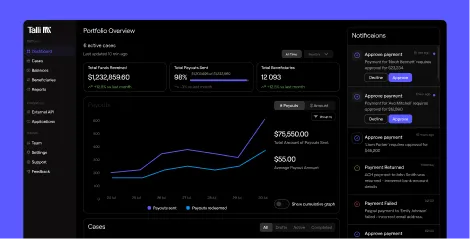
For insurance carriers and TPAs, Talli's platform provides custom multi-party approval workflows connecting carriers, providers, vendors, and claimants, ensuring every payment is properly authorized, tracked, and reconciled across the entire payment lifecycle.
Choosing the Best Identity Verification Software for Claims Payouts
Selecting identity verification technology requires evaluating several dimensions beyond basic accuracy rates.
Integration Capabilities
The most effective verification occurs within the claim workflow, not as a separate step:
- API-first architecture enabling seamless integration with existing claims management systems
- Webhook support for real-time status updates
- Configurable workflows matching specific business rules
- No-code dashboards for non-technical users plus low-code options for developers
Compliance Features
Verification must satisfy regulatory requirements across multiple jurisdictions:
- KYC compliance with Customer Identification Program (CIP) and Customer Due Diligence (CDD) requirements
- OFAC screening against Treasury sanctions lists with documented timestamps
- AML monitoring for suspicious activity patterns
- Tax compliance including W-9 collection and 1099 generation for reportable payments
Talli's integrated compliance infrastructure combines sanctions screening and other compliance controls with documented workflows designed for regulated disbursements.
Scalability
Settlement distributions range from hundreds to hundreds of thousands of claimants:
- Support for phased rollouts monitoring results before full release
- Performance consistency whether processing 1,000 or 100,000+ recipients
- Catastrophe event readiness for sudden high-volume demands
- Multi-jurisdictional support across 190+ countries with 150+ currencies
User Experience
Verification that frustrates legitimate claimants defeats its purpose:
- Mobile-optimized flows completing verification in under a minute
- Multiple verification methods accommodating different claimant preferences
- Clear communication explaining why verification is required
- Fallback paths for claimants who cannot complete primary verification
The Role of KYC Verification in Preventing Financial Crime
Know Your Customer (KYC) requirements form the regulatory foundation for identity verification in financial services. KYC encompasses the processes financial institutions use to verify customer identities, assess risk levels, and monitor accounts for suspicious activity.
Core KYC Components
Customer Identification Program (CIP): For financial institutions covered by federal CIP rules, risk-based identity verification generally includes collecting identifying information such as:
- Name
- Date of birth
- Address
- Government identification number
Customer Due Diligence (CDD): Covered financial institutions also apply customer due diligence requirements that can include understanding:
- Customer's expected transaction patterns
- Beneficial ownership of legal entities
- Risk level based on customer profile and geography
- Ongoing monitoring for unusual activity
Enhanced Due Diligence (EDD) applies to higher-risk situations:
- Politically exposed persons (PEPs)
- High-net-worth individuals
- Customers in high-risk jurisdictions
- Complex ownership structures
KYC in Settlement Distributions
For claims administrators and settlement fiduciaries, identity verification can support fraud prevention, sanctions controls, claimant protection, and compliance obligations that apply to a particular payment program. The FinCEN Customer Due Diligence Rule specifically applies to covered financial institutions and includes requirements involving customer risk profiles and legal-entity beneficial ownership.
Platforms built for legal settlements integrate these requirements into the disbursement workflow:
- Automated identity verification cross-referencing claimant data against authoritative databases
- OFAC screening at points where sanctions risk arises
- Documentation supporting court review and audit requirements
- Tax form collection and reporting integrated with payment release
The Talli Trust Center provides information on Talli's security and compliance program, including SOC 2 Type I and PCI DSS 4.0.1.
Ensuring Identity for Digital Payments: Verification Methods and Solutions
Multiple approaches exist for digital identity verification, each with distinct strengths and appropriate use cases.
Government ID Verification
Document authentication verifies that government-issued identification is genuine:
- Optical character recognition (OCR) extracts data from ID images
- Security feature verification confirms authenticity markers
- Database cross-reference validates extracted information
- LexisNexis reports 99.998% accuracy for biometric matching when combined with facial verification
Biometric Verification
Facial recognition and liveness detection confirm the person presenting credentials is the genuine credential holder:
- Selfie comparison to ID photo
- Liveness detection preventing spoofing with photos or videos
- One-to-one matching (verifying identity) rather than one-to-many searching
- Retention policies minimizing data persistence after verification completes
Phone and Device Intelligence
Digital signals provide additional verification without requiring claimant action:
- Phone risk scoring identifying suspicious numbers
- SIM swap detection flagging recent changes
- Device fingerprinting recognizing returning devices
- Location intelligence identifying geographic anomalies
Federated Identity Services
Services provide pre-verified identity credentials that users can present to multiple parties:
- Single verification experience reused across services
- Government-level identity assurance for qualifying use cases
- Reduced friction for claimants with existing verified accounts
- Privacy considerations around data sharing between parties
For settlement administrators, the optimal approach often combines multiple methods based on risk level and claimant circumstances, using biometric identity verification for high-risk events while allowing lower-friction methods for standard claims.
Protecting Claimants: Secure and Speedy Payouts with Verified Identities
Identity verification ultimately serves claimants by ensuring funds reach rightful recipients through secure, convenient channels.
Serving Diverse Claimant Populations
Settlement distributions often include claimants with varying levels of technology access and banking relationships:
- Banked claimants receive ACH direct deposit at lowest cost ($0.25-$0.50 per transaction)
- Unbanked households: approximately 5.6 million U.S. households were unbanked in 2023, making prepaid cards and other nonbank payment options important alternatives for some claimants
- Digital-native claimants access funds instantly through PayPal or Venmo integration
- Technology-limited claimants retain paper check options as fallback
This multi-channel approach, combined with identity verification that builds trust, achieves the redemption rate improvements that distinguish modern disbursement platforms.
Maintaining Speed for Legitimate Claims
The verification goal isn't maximum security, it's appropriate security. Risk-based verification ensures:
- Low-risk transactions proceed quickly with minimal verification steps
- Medium-risk transactions trigger additional checks without automatic denial
- High-risk transactions receive full scrutiny including potential manual review
- All transactions generate audit trails supporting compliance and dispute resolution
Talli helps carriers and TPAs cut weeks from payment cycles through configurable workflows, digital payment options, real-time tracking, and automated reconciliation.
Building Claimant Confidence
Claimants increasingly recognize that legitimate payment requests include verification:
- Phishing awareness training teaches recipients to expect identity confirmation
- Verification distinguishes genuine settlement payments from scams
- Status tracking provides visibility reducing claimant anxiety
- Multiple payment options signal legitimacy and recipient-focused design
The result is security measures that protect claimants actually increase their willingness to complete the claim process, driving the redemption rate improvements that benefit all parties.
How Talli Delivers Identity Verification for Claim Payouts
Talli's digital disbursement platform integrates identity verification directly into the claim-to-payment workflow rather than treating verification as a separate gate. This integration delivers both stronger fraud prevention and better claimant experience.
Purpose-Built for Regulated Claim Payments
Unlike generic payment processors requiring extensive customization, Talli is designed specifically for court-supervised fund distributions:
- Multi-party approval workflows connecting carriers, TPAs, providers, vendors, and claimants
- Real-time payment tracking across the payment lifecycle
- Automated reconciliation with complete auditability from funding through delivery
- Flexible payment options including ACH, PayPal, Venmo, virtual debit cards, and paper checks
Integrated Compliance Infrastructure
Built-in verification operates automatically:
- KYC identity verification cross-referencing against authoritative databases
- OFAC sanctions screening with documented timestamps
- W-9 collection achieving 90% completion through smart reminders
- 1099 generation with IRS e-filing integration
Proven Results
AB Data, a leading U.S. claims administrator managing settlements worth hundreds of millions of dollars, achieved:
- 30% increase in claimant redemption rates
- 60% reduction in unresolved exceptions and manual reissuance overhead
- 100% fiduciary compliance maintained across all distribution cycles
Thomas R Glenn, President & CEO of AB Data, stated: "We don't think of digital disbursement as a feature, we think of it as infrastructure. Talli gave us the regulated payout rails we needed to move faster, reduce unclaimed funds, and give courts full confidence in how settlement money is being distributed."
For claims administrators, TPAs, and fiduciaries seeking to implement identity verification without slowing legitimate claims, Talli provides the infrastructure connecting fraud prevention, compliance automation, and claimant-friendly payment options in a single platform.
Frequently Asked Questions
What specific events should trigger step-up identity verification during claims processing?
Risk-based verification focuses on four high-risk events: payout instruction changes (bank account modifications, payment method switches, address updates), beneficiary updates for life insurance or estate claims, high-value claims exceeding defined thresholds, and anomalous patterns detected through behavioral analytics. Standard claims with no risk indicators should proceed with lighter verification to maintain speed for legitimate claimants. The key principle is applying friction proportionally: maximum scrutiny for suspicious transactions, minimal friction for routine ones.
How do biometric privacy laws affect settlement administrators using facial verification?
Settlement administrators using biometric verification must implement what practitioners call "deployment without exposure": using biometrics only for specific high-risk events rather than universally, capturing explicit written consent before any biometric collection, minimizing retention periods, providing non-biometric fallback paths for claimants who cannot or will not complete biometric checks, and maintaining comprehensive audit trails documenting consent and destruction. Illinois BIPA, Texas CUBI, and Washington state laws have similar requirements with varying specifics. Fiduciaries face heightened exposure because their duty of care extends to responsible data stewardship.
What redemption rate improvements can claims administrators realistically expect from implementing digital verification?
Class action settlement data shows traditional check-based distributions achieve approximately 30% redemption rates, meaning 70% of entitled claimants never collect their funds. Digital disbursement platforms with integrated identity verification can materially improve these results, with some achieving rates exceeding 60%. AB Data achieved a 30% increase in redemption rates after implementing Talli's platform. The improvement comes from multiple factors: verification signals legitimacy, multiple payment channels offer convenient options claimants recognize, and real-time tracking eliminates uncertainty. Results vary by claim type and recipient population.
How should organizations balance verification thoroughness against claimant experience?
The balance comes through risk-based decisioning rather than uniform verification. Low-risk transactions (standard claims, no pattern anomalies, no recent account changes) proceed with minimal verification, perhaps just confirming claimant identity against existing records. Medium-risk transactions (moderate claim values, minor anomalies) trigger additional checks like phone verification or knowledge-based authentication. High-risk transactions (payout instruction changes, beneficiary updates, large values, fraud signals) require full verification including potential document authentication and biometric matching. This tiered approach ensures 80-90% of claimants experience fast, frictionless processing while fraudulent attempts face appropriate scrutiny.
What compliance documentation should identity verification generate for court reporting?
Court-ready verification documentation should include: timestamp of when verification was initiated and completed, verification method used (document authentication, biometric matching, data verification), match confidence score or pass/fail determination, specific data points verified (name, DOB, address, SSN last four), any exceptions flagged and how they were resolved, and audit trail linking verification completion to payment authorization. This documentation demonstrates the fiduciary fulfilled their duty of care by confirming recipient identity before releasing funds. Platforms designed for legal settlements generate this reporting automatically rather than requiring manual compilation.