ACH payments offer claims administrators the lowest-cost method for distributing settlement funds, but returned payments create compliance headaches, reconciliation delays, and hidden costs that far exceed the visible bank fees. Understanding Nacha return codes, and knowing exactly when to reissue versus pivot to alternative payment rails, separates efficient settlement administration from chaotic exception management. For fiduciaries managing high-volume distributions, a digital disbursement platform with built-in return handling transforms code-specific triage from manual firefighting into automated workflows.
Key Takeaways
- ACH return codes are standardized Nacha identifiers explaining why payments are returned, with remediation requirements varying by code
- R02 (Account Closed) and R03 (No Account) are the most common returns in settlement distributions due to outdated claimant banking information
- Nacha monitors ACH debit originators using a 0.5% unauthorized return threshold and 3% administrative and 15% overall return-rate review levels. These thresholds do not apply directly to settlement ACH credits
- Unauthorized debit returns, including R05, R07, R10, and R29, require separate authorization review. These codes generally do not apply to outgoing settlement credits.
- ACH return fees vary by bank and payment provider, while staff time, claimant follow-up, and reconciliation can add substantially to the total cost of each failed payment.
- Prevention beats remediation: real-time account validation and multi-channel payment options reduce avoidable returns significantly
- Every return creates a second accounting event requiring documentation for court reporting and QSF compliance
Understanding ACH Payments: What They Are and How They Work for Settlements
The Automated Clearing House (ACH) network processes electronic funds transfers between financial institutions through Nacha-governed rules. For settlement distributions, ACH credits push money from settlement accounts to claimant bank accounts at the lowest cost per transaction, typically $0.25-$0.50 compared to $7-20 for paper checks.
The Role of Nacha in ACH Transactions
Nacha (National Automated Clearing House Association) maintains the operating rules governing all ACH payments. Two key institutions process every transaction:
- Originating Depository Financial Institution (ODFI): Your bank that initiates the payment
- Receiving Depository Financial Institution (RDFI): The claimant's bank that receives the funds
When a payment cannot be completed, the RDFI returns it to the ODFI with a standardized return code explaining the failure. These codes determine your remediation path.
Key Information for Successful ACH Payments
Every ACH payment requires:
- Routing number: 9-digit ABA number identifying the receiving bank
- Account number: The claimant's specific account identifier
- Account type: Checking or savings designation
- Account holder name: Must match the name on the bank account
Data quality at collection determines return rates. Claimants who submit information via paper forms generate significantly more R03 and R04 returns than those using digital entry with real-time validation.
Common Reasons for Returned ACH Payments
Return codes fall into three primary categories, each carrying different compliance weight and remediation requirements:
Administrative/Data Error Codes
These indicate correctable problems with account information:
- R02, R03, R04: Account closed, doesn't exist, or has invalid format
- R13: Invalid routing number
- R20: Non-transaction account (savings or investment that doesn't accept ACH)
Administrative returns count toward the 3% Nacha review level for debit originators. High rates signal poor data quality during claimant onboarding.
Authorization/Dispute Codes
These indicate the claimant or their bank disputes the transaction:
- R05, R07, R10, R29: Various forms of "not authorized"
- R11: Authorization exists but amount or timing is wrong
Authorization returns are closely monitored for debit originators, counting toward the 0.5% unauthorized threshold. Exceeding this triggers Nacha enforcement, potential fines, and possible loss of ACH origination privileges.
Account Status Codes
These indicate the account cannot accept payments regardless of data accuracy:
- R16: Account frozen (often OFAC-related)
- R23: Receiver refused the credit
These require investigation and typically mandate alternative payment methods rather than reissue attempts.
Specific ACH Return Codes and Their Implications for Claims Administrators
Understanding the most common codes enables faster, code-specific remediation:
R01, Insufficient Funds
- Timeframe: 2 banking days
- Reissue: R01 (Insufficient Funds): Applies to ACH debits, not typical settlement credits. Follow Nacha's permitted debit reinitiation rules when applicable.
- Claims context: Less common for settlement credits since you're pushing money TO claimants
R02, Account Closed
- Timeframe: 2 banking days
- Reissue: No to same account, obtain new banking information first
- Claims context: Very common when claimants changed banks after providing payment details
- Best practice: Contact claimant for updated details or offer alternative payment methods (prepaid card, PayPal, check)
R03, No Account/Unable to Locate Account
- Timeframe: 2 banking days
- Reissue: No, verify and correct account information first
- Claims context: Usually data entry error (transposed digits, wrong account number)
- Best practice: Request voided check or bank letter. Never blind retry.
R04, Invalid Account Number Structure
- Timeframe: 2 banking days
- Reissue: No, validate account number format requirements
- Claims context: Account number has wrong digit count or fails check-digit validation
R10, Customer Advises Not Authorized
- Timeframe: 60 calendar days (consumer accounts)
- Reissue: No, resolve authorization dispute first
- Claims context: Can indicate fraud, identity confusion, or claimant not recognizing payment description
- Best practice: Review authorization documentation, contact claimant, document resolution. For debit originators, counts toward the 0.5% threshold.
R11, Entry Not in Accordance With Authorization
- Timeframe: 60 calendar days
- Reissue: R11 (Entry Not in Accordance With Authorization): Applies to disputed debits. Investigate the authorization issue and obtain any required correction or new authorization before submitting another debit.
- Claims context: More relevant to debit scenarios than settlement credits
R16, Account Frozen
- Timeframe: 2 banking days
- Reissue: No, cannot process until account unfrozen
- Claims context: May indicate OFAC sanctions match or legal holds
- Best practice: Escalate to the compliance team, determine whether sanctions or legal restrictions apply, and document the findings. Offer another payment method only after compliance clearance. Document for audit trail.
Reissuing Payments After an ACH Return: Best Practices and Strategic Considerations
Not all returns warrant reissue attempts. The decision framework depends entirely on the return code category.
When to Reissue vs. Choose an Alternative Payment Method
Reissue after correction:
- R17 (File Record Edit/Questionable): Review the return details first. Correct formatting errors before resubmission, and investigate any questionable transaction flags.
- Administrative errors: Correct account details, verify with claimant, resubmit
Never reissue without new authorization:
Unauthorized debit returns, including R05, R07, R10, and R29, require authorization review. R11 identifies an entry that does not conform to an existing authorization. These codes generally do not apply to outgoing settlement credits.
Offer alternative payment rail:
- R02, R20, R23: Consider an alternative payment method after verifying the claimant and resolving the return reason. R16 requires investigation and compliance clearance before any replacement payment.
Streamlining the Reissuance Workflow with Digital Tools
Effective remediation follows a structured process:
- Code-specific triage (within 24 hours): Capture return code, map to remediation category, assign to appropriate team
- Claimant communication (within 48 hours): Notify with explanation and next steps
- Correction and re-validation: Verify new details, request supporting documentation
- Compliance re-check: Re-run KYC verification and OFAC screening for corrected details
- Reissue or alternative payout: Submit as NEW payment, not retry of original
- Audit trail completion: Link original payment, return, correction, and replacement in ledger
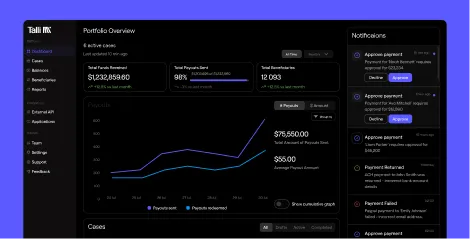
Talli's platform automates this workflow by routing failed payments to exception queues where claimants can self-service corrections through a portal, maintaining full audit documentation throughout.
Costs and Fees Associated with Returned ACH Payments
Calculating the True Cost of ACH Returns
ACH return fees vary by bank and payment provider, while staff time, claimant follow-up, and reconciliation can add substantially to the total cost of each failed payment. The hidden costs often dominate:
- Staff remediation time: 30+ minutes per exception for claimant contact, data correction, compliance review
- Claimant support burden: Phone calls, emails, portal assistance
- Reconciliation work: Every return creates second accounting event
- Delayed closeout: Unresolved exceptions hold up final accounting
- Court reporting: Must explain return patterns and remediation efforts
A mass tort distribution with 50,000 claimants and an assumed 8% return rate would generate 4,000 failed payments. At an illustrative $25 in internal labor per exception, remediation would cost $100,000, excluding bank fees.
How Digital Platforms Reduce Return-Related Expenses
Prevention strategies deliver the highest ROI:
- Real-time account validation at claimant enrollment catches R03/R04 errors before payment
- Multi-rail payment options allow claimants to choose prepaid cards or digital wallets, avoiding ACH entirely when their banking situation is unstable
- Automated exception routing reduces staff time per return from 30 minutes to under 15 minutes
- Self-service claimant portals enable corrections without support team involvement
Talli reports clients achieving higher redemption rates through these prevention-first approaches, with significant reduction in unresolved exceptions.
Ensuring Compliance and Reducing Risk with ACH Payments in Legal Settlements
Integrated Compliance for Secure and Compliant Disbursements
Settlement distributions face unique compliance requirements beyond standard ACH payments:
- KYC verification: Confirm claimant identity before release
- OFAC sanctions screening: Check against U.S. Treasury lists with documented timestamps
- W-9 collection: Obtain taxpayer information when required for payment classification and applicable reporting obligations
- 1099 generation: Prepare required information returns for reportable settlement distributions
- Backup withholding: Apply to payments subject to backup withholding when valid taxpayer information is missing or other IRS withholding conditions are met
Talli's compliance infrastructure handles these automatically, achieving high W-9 completion rates through smart reminders versus lower rates without automation.
The Importance of FBO Accounts in Settlement Administration
Qualified Settlement Funds require strict fund segregation. Dedicated FBO (For Benefit Of) account structures:
- Support fund segregation and accounting for arrangements that independently qualify as QSFs under Section 468B
- Prevent commingling that triggers bar association violations
- Simplify court reporting with matter-level fund tracking
- Maintain audit-ready documentation throughout disbursement lifecycle
When ACH payments return, funds flow back to the segregated account, not operating capital. Banking services are provided through Patriot Bank, N.A., Member FDIC. Applicable FDIC insurance coverage depends on account ownership, recordkeeping, and deposit insurance limits.
ACH vs. Wire Transfers for Settlement Payouts: A Comparative Look
Both ACH and wire transfers move money electronically, but they serve different purposes in settlement administration.
- Cost: ACH transactions typically range from $0.25-$0.50 per transaction, while wire transfers can cost $10-$30 per transaction, making ACH more economical for high-volume distributions.
- Speed: ACH payments settle in 1-2 business days (same-day ACH available), while wire transfers complete same day, often within hours, suited for time-sensitive payments.
- Best use cases: ACH works best for high-volume, lower-value distributions to domestic claimants with stable U.S. bank accounts. Wire transfers suit high-value individual distributions (attorney fees, large awards), international claimants requiring cross-border payments, and time-critical payments requiring same-day delivery.
- Return handling: ACH uses standardized Nacha codes for systematic remediation, while wire transfers have limited return mechanisms and don't "return" in the same structured way.
- International capability: ACH offers limited international reach (IAT codes available), while wire transfers provide full global capability across borders.
When to Choose ACH vs. Wire for Different Claimant Needs
ACH works best for:
- Domestic claimants with stable U.S. bank accounts
- High-volume distributions where cost matters
- Standard settlement amounts under $10,000
Wire transfers suit:
- International claimants requiring cross-border payments
- High-value individual distributions (attorney fees, large awards)
- Time-critical payments requiring same-day delivery
Talli supports both rails plus prepaid Mastercard, PayPal, Venmo, gift cards, and paper checks, ensuring every claimant receives funds through their preferred method.
Enhancing Claimant Experience and Reducing Unclaimed Funds with Digital Payments
Meeting Claimants Where They Are: Multi-Channel Distribution
ACH-only distribution designs create avoidable exceptions. Research shows millions of U.S. households remain unbanked with many more underbanked. Forcing all claimants through ACH guarantees returns.
Multi-channel distribution addresses this reality:
- Prepaid Mastercard: Virtual cards delivered via SMS/email in 30 seconds, serving unbanked populations
- Digital wallets: PayPal and Venmo integration for instant access, particularly popular with younger demographics
- Gift cards: Via InComm for Amazon, Target; highest redemption rates for small-value distributions under $100
- Paper checks: Maintained as fallback for claimants preferring traditional methods
The Impact of Digitalization on Settlement Success
Same Day ACH volume grew substantially in recent years, reaching billions of payments worth trillions annually. This acceleration means:
- Returns surface within 1-2 banking days (not 3-5)
- Less time to manage exceptions manually
- Claimant expectations for speed have increased
- Automated return handling becomes essential, not optional
Talli's real-time dashboard provides live visibility into completion rates, payment method distribution, failure root cause analysis, and fraud flags, enabling proactive management rather than reactive cleanup.
How Talli Streamlines ACH Return Management
Talli automates ACH return handling, reducing manual work while maintaining compliance and protecting administrators and claimants.
- Automated Code-Specific Routing: Categorizes returns and routes them for resolution. R02 and R03 trigger claimant notifications to update banking details, while R16 escalates to compliance review.
- Self-Service Exception Resolution: Claimants receive instant notifications and update information through secure claimant portals, reducing resolution time from days to hours and cutting support workload by more than half.
- Built-In Compliance Documentation: Logs returns, corrections, and reissues with timestamps, creating comprehensive audit trails and chain-of-custody records for court reporting.
- Multi-Rail Fallback Options: Offers prepaid cards, digital wallets, and checks when ACH issues cannot be resolved quickly, helping prevent unclaimed funds while preserving claimant choice.
- Real-Time Account Validation: Checks routing numbers and account formats before submission to prevent R03 and R04 errors and reduce remediation costs.
By automating return code interpretation, compliance documentation, and multi-channel resolution, Talli helps claims administrators spend less time managing payment exceptions and more time on case strategy.
Frequently Asked Questions
What's the difference between an ACH return and an ACH reversal?
A return is initiated by the receiving bank (RDFI) when it cannot process your payment; return codes explain the reason. A reversal is initiated by you (the sender) to undo an erroneous payment you sent. Nacha requires reversals within 5 banking days of the erroneous entry's settlement date. Returns are outside your control, while reversals are corrections you initiate.
Can NOC (Notification of Change) codes prevent future returns?
Yes. When a bank sends a Notification of Change, it's telling you the account information is slightly wrong but they processed the payment anyway. Common NOCs include C01 (incorrect account number), C02 (incorrect routing number), and C03 (incorrect routing and account). Update your claimant records immediately; ignoring NOCs leads to future R03 or R04 returns.
How do ACH returns affect final accounting reports to the court?
Every return creates a second accounting event: original payment, return event, and reissue or alternative disposition. Courts expect documentation showing total distributions attempted versus completed, return rates by code category, remediation actions taken, and final status of all payments. Unresolved returns may require court approval for alternative disposition such as cy pres or escheatment.
What happens if my bank loses ACH origination privileges due to high return rates?
If your ODFI terminates your ACH access due to Nacha threshold violations, you lose the ability to make electronic direct deposits entirely. This would require finding a new banking relationship (difficult with a violation history) or reverting to paper checks for all distributions, dramatically increasing costs and timelines. Monitoring return rates and addressing patterns before they reach thresholds is critical.
Are there special ACH considerations for cross-border settlement payments?
International ACH Transactions (IAT) use different entry class codes and require additional compliance screening. Return codes R17 (file record edit criteria) are more common with IAT due to formatting complexity. For significant cross-border volumes, wire transfers often prove more reliable despite higher costs. Talli supports 190+ countries with multiple currencies and payment rails for global settlement distributions.