.svg)


.svg)
Claims administrators serve as the critical intermediaries managing settlement fund distribution, claimant verification, and regulatory compliance across class action lawsuits, mass tort litigation, and bankruptcy proceedings. With insurance fraud estimated to cost the U.S. $308.6 billion annually and insurers increasingly testing and deploying AI across claims workflows, the role has become increasingly complex. Modern claims administration platforms can automate compliance workflows, reduce fraud exposure, and accelerate payment disbursement from weeks to 24-48 hours, transforming how settlements reach eligible claimants.
Key Takeaways
- Claims administrators operate across multiple domains: insurance, class action settlements, probate estates, and legal settlements, serving as neutral parties managing verification and payment processes
- In class actions, courts typically review settlement administration arrangements, and administrators may be appointed or approved under the settlement agreement and applicable court orders
- Third-party administrators (TPAs) play a major role in employer health-plan administration, with industry estimates placing their involvement at roughly 50-60% of U.S. workers with non-federal employer health coverage
- AI-powered systems can automate document processing, fraud detection, and routine claims workflows, although performance varies significantly by use case and implementation
- Fraudulent and suspicious claims have become a significant settlement-administration challenge, increasing demand for stronger validation and fraud-detection controls
- Digital payment platforms reduce processing costs from paper checks (approximately $8 each) to $0.25-$5 per digital transaction
Understanding the Role of a Claims Administrator in Legal Settlements
A claims administrator is a specialized professional or entity responsible for managing the complete lifecycle of claims from initial intake through final disbursement. In legal settlement contexts, these administrators serve as neutral third parties who verify eligibility, process claims, manage fund distribution, and ensure regulatory compliance.
Defining the Core Function
Claims administrators act as operational intermediaries between settlement stakeholders and eligible claimants, carrying out duties established by the settlement agreement, court orders, and applicable law. Their core responsibilities include:
- Claimant notification through multi-channel outreach campaigns
- Eligibility verification using KYC and identity validation protocols
- Payment processing across multiple disbursement channels
- Compliance management including OFAC screening and tax reporting
- Court reporting with audit-ready documentation
Settlement timelines vary widely based on case complexity, appeals, claims processing, and distribution requirements, with administrators carrying out responsibilities established by the settlement agreement and court orders.
Types of Legal Cases They Oversee
Claims administrators handle diverse settlement types requiring specialized expertise:
- Class action lawsuits distributing billions annually across consumer, securities, and antitrust matters
- Mass tort litigation managing complex multi-tier payment structures across thousands of claimants
- Bankruptcy proceedings systematically distributing assets to creditors
- Data breach settlements processing tiered payments based on exposure levels
- Employment law settlements handling wage-and-hour and discrimination claims
Key Responsibilities of a Claims Administrator: From Intake to Payout
Data Management and Verification
Claims administrators process claimant data through multiple validation layers. This includes cross-referencing provided information against identity databases, verifying purchase records or proof of harm, and flagging inconsistencies for manual review.
Essential data management functions include:
- Batch uploads of claimant data with automated validation
- Document verification for supporting evidence
- Duplicate claim detection and resolution
- Address verification and skip-tracing for unlocatable claimants
- Real-time status tracking across all claim stages
Payment Distribution and Tracking
Efficient settlement disbursement requires multi-channel payment capabilities. Modern administrators offer various distribution methods:
- ACH direct deposit at $0.25-$0.50 per transaction for banked claimants
- Prepaid cards serving unbanked populations with instant digital delivery
- Digital wallets including PayPal and Venmo for immediate access
- Gift cards achieving highest redemption rates for small-value distributions
- Paper checks maintained as fallback despite higher costs
Real-time dashboards provide live visibility into completion rates, payment method distribution, and failure root cause analysis.
Ensuring Compliance and Reporting
Regulatory compliance represents a non-negotiable administrator responsibility. Claims administrators may need to support compliance requirements based on the settlement, payment structure, and financial institutions involved, including:
- Identity verification appropriate to the distribution
- OFAC compliance for transactions subject to U.S. sanctions rules
- Fraud controls for suspicious or duplicate claims
- Tax documentation and reporting when required by the payment's tax treatment
- Unclaimed-property compliance when applicable under the settlement and state law
Courts increasingly demand comprehensive audit trails documenting every fund movement. Administrators must generate post-distribution accounting reports demonstrating complete chain of custody from settlement fund receipt through final claimant payment.
Appointment Process: How Claims Administrators Are Selected
Court Oversight and Approval
In class actions, courts typically review settlement administration arrangements, and administrators may be appointed or approved under the settlement agreement and applicable court orders. The appointment process typically involves:
- Proposal submission detailing qualifications and methodology
- Fee structure review and approval
- Conflict of interest disclosures
- Technology capability assessment
- Reference verification from prior settlements
Courts evaluate administrators based on their track record managing similar settlements, technical infrastructure, and compliance history.
Criteria for Selection
Selection criteria for claims administrators include:
- Administrative capacity to handle projected claim volumes
- Technology infrastructure supporting digital submissions and payments
- Compliance expertise across relevant regulatory frameworks
- Financial stability to manage settlement fund fiduciary duties
- Geographic capabilities for multi-jurisdictional distributions
Legal and Financial Safeguards
For probate administration, courts may require administrator bonds guaranteeing faithful performance. These fiduciary bonds protect beneficiaries against administrator misconduct or negligence.
Qualified Settlement Fund structures under IRC Section 468B provide tax treatment protections while maintaining complete fund segregation between settlement monies and operating capital.
Digital Transformation in Claims Administration: Modern Solutions
Moving Beyond Paper Checks
Traditional paper check distribution creates significant inefficiencies. Uncashed check tracking costs approximately $7.78-$20 per check, while 20-30% of paper distributions go unredeemed, creating additional follow-up and residual-fund administration requirements.
Digital payment platforms can achieve 95-98% redemption rates compared to 70-80% for paper methods, while reducing distribution timelines from 6-8 weeks to 24-48 hours.
Leveraging AI for Efficiency and Security
Insurers increasingly test and deploy AI for claims processing, with machine learning reducing claim cycle times from days to minutes for straightforward claims. Key AI applications include:
- Fraud detection using pattern recognition and behavioral analytics
- Document processing extracting data from unstructured submissions
- Eligibility scoring automating initial claim validation
- Anomaly detection flagging suspicious submission patterns
- Predictive analytics identifying high-risk claims requiring review
AI systems can improve claims-processing efficiency by automating document review, data extraction, fraud detection, and other repetitive workflows, but accuracy and cost savings vary by insurer and use case.
Cost and Efficiency: How Digital Payments Impact Claims Administration
Reducing Operational Expenses
Cost comparison between traditional and digital methods reveals substantial savings. Paper checks cost approximately $7-20 per transaction with 6-8 week delivery times. ACH direct deposit costs $0.25-$0.50 with 1-2 day delivery. Prepaid cards cost $1-3 with 30-second virtual delivery. Digital wallets cost $0.50-$1.00 with instant delivery.
Beyond direct costs, digital platforms eliminate manual reissuance overhead, reduce exception handling, and automate three-way reconciliation, cutting monthly closing time by 70%.
Minimizing Unclaimed Funds
Unclaimed settlement funds may become subject to state unclaimed-property laws, but their ultimate disposition depends on the settlement agreement, court orders, and applicable law. Some settlements instead provide for redistribution, cy pres distributions, or other court-approved treatment.
Digital payment options directly address this problem through:
- Multiple channel choices matching claimant preferences
- Automated reminder sequences for unclaimed payments
- Real-time status tracking enabling proactive intervention
- Extended redemption windows through prepaid card programs
The Role of Third-Party Administrators in Claims Management
Third-party administrators (TPAs) manage claims on behalf of insurers or self-insured entities without assuming financial risk. Industry estimates suggest TPAs are involved in health-plan administration for roughly 50-60% of U.S. workers with non-federal employer health coverage, filling significant operational gaps.
TPA Functions and Services
TPAs provide comprehensive claims services including:
- Claims intake and initial triage
- Investigation and documentation
- Coverage determination
- Payment processing and reconciliation
- Reporting and analytics
Organizations may engage a TPA when claim volume, complexity, geographic reach, or staffing requirements make outsourced administration more efficient than handling claims internally.
TPA vs. Insurance Carrier Distinctions
Unlike insurance carriers, TPAs don't underwrite policies or bear claims risk. This distinction allows specialized focus on operational excellence without capital reserve requirements.
Ensuring Compliance and Security in Settlement Distributions
Regulatory Adherence and Risk Mitigation
Claims administrators may need to support compliance requirements based on the settlement, payment structure, and financial institutions involved. Fraud detection systems achieving high detection accuracy while processing fraud checks significantly faster than manual review have become essential as fraudulent claims increase.
Protecting Settlement Funds
Dedicated settlement accounts can support fund segregation and reconciliation. When a fund is structured as a Qualified Settlement Fund, QSF status depends on satisfying the requirements of Treasury Regulation Section 1.468B-1, not merely on using an FBO account.
SOC 2 Type II and PCI DSS Level 1 certifications demonstrate administrator commitment to data security and privacy protection.
Industry Trends and the Future of Claims Administration
The Rise of AI in Fraud Prevention
Western Alliance and Digital Disbursements reported more than 80 million class action and mass tort claims with significant indicia of fraud in their 2023 data, up more than 19,000% from 2021. This explosion in fraud attempts demands sophisticated detection capabilities beyond manual review.
However, limited skills and resources remain barriers to AI adoption, while data challenges persist. The industry faces a talent crisis with significant retirements expected in the coming years.
Growing Complexity and Severity
Claims severity is reshaping administrator requirements. As industry experts note: "Claims frequency is not the primary story anymore, severity is. Challenging claims now come with more cost and complexity than ever."
Average property claim processing takes substantial time, with catastrophe claims requiring significantly longer than standard claims. This complexity drives demand for technology-enabled administration.
Choosing a Claims Administrator: Key Considerations
Evaluating Technology and Scalability
Effective administrator selection requires assessment of:
- Processing capacity from 1,000 to 100,000+ recipients without degradation
- Multi-channel payment options matching claimant demographics
- API integration capabilities for system connectivity
- Real-time tracking and status reporting
- Automated compliance reducing manual intervention
Assessing Compliance and Security Protocols
Verify administrator certifications and compliance capabilities:
- SOC 2 Type II certification demonstrating security controls
- PCI DSS compliance for payment card handling
- OFAC screening integration with documented timestamps
- Automated tax document collection and filing
- Court-ready audit trail generation
Why Talli Streamlines Claims Administration and Settlement Disbursement
While traditional claims administrators rely on legacy payment systems, Talli provides purpose-built digital disbursement infrastructure specifically designed for legal settlement compliance requirements.
Talli transforms settlement administration with its AI-driven payment platform that includes:
- Multi-Channel Payment Distribution: ACH, prepaid Mastercard via Patriot Bank N.A., digital wallets (PayPal, Venmo), and gift cards, reducing costs from $7-20 per check to $0.25-$5 per digital transaction
- Integrated Compliance Automation: Built-in KYC verification, OFAC sanctions screening, automated W-9 collection achieving 90% completion rates, and 1099 generation with IRS e-filing integration
- AI-Powered Fraud Detection: Pattern recognition across device fingerprinting, behavioral analytics, and identity verification achieving high detection accuracy while processing fraud checks significantly faster than manual review
- Fund Segregation Architecture: Dedicated settlement accounts supporting clear separation of settlement funds from operating capital, including distributions involving properly established Qualified Settlement Funds
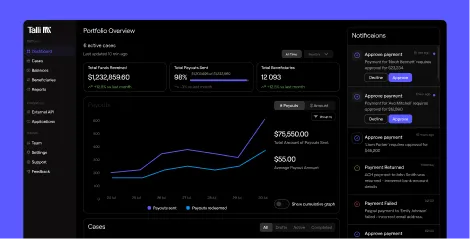
- Real-Time Dashboard: Live monitoring of completion rates, payment method distribution, and court-ready audit trails
The platform processed significant settlement volumes in Q4 2024 alone. The AB Data case study demonstrates real-world impact: 34% increase in claimant redemption rates, 60% reduction in unresolved exceptions, and 100% fiduciary compliance maintained across all distribution cycles.
For claims administrators and settlement trustees requiring compliant, efficient payment infrastructure, Talli's digital disbursement platform provides the regulated payout rails needed to reduce unclaimed funds and accelerate time-to-payment.
Frequently Asked Questions
What is the primary function of a claims administrator?
A claims administrator serves as a neutral intermediary managing the complete lifecycle of claims from initial intake through final payment disbursement. Their responsibilities include claimant notification, eligibility verification, payment processing, compliance management, and court reporting. Settlement timelines vary widely based on case complexity, appeals, claims processing, and distribution requirements.
How does a claims administrator get appointed for a legal settlement?
In class actions, courts typically review settlement administration arrangements, and administrators may be appointed or approved under the settlement agreement and applicable court orders. Courts evaluate administrators based on qualifications, methodology, fee structure, conflict of interest disclosures, and technology capabilities. For probate administration, courts may appoint administrators based on state-specific criteria. Administrator bonds may be required to guarantee faithful performance.
What types of payments do claims administrators handle?
Modern claims administrators offer multiple payment methods including ACH direct deposit ($0.25-$0.50 per transaction), prepaid cards for unbanked claimants, digital wallets like PayPal and Venmo, gift cards for small-value distributions, and traditional paper checks as fallback. Digital options achieve significantly higher redemption rates than traditional paper checks, while significantly reducing processing costs.
What compliance requirements do claims administrators face?
Claims administrators may need to support compliance requirements based on the settlement, payment structure, and financial institutions involved. This can include identity verification, OFAC sanctions screening, fraud controls, tax documentation and reporting, and unclaimed-property compliance. QSF compliance under IRC Section 468B requires proper fund segregation and tax treatment. SOC 2 Type II and PCI DSS certifications demonstrate security controls for payment handling.
What happens to unclaimed funds in a settlement?
Unclaimed settlement funds may become subject to state unclaimed-property laws, but their ultimate disposition depends on the settlement agreement, court orders, and applicable law. Some settlements instead provide for redistribution, cy pres distributions, or other court-approved treatment. Before any residual distribution, administrators must conduct due diligence efforts to locate claimants. Digital payment options significantly reduce unclaimed fund rates by offering multiple channel choices and automated reminder sequences.