.svg)


.svg)
The best disbursement platform for claims administrators is one that combines automated compliance (KYC, OFAC screening, QSF account segregation), multi-channel payment support, integration with your claims management system, scalability under high-volume distributions, and vendor security certifications including SOC 2 Type II and PCI DSS. Settlement administrators managing multi-million-dollar distributions face a decision that directly affects redemption rates, compliance posture, and operational cost: which disbursement platform to use. With class action and government enforcement settlements totaling more than $42 billion in 2024, the stakes of choosing the wrong platform — or sticking with paper checks — are measurable in unclaimed funds, compliance gaps, and manual rework. This guide walks through the evaluation criteria that matter most when choosing a disbursement platform for claims administrators in 2026, from regulatory compliance and payment method flexibility to system integration and vendor security. Whether you are replacing a legacy check-based workflow or evaluating your first digital disbursement vendor, the framework here applies.
Key Takeaways
- Digital disbursement platforms improve redemption rates by 15-25% over paper checks, and offering multiple payment methods increases redemption by an additional 20-30%.
- Compliance capabilities — KYC verification, OFAC screening, QSF account segregation — should be non-negotiable selection criteria, not add-ons.
- Integration with your existing claims administration system determines whether a platform reduces workload or creates new manual processes.
- Vendor security should be verified with evidence — especially SOC 2 Type II, PCI DSS compliance, encryption standards, and documented incident response processes — because claims administrators handle large volumes of sensitive claimant data.
- The lowest per-transaction price is rarely the lowest total-cost option; platforms that automate failed payment recovery, tax reporting, reconciliation, and claimant self-service reduce labor, reissuance costs, and unclaimed funds far more effectively than paper-based workflows.
What Is a Claims Disbursement Platform and Why Does It Matter?
A disbursement platform for claims administrators is software infrastructure that automates the distribution of settlement funds to verified recipients through digital payment channels. Unlike general payment processors, these platforms are purpose-built for the regulatory, audit, and multi-party requirements of settlement administration.
The distinction matters because settlement disbursement carries obligations that standard payment tools were not designed to handle: Qualified Settlement Fund (QSF) account segregation under IRS Section 468B, OFAC sanctions screening on every outbound payment, court-mandated audit trails, and tax document generation (W-9 collection, 1099 issuance) for thousands of recipients simultaneously.
Claims administrators who rely on manual check processes or repurposed accounts payable software often discover these gaps when a court requests documentation they cannot produce — or when redemption rates fall below expectations set during settlement approval. For a deeper look at what separates settlement-grade platforms from general payment tools, see the guide on comparison criteria for digital disbursement platforms.
Why Claims Administrators Are Moving Away from Paper Checks
The economics of paper check disbursement have become difficult to justify. Each check costs approximately $8 including processing and postage. For a settlement distributing to 50,000 claimants, that is $400,000 in check-related costs before a single dollar reaches a recipient.
Beyond cost, checks introduce failure points:
- Low redemption rates. Paper-check distributions often leave a meaningful share of funds uncashed or unclaimed. FTC research found a median claims rate of 9% in claims-made consumer class actions, while Western Alliance reported paper-check success rates of 77% in cases with a claims process and 55% in cases without one.
- Fraud exposure. Check fraud remains one of the fastest-growing financial crimes, and settlement checks are particularly vulnerable to interception and alteration. Understanding fraud risks in digital disbursements helps administrators weigh the security trade-offs.
- Slow delivery. Mail-based distribution adds 7-14 days of float time, with no visibility into whether the recipient has received or deposited the check.
- Manual reconciliation. Tracking outstanding, voided, and reissued checks across thousands of payees requires dedicated staff time that digital platforms eliminate.
Digital disbursement platforms address each of these problems. Digital disbursement can shorten average payment time by up to 5.5 days while reducing the printing and mailing costs associated with paper checks. And 91% of recipients prefer digital over paper checks when given the choice.
7 Critical Features in a Disbursement Platform for Claims Administrators
Not every digital payment tool qualifies as a true disbursement platform for claims administrators. These seven capabilities separate settlement-grade platforms from general-purpose payment software.
Multi-Channel Payment Support
The platform must support ACH direct deposit, prepaid debit cards, digital wallets (PayPal, Venmo), and physical card mail options at minimum. For a comparison of these channels, see ACH, prepaid cards, vs. digital wallets. Offering claimants several payment options increases settlement completion because recipients can choose the method they actually use rather than waiting for a check they may never deposit.
Automated Compliance Verification
Look for built-in KYC (Know Your Customer) identity verification, real-time OFAC sanctions screening, and automated W-9 collection with 1099 generation. Manual compliance processes do not scale when you are disbursing to tens of thousands of recipients. For background on OFAC screening mechanics, see OFAC screening for disbursements. OFAC violations carry severe civil penalties, making automated screening a financial necessity rather than a convenience feature.
QSF-Compliant Account Segregation
Settlement funds must be held in properly segregated accounts that comply with IRC Section 468B Qualified Settlement Fund requirements. The platform should provide dedicated FBO (For Benefit Of) account structures with complete fund separation between settlements rather than a pooled omnibus account.
Real-Time Tracking and Audit Trails
Courts, plaintiff counsel, and administrators all need visibility into disbursement status. Implementing audit trails for legal distributions is a baseline requirement. The platform should provide real-time dashboards showing payment status per recipient, complete audit logs of every transaction, and exportable reports formatted for court filings.
Scalability Under Load
A platform that works for small settlements may fail at larger volumes. Learn how to benchmark vendor scalability before committing. Ask vendors to demonstrate how their infrastructure handles high-volume concurrent disbursements. Request production metrics: peak transaction throughput, failure rates under load, and recovery time for failed payments.
Failed Payment Recovery
No disbursement achieves full success on the first attempt. Learn how administrators resolve failed and returned payments efficiently. The platform needs automated retry logic for returned ACH payments, address verification for bounced card shipments, and claimant self-service portals where recipients can update their payment information without administrator intervention.
Tax Reporting Automation
Settlements involving individual payments above IRS thresholds require 1099 issuance. Administrators need to streamline tax compliance for settlements from day one. The platform should automate W-9 collection during the claimant onboarding process and generate 1099 forms in bulk at year-end, with filing-ready electronic submission to the IRS.
How Do Compliance Requirements Shape Platform Selection?
When evaluating any disbursement platform for claims administrators, compliance is not a feature checkbox — it is the foundation that determines which platforms are even viable for settlement disbursement. Three regulatory frameworks drive the requirements.
KYC (Know Your Customer) verification requires government ID scanning, Social Security Number validation, and address verification during claimant onboarding. Platforms that rely on self-reported identity data without verification create liability for the administrator and risk for the fund.
OFAC (Office of Foreign Assets Control) screening must occur on every outbound payment, not just at onboarding. The U.S. Treasury's Specially Designated Nationals list changes regularly, and a payment that was compliant at onboarding may violate sanctions weeks later at disbursement time. Platforms should provide automated, real-time screening with documentation of every check — not batch processing with manual review.
QSF (Qualified Settlement Fund) requirements under IRC Section 468B mandate specific account structures. Settlement funds must be held in segregated accounts with FDIC insurance through regulated banking institutions. The platform's banking partner matters: look for named banking relationships (not unnamed "partner banks") with explicit FDIC coverage per settlement account.
Additionally, IOLTA trust accounting rules, state-specific escheatment laws, and PCI DSS requirements for card-based disbursements add compliance layers that general payment platforms rarely address. For a side-by-side comparison of regulatory compliance across disbursement vendors, administrators can evaluate how different platforms handle these overlapping requirements.
Payment Method Options: ACH, Prepaid Cards, Digital Wallets, and More
Each payment channel has trade-offs that affect redemption rates, cost, and claimant experience differently.
The most effective approach is offering claimant choice. Platforms that let recipients select their preferred payment method consistently achieve the highest overall redemption rates. 41% of consumers received instant disbursements, up from just 11% in 2018 — expectations have shifted.
Integration with Existing Claims Administration Systems
Integration is the most critical factor after compliance. A disbursement platform creates value only if it connects to your existing workflow. Evaluate integration on three dimensions:
API Quality. The platform should provide well-documented REST APIs with webhooks for real-time disbursement notifications (payment sent, payment failed, payment redeemed). Ask for the API documentation before the sales demo — the quality of documentation reveals the maturity of the integration layer.
Claims Management System Connectors. If you use settlement administration software, verify that the disbursement platform has existing integrations or proven implementation templates. Custom integrations add 3-6 months and significant cost.
Data Import/Export. The platform must accept claimant data in bulk (CSV, SFTP, API batch upload) and export disbursement data in formats compatible with your reporting and court filing requirements. Verify that exports include the specific fields courts require: payment date, method, amount, recipient ID, redemption status, and compliance screening results.
How to Evaluate Vendor Security and Data Protection
Any disbursement platform for claims administrators handles personally identifiable information (PII) for thousands or millions of claimants. Security evaluation is the most overlooked step in vendor selection and should be evidence-based, not vendor-asserted.
Require SOC 2 Type II certification. The AICPA SOC 2 audit framework defines the standard. Type II (not Type I) means the vendor's controls have been independently audited over a sustained period. Request the most recent audit report — vendors confident in their security will share it during evaluation.
Verify PCI DSS compliance level. If the platform handles card disbursements, verify PCI DSS compliance appropriate to the vendor’s card-processing role and transaction volume.
Assess data residency and encryption. Settlement data should be encrypted at rest (AES-256) and in transit (TLS 1.2+). Ask where data is physically stored and whether it crosses international borders — this matters for settlements with U.S. court jurisdiction requirements.
Review incident response history. Ask vendors directly: have they experienced a data breach? What is their documented incident response plan? How quickly do they notify affected parties? Vendors who cannot answer these questions clearly have not invested in security operations.
Cost Analysis: Why a Disbursement Platform for Claims Administrators Beats Paper Checks
The total cost comparison extends beyond per-transaction fees.
For a 50,000-recipient settlement at $200 average payout:
- Paper checks: ~$400,000 in direct costs + ~$3.6M in unredeemed funds (at 36% uncashed rate)
- Digital platform: ~$75,000-$150,000 in direct costs + ~$1M in unredeemed funds (at 10% rate)
The difference is not marginal. Digital disbursement platforms materially outperform paper checks, and offering multiple payment options can further improve completion by giving recipients a method they are more likely to use.
Decision Framework: Matching Platform Capabilities to Your Settlement Needs
When evaluating a disbursement platform for claims administrators, use this framework to weight your evaluation based on your specific settlement profile.
Scoring approach: Rate each vendor 1-5 on each criterion. Multiply by the weight (Heavy = 3, Medium = 2). The vendor with the highest weighted score across your priority dimensions is your strongest match.
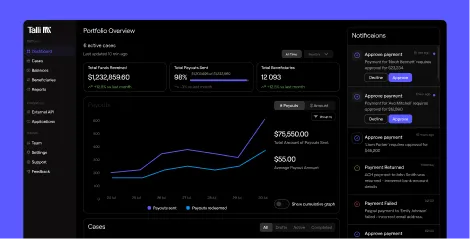
Talli, for example, is purpose-built for legal settlement administration — handling segregated QSF-compliant accounts, automated OFAC screening, multi-channel payouts (ACH, prepaid Mastercard, PayPal, gift cards), and real-time court-ready reporting. For administrators whose primary need is regulatory compliance and high redemption rates, that purpose-built approach eliminates the gaps that repurposed payment platforms leave open.
Common Mistakes When Selecting a Disbursement Platform
Selecting a disbursement platform for claims administrators involves trade-offs. Avoid these errors that settlement teams frequently make during vendor evaluation.
Evaluating on features alone without testing at scale. A platform may demonstrate every capability in a 100-recipient pilot and fail at 50,000. Require load-test evidence or production references from settlements of comparable size.
Treating compliance as a vendor responsibility. The administrator retains fiduciary liability for settlement fund handling regardless of which platform processes payments. Verify that the platform provides the documentation you need to demonstrate compliance — not just their own internal compliance.
Ignoring claimant experience. Administrators can design recipient-friendly redemption flows that reduce abandonment. If the redemption process is confusing, claimants abandon it. Test the claimant-facing portal yourself: how many steps to claim a payment? Is it mobile-friendly? Does it support multiple languages if your settlement population requires it?
Choosing the cheapest per-transaction rate. A platform with $0.25 per transaction but no compliance automation may cost far more in staff time, legal exposure, and unredeemed funds than a platform charging $1.50 with full compliance built in.
Skipping integration due diligence. "We integrate with everything" means "we have an API." Verify that integration with your specific claims management system has been implemented before — not that it theoretically could be.
Final Verdict: Choose Based on Settlement Requirements, Not Feature Lists
There is no single best disbursement platform for every claims administrator. The right choice depends on your settlement profile:
- If compliance is your primary concern (QSF funds, court-mandated reporting, OFAC-sensitive recipients): prioritize platforms purpose-built for legal settlement administration. General payment tools will leave gaps that create fiduciary risk.
- If scale is your primary concern (50,000+ recipients, multiple concurrent settlements): prioritize demonstrated throughput and automated compliance at volume. Request production references, not demo environments.
- If claimant experience is your primary concern (unbanked populations, low historical redemption): prioritize multi-channel payment options and mobile-friendly claimant portals.
Start your evaluation with compliance (KYC, OFAC, QSF), then layer on payment method flexibility, integration capability, and vendor security. Use the weighted scoring framework above to compare vendors against your specific needs rather than generic feature comparisons.
For administrators managing legal settlements that require QSF-compliant account segregation, automated compliance verification, and multi-channel payouts — book a Talli demo to see how purpose-built digital claims disbursement infrastructure compares to repurposed payment platforms.
Frequently Asked Questions
What is the best disbursement platform for class action settlements?
The best disbursement platform for claims administrators depends on your settlement's specific requirements. For legal settlement administration requiring QSF compliance, OFAC screening, and court-ready reporting, purpose-built platforms like Talli offer capabilities that general payment processors do not. Evaluate based on your compliance requirements, recipient volume, and payment method needs.
How do digital disbursement platforms improve redemption rates?
Digital platforms improve redemption by offering recipients their preferred payment method, eliminating the delays and friction of paper checks, and enabling automated reminders for unclaimed funds. Administrators who switch from checks to multi-channel digital disbursement typically see 15-25% improvement in redemption rates, with further gains when offering 3-4 payment options.
What compliance certifications should a disbursement platform have?
At minimum, look for SOC 2 Type II certification, PCI DSS compliance (Level 1 if handling card disbursements), FDIC-insured banking partnerships, and documented OFAC screening processes. For settlement-specific work, verify QSF-compliant account segregation under IRC Section 468B and automated 1099/W-9 tax reporting capabilities.
How long does it take to implement a disbursement platform?
Implementation timelines range from 2-4 weeks for platforms with existing connectors to your claims management system, to 3-6 months for custom API integrations. Ask vendors for implementation timelines from comparable-size clients, not generic estimates. Factor in claimant portal customization, compliance configuration, and user training.
What is a Qualified Settlement Fund and how does it affect disbursements?
A Qualified Settlement Fund (QSF) under IRC Section 468B is a court-established trust that holds settlement proceeds. QSF rules require specific account structures: segregated, FDIC-insured accounts with dedicated FBO designations. Your disbursement platform must support these structures — commingling settlement funds in a single pooled account violates QSF requirements and creates fiduciary liability.
How much do digital disbursement platforms cost compared to paper checks?
Per-transaction costs range from $0.25 (ACH) to $5.00 (physical prepaid card mailing) for digital platforms, versus $5.00-$8.00 per paper check. The larger savings come from reduced escheatment (digital platforms achieve 85-95% redemption versus 60-70% for checks), eliminated reconciliation labor, and automated compliance documentation. For a 50,000-recipient settlement, the total cost difference typically exceeds $250,000.