.svg)


.svg)
Paying the wrong person, or paying anyone without proper documentation, creates immediate legal liability for claims administrators, bankruptcy trustees, and settlement managers. Traditional check-based disbursement methods create avoidable unclaimed fund exposure, while incomplete W-9 collection and TIN mismatches can trigger IRS notices, backup withholding obligations, and extensive remediation work. Document-gated disbursements solve this problem by holding funds until lien releases, W-9 forms, identity verification, and sanctions checks are complete.
For class action settlements and complex legal distributions, this methodology turns payment release into a controlled compliance workflow. Funds do not move because a spreadsheet says a claimant is eligible. Funds move only when the right claimant, the right documentation, and the right compliance status line up in one auditable record.
Key Takeaways
- Document-gated disbursements prevent fund release until W-9s, lien releases, identity verification, and payment eligibility checks are complete.
- Traditional check processing can cost $7 to $20 per payment, while digital methods can reduce payment costs to a fraction of that amount depending on the payment rail.
- IRS TIN matching validates name and TIN combinations before 1099 filing, helping administrators identify mismatches before B-notice remediation begins.
- Automated W-9 collection can improve completion rates compared with manual mail-based outreach, especially when paired with reminders and self-service claimant portals.
- Digital disbursements reduce unclaimed fund exposure by giving claimants faster, more flexible ways to receive settlement funds.
- OFAC screening and KYC verification help prevent sanctions violations, identity fraud, duplicate payouts, and payment release to blocked or ineligible parties.
- Settlement administrators using document-gated workflows can improve redemption rates, reduce unresolved exceptions, and create court-ready audit trails.
The Compliance Risk of Unverified Disbursements
Every settlement administrator faces the same operational risk: issuing thousands of payments before the supporting documentation is complete. The mistake may not appear on day one. It often appears months later, when a 1099 filing produces IRS notices, a lienholder disputes release of funds, or a claimant reports that someone else received a payment in their name.
Tax compliance is one of the most visible failure points. The IRS TIN Matching program allows authorized payors to validate name and taxpayer identification number combinations before filing information returns. That does not eliminate every reporting issue, but it gives administrators a practical way to catch mismatches before 1099 filing creates downstream B-notice work.
Backup withholding adds another layer of risk. When 24% backup withholding applies to reportable payments with missing or incorrect TINs, the financial and administrative burden compounds quickly. The IRS backup withholding rules require payors to document solicitation, withholding, and reporting activity carefully, which becomes difficult when W-9 collection sits in email inboxes, mailroom logs, or disconnected spreadsheets.
The problem extends beyond tax compliance. Fraudulent claims in class action settlements have increased sharply, and high-volume administrators now face coordinated attempts involving stolen identities, duplicated submissions, synthetic identities, and automated bot activity. Without proper identity verification before payment release, administrators risk paying impersonators while legitimate claimants go uncompensated. For high-volume programs, even a small error rate can turn into thousands of payment exceptions.
Traditional disbursement workflows separate document collection from payment processing, creating gaps such as:
- W-9s collected through manual outreach with inconsistent follow-up.
- Paper checks carrying printing, postage, reconciliation, stop-payment, and reissuance costs.
- OFAC screening performed inconsistently or without a timestamped audit trail.
- Lien releases tracked in spreadsheets with no automated payment hold.
- Court reporting assembled manually after the fact instead of generated from live payment records.
Document-gated disbursements integrate these steps into one control mechanism. Payment release depends on verified documentation, validated claimant data, sanctions screening, and internal approval status. That structure reduces the chance that a payment moves before the record is ready.
How Document-Gated Disbursements Work
Document-gated disbursement is a simple concept with a high operational impact. A settlement administrator defines the documents and checks required for a claimant, creditor, lienholder, or other payee. The platform then prevents payment release until those requirements are satisfied.
For legal settlements, this model usually combines three categories of controls: identity verification, tax compliance, and sanctions screening. In more complex programs, it can also include lien releases, probate documentation, address confirmation, trustee approval, or court-required acknowledgments.
The strongest implementations do not treat document collection as a separate administrative step. They connect documents directly to payment eligibility. That means the system can show which claimants are payable, which are blocked, which need outreach, and which require legal or administrator review.
Gate 1: Identity Verification
Before funds leave escrow or a settlement account, the administrator needs confidence that the claimant is who they claim to be. Identity verification checks submitted information against the approved claimant record and flags inconsistencies before payment release.
Key verification elements may include:
- Government ID validation against submitted claim information.
- Address verification against approved records or supporting documentation.
- Device fingerprinting to identify repeat submissions from the same source.
- Behavioral signals that may indicate bot activity or coordinated fraud.
- Duplicate claim detection across names, addresses, emails, phone numbers, and payment credentials.
This gate is especially important in mass settlement programs where claimants may never interact directly with the administrator. A digital portal can improve claimant experience, but it also needs controls that prevent unauthorized users from capturing funds meant for someone else.
Strong identity verification does not mean every claimant must complete the same process. Lower-risk claims may require basic data matching, while higher-value payments may require stronger identity proofing or manual review. The goal is risk-based verification that protects funds without creating unnecessary friction for legitimate claimants.
Gate 2: Tax Compliance
The W-9 collection and validation gate ensures that reportable payments are supported by the right taxpayer information before payment release or tax reporting. For U.S. persons, that usually means collecting Form W-9 and validating the claimant’s name and taxpayer identification number. For non-U.S. persons, the workflow may require the appropriate W-8 form instead.
Critical compliance functions include:
- Automated W-9 solicitation through secure digital portals.
- Name and TIN validation through IRS-supported matching workflows.
- Name-control formatting review based on IRS reporting requirements.
- Automated resubmission prompts when claimants enter inconsistent information.
- Backup withholding workflows when withholding applies.
- Appropriate 1099 generation and e-filing support based on the tax character and payment method of each distribution.
This last point matters. Settlement tax reporting depends on the nature of the payment. Some payments may be reportable on Form 1099-MISC, some may involve Form 1099-NEC, and some third-party network or card-based payment flows may involve different reporting obligations. A document-gated platform should support the administrator’s tax determination instead of assuming one form applies to every settlement payment.
A well-designed tax gate also reduces claimant frustration. Instead of discovering a mismatch after the payment deadline or after filing season, administrators can prompt claimants while the distribution is still active. That improves completion rates and limits the amount of remediation required after funds have already moved.
Gate 3: Sanctions Screening
OFAC screening checks each payment recipient against the SDN list and relevant non-SDN sanctions lists before funds are released. Current OFAC list data supports compliance, while automated flagging routes potential matches to review queues with documented resolution steps.
This gate addresses:
- Specially Designated Nationals list screening.
- Relevant non-SDN sanctions list screening.
- False positive handling for common names.
- Timestamped proof that screening occurred before payment.
- Hold, reject, or escalation workflows for unresolved matches.
The OFAC sanctions lists are not static. They change when Treasury updates them, so administrators need current screening data and a repeatable process for documenting results. A court order approving a distribution does not override sanctions obligations. The defensible approach is to screen, document the result, escalate potential matches, and release funds only when the review supports release.
Implementation: From Setup to First Payment
Deploying document-gated disbursements requires careful planning, but the operating model is straightforward. The administrator maps each payment population, defines document requirements, configures approval rules, and launches claimant outreach. Payments then flow as individual recipients complete the required steps.
Most legal distribution teams should think in three phases: data preparation, configuration and testing, and rollout with monitoring.
Phase 1: Data Preparation
Clean claimant data determines whether the workflow performs well. Even the strongest platform will struggle if the source file includes stale addresses, missing email records, duplicate names, inconsistent award amounts, or unresolved lien flags.
Essential preparation includes:
- Auditing claimant names, mailing addresses, email addresses, and phone numbers.
- Identifying records with missing or outdated digital contact information.
- Confirming the settlement agreement permits digital disbursement methods.
- Mapping payment populations by risk level, award amount, and document requirement.
- Assigning lien, tax, and identity requirements before claimant outreach begins.
- Preparing fallback workflows for claimants who require paper checks or manual review.
Administrators should also plan for claimant communication. If the first message looks generic, confusing, or suspicious, claimants may ignore it. Clear branding, plain-language instructions, and recognizable case information improve trust and response rates. Talli’s recipient-friendly flows are built around that principle: make the claimant action clear while preserving administrator control.
Phase 2: Configuration and Testing
Platform setup defines the documents, rules, and approval thresholds for each settlement. This is where administrators decide what must happen before funds can move.
Key configurations include:
- Required document types by claimant group.
- W-9, W-8, lien release, probate, or trustee approval requirements.
- TIN matching and mismatch resolution workflows.
- OFAC review queues and escalation rules.
- Payment method options based on claimant demographics and court approval.
- Notification templates for email, SMS, and mailed fallback outreach.
- Audit trail fields required for court, trustee, or administrator reporting.
A pilot group of 50 to 100 claimants can validate the workflow before full launch. The goal is not just to test payment delivery. It is to test the full chain: claimant notification, portal access, document upload, validation, exception routing, approval, payment release, reconciliation, and reporting.
Phase 3: Rollout and Monitoring
Phased deployment reduces risk while improving participation. Administrators can launch first to clean records or early adopters, then expand to the broader population once the workflow is validated.
A practical rollout plan includes:
- Early launch to claimants with complete email and mobile records.
- Expansion to the majority of claimants after initial monitoring.
- Intensive follow-up for non-responsive claimants.
- Paper fallback for claimants who cannot or will not use digital options.
- Exception review for mismatches, OFAC flags, duplicate records, and lien disputes.
The best teams monitor operational metrics daily. Useful indicators include document submission rate, first-pass TIN match rate, payment delivery success rate, unresolved exception count, claimant support volume, and aging records by hold reason. Talli’s real-time tracking helps administrators understand where each payment stands instead of waiting for a final reconciliation report.
The ROI of Document-Gated Disbursements
The value of document-gated disbursement comes from three places: lower payment cost, fewer exceptions, and faster completion. Consider a 1,000-claimant settlement with $500 average payments. Actual costs vary by payment method, support model, settlement requirements, and vendor pricing, but the operating pattern is consistent.
A simplified example might look like this:
The precise savings will vary, but the drivers are practical and easy to identify. Paper checks require printing, postage, bank reconciliation, returned mail handling, stop-payment processing, and reissuance. Digital methods reduce much of that burden while giving claimants more ways to receive funds.
Beyond direct costs, digital workflows provide operational advantages that compound over time:
- Staff can manage more settlements with the same headcount.
- Faster case closure reduces long-tail administrative burden.
- Fraud detection prevents costly recovery efforts.
- Audit-ready reporting reduces manual court report preparation.
- Automated reminders reduce claimant support volume.
- Exception queues help administrators focus only on records that need review.
For high-volume administrators, the ROI is not just cost per payment. It is the ability to run more distributions without adding proportional staff, risk, or reconciliation work. Talli’s payout automation supports that shift by tying claimant engagement, payment selection, compliance checks, and reporting into the same workflow.
Real-World Results: The AB Data Case Study
AB Data, one of the largest claims administrators in the United States, implemented Talli’s digital disbursement infrastructure for settlements involving hundreds of millions of dollars and hundreds of thousands of claimants.
The results validate the methodology:
- 30% increase in claimant redemption rates across check-issued populations.
- 60% reduction in unresolved exceptions and manual reissuance overhead within 12 months.
- 100% fiduciary compliance record maintained across all distribution cycles and regulatory reviews.
- Faster time-to-funds for claimants while lowering distribution costs.
Thomas R. Glenn, President and CEO of AB Data, summarized the transformation: "We don't think of digital disbursement as a feature, we think of it as infrastructure. Talli gave us the regulated payout rails we needed to move faster, reduce unclaimed funds, and give courts full confidence in how settlement money is being distributed."
The AB Data case study illustrates why document-gated disbursement matters. The improvement was not just about replacing checks with digital payments. It was about creating a controlled system where claimant communication, payment preference, compliance checks, exception review, and reporting all operate from one source of truth.
Addressing Common Objections
"Our Claimants Won't Use Digital Payments"
This assumption often overstates claimant resistance. Many claimants prefer digital options when the instructions are clear, the payment choices are familiar, and a check remains available as a fallback. The right model is not digital-only for every claimant. It is digital-first with paper support for claimants who need it.
A hybrid approach allows administrators to offer ACH, prepaid cards, PayPal, Venmo, gift cards, wire transfers, and checks where appropriate. That flexibility is especially important for unbanked and underbanked claimants who may not be able to receive ACH but can use a prepaid card or digital wallet.
Prepaid Mastercards can serve as an effective middle ground for claimants who do not want to share bank information. Issued through Patriot Bank, N.A., Member FDIC, these cards function like familiar payment instruments while reducing check printing and postal delays. Administrators can review claimant payment options to match payment methods to settlement needs.
"Courts Won't Approve Digital Methods"
Many modern settlement agreements already allow electronic disbursement methods. For older cases or cautious courts, administrators can prepare a briefing package that explains the controls, claimant choice, fallback process, security certifications, payment cost comparison, and expected reduction in unclaimed funds.
The strongest court presentation focuses on fiduciary benefit. Digital disbursement is not just a convenience feature. It can reduce administrative expenses, improve redemption, lower returned-mail issues, and create clearer reporting. Courts generally want settlement money to reach approved claimants efficiently, and document-gated workflows support that goal by adding controls before money moves.
Useful materials include:
- Payment method comparison.
- Claimant notice language.
- Data security and privacy overview.
- OFAC, KYC, W-9, and lien release workflow diagrams.
- Check fallback procedures.
- Reporting samples for the court or settlement administrator.
"What About Lien Holders?"
Bankruptcy distributions, mass tort settlements, and complex claimant programs often require lien releases before funds can move. Document-gated workflows are especially useful in those cases because they connect lien documentation directly to payment eligibility.
Instead of tracking lien status in a spreadsheet, the administrator can create a gate that prevents disbursement until the lien release is uploaded, reviewed, and approved. Digital signature tools, trustee approval queues, and timestamped document storage can all support a more reliable record.
This structure helps with:
- Lien release request distribution.
- Digital signature capture.
- Trustee or administrator approval before release.
- Payment holds for incomplete lien documentation.
- Court-ready documentation showing why a payment was released or held.
When a claimant has multiple lienholders, partial releases, or disputed amounts, the system should support manual review without breaking the overall payment workflow. The goal is not to automate legal judgment. The goal is to make sure legal judgment is documented before money moves.
Your Document-Gated Disbursement Readiness Checklist
Before implementing document-gated disbursements, assess the current state of your data, legal authority, technology, and staffing. A readiness review helps prevent avoidable delays after launch.
Data Quality Assessment
- What percentage of claimant records include valid email addresses?
- Are mobile phone numbers available for SMS reminders?
- How old is the contact information?
- Are mailing addresses standardized and validated?
- Are duplicate records already identified?
- Are award amounts final and approved?
Legal Review
- Does the settlement agreement permit digital disbursement methods?
- Will court approval be required for electronic payment options?
- Are there claimant populations that must receive checks?
- Are there lienholder notice requirements?
- Are tax reporting responsibilities clearly assigned?
- Are foreign claimants included in the population?
Technology Infrastructure
- Can the case management system export claimant data in standard formats?
- Does the administrator need API integration for real-time status updates?
- Can payment status sync back into CRM or case management tools?
- What audit fields must be preserved?
- What court reporting requirements must be met?
- How will failed or returned payments be resolved?
Staffing Considerations
- Who will manage exception review?
- Who approves lien release documentation?
- Who handles OFAC potential matches?
- Is multilingual claimant support available?
- What escalation process applies to complex or disputed records?
- Who signs off before final reconciliation?
The readiness checklist should produce a clear launch plan. Every claimant record should have a status, every required document should have an owner, and every payment hold should have a resolution path.
Why Document-Gated Disbursements with Talli
Talli’s document-gated disbursement platform integrates document verification, payment controls, compliance screening, claimant communication, and real-time reporting into one workflow purpose-built for legal settlements. The platform addresses the fundamental weakness of traditional methods: too many critical steps happen outside the payment system.
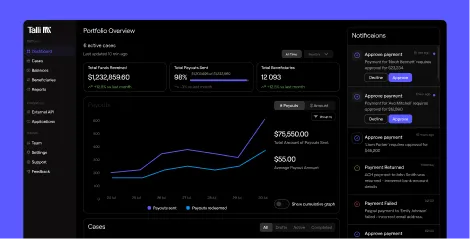
For claims administrators, bankruptcy trustees, and settlement managers handling high-volume distributions, that integration matters. Talli supports complete fund segregation, multiple claimant payment options, KYC verification, OFAC screening, W-9 collection, fraud mitigation, and audit logging. Claims teams can launch campaigns, monitor completion, manage exceptions, and track every payment from a single dashboard.
The operational benefit is straightforward. Instead of asking staff to manually compare W-9 files, lien release folders, OFAC notes, payment spreadsheets, and court reports, Talli connects those controls to payment release. A claimant is either payable, blocked, pending, or under review. Administrators can see why.
Talli also helps reduce unclaimed funds by giving claimants flexible redemption options, including ACH, prepaid Mastercard, PayPal, Venmo, Amazon gift cards, and checks as a fallback. That flexibility matters because claimant populations are not uniform. Some claimants are fully banked, some prefer wallets, some need prepaid cards, and some still require paper checks.
AB Data’s results demonstrate the impact: 30% higher claimant redemption rates, 60% fewer unresolved exceptions, and a 100% fiduciary compliance record across distribution cycles. Those outcomes show why document-gated workflows are becoming core infrastructure for legal distributions, not an optional add-on.
Talli Conclusion: Build Payment Control Before Money Moves
Document-gated disbursement changes the settlement distribution model from reactive cleanup to proactive control. Instead of releasing payments first and reconciling problems later, administrators can verify identity, collect tax documentation, resolve lien requirements, screen for sanctions risk, and document approval before funds move.
That structure protects claimants, administrators, trustees, and courts. It reduces the risk of paying the wrong person, filing inaccurate tax forms, releasing funds before lien documentation is complete, or creating an incomplete audit record. It also improves claimant experience by giving approved recipients faster and more flexible ways to receive funds.
Talli brings those controls into one purpose-built legal disbursement platform. For teams managing class actions, mass torts, bankruptcy cases, shareholder distributions, or other court-supervised payments, the result is faster distribution without losing compliance control.
Frequently Asked Questions
How long does IRS TIN matching take, and what happens when mismatches occur?
The IRS TIN matching program supports interactive and bulk validation, with turnaround depending on submission method and processing workflow. When mismatches occur, automated re-solicitation workflows can prompt claimants to verify their information. Common issues include typos, use of a nickname instead of a legal name, business name formatting issues, or a recent name change. When backup withholding applies to a reportable payment, administrators should document the solicitation and withholding process.
Can document-gated disbursements handle international claimants?
Yes, but international claimants usually require additional tax, identity, and payment controls. Non-U.S. persons generally complete the appropriate W-8 form instead of Form W-9. OFAC screening remains important regardless of location, and local payment options vary by country. For cross-border programs, administrators should confirm available payment rails, currency support, tax documentation, and data privacy requirements before launch.
What security certifications should a platform have?
At minimum, administrators should look for strong security controls, payment security practices, documented audit logs, role-based access controls, and appropriate vendor due diligence materials. SOC 2 Type II and PCI DSS Level 1 are commonly requested standards for platforms handling sensitive data and payment workflows. For legal settlements, the platform should also support fund segregation, permissioned access, and court-ready reporting.
How do I handle claimants who already received partial payments?
Document-gated platforms can support complex payment histories and tiered distribution structures. Administrators should import previous payment records during setup so the system can track remaining balances, prior payment methods, and open documentation requirements. For claimants moving from checks to digital payments mid-settlement, identity validation should compare the claimant against the approved record before releasing additional funds.
What happens when claimants never complete document requirements?
Funds remain subject to the settlement agreement, court order, administrator procedures, and applicable unclaimed property rules. Document-gated platforms help by tracking outreach attempts, hold reasons, missing documents, and applicable deadlines. For persistent non-responders, administrators may run final outreach campaigns through email, SMS, phone, or mail before following the required escheatment or residual fund process.
Can lien releases be reviewed manually before payment?
Yes. Document-gated workflows should allow manual review for lien releases, trustee approvals, probate documents, or disputed records. The system can hold payment until an authorized reviewer approves the document. That creates a defensible audit trail showing who reviewed the record, when it was approved, and why payment was released.
Do digital disbursements eliminate paper checks completely?
Not always. Many settlement programs use a digital-first model with paper checks as a fallback. That gives most claimants faster payment options while preserving access for claimants who cannot use digital methods. The better goal is not to eliminate checks in every case. It is to reduce unnecessary check issuance, lower reissuance volume, and improve redemption.
How does document-gating improve court reporting?
Document-gating creates a real-time record of claimant status, document completion, payment eligibility, payment delivery, exceptions, and unresolved balances. Instead of assembling reports from separate spreadsheets after the fact, administrators can generate audit-ready reporting from the same workflow used to control payment release. That improves transparency for courts, trustees, administrators, and counsel.