.svg)


.svg)
Data breach settlements can involve millions of class members, yet participation in consumer settlements is often limited. When funds remain after valid claims, expenses, and permitted redistributions, courts may authorize cy pres payments to organizations whose work relates closely to the class’s interests.
Recent settlements involving Dakota Eye Institute and Independent Living Systems show how courts structure cy pres as a residual mechanism rather than a substitute for feasible payments to class members.
Key Takeaways
- Dakota Eye Institute and Independent Living Systems received preliminary settlement approval in 2025 with provisions addressing residual funds.
- FTC research covering 149 consumer settlements found an overall claims rate below 10%.
- The Ninth Circuit requires a substantial nexus between recipients, the lawsuit, and class interests.
- The Third Circuit emphasizes Rule 23 review, recipient affiliations, and a defensible selection process.
- Cy pres should generally follow reasonable efforts to compensate class members directly.
- Digital disbursement can reduce payment friction and the number of failed or unredeemed distributions.
Understanding Cy Pres in Data Breach Settlements
The cy pres doctrine originated in trust law. Its name comes from a French phrase meaning “as near as possible.” In class actions, it can allow residual settlement funds to support an organization whose work reasonably advances interests connected to the lawsuit.
Cy pres does not give courts unlimited authority to select any charitable cause. A proposed distribution must comply with the settlement agreement, Rule 23, applicable circuit precedent, and the final approval order.
Residual funds may arise when:
- Class members cannot be identified or located
- Valid claims consume less than the available fund
- Checks or digital payments are not redeemed
- Another distribution would cost more than the amount delivered
- The settlement does not permit reversion to the defendant
- The court determines that further pro rata payments are not practical
The existence of unclaimed money does not automatically make cy pres appropriate. Courts may first consider a second distribution, automatic payments, updated address searches, digital payment methods, longer redemption periods, or escheatment where applicable.
Why Data Breach Settlements Create Residual Funds
Data breach cases frequently involve large classes and relatively small payments per person. Affected individuals may also have difficulty connecting an incident to a measurable financial loss.
Common participation barriers include:
- Notices that recipients mistake for spam
- Complex documentation requirements
- Small expected payments
- Outdated addresses or contact records
- Concerns about providing more personal information
- Claim forms that take too long to complete
The Federal Trade Commission studied 149 consumer class action settlements and found an overall claims rate below 10%. Results varied based on notice methods and settlement design, but the report did not establish that 90% of settlement dollars remained unclaimed. Claim rates measure participation, not the percentage of the fund left over.
Improving the claimant experience remains important because direct compensation is generally preferred when it is economically and administratively feasible.
Dakota Eye Institute Settlement
The $1 million Dakota Eye settlement received preliminary approval on August 20, 2025. The proposed class included approximately 107,143 U.S. residents whose information was compromised in an October 2023 security incident.
Available benefits included:
- Reimbursement of ordinary documented losses up to $1,000
- Reimbursement of qualifying extraordinary losses up to $5,000
- Two years of credit monitoring
- An alternative cash payment initially stated as $45
- A residual distribution to a court-approved charitable organization
The alternative payment could be increased or reduced depending on valid claims and available funds. This is important because it shows that the settlement’s benefits were not necessarily fixed regardless of participation.
The cy pres provision operated as a final residual mechanism after approved benefits, fees, expenses, and other authorized payments. It was not the principal form of relief.
Independent Living Systems Settlement
The $14 million ILS settlement received preliminary approval in 2025. The underlying breach was reported to the U.S. Department of Health and Human Services as affecting 4,226,508 individuals. The preliminary approval order referred to an estimated settlement class of approximately 3.9 million people.
The settlement offered:
- Reimbursement of qualifying documented losses up to $5,000
- Pro rata payments from the remaining net settlement fund
- Two shares for eligible California residents
- One share for eligible non-California residents
- A non-reversionary settlement structure
- A designated residual recipient under the settlement terms
The settlement identified the Alzheimer’s Association as the proposed cy pres recipient. The healthcare connection gave the parties a basis for arguing that the recipient had a relationship to members of the affected population.
However, a demographic connection alone does not guarantee approval. Courts must still assess whether the proposed recipient, selection process, and anticipated use of the money satisfy Rule 23 and applicable precedent.
Judicial Standards for Cy Pres Approval
Third Circuit Requirements
The Third Circuit has emphasized careful review of cy pres provisions under Rule 23.
In In re Baby Products Antitrust Litigation, the court explained that direct distributions are generally preferred and that the district court must understand how much of the settlement will actually reach class members.
In re Google Inc. Cookie Placement Consumer Privacy Litigation, the Third Circuit instructed the district court to examine whether proposed recipients had significant prior affiliations with Google, class counsel, or the court. It also required consideration of whether those relationships raised substantial questions about whether the recipients were chosen on the merits.
Important Third Circuit considerations include:
- The expected value delivered directly to the class
- The size of the anticipated cy pres distribution
- Whether additional claimant payments are practical
- Relationships among recipients, counsel, parties, and the court
- The breadth of the release compared with the relief obtained
- Whether the selection process was adequately documented
The Third Circuit does not simply apply the Ninth Circuit’s substantial nexus formulation. Its analysis focuses heavily on Rule 23 fairness and the integrity of recipient selection.
Ninth Circuit Requirements
The Ninth Circuit requires a substantial nexus between the proposed recipient and the interests of the class.
In Nachshin v. AOL, the court rejected distributions to geographically limited and substantively unrelated charities in a nationwide case. In Dennis v. Kellogg, it rejected a recipient arrangement that did not adequately track the interests underlying the litigation.
Relevant considerations include:
- The objectives of the statutes involved
- The nature of the alleged injury
- The characteristics of the class
- The geographic scope of the case
- The recipient’s mission and proposed use of funds
- Relationships that could create actual or apparent conflicts
The Northern District of California also requires parties seeking preliminary approval to identify proposed recipients, explain their relationship to the case, and disclose relevant connections.
Selecting a Defensible Recipient
Privacy, cybersecurity, consumer education, and digital-rights organizations are frequently considered in data breach settlements because their missions can relate to the injuries alleged.
Organizations seeking cy pres awards may provide:
- Proof of tax-exempt status
- Mission and program descriptions
- Proposed budgets for the award
- Geographic service information
- Conflict disclosures
- Reports on previous awards
- Procedures for tracking and reporting expenditures
The National Cybersecurity Alliance publicly identifies itself as a potential cy pres recipient for privacy and cybersecurity matters.
A prior history of receiving cy pres funds is not enough by itself. The parties should explain why the organization is suitable for the specific class, case, and settlement.
Financial Dependence and Conflict Concerns
Some privacy organizations have received meaningful portions of their revenue from cy pres awards. Historical court filings reported that the Center for Democracy and Technology received approximately 17% of its 2017 revenue from cy pres, while the Electronic Frontier Foundation received varying portions of its income from such awards in earlier years.
These figures are historical, not current operating-budget percentages. They should not be presented as evidence that the organizations presently receive the same share of revenue.
Financial dependence can increase scrutiny, particularly when:
- Counsel repeatedly select the same organization
- A recipient has donated to or worked with counsel
- The defendant has an existing relationship with the recipient
- The recipient has ties to the court
- The proposed use of funds is vague
- The class receives little or no direct monetary relief
Transparent disclosure and a documented comparison of potential recipients can reduce these concerns.
Fraud and Direct Distribution
Fraud can complicate data breach claims because high-profile settlements attract duplicate, automated, or fabricated submissions. Claims teams may need identity verification, duplicate detection, device analysis, document review, and sanctions screening.
Fraud does not itself justify diverting money from legitimate class members. Instead, administrators should use proportionate controls that distinguish suspicious claims from valid ones without creating unnecessary barriers.
Useful controls include:
- Duplicate identity and address checks
- Device and submission-pattern analysis
- Validation against known class data
- Document authentication
- Manual review of high-risk claims
- Clear deficiency and appeal procedures
- Complete decision logs
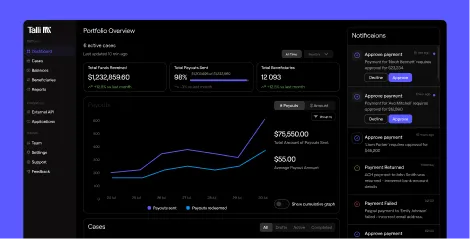
Talli supports claims teams with identity verification, OFAC screening, fraud controls, and auditable payment records.
How Digital Disbursement Can Reduce Residual Funds
Cy pres analysis often depends on whether further direct distribution is practical. Electronic payment methods can change that assessment by reducing printing, postage, returned-mail, reconciliation, and reissuance work.
Available methods may include:
- ACH transfers
- Prepaid cards
- PayPal
- Venmo
- Gift cards
- Wire transfers
- Paper checks as a fallback
The appropriate method depends on claimant preferences, award size, court requirements, accessibility, and provider pricing. Costs should be verified through the provider’s actual agreement rather than treated as universal market rates.
A multi-channel payout process can also allow claimants to choose a method they recognize and can access. This is especially important for people without traditional bank accounts.
Other tools that can improve completion include:
- Email and SMS reminders
- Mobile-friendly payment selection
- Address and contact updates
- Real-time payment status
- Simple identity-verification steps
- Rapid handling of failed payments
- Accessible claimant support
Talli’s platform provides multiple payment options, automated reminders, segregated settlement accounts, compliance controls, and real-time tracking for legal distributions.
Fund Segregation and Reporting
Settlement funds may be held through a Qualified Settlement Fund under IRC Section 468B when the legal and tax requirements are satisfied. A QSF is not mandatory for every settlement, and its use does not determine whether cy pres is permissible.
Administrators should maintain:
- Matter-level fund accounting
- Separation from operating funds
- Records of every incoming and outgoing transfer
- Approved recipient documentation
- Court orders and settlement agreements
- Reconciliation records
- Reports showing direct and residual distributions
Talli’s audit trail tools help claims teams track payment activity and prepare court-ready reporting.
Compliance for Cy Pres Payments
Compliance obligations depend on the court order, settlement structure, account type, recipient, and payment method.
Administrators should consider:
- Verification of the recipient’s legal identity
- Confirmation of tax-exempt status when relevant
- Screening required by institutional or sanctions policies
- Review of recipient relationships and potential conflicts
- Confirmation that the payment matches the court order
- Tax analysis of any reporting obligation
- State unclaimed-property law where applicable
- Documentation of how the recipient used the award
Payments to qualifying tax-exempt organizations are generally exempt from Forms 1099-MISC and 1099-NEC, although exceptions may apply. Administrators should not automatically issue a Form 1099 solely because a cy pres payment exceeds a general dollar threshold.
State escheatment also requires case-specific analysis. Some settlement agreements authorize cy pres, while others require redistribution, reversion, or transfer under unclaimed-property law.
Why Talli Helps Minimize Cy Pres
Cy pres remains useful when funds genuinely cannot be distributed to class members. It should not become the default response to avoidable payment friction.
Talli helps claims administrators reduce residual balances through:
- Multiple claimant payment methods
- Automated email and SMS reminders
- Unbanked claimant options
- Built-in KYC and OFAC workflows
- Fraud and duplicate-claim controls
- Complete fund segregation
- Real-time payout tracking
- Court-ready audit records
- Failed-payment resolution workflows
- Scalable bulk distribution
The AB Data case study reported a 30% increase in claimant redemption rates and a 60% reduction in unresolved exceptions and manual reissuance work. These results are more useful than unsupported universal cost claims because they show the performance of a defined implementation.
For claims teams preparing a settlement motion, Talli can help document the practical steps taken to reach class members, deliver payments, resolve exceptions, and account for every residual dollar.
Frequently Asked Questions
What Is Cy Pres in a Data Breach Settlement?
Cy pres is a court-approved method for directing settlement funds that cannot feasibly be distributed to class members. The recipient should have a meaningful connection to the lawsuit, the alleged harm, and the class’s interests. It normally operates after direct distributions and other practical payment options have been considered.
Must Cy Pres Represent Only a Small Percentage?
Courts generally prefer direct compensation, but there is no universal percentage limit applying to every federal case. The expected cy pres amount, direct class recovery, settlement structure, circuit precedent, and availability of additional distributions all affect whether the provision is fair under Rule 23.
How Do Courts Select Cy Pres Recipients?
Courts examine the recipient’s mission, geographic reach, relationship to the alleged harm, proposed use of funds, and connections to counsel, the parties, or the court. The parties should provide a documented selection rationale and disclose relationships that could create an actual or apparent conflict.
Can Digital Payments Reduce Cy Pres Amounts?
Yes. Electronic payment choices, automated reminders, updated contact information, and faster failed-payment resolution can help more class members complete distributions. Results depend on settlement design and claimant behavior, so administrators should support projections with provider data and case-specific evidence.
Does Every Cy Pres Payment Require a Form 1099?
No. Payments to qualifying tax-exempt organizations are generally exempt from Forms 1099-MISC and 1099-NEC, subject to exceptions. The administrator should confirm the recipient’s status and obtain case-specific tax advice rather than applying a general reporting threshold automatically.