.svg)


.svg)
Cy pres motions face close review because residual settlement funds are intended to benefit class members as nearly as practicable. Class counsel must show why additional direct distributions are not feasible, why the proposed recipient has an appropriate connection to the litigation, and how the funds will be controlled and reported.
Effective class action settlement administration begins before residual funds arise. A distribution plan that combines accessible payment methods, structured reminders, documented reissuance procedures, and accurate reporting can maximize direct recovery and reduce the amount ultimately considered for cy pres.
Key Takeaways
- Direct distributions to class members generally take priority over cy pres when further payments are economically and administratively feasible.
- A motion should explain the connection among the recipient, the class, the alleged harm, and the objectives of the underlying statutes.
- California, Illinois, and Washington impose different statutory or court-rule requirements for residual funds.
- Recipient relationships with counsel, defendants, judges, or related organizations should be fully disclosed.
- A second distribution, increased claimant payments, escheat, or another alternative may need to be considered before cy pres.
- The motion should document claims activity, uncashed payments, reissuance efforts, administrative costs, and the final residual calculation.
- Digital payment options and automated reminders can reduce undelivered payments before a cy pres request becomes necessary.
- Any proposed recipient should be vetted for legal eligibility, operational capacity, financial controls, geographic reach, and conflicts.
- Court approval should precede any transfer of residual funds.
- Post-distribution reporting should match the settlement agreement and the court’s order.
Understanding the Cy Pres Doctrine
What Is Cy Pres?
The term cy pres comes from the French phrase cy pres comme possible, meaning “as near as possible.” In class action administration, it generally describes a court-approved distribution of funds to an organization or program when further direct distribution to class members is not practicable.
Cy pres may be considered when:
- Eligible class members cannot be identified or located after reasonable efforts
- A residual remains after checks, digital payments, and reissuances
- Another direct distribution would provide little practical benefit compared with its cost
- The settlement agreement authorizes a residual distribution
- Governing state law or a court rule directs how residual funds must be handled
Cy pres is not the only possible treatment. Depending on the agreement and governing law, alternatives may include a second distribution, increased payments to claimants, escheat, reversion, or another court-approved use.
Under Federal Rule 23, a federal court must determine whether a proposed class settlement is fair, reasonable, and adequate. That review includes the distribution plan and any provision governing residual funds.
Why Courts Prefer Direct Recovery
The Third Circuit’s decision in In re Baby Products Antitrust Litigation explained that cy pres distributions may be permissible but are generally inferior to payments that directly compensate class members. The court vacated approval where approximately $3 million was expected to reach class members while a much larger portion could go to charitable recipients.
The decision does not prohibit cy pres. It requires courts and counsel to examine the actual benefit delivered to the class and consider whether settlement design could place more money in class members’ hands.
Class counsel should therefore avoid presenting cy pres as the default destination for unused funds. The motion should establish that reasonable direct-distribution measures have been completed or carefully evaluated.
Important Appellate Frameworks
Several decisions shape modern cy pres analysis:
- In re Baby Products: Direct compensation should remain the primary objective, and courts should evaluate the amount the class is likely to receive.
- Lane v. Facebook: The Ninth Circuit upheld a cy pres-only settlement after finding an adequate connection between the recipient’s activities, the privacy claims, and the class.
- Nachshin v. AOL: The Ninth Circuit rejected recipients whose work did not adequately match the objectives of the lawsuit, the class, or its geographic scope.
- Dennis v. Kellogg: The Ninth Circuit rejected a proposed recipient where the settlement record did not establish an appropriate connection to the false-advertising claims.
- Hawes v. Macy’s: A federal district court rejected a settlement because the proposed recipient’s broad consumer work did not adequately match claims involving allegedly inflated bedsheet thread counts.
These cases show why the motion must analyze the recipient’s programs rather than relying on general descriptions such as “consumer advocacy” or “public interest work.”
Selecting an Appropriate Cy Pres Recipient
Establish a Meaningful Nexus
The required connection varies by jurisdiction, but the motion should ordinarily address four dimensions.
The Underlying Harm
Identify the injury alleged in the complaint. Examples include unauthorized disclosure of personal data, deceptive pricing, employment discrimination, anticompetitive conduct, environmental damage, or investor misinformation.
The Class Population
Explain who was affected, where class members live, and whether the recipient serves the same or a closely comparable population.
The Statutory Objectives
Connect the recipient’s proposed use of funds to the laws underlying the claims. A recipient may support enforcement, education, prevention, representation, or research directly related to those objectives.
The Funded Program
Identify the specific program that will receive the money. A restricted grant tied to relevant work is usually easier to defend than an unrestricted contribution to a large organization with many unrelated activities.
Match the Geographic Scope
A recipient’s reach should correspond to the class whenever practicable. A national class ordinarily calls for a national program or a documented method of delivering benefits across the areas where class members reside.
A regional recipient may still be appropriate when:
- The class is concentrated in that region
- The alleged conduct occurred there
- The settlement agreement provides for regional allocation
- Multiple recipients collectively cover the class
- The motion clearly explains why the geographic limitation remains reasonable
Avoid claiming nationwide impact based only on a website or occasional remote services. Provide program locations, service statistics, eligibility rules, and expected beneficiaries.
Verify Legal and Operational Eligibility
Federal law does not establish a universal requirement that every cy pres recipient be a Section 501(c)(3) organization. However, nonprofit or tax-exempt status may be required by a state statute, settlement agreement, tax structure, or court order.
Recipient vetting should confirm:
- Legal name and organizational form
- Employer Identification Number
- Tax-exempt status, when applicable
- Good standing and required registrations
- Governance and authorized signatories
- Financial statements or Form 990 filings
- Capacity to administer the award
- Ability to segregate or restrict the funds
- Reporting and record-retention procedures
- Any legal, financial, or reputational concerns
The recipient should also confirm that accepting the award will not create lobbying, tax, grant-restriction, or donor-compliance problems.
Disclose Relationships and Conflicts
The motion should disclose material connections between the proposed recipient and:
- Class counsel
- Defense counsel
- The defendant
- Named plaintiffs
- Settlement administrators
- Experts or consultants
- The presiding judge
- Immediate family members of decision-makers
- Organizations involved in selecting the recipient
Relevant relationships may include board service, donations, employment, sponsorships, speaking engagements, prior grants, advisory roles, or institutional affiliations.
A relationship does not always disqualify a recipient. Nondisclosure, however, can create the appearance that the selection process served counsel, the defendant, or the court rather than the class.
Drafting the Cy Pres Motion
Explain the Procedural Authority
Begin by identifying the provisions authorizing the request:
- The settlement agreement
- The final approval order
- The judgment
- Federal or state procedural rules
- Applicable state residual-fund statutes
- Any prior order governing redistribution
- The court’s retained jurisdiction
Quote the controlling language and explain whether the court approved the proposed recipient earlier or reserved recipient selection until the residual became known.
Do not assume that a general residual clause authorizes an immediate transfer. Some agreements require notice, another distribution, supplemental approval, or a specified calculation procedure.
Present the Complete Distribution History
The motion should provide a clear accounting of how the settlement reached its current balance.
Include:
- Gross settlement fund
- Interest and other fund income
- Approved attorney fees and expenses
- Service awards
- Taxes and tax-administration expenses
- Notice and administration costs
- Number of class members identified
- Number of claims submitted
- Number of claims approved and rejected
- Initial payment amount
- Total amount issued
- Total amount successfully delivered or negotiated
- Failed, returned, expired, or uncashed payments
- Reissuance and reminder activity
- Remaining reserve obligations
- Final amount proposed for cy pres
Link the accounting to court-ready reporting and provide a settlement-administrator declaration supporting the figures.
Document Direct-Distribution Efforts
The record should demonstrate that the administrator used reasonable methods to deliver funds.
Depending on the case, those methods may include:
- Address updating
- Email and SMS reminders
- Reissued checks
- Replacement digital payments
- Returned-payment outreach
- Claimant support
- Payment-preference collection
- Extended cashing periods
- A second distribution
- Pro rata increases to eligible claimants
- Simplified identity-verification procedures
Maintaining full audit trails allows counsel to show exactly when notices were sent, payments failed, claimant information changed, or replacement payments were completed.
Compare Cy Pres With the Alternatives
Do not state only that another distribution would be “too expensive.” Provide evidence.
A useful analysis includes:
No nationwide $5 or $10 threshold determines whether another distribution is feasible. The court needs a case-specific comparison between the likely class benefit and the actual operational cost.
Describe the Recipient and Proposed Use
For each recipient, explain:
- Its mission and primary programs
- The specific program funded by the award
- How that program relates to the alleged harm
- Who will benefit
- Where the program will operate
- The proposed award amount
- Administrative or overhead charges
- Restrictions on use
- Reporting milestones
- Procedures for unused funds
- Whether public recognition is permitted
- Whether the recipient may subcontract any work
Attach a declaration or commitment letter from an authorized representative. Avoid descriptions copied from promotional material without evidence that the funded program currently exists and can absorb the award.
Include Backup Provisions
The order should address what happens if a recipient:
- Loses nonprofit or tax-exempt status
- Cannot accept the full award
- Fails financial or compliance review
- Discontinues the relevant program
- Does not satisfy reporting conditions
- Merges, dissolves, or changes its mission
A backup recipient may be identified in advance, but the motion should clarify whether substitution requires further court approval. Class counsel should not reserve unilateral authority to redirect material settlement funds without judicial oversight.
Addressing Objections
Inadequate Nexus
Respond with evidence about the exact funded program, not merely the organization’s general mission. Show how the program addresses the same injury, protects similarly situated people, advances the relevant law, or provides services to the affected population.
Insufficient Direct Distribution
Provide the administrator’s declaration, cost analysis, failed-payment data, and results of reissuance or reminder campaigns. Explain whether a second distribution was performed and, when it was not, why it would provide limited practical value.
Resources on claimant abandonment can help counsel identify where claimants leave the process, but the motion should rely on settlement-specific data whenever possible.
Geographic Mismatch
Supply evidence showing the recipient’s service area and expected impact. For a nationwide class, consider multiple recipients, a nationally administered program, or allocation based on claimant geography.
Conflicts of Interest
Disclose the relationship directly and explain the selection process. Competitive requests for proposals, independent recommendations, written scoring criteria, and review by the settlement administrator can help demonstrate that the selection was based on class benefit.
Excessive Administrative Costs
Separate the cost of claimant distribution from the cost of administering the cy pres award. Explain whether the recipient will deduct overhead and whether monitoring requirements are proportionate to the award.
State-Specific Residual Fund Rules
California
California Code Section 384 directs qualifying unpaid residue and unclaimed or abandoned class funds to specified categories. These include nonprofit organizations or foundations supporting projects that benefit the class or similarly situated persons, projects promoting law consistent with the underlying action, child advocacy programs, and nonprofit civil legal services organizations.
Class counsel should analyze the complete statute rather than relying only on the general federal cy pres framework.
Illinois
Illinois Code of Civil Procedure Section 2-807 generally requires at least 50% of qualifying residual funds in covered state-court class actions to be distributed to eligible organizations that improve access to justice for low-income Illinois residents.
The remaining funds may be distributed as permitted by the statute and the court’s order. The article should not describe Illinois law as allowing courts to divert up to 50% from access-to-justice organizations only upon a showing of good cause.
Washington
Washington Superior Court Civil Rule 23 requires at least 25% of qualifying residual funds to be distributed to the Legal Foundation of Washington. The balance may be distributed to that foundation or another entity whose work relates directly or indirectly to the litigation’s objectives or promotes class members’ substantive or procedural interests.
These differences make a jurisdiction-specific review essential before the settlement agreement is finalized.
Reducing Residual Funds Before Cy Pres
Offer Accessible Payment Methods
The strongest cy pres motion is often supported by a distribution program designed to maximize direct recovery first.
Depending on the settlement, claimants may benefit from:
- ACH transfers
- Prepaid cards
- PayPal
- Venmo
- Gift cards
- Wire transfers
- Paper checks as a fallback
Talli supports multiple redemption options and matter-level tracking from one cloud-based platform. Its workflow can also incorporate KYC, OFAC screening, W-9 collection, fraud controls, and audit logs.
Class counsel can review claimant payment options when drafting the distribution plan.
Use Structured Claimant Communication
A single notice may not be enough to complete a payment. Reminder campaigns can address:
- Unopened payment notifications
- Incomplete payment selections
- Failed account verification
- Returned ACH transfers
- Expired prepaid-card links
- Missing tax documentation
- Uncashed checks
- Claimants who changed addresses
Resources on multi-channel payouts and failed payment resolution can help administrators build structured follow-up procedures.
Maintain Accurate Payment Records
A motion is easier to defend when the administrator can reconcile every dollar and payment status.
Useful records include:
- Issuance date
- Delivery channel
- Claimant selection
- Redemption or negotiation date
- Returned-payment reason
- Reissue history
- Identity-verification status
- Sanctions-screening result
- Tax-document status
- Support interaction
- Final disposition
Real-time tracking and automated reconciliation help preserve the evidence needed for the final accounting.
Compliance and Post-Award Controls
QSF and Fund Segregation
When a settlement fund qualifies as a QSF under Treasury Regulation Section 1.468B-1, dedicated accounts and matter-level records help prevent commingling and support tax administration, reconciliation, and court oversight.
Account segregation does not independently create or preserve QSF status. Counsel and tax advisers must confirm that the fund satisfies the regulatory requirements, including governmental approval and continuing jurisdiction.
See Talli’s QSF fund overview for additional operational context.
Recipient Verification
OFAC screening may be appropriate before transferring funds, particularly when the recipient, its controlling persons, or its accounts create cross-border or sanctions considerations. Review OFAC payment screening when designing approval controls.
For material transfers, consider:
- Verified bank instructions
- Callback confirmation
- Dual approval
- Restricted accounts
- Milestone payments
- Fraud screening
- Written acknowledgment of restrictions
- Return-of-funds provisions
Reporting Requirements
The proposed order should identify who must report, when reports are due, and what each report must contain.
Reports may include:
- Confirmation of receipt
- Program expenditures
- Administrative charges
- Number and location of beneficiaries
- Program outcomes
- Remaining balance
- Material deviations
- Conflicts discovered after approval
- Final certification of expenditure
The reporting burden should be proportional to the award while remaining sufficient for court supervision.
How Talli Supports Direct Distribution and Court Reporting
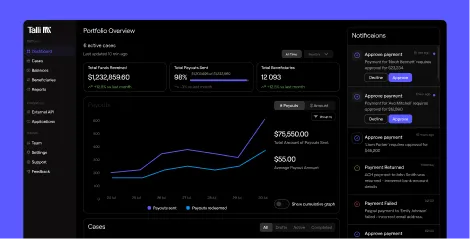
Cy pres should not substitute for a distribution program that could reasonably deliver more funds to class members. Talli helps claims teams reduce residual balances by giving claimants multiple payment options, automating reminders, resolving failed payments, and tracking each distribution from issuance through completion.
The platform is designed for legal settlement disbursements and provides matter-level visibility, built-in compliance workflows, and auditable payment records. Claims teams can monitor redemption, returned payments, claimant communications, and remaining balances without relying on disconnected spreadsheets. Talli’s platform description confirms support for ACH, prepaid Mastercard, PayPal, Venmo, gift cards, compliance controls, and real-time tracking.
When a residual remains, those records help class counsel explain:
- How much was distributed directly
- Which payment attempts failed
- What reissuance measures were used
- Why another distribution is or is not feasible
- How the residual amount was calculated
- Whether all required reserves remain funded
- When the court-approved recipient received the funds
By improving direct distribution and preserving a complete audit trail, Talli helps class counsel create a stronger factual record before requesting cy pres approval.
Frequently Asked Questions
What Is the Typical Timeline for a Cy Pres Motion?
There is no universal timeline. A motion generally follows completion of claims review, direct payments, the check-cashing or redemption period, reissuances, and any required second distribution. Objections, supplemental briefing, appeals, recipient vetting, and unresolved tax or claimant issues can extend the process.
Can Class Members Object to a Cy Pres Distribution?
Yes. Class members may challenge the recipient’s connection to the lawsuit, the fairness of the selection process, conflicts of interest, geographic reach, or the adequacy of direct-distribution efforts. The applicable objection procedure depends on the settlement, prior notices, governing law, and the court’s orders.
How Do Attorney Fees Interact With Cy Pres?
Section 1712 governs fees in coupon settlements, not every settlement containing cy pres. In other cases, courts may still examine actual class recovery, requested fees, administration costs, and the amount directed to recipients when deciding whether the settlement and fee request are reasonable.
What Happens if the Recipient Cannot Accept the Award?
The settlement agreement or proposed order should identify a backup process. A substitute recipient may require further court approval, especially when the original recipient was material to the fairness analysis. Counsel should avoid transferring funds to an alternative organization without authority from the court.
Is There a Minimum Amount Before Cy Pres Applies?
No universal dollar threshold applies. Courts consider the residual amount, number of eligible claimants, expected payment, distribution cost, contact-data quality, previous redemption, and available alternatives. Counsel should provide a settlement-specific analysis showing why further direct payment is not reasonably practicable.