.svg)


.svg)
Escheatment transfers unclaimed financial property to state custody after statutory dormancy periods, typically 3-5 years for bank accounts and as short as 1 year for wages. With one in seven Americans holding unclaimed property and states collectively managing tens of billions in escheated funds, understanding this process is critical for fiduciaries, trustees, and administrators managing legal settlements. Modern digital disbursement platforms can dramatically reduce escheatment risk by achieving 95-98% redemption rates compared to 70-80% for traditional paper checks, preventing funds from ever entering the dormancy cycle.
Key Takeaways
- Escheatment requirements apply across all 50 states, the District of Columbia, and applicable U.S. territories, with dormancy periods, reporting rules, and due diligence requirements varying by jurisdiction
- Dormancy periods range from 1 year for wages to 5-7 years for securities depending on state and property type
- Due diligence requirements vary by state, with each jurisdiction establishing its own timing, property-value thresholds, notice methods, and required language before unclaimed property is reported
- An estimated 65-90% of companies remain non-compliant with unclaimed property laws
- State audit lookback periods extend 10-15 years, exposing holders to significant retroactive liability
- States return billions of dollars in unclaimed property to owners each year, but preventing payments from becoming dormant can reduce administrative work for holders and help recipients receive funds sooner
Understanding Escheatment: Definition and Core Principles
What Is Escheatment?
Escheatment is the legal process whereby financial institutions and businesses transfer unclaimed property to state governments after prescribed dormancy periods. The term originates from English common law, where property without legal heirs reverted to the crown. Today, states act as custodians rather than permanent owners, meaning rightful owners or heirs can theoretically reclaim escheated property indefinitely.
Property subject to escheatment includes:
- Bank accounts and certificates of deposit
- Uncashed checks including payroll, dividend, and settlement payments
- Securities such as stocks, bonds, and mutual fund shares
- Insurance proceeds and annuity payments
- Customer refunds and credit balances
- Gift cards and stored value accounts
Key Principles of Unclaimed Property Laws
The foundational principle underlying escheatment is consumer protection. States hold funds as custodians to reunite owners with their property. Unlike asset forfeiture, escheated property can be reclaimed in perpetuity by rightful owners or heirs, with states maintaining searchable databases and outreach programs.
Three parties interact in every escheatment scenario:
- Owner: The individual or entity entitled to the property
- Holder: The business or institution currently holding the property
- State: The government acting as custodian until the owner claims funds
The Escheatment Process: From Unclaimed Funds to State Custody
Steps in the Escheatment Lifecycle
The escheatment process follows a predictable sequence that fund holders must understand to maintain compliance:
1. Dormancy Period Begins
Property becomes "dormant" when owners fail to demonstrate activity: deposits, withdrawals, correspondence, or login attempts. Definitions of inactivity vary by state, with some requiring returned mail triggers while others deem accounts dormant based solely on lack of owner-initiated contact.
2. Due Diligence Requirements
Before escheating property, holders must perform reasonable efforts to contact owners. Requirements typically include mailing letters to last known addresses before reporting, with specific language requirements in many jurisdictions. Some states now accept email notifications if owners previously consented.
3. Reporting and Remittance
Holders file annual reports with state unclaimed property divisions, typically following NAUPA-format electronic submissions. Many states use fall reporting deadlines, often around October or November, while others follow different reporting cycles. Holders must follow the specific reporting and remittance deadlines established by each applicable jurisdiction.
4. State Custody
Once received, states maintain funds and attempt owner reunification through searchable databases, media campaigns, and direct outreach. States may eventually liquidate escheated securities under state-specific procedures and holding rules, which can leave owners entitled to cash proceeds rather than the original securities and may affect their exposure to subsequent market gains.
Reporting Unclaimed Property to the State
Annual reporting cycles vary by jurisdiction:
- Spring reporting (March 1-May 31): Select states
- Summer reporting (June 15-July 1): Only 3 states
- Fall reporting (October 31-November 1): Majority of states
Holders must maintain comprehensive documentation including proof of due diligence attempts, returned mail evidence, and owner contact histories for potential audits.
State-Specific Escheatment Requirements: California, Pennsylvania, and Maryland
California's Unclaimed Property Program
California's unclaimed property laws generally apply three-year dormancy periods to many common property types, although the applicable period depends on the property. The California State Controller's Office administers the state's Unclaimed Property Program. The state secured a $7.7 million settlement from a healthcare provider in September 2023 for unclaimed property violations.
California's new Voluntary Compliance Program offers 12% annual interest waivers for companies that proactively disclose unreported property, providing a pathway to compliance without punitive penalties.
Pennsylvania Escheatment Regulations
Pennsylvania requires reporting across multiple property types with varying dormancy periods. The state participates in the States' Unclaimed Property Clearing House, enabling streamlined multi-state reporting and coordination for retirement benefits.
Maryland's Office of the Comptroller
Maryland enacted H.B. 761 in 2025 to modernize its abandoned-property rules, including provisions governing electronic communications with apparent owners and circumstances in which holders must follow up by first-class mail.
The Impact of Escheatment on Fund Holders: Risks and Costs
Financial and Operational Implications
The hidden cost of settlements extends far beyond the unclaimed amounts themselves. Fund holders face:
- Compliance costs: Staff time, software licensing, and professional services for multi-jurisdictional tracking
- Audit exposure: State examinations with 10-15 year lookback periods lasting 2-7 years
- Penalty accumulation: Interest charges, late fees, and potential treble damages under false claims acts
- Reputational damage: Client trust erosion when funds reach state custody
Delaware collected $607.1 million in gross unclaimed property receipts in fiscal 2017, with $248 million from escheated stock alone, demonstrating the scale of state enforcement activity.
The Cost of Uncashed Checks in Legal Settlements
For settlement administrators, uncashed settlement checks create cascading problems. Paper checks have 20-30% non-redemption rates, with each uncashed check costing approximately $150 for tracking and reissuance before eventual escheatment. States view settlement funds as prime escheatment targets due to their concentrated value and limited owner contact periods.
New York obtained a $4.4 million settlement from a gift card company in December 2023, highlighting enforcement across multiple property types.
Reclaiming Your Money: How to Perform a Free Unclaimed Money Search
Accessing State Unclaimed Property Databases
Every state maintains searchable databases where individuals can check for escheated property in their name. The National Association of Unclaimed Property operates MissingMoney.com, providing multi-state search capabilities from a single interface.
To search effectively:
- Check all states where you've lived, worked, or done business
- Search maiden names and name variations
- Include deceased relatives whose property may remain unclaimed
- Review business names for corporate accounts
Federal Agencies Holding Unclaimed Funds
Beyond state programs, federal agencies maintain unclaimed property including:
- IRS: Undelivered tax refund checks
- Treasury Department: Matured savings bonds
- Pension Benefit Guaranty Corporation: Unclaimed pension benefits
- HUD: FHA mortgage insurance refunds
Tips for a Successful Unclaimed Money Search
Claims processing times vary by state and claim complexity, and owners may need to provide identification, address history, estate records, or other documentation establishing their right to the property.
Preventing Escheatment: Strategies for Fund Holders and Legal Settlement Administrators
Best Practices for Minimizing Unclaimed Funds
Preventing funds from becoming dormant can reduce reporting and administrative burdens while helping owners receive their property before it enters the state unclaimed-property system.
Effective prevention strategies include:
- Address verification: Validate recipient information before payment issuance
- Multi-channel outreach: Contact owners via mail, email, and phone before dormancy triggers
- Activity monitoring: Track account engagement to identify at-risk balances early
- Digital payment options: Offer ACH, prepaid cards, and digital wallets alongside paper checks
- Reminder campaigns: Automated notifications for pending payments
The Role of Technology in Escheatment Prevention
Modern settlement administration software integrates escheatment prevention into payment workflows rather than treating compliance as a separate back-office function. Key capabilities include:
- Automated dormancy tracking across multiple jurisdictions
- Real-time payment status monitoring identifying failed deliveries
- Digital due diligence with delivery verification
- Court-ready audit trails documenting all contact attempts
Use Talli's uncashed check calculator to estimate your potential escheatment exposure and identify opportunities for digital payment adoption.
Escheatment in Legal Settlements: A Critical Concern
The Unique Escheatment Challenges of Legal Payouts
Class action and mass tort distributions face heightened escheatment risk due to several factors:
- One-time contact: Limited opportunity to establish ongoing owner relationships
- Address decay: Settlement timelines extend years beyond initial claim filing
- Small-dollar amounts: Recipients may not prioritize depositing modest checks
- Population characteristics: Claimants may include transient or hard-to-reach individuals
The consequence is substantial. Settlement administrators managing hundreds of thousands of claimants can face millions in unclaimed funds requiring multi-state reporting and documentation.
Protecting Qualified Settlement Funds from Unclaimed Property Laws
Qualified Settlement Funds (QSFs) under IRC Section 468B require careful settlement escheatment planning. Fund segregation architecture must maintain separate tracking for each settlement while preparing for potential escheatment across multiple jurisdictions.
January 2025's DOL Field Assistance Bulletin established a temporary ERISA enforcement policy for fiduciaries that voluntarily transfer certain small retirement benefit payments owed to missing participants or beneficiaries to eligible state unclaimed-property funds, subject to specified fiduciary and state-fund conditions.
Legal Frameworks and Abandoned Property Laws
The Uniform Unclaimed Property Act
The Revised Uniform Unclaimed Property Act (RUUPA 2016) attempted standardization across states, but only approximately 12 states adopted it fully. Since 2023, no new states have adopted RUUPA, with many instead passing non-uniform legislation that shortens dormancy periods contrary to the model act.
Understanding abandoned property laws requires recognizing the distinction between real and personal property. Escheatment typically applies to intangible personal property (financial assets), while real property follows different adverse possession rules.
Priority Rules for Multi-State Holdings
When determining which state receives escheated property, courts apply priority rules:
- First Priority: The state of the owner's last known address, as shown in the holder's records
- Secondary Priority: Generally, the holder's state of incorporation or corporate domicile when the primary rule cannot apply
- Special Rules: Certain instruments, including some money orders and traveler's checks, are governed by separate federal statutory rules
These rules create particular challenges for holders incorporated in Delaware, a state of incorporation for many companies that aggressively enforces secondary priority claims.
Comparing Digital Payouts to Traditional Checks: An Escheatment Perspective
Why Digital Payments Reduce Escheatment Risk
Paper checks carry inherent escheatment risk through 20-30% non-redemption rates. Digital payment alternatives, ACH direct deposit, prepaid cards, and digital wallets, achieve 95-98% redemption rates by removing friction from the payment experience.
Digital payment advantages include:
- Instant delivery: Recipients access funds within 24-48 hours versus weeks for mail
- No lost checks: Electronic delivery eliminates address-related failures
- Activity tracking: Digital platforms verify recipient engagement
- Reduced costs: Processing drops from $7-20 per check to $0.25-$5 for digital payments
The Hidden Costs of Paper Checks in Settlements
Each uncashed settlement check costs approximately $150 for tracking and reissuance efforts before eventual state escheatment. Multiply this across thousands of claimants, and paper check programs face millions in hidden unclaimed settlement costs beyond the face value of unclaimed amounts.
The shift to digital-first disbursement transforms escheatment from an inevitability into a preventable exception, protecting both claimants and administrators from the costs and complications of state custody transfers.
Why Talli Simplifies Escheatment Prevention for Legal Settlements
While escheatment compliance traditionally requires separate systems for payment processing, dormancy tracking, and due diligence documentation, Talli delivers integrated infrastructure purpose-built for legal settlement administration.
Talli's digital disbursement platform addresses escheatment risk at its source through:
- 95-98% redemption rates: Multi-channel payment options, ACH, prepaid Mastercard, PayPal, Venmo, and gift cards, ensure claimants actually receive and access funds
- 24-48 hour delivery: Compressed timelines reduce address decay and increase redemption before dormancy triggers begin
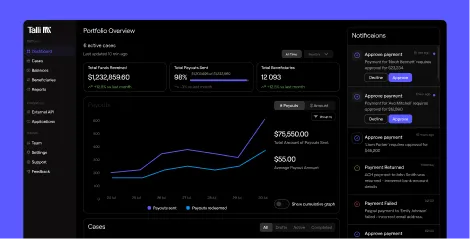
- Real-time tracking: Live dashboards monitor completion rates, identify failed deliveries, and flag at-risk payments requiring intervention
- Automated compliance: Integrated OFAC screening, KYC verification, and W-9 collection with 90% completion rates
- Court-ready audit trails: Complete documentation of all payment attempts and claimant communications for regulatory reviews
Unlike generic payment processors requiring extensive customization, Talli embeds QSF compliance directly into disbursement workflows. Dedicated FBO account structures preserve Qualified Settlement Fund tax treatment while maintaining fund segregation that simplifies multi-state escheatment reporting when required.
For claims administrators, class action law firms, and bankruptcy trustees managing high-volume legal payouts, Talli eliminates the operational gap between payment delivery and escheatment prevention, transforming a compliance burden into streamlined infrastructure that protects client assets while accelerating claimant access to settlement funds.
Frequently Asked Questions
What is the typical dormancy period before property escheats to the state?
Dormancy periods vary significantly by state and property type. Bank accounts typically have 3-5 year dormancy periods, while wages and payroll checks can trigger after just 1 year. Securities range from 3-7 years depending on state requirements. Some states have accelerated dormancy to 2 years following owner death across all property types, not just life insurance.
Can I reclaim money that has already escheated to the state?
Yes, most states allow owners to reclaim escheated property indefinitely, as states act as custodians rather than permanent owners. However, securities are typically liquidated upon transfer, meaning you'll receive sale proceeds rather than the original shares. Claims processing times vary by state and complexity, and owners may need to provide identification, address history, estate records, or other documentation establishing their right to the property.
What responsibilities do businesses have regarding unclaimed property?
Businesses holding unclaimed property must track dormancy periods across multiple jurisdictions, perform due diligence by notifying owners before reporting, file annual reports with applicable states, and maintain documentation for potential audits with 10-15 year lookback periods. Failure to comply can result in interest charges, penalties, and false claims litigation.
How do states use escheated funds?
States hold escheated funds in custodial accounts while attempting to reunite owners with their property through searchable databases and outreach campaigns. State unclaimed-property programs returned more than $5 billion to rightful owners in FY2023, according to the National Association of Unclaimed Property Administrators. However, unclaimed balances may be used for state general fund purposes, making escheatment a significant revenue source for many jurisdictions, the third largest line-item in some state budgets.
Is there a federal escheatment program, or is it solely state-governed?
Escheatment and unclaimed-property compliance are primarily governed by state law, although federal statutes and regulations can affect or preempt state rules for certain property types and federally regulated benefits. Federal agencies do hold unclaimed property including IRS tax refunds and Treasury savings bonds. The January 2025 DOL Field Assistance Bulletin established a temporary ERISA enforcement policy for certain small retirement benefit payments transferred to eligible state unclaimed-property funds, marking rare federal-state coordination in this area.