.svg)


.svg)
Escheatment transfers unclaimed financial property to state custody after prescribed dormancy periods, affecting one in seven people with unclaimed property waiting to be recovered. For organizations managing legal settlements, bankruptcy distributions, or shareholder payments, escheatment represents both a regulatory burden and a preventable cost center. Modern digital disbursement platforms can achieve 95-98% redemption rates compared to 70-80% for traditional paper checks, fundamentally preventing funds from entering the dormancy cycle that leads to state transfer.
Key Takeaways
- Escheatment transfers unclaimed property to states after dormancy periods ranging from 1-5 years, with significant variation by state and property type
- One in seven people has unclaimed property held by state governments, totaling tens of billions nationwide
- Paper checks create 20-30% non-redemption rates versus 2-5% for digital payments
- Each uncashed settlement check costs approximately $150 for tracking and reissuance before eventual state transfer
- State audit lookback periods extend 10-15 years, requiring comprehensive documentation
- California charges 12% annual interest penalties while Delaware imposes penalties up to $25,000 plus 25% of unreported property for certain willful failures
- Digital disbursement platforms achieve 95-98% redemption rates, eliminating 80-90% of escheatment exposure
Understanding Escheatment: What Happens to Unclaimed Money?
Defining Escheatment: A Legal Overview
Escheatment is the legal process by which unclaimed financial property transfers to state custody after owners fail to demonstrate activity for specified periods. The term derives from medieval law where property reverted to the crown when owners died without heirs. Today, all 50 states, the District of Columbia, and U.S. territories maintain unclaimed property programs that hold funds until rightful owners claim them.
The escheatment process follows a standard sequence:
- Identification: Holders identify dormant property based on inactivity thresholds
- Due diligence: Required owner outreach before reporting, with timing and notice requirements varying by state and property type
- Reporting: Annual submission to state unclaimed property divisions
- Transfer: Assets move to state custody where they're held indefinitely
Common Causes of Unclaimed Funds
Funds become unclaimed through various circumstances that compound in high-volume disbursement environments:
- Address changes without updated records
- Forgotten accounts after employment or service changes
- Unredeemed checks lost in mail or ignored
- Deceased owners without proper beneficiary designations
- Corporate restructuring disrupting payment records
- Small balances considered not worth claiming
For settlement administrators managing thousands of claimants, these factors multiply exponentially. Class action settlements often involve one-time contact with recipients who may have moved, making traditional paper-based distribution particularly vulnerable to dormancy.
The Role of State Governments in Escheatment
States act as custodians rather than owners of escheated property, holding funds until claimed while often using them for general revenue. Unclaimed property represents a significant line item in some state budgets, creating enforcement incentives that have intensified recently.
Delaware collected over $600 million in gross unclaimed property receipts in a recent fiscal year, with significant amounts from escheated stock alone. Pennsylvania holds approximately $5 billion in unclaimed property. Nationally, state unclaimed property programs return billions of dollars to rightful owners each year.
How to Find and Claim Unclaimed Money: A Free Search Guide
Utilizing State Unclaimed Property Databases
Every state maintains free searchable databases for unclaimed property. The National Association of Unclaimed Property Administrators provides links to all state programs. MissingMoney.com offers multi-state search capabilities, though individual state searches remain more comprehensive.
Key resources include state treasury websites with property-specific search tools, federal agencies including IRS and Treasury for specific claim types, and multi-state database portals for broader searches.
Step-by-Step Guide to Claiming Your Funds
The claims process varies by state but generally follows these steps:
- Search databases using current and previous names, addresses, and variations
- Verify ownership by matching property details with your records
- Submit claim forms with required documentation
- Provide identification including government ID and proof of address
- Demonstrate ownership through account statements, tax records, or other documentation
- Await verification which can take 30-180 days depending on state and amount
Most states require claims for property they hold. There are no fees for searching or claiming your own property through official state channels.
Avoiding Scams: What to Look For
Legitimate unclaimed property programs never charge fees for searches or require upfront payments. Be wary of finder services charging 10-35% of property value, requests for financial information beyond identification, and pressure tactics demanding immediate action. State unclaimed property offices provide free assistance. Only use official .gov websites for searches and claims.
Navigating Unclaimed Property by State: From CA to PA
California's Unclaimed Property Program
California applies 3-year dormancy to most property types with specific requirements:
- Notice Report: Due before November 1 for most holders
- Remit Report: Generally due June 1-15 of the following year
- Due diligence: Generally required 6-12 months before property becomes reportable
- Penalties: 12% annual interest on late-reported property
- Voluntary compliance: Program available with interest waivers
California secured a $7.7 million settlement from a healthcare provider in September 2024 for failing to escheat patient overpayments, signaling intensified enforcement.
Pennsylvania's Treasury for Unclaimed Property
Pennsylvania maintains distinct requirements including:
- Reporting period: January 1 to December 31
- Deadline: April 15 of following year
- Interest: 12% annual rate on unreported property
- Auto-return program: Pennsylvania's Money Match program, created by Act 81 of 2024 and launched in 2025, allows Treasury to automatically return certain verified single-owner properties valued up to $500
Pennsylvania's auto-return innovation demonstrates states' growing recognition that returning property serves public interest better than perpetual custody.
Maryland's Unclaimed Property Division
Maryland recently modernized its program with email notifications authorized as of October 2025 with first-class mail fallback, 3-year dormancy periods for most property, and searchable databases with online claims processing.
Preventing Escheatment: Best Practices for Businesses and Individuals
Maintaining Up-to-Date Records
Prevention starts with accurate record-keeping that eliminates the conditions leading to dormancy:
- Regular address verification through postal service databases
- Multiple contact methods including email, phone, and physical mail
- Beneficiary updates triggered by life events
- Account activity prompts encouraging periodic engagement
- Digital communication preferences for faster, trackable outreach
Strategies for Proactive Communication
Effective due diligence extends beyond minimum compliance requirements:
- Early outreach before dormancy periods trigger
- Multiple contact attempts across different channels
- Clear messaging explaining consequences of inaction
- Easy response mechanisms reducing friction
- Documented attempts creating audit trails
Organizations managing settlement distributions should implement communication strategies specifically designed for one-time payment recipients who have no ongoing relationship.
The Importance of Regular Account Review
For individuals, preventing escheatment requires periodic attention through annual account inventory across all financial institutions, login activity demonstrating engagement with dormant accounts, address updates filed promptly after moves, beneficiary reviews following life changes, and document retention proving ownership if claims become necessary.
The Cost of Unclaimed Funds: Why Businesses Must Act
Financial Impact of Uncashed Checks
The true cost of uncashed settlement checks far exceeds face value. Each unredeemed paper check triggers cascading expenses:
- Initial issuance: $7-20 including printing, postage, and reconciliation
- Tracking costs: Around $150 per uncashed check for reissuance attempts
- Administrative burden: Staff time for exception handling
- State reporting: Compliance preparation and submission
- Eventual transfer: Loss of funds plus potential penalties
For a class action with 250,000 claimants and 25% non-redemption, these costs multiply to millions in administrative burden before funds even transfer to states.
Regulatory Scrutiny and Penalties
Enforcement has intensified significantly. Beyond California's $7.7 million settlement, New York obtained $4.4 million from a gift card company in December 2024. Penalties vary by jurisdiction:
- California: 12% annual interest on unreported property
- Delaware: $1,000 per day for certain willful failures, capped at $25,000, plus 25% of property that should have been reported or delivered
- Texas: 5% of the property value for late delivery, an additional 5% after 30 days, plus 10% annual interest on overdue property
- General: 10-15 year lookback periods during audits
An estimated 65-90% of companies remain non-compliant with unclaimed property laws, creating substantial audit exposure.
From Paper to Digital: Reducing Escheatment Through Modern Disbursement
The Inefficiencies of Traditional Check Systems
Paper checks create systemic escheatment risk through inherent limitations:
- Address decay: Settlement timelines spanning years mean addresses change
- Mail failures: Lost, damaged, or stolen checks require reissuance
- Cashing friction: Recipients must physically deposit checks
- Processing delays: Weeks between issuance and potential redemption
- Limited tracking: Visibility ends at postal handoff
Traditional methods produce 20-30% non-redemption rates, with each unredeemed payment entering the dormancy cycle.
How Digital Platforms Improve Redemption Rates
Digital disbursement solutions fundamentally change the redemption equation:
- ACH direct deposit: Funds arrive in 1-2 days at $0.25-$0.50 per transaction
- Prepaid cards: Virtual delivery via SMS or email in 30 seconds
- Digital wallets: PayPal, Venmo integration for instant access
- Gift cards: Highest redemption for small-value distributions
- Real-time tracking: Visibility from initiation through completion
Digital platforms achieve 95-98% redemption rates, reducing potential escheatment exposure by 80-90%.
Reducing Administrative Overhead Through Automation
Modern platforms automate compliance-heavy processes including dormancy tracking across multiple jurisdictions simultaneously, due diligence communications with documented timestamps, KYC verification achieving 90% W-9 completion rates, OFAC screening with automated sanctions checking, and audit trail generation for court-ready documentation.
Automation transforms escheatment from an inevitability into a preventable exception through proactive infrastructure rather than reactive compliance.
Ensuring Compliance and Security in Fund Distributions
Automating Regulatory Checks for Payouts
Compliance automation eliminates manual errors while ensuring regulatory adherence:
- KYC verification cross-referencing identity databases
- OFAC screening against U.S. Treasury sanctions lists
- W-9 collection via digital forms with smart reminders
- 1099 generation with IRS e-filing integration
- 24% backup withholding calculation for missing TIN numbers
Integrated compliance infrastructure operates automatically, reducing the administrative burden that often leads to deferred payments and subsequent dormancy.
Protecting Funds with QSF-Compliant Architecture
Qualified Settlement Fund compliance requires specific fund handling that prevents commingling and maintains tax treatment:
- Dedicated FBO accounts for each settlement
- Complete fund separation from operating capital
- Fund segregation for QSF workflows: Dedicated accounts help keep settlement assets separate while supporting distributions from Qualified Settlement Funds structured under IRC Section 468B
- Matter-level tracking for court reporting
- Bank-held settlement accounts, with deposit insurance coverage determined under applicable FDIC ownership and pass-through insurance rules
Proper fund segregation simplifies compliance while reducing the risk of funds becoming lost in operational accounts where they might trigger dormancy.
Maintaining Audit-Ready Documentation
Audit trail requirements for escheatment compliance demand comprehensive records including payment initiation with timestamps and approvals, delivery confirmation proving funds reached recipients, communication logs documenting outreach attempts, exception handling records for failed payments, and state reporting preparation and submission verification.
Digital platforms generate these records automatically, eliminating the manual documentation that often proves incomplete during 10-15 year lookback audits.
Activating Dormant Accounts and Reclaiming Funds
Steps to Reactivate a Dormant Bank Account
Before escheatment occurs, dormant accounts can typically be reactivated by contacting the financial institution to verify dormancy status, providing identification including government-issued ID, verifying ownership through account details, completing required forms for reactivation, and initiating activity through deposit, withdrawal, or other transaction.
Preventing Future Dormancy
Maintain account activity through simple periodic actions including annual login to online accounts, small transactions such as minimal deposits, correspondence responses to any institution communications, contact updates filed promptly after moves, and beneficiary reviews following life events.
Why Talli Prevents Escheatment at the Source
While escheatment compliance software helps manage reporting obligations, Talli takes a fundamentally different approach by preventing funds from becoming unclaimed in the first place.
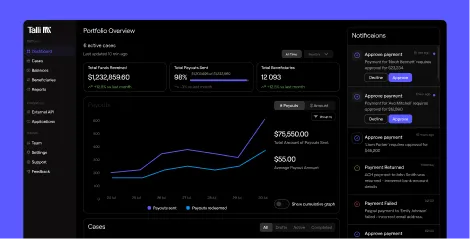
Talli's digital disbursement platform addresses escheatment at its source through multi-channel payment options where recipients choose ACH, prepaid Mastercard, PayPal, Venmo, or gift cards to match their preferences and maximize redemption. Funds reach recipients within 24-48 hours before addresses decay or recipients forget about payments.
Real-time tracking provides complete visibility from payment initiation through redemption. Integrated compliance features automate KYC, OFAC screening, and W-9 collection with 90% completion rates, while QSF-compliant architecture maintains dedicated FBO accounts for Qualified Settlement Fund tax treatment under IRC Section 468B.
For class action settlements, mass tort distributions, and bankruptcy payouts, Talli's platform achieves 95-98% redemption rates compared to 70-80% for paper checks, reducing escheatment exposure by 80-90%.
The AB Data case study demonstrates this impact with a 30% increase in claimant redemption rates, 60% reduction in unresolved exceptions, and 100% fiduciary compliance maintained across all distributions. As AB Data's President & CEO noted, digital disbursement provides "the regulated payout rails we needed to move faster, reduce unclaimed funds, and give courts full confidence in how settlement money is being distributed."
For organizations managing high-volume legal settlements where escheatment costs multiply across thousands of payments, Talli's prevention-first approach delivers measurable ROI while ensuring regulatory compliance through the Trust Center's SOC 2 Type I and PCI DSS 4.0.1 compliance.
Frequently Asked Questions
What is the difference between unclaimed property and escheated funds?
Unclaimed property refers to financial assets that have been dormant, showing no owner activity, for a specified period but remain with the original holder. Escheated funds have completed the transfer to state custody after the holder fulfilled due diligence and reporting requirements. Property becomes "escheated" once the state takes custody, though owners retain the right to reclaim their funds indefinitely in most states. The distinction matters for compliance, as holders must track dormancy periods and perform due diligence before escheatment, while owners must search state databases to locate already-escheated property.
How long does a bank account have to be inactive before it's considered dormant?
Dormancy periods vary by state and property type, typically ranging from 1-5 years. Most states apply 3-year dormancy to bank accounts, while wages often have shorter 1-year periods. Traveler's checks may have dormancy periods extending to 15 years. States increasingly apply accelerated 2-year dormancy following an owner's death. Activity that resets dormancy clocks includes deposits, withdrawals, correspondence, or login attempts, though definitions vary by state. Check your specific state's requirements, as non-uniform adoption of the Revised Uniform Unclaimed Property Act means rules differ significantly across jurisdictions.
Are there fees for searching for or claiming unclaimed money?
No legitimate fees exist for searching official state databases or claiming your own property through state unclaimed property offices. All 50 states provide free search tools and claims processing. However, "finder services" or "heir search" companies may charge 10-35% of recovered property value for locating and claiming funds on your behalf. These services are legal but unnecessary. You can perform the same searches and file claims directly through state treasury websites at no cost. Be wary of any service requesting upfront payment or financial information beyond standard identification.
Can I claim unclaimed property for a deceased family member?
Yes, heirs and beneficiaries can claim unclaimed property belonging to deceased individuals. Required documentation typically includes death certificate, proof of your relationship such as birth certificate, marriage certificate, or will, probate documents if estate went through probate, and your own identification. The process varies by state and often takes longer than standard claims, with verification periods of 60-180 days. If the deceased had no will, state intestacy laws determine who can claim. Multiple heirs may need to submit joint claims or provide documentation showing their share of the estate.
How do digital payment platforms help reduce unclaimed funds?
Digital disbursement platforms prevent funds from becoming unclaimed by eliminating the failure points inherent in paper check distribution. Where paper checks produce 20-30% non-redemption rates due to address decay, mail failures, and cashing friction, digital platforms achieve 95-98% redemption through instant delivery to recipients' preferred channels including ACH, prepaid cards, or digital wallets. Real-time tracking identifies failed payments immediately for resolution rather than discovering non-redemption months later when dormancy clocks have already started. For settlement administrators managing high-volume distributions, this translates to 80-90% reduction in potential escheatment exposure while improving claimant experience through faster access to funds.