.svg)


.svg)
Recovery payments land in merchant bank accounts every day: class action settlements, insurance claim recoveries, antitrust distributions. Then they sit there, unexplained. The money arrived successfully through ACH, wire, or check, but the critical information explaining what it covers travels separately or never arrives at all. This disconnection forces finance and cash application teams to park incoming funds as "unapplied cash" in suspense accounts while someone manually investigates the source. Modern settlement reconciliation platforms can compress this research from days to hours, but first, finance teams need to understand why the problem exists and what infrastructure actually solves it.
Key Takeaways
- Payments and remittance advice travel through different channels on different timelines, creating the "unexplained deposit" problem where money arrives but can't be matched to invoices
- Common ACH formats such as CCD, PPD, and WEB provide an 80-character payment-related information field, which can limit detailed remittance, although formats such as CTX support additional remittance records
- Manual remittance matching can consume up to 200 hours per week in high-volume environments, scaling linearly with every new payer added
- Only an estimated 32.6% of B2B invoices achieve straight-through processing, indicating payment technology has outpaced reconciliation capability
- There is no single universally adopted remittance format, so data may arrive as paper stubs, PDFs, spreadsheets, standardized EDI 820 files, or portal downloads
- Unresolved deposits can create significant accounting and reconciliation problems, while separate unclaimed-property obligations may arise when an organization holds funds that are legally owed to another party
Understanding the Remittance Advice Gap in Cash Application
The fundamental issue isn't that payments fail. Money moves successfully through banking rails every day. The crisis occurs because remittance advice and the payment itself travel separately. Funds move on a payment rail; the explanation arrives by email, portal, or file, on its own schedule. This temporal and channel separation is why deposits become "unexplained."
The Role of Remittance Advice in Financial Clarity
Remittance advice serves as the payment's instruction manual, telling recipients exactly how to apply incoming funds. For recovery payments specifically (settlements, insurance recoveries, refunds), this documentation becomes critical because:
- Multiple invoices consolidated: A single recovery payment often covers dozens or hundreds of underlying claims
- Deduction codes: Adjustments, fees, and offsets require explanation to reconcile correctly
- Audit trail requirements: Courts and regulators demand documentation proving proper fund allocation
- Tax reporting: 1099 and other tax forms require accurate payment attribution
Without this information, even a perfectly processed payment creates operational paralysis downstream.
Common Causes of Unmatched Recovery Payments
Recovery payments present unique matching challenges that differ from standard commercial transactions:
- Timing gaps: Settlement distributions may occur months or years after the original claim filing
- Name mismatches: Payer names on recovery payments rarely match the original vendor or claim reference
- Aggregated distributions: Class action administrators batch thousands of claimants into single wire transfers
- Missing reference numbers: Recovery payments frequently omit the invoice or claim numbers needed for matching
- Format inconsistency: Each payer sends remittance in their own format, creating exponential complexity
The Pain Points: Manual Processes and Unexplained Deposits
When remittance information is missing or incomplete, payments don't bounce. They sit in suspense accounts as "unapplied cash" while teams research what the money was for. This pattern is industry-wide and creates compounding operational drag.
How Manual Reconciliation Leads to Unexplained Deposits
The workflow breakdown follows a predictable pattern. A payment lands in the bank feed. Somewhere in an inbox is the remittance advice explaining which invoices it covers, and it might list three or three hundred. Until someone opens that document, reads every line, finds each invoice in the ledger, and allocates the amounts by hand, that money is just an unexplained deposit.
This manual process creates multiple failure points:
- Portal fatigue: Teams must log into dozens of different payer portals to retrieve remittance
- Email archaeology: Critical remittance documents get buried in inboxes or spam folders
- Format translation: Each payer's remittance format requires custom interpretation
- Data entry errors: Manual transcription introduces mistakes that cascade through reconciliation
- Backlog accumulation: Month-end creates pileups when team capacity is exceeded
The Impact on Cash Application Teams
Cash application and finance specialists bear the operational burden of this disconnection. None of the matching work is difficult; that is exactly the problem. It is transcription that scales linearly with your customer base: every new payer adds another advice to open, in another layout, with invoice numbers written another way.
The human cost manifests in several ways:
- Time consumption: Some organizations lose an estimated 200 hours per week to manual remittance matching
- Skill underutilization: Experienced finance professionals spend time on data entry instead of analysis
- Month-end pressure: Reconciliation backlogs create deadline stress and overtime requirements
- Error rates: Manual processes introduce mistakes that require additional investigation
- Staff turnover: Repetitive, frustrating work drives talent away from finance roles
Bridging the Gap: The Critical Role of Remittance Advice in Recovery Payments
Effective remittance advice transforms an unexplained deposit into a properly allocated payment. Understanding what good remittance looks like (and what elements are essential) helps both payers and receivers communicate payment intent clearly.
Essential Elements of Effective Remittance Advice
Complete remittance advice for recovery payments should include:
- Payer identification: Company name, address, and unique identifier
- Payment reference: Check number, ACH trace ID, or wire reference
- Payment date and amount: Total payment with currency specification
- Invoice or claim detail: Individual items covered with amounts for each
- Adjustment explanations: Deduction codes with descriptions for any offsets
- Contact information: Who to call if questions arise
For recovery payments specifically, additional elements become critical:
- Settlement or case reference: The underlying litigation or claim program identifier
- Distribution tier: If tiered payments exist, which tier this payment represents
- Tax withholding: Any backup withholding applied per IRS requirements
- Release documentation: References to any required releases executed
Streamlining Recovery Payment Identification
Recovery payments require specialized handling because they rarely follow standard commercial payment patterns. Best practices for improving identification include:
Standardized reference fields: Establish consistent reference number formats that travel with payments and remittance alike.
Centralized intake: Route all recovery payments through a dedicated process rather than treating them as standard receivables.
Payer communication: Proactively provide payers with your required remittance format before distribution.
Dedicated reconciliation workflows: Separate recovery payment matching from routine processes to apply specialized expertise.
Automating Cash Application: Solutions for Efficient Bank Reconciliation
Technology exists to bridge the payment-remittance gap, though solutions vary widely in capability and approach. The goal is achieving higher straight-through processing rates where payments match to invoices automatically without human intervention.
The Benefits of Cash Application Software for Recovery Funds
Automated cash application transforms the reconciliation workflow:
- Multi-channel ingestion: Capture remittance from email, portals, EDI, lockbox, and bank feeds automatically
- AI-powered extraction: Machine learning reads unstructured documents (PDFs, images) to extract payment details
- Intelligent matching: Algorithms suggest invoice allocations based on amounts, dates, and historical patterns
- Exception routing: Flag only true exceptions for human review while processing matches automatically
- Audit documentation: Generate complete audit trails for every allocation decision
Organizations implementing these systems have achieved automation rates exceeding 90%, dramatically reducing the unexplained deposit backlog.
Integrating Bank Reconciliation with Cash Application
Effective integration requires connecting multiple systems:
Bank feed integration: Real-time transaction data from all banking relationships, not just daily batch files.
ERP connectivity: Direct posting to accounting systems eliminates manual journal entries and ensures ledger accuracy.
CRM synchronization: Payment status updates flow to customer-facing teams automatically via webhook integration.
Document management: Link remittance documents directly to payment records for audit accessibility.
The key architectural decision is whether to implement best-of-breed point solutions or integrated platforms. Recovery payments often require the latter due to their compliance complexity and specialized workflows.
The Costs of Unclaimed Funds: Why Businesses Lose Out on Recovery Payments
Unexplained deposits don't simply represent operational inconvenience. They create tangible financial losses and compliance exposure that compound over time.
Understanding Escheatment for Unclaimed Recovery Funds
An unmatched recovery payment does not become subject to escheatment merely because it remains unapplied. Unclaimed-property rules may apply when an organization is holding money legally owed to another owner, subject to the applicable state's property type, dormancy period, and reporting rules.
For recovery payments specifically, escheatment creates particular problems:
- Lost recovery value: Money won through litigation or claims processes may end up with the state rather than the intended recipient
- Compliance complexity: Multi-state operations must track dormancy periods and reporting requirements across jurisdictions
- Administrative burden: Escheatment reporting requires detailed documentation of due diligence efforts
- Reputational risk: Repeated escheatment suggests poor financial controls to auditors and counterparties
The Financial and Operational Impact of Unidentified Deposits
Beyond escheatment concerns, unexplained deposits create immediate operational costs:
Accounting inefficiency: Cash recorded in suspense may already be in the bank, but teams still need to determine its proper accounting treatment, clear outstanding balances, and maintain accurate financial reporting.
Reconciliation labor: Unexplained deposits require additional research, remittance retrieval, matching, and exception handling, increasing finance-team workload and delaying accurate cash application.
Vendor relationship strain: Slow cash application creates disputes with payers who believe they've satisfied obligations.
Audit findings: External auditors flag suspense account balances as control weaknesses requiring remediation.
Interest float exposure: Delayed application means delayed recognition, with implications for financial reporting and covenant compliance.
Optimizing Your Finance Team for Recovery Payment Efficiency
Process improvement can reduce unexplained deposits even before technology solutions are implemented. Organizational changes often deliver immediate benefits while building the foundation for automation.
Best Practices for Handling Recovery Payments
Implement these practices to improve recovery payment processing:
- Dedicated intake workflows: Create separate processes for recovery payments rather than routing through standard procedures
- Specialized training: Ensure team members understand recovery payment structures and compliance requirements
- Proactive payer communication: Contact settlement administrators before distribution to establish remittance expectations
- Reference number tracking: Maintain database linking original claims to expected recovery payments
- Escalation protocols: Define clear paths for resolving unmatched payments within specified timeframes
Structuring Your Finance Team for Success
Organizational structure affects recovery payment processing effectiveness:
Centralized versus distributed: Centralized functions typically achieve better consistency for specialized payment types like recoveries.
Specialist roles: Designate team members with recovery payment expertise rather than rotating assignments.
Cross-functional coordination: Connect finance teams with legal and compliance teams who have context on pending settlements.
Metrics and accountability: Track unexplained deposit aging, resolution times, and escheatment exposure by responsible party.
Documentation standards: Establish consistent record-keeping practices that support both operations and audits.
Leveraging Digital Solutions for Secure and Transparent Recovery Payouts
The best solution to the unexplained deposit problem is preventing it at the source: ensuring that recovery payments arrive with complete, structured remittance information attached.
The Advantages of Digital Disbursement for Senders
Organizations distributing recovery payments benefit from digital platforms that:
- Automate remittance generation: Produce complete, structured remittance documentation with every payment
- Offer payment choice: Allow recipients to select their preferred payment method (ACH, card, digital wallet)
- Provide real-time tracking: Give both sender and recipient visibility into payment status
- Ensure compliance: Handle OFAC screening, tax reporting, and other regulatory requirements automatically
- Reduce exceptions: Verify recipient information before payment to minimize failures and reissuances
How Digital Platforms Ensure Payment Clarity for Receivers
From the recipient's perspective, well-designed digital disbursement platforms eliminate the remittance gap by:
Bundling payment and remittance: Structured data travels with the payment rather than through separate channels.
Standardized formats: Consistent remittance structure regardless of payment method selected.
Self-service access: Recipient portals provide on-demand access to payment details and documentation.
Automated notifications: Proactive alerts when payments are initiated, processed, and completed.
Integration support: APIs and file exports that connect directly to recipient accounting systems for automated reconciliation.
Beyond the Basics: Advanced Bank Reconciliation for Complex Transactions
High-volume recovery payment operations require sophisticated reconciliation capabilities that go beyond basic matching.
Handling Large Volumes of Recovery Payments
Scale creates unique challenges:
- Batch processing: Ability to ingest and process thousands of transactions simultaneously
- Performance under load: Systems must maintain response times during peak processing periods
- Exception management: Workflows to handle high volumes of exceptions without overwhelming teams
- Parallel processing: Support for multiple reconciliation efforts proceeding concurrently
- Capacity planning: Forecasting tools to anticipate resource needs based on expected distributions
Organizations processing recovery payments at scale report that single payments covering hundreds of invoices require specialized handling that generic reconciliation tools cannot provide.
Analytical Tools for Deep Dive Reconciliation
When automatic matching fails, investigation tools become critical:
Variance analysis: Identify discrepancies between expected and actual payment amounts with root cause classification.
Pattern recognition: Detect systematic issues (duplicate payments, timing mismatches, calculation errors) across transaction populations.
Historical trending: Track reconciliation metrics over time to identify improvement opportunities and regression.
Root cause reporting: Categorize exception causes to drive process improvements with payers.
Audit support: Generate documentation demonstrating reconciliation completeness for internal and external reviewers.
The Future of Recovery Payments: AI-Powered Fraud Detection and Automated Compliance
Technology continues to reshape how organizations handle recovery payments and reconciliation, with artificial intelligence and automation driving the most significant advances.
How AI Enhances Fraud Prevention in Recovery Payments
Recovery payments present unique fraud vectors that AI systems are particularly suited to address:
- Duplicate claim detection: Identify attempts to claim the same recovery multiple times across related entities
- Identity verification: Confirm that payment recipients match legitimate claimants before distribution
- Pattern analysis: Detect anomalous claiming behavior that suggests coordinated fraud schemes
- Document validation: Verify authenticity of supporting documentation submitted with claims
- Network analysis: Map relationships between claimants to identify suspicious connections
Talli reports that its AI-powered fraud detection can achieve 95% accuracy while identifying suspicious activity 50% faster than manual review.
The Evolving Compliance Landscape
Compliance requirements for recovery payments continue to expand:
OFAC compliance: Organizations subject to U.S. sanctions rules must prevent prohibited transactions, with screening and other controls applied according to an appropriate risk-based sanctions compliance program.
Tax reporting: 1099 requirements demand accurate recipient information and timely IRS filing.
KYC verification: Identity verification obligations apply to many recovery payment programs.
AML monitoring: Anti-money laundering rules require suspicious activity monitoring and reporting.
State regulations: Unclaimed property, escheatment, and prompt payment laws vary by jurisdiction.
Automation becomes essential as manual compliance processes cannot scale with payment volumes while maintaining accuracy.
Why Choose Talli for Recovery Payment Processing
Recovery payments create particularly acute versions of the unexplained deposit problem because they operate at the intersection of legal compliance, financial operations, and multi-party coordination. Talli addresses these challenges through purpose-built infrastructure for legal settlement disbursements.
Unlike generic payment platforms, Talli embeds recovery payment requirements into its core architecture:
- Automated three-way reconciliation: Reduces settlement reconciliation from weeks to hours with estimated 90% auto-match rates, eliminating the manual research that creates unexplained deposits
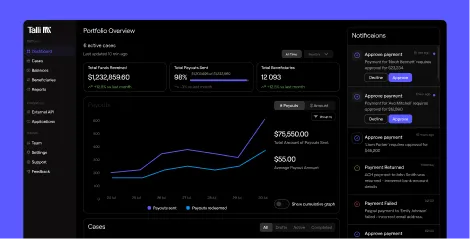
- Connected payment records: Talli provides real-time payment tracking, reconciliation data, and CRM synchronization, helping claims teams maintain clear records from distribution through payment completion
- Real-time tracking dashboard: Both payers and recipients have live visibility into payment status, completion rates, and exception details without waiting for batch reports
- Multi-channel payment options: Recipients choose ACH, prepaid cards, digital wallets (PayPal, Venmo), or gift cards with structured payment records attached
- Compliance automation: Integrated OFAC screening, KYC verification, and 1099 generation ensure every payment meets regulatory requirements automatically
For settlement administrators and claims teams sending recovery payments, Talli provides centralized payment tracking, reconciliation data, and auditable records that can reduce downstream payment exceptions and improve distribution visibility. The platform's court-ready audit trails document every payment from authorization through delivery.
The platform has processed $3 billion in disbursements across 38 class action cases in a single quarter, demonstrating the scale required for major recovery payment programs while achieving 95-98% redemption rates that minimize escheatment exposure for both payers and recipients.
Frequently Asked Questions
What is remittance advice and why is it important for recovery payments?
Remittance advice is documentation that accompanies a payment explaining what invoices, claims, or obligations the payment covers. For recovery payments specifically (settlements, insurance recoveries, refunds), remittance advice is critical because these payments often cover multiple underlying claims, arrive months or years after original filing, and come from entities (settlement administrators, insurance carriers) whose names don't match the original transaction. Without proper remittance, even successfully processed payments become unexplained deposits that require manual investigation before they can be applied to the correct account.
How do unexplained deposits impact a finance team?
Unexplained deposits create cascading operational problems. Cash recorded in suspense may already be in the bank, but teams still need to determine its proper accounting treatment. Staff spends time researching payment sources instead of higher-value activities; some organizations lose an estimated 200 hours per week to manual remittance matching. Month-end closes are delayed while teams resolve outstanding items. Auditors flag suspense account balances as control weaknesses. Long-term unresolved deposits can create accounting, audit, and reconciliation problems. Separate escheatment requirements may apply when the organization is holding property legally owed to another owner.
What are common reasons for missing or inadequate remittance advice with recovery payments?
The primary cause is architectural: payments move through banking rails while remittance travels through completely different channels (email, portals, paper) on unpredictable timelines. Common ACH formats such as CCD, PPD, and WEB provide an 80-character payment-related information field, which can constrain detailed remittance, while formats such as CTX can carry additional remittance data. There is no single universally adopted remittance format, so each payer sends data differently. For recovery payments specifically, long gaps between claim filing and payment mean original reference numbers may be lost, and payer names often don't match the expected source.
Can technology really solve the problem of unexplained deposits?
Technology significantly reduces unexplained deposits through two approaches. First, cash application automation uses AI to extract remittance from unstructured sources (emails, PDFs, portals) and match payments to invoices automatically. Organizations have achieved automation rates exceeding 90%. Second, modern disbursement platforms bundle structured remittance directly with payments so the information arrives together rather than separately. However, technology cannot extract remittance that doesn't exist; the ultimate solution requires payers to send complete documentation, which digital disbursement platforms can enforce by generating remittance automatically.
What steps can a finance team take to improve their handling of recovery payments?
Start with organizational changes: create dedicated workflows for recovery payments rather than routing through standard procedures, designate specialists with recovery payment expertise, and establish proactive communication with settlement administrators before distributions begin. Implement tracking systems that link original claims to expected recoveries so incoming payments can be matched against known expectations. Define clear escalation protocols with time limits for resolving unmatched payments. Finally, evaluate automated reconciliation tools that can ingest remittance from multiple channels and match payments using AI. The manual approach simply doesn't scale as recovery payment volumes grow.