.svg)


.svg)
Exception management for shareholder payments is the structured process of detecting, classifying, routing, and resolving disbursement failures across shareholder distribution cycles. The strongest programs treat it as payment infrastructure, not as a reactive backlog assigned to operations after a dividend, rights offering, settlement, or shareholder distribution has already gone out.
A meaningful share of shareholder payment issues come from predictable failure points: returned checks, failed ACH transfers, OFAC compliance holds, missing W-9 documentation, stale-dated instruments, duplicate payment flags, deceased accounts, and legally constrained payees. For a program distributing funds to 50,000 shareholders, even a small exception rate can create hundreds or thousands of work items per cycle.
This guide covers the most common shareholder payment exceptions, why manual workflows break under volume pressure, the compliance exposure they create, and what modern exception management infrastructure looks like for corporate issuers, transfer agents, settlement administrators, and shareholder services teams.
Key Takeaways
- Exception volume compounds at scale: Returned mail, ACH failures, missing documentation, compliance holds, and reissuance requests become operationally expensive when they repeat across thousands of payees.
- Failed payments are costly: LexisNexis Risk Solutions found that each rejected or repaired payment costs businesses an average of $12.10, before considering escalated legal, estate, or compliance review.
- Manual workflows hit capacity limits quickly: When exception volume reaches hundreds per quarter, triage, research, outreach, reissuance, and documentation usually require dedicated staff.
- Reissuance needs current compliance checks: A recipient who cleared a prior payment cycle should not automatically be cleared for a replacement payment. Reissued payments should be screened against current OFAC data, with KYC refreshed where required.
- Unresolved exceptions can become unclaimed property: Dividend dormancy periods vary by state, commonly three to five years, and unresolved shareholder payments can become reportable unclaimed property.
What Is Exception Management for Shareholder Payments?
Exception management for shareholder payments is the process of identifying and resolving disbursement transactions that fail normal processing. A payment exception occurs when a transaction cannot reach the intended recipient, fails a compliance check, lacks required documentation, or is flagged before settlement proceeds.
In shareholder services, the exception taxonomy is wider than in ordinary accounts payable. Common categories include:
- Address failures: Checks returned as undeliverable because shareholder mailing records are outdated.
- Electronic payment failures: ACH returns caused by closed accounts, invalid account numbers, or revoked authorization.
- Compliance holds: Payments flagged for OFAC screening, sanctions review, or identity verification.
- Tax documentation gaps: Missing W-9 forms, incorrect TINs, or backup withholding requirements.
- Stale-dated instruments: Uncashed checks that have passed the stated validity window.
- Duplicate payment flags: Reissuance errors, data mismatches, or duplicate entitlement records.
- Deceased and legally constrained accounts: Payments requiring estate documentation, court orders, trust review, or legal hold clearance.
Each exception type has a different resolution workflow, compliance requirement, and documentation standard. Treating all exceptions as one generic payment issue is why manual shareholder payment operations develop backlogs and audit gaps.
For teams building a more resilient process, shareholder services payment infrastructure should connect payment delivery, exception routing, compliance checks, reporting, and audit documentation in one system.
The Seven Most Common Shareholder Payment Exceptions
1. Returned Mail and Undeliverable Checks
Returned mail is one of the most common shareholder payment exceptions. It occurs when a paper check is mailed to the address of record but comes back as undeliverable. Shareholders move, forwarding windows expire, and address records degrade over time.
Once a check is returned, the workflow usually requires address research, NCOA processing, direct outreach, payment cancellation or reissuance, and updated documentation. Without proactive address hygiene before each distribution cycle, returned mail exceptions repeat every quarter.
Digital-first distribution reduces dependency on physical addresses. A program that uses multi-channel payout options can give recipients more than one way to receive funds, lowering the chance that one bad address blocks payment completion.
2. Bounced ACH and Failed Electronic Transfers
ACH failures are the electronic equivalent of returned checks. Common administrative return issues include closed accounts, no account on file, and invalid account numbers. Nacha identifies R02, R03, and R04 as administrative return codes tied to account or data errors.
ACH failures can be faster to detect than returned checks, but they still require structured resolution. Some returns require updated banking details. Others require new authorization, fraud review, or escalation if the failure suggests a deceased account or legal restriction.
Organizations that move from paper checks to ACH without exception infrastructure often reduce physical mail failures but inherit a new set of electronic return workflows. A stronger approach is to connect ACH, prepaid card, wallet, and fallback payment logic inside a broader digital disbursement platform, so failures can be routed and resolved without starting from scratch.
3. OFAC and Sanctions Compliance Holds
Payments flagged against OFAC sanctions lists cannot proceed until the issue is investigated and resolved. The OFAC Sanctions List Service provides current sanctions list data, which matters because a recipient who cleared a previous distribution may not remain clear in a later cycle.
OFAC holds require compliance review, documentation, and clear release criteria. In manual workflows, these cases can sit behind ordinary payment failures even though they carry higher regulatory exposure. A modern workflow routes sanctions holds separately and prevents reissuance until current screening is complete.
For shareholder services teams, OFAC screening for settlement payments is not only a front-end onboarding step. It should also be part of reissuance, exception resolution, and payment release controls.
4. Missing Tax Documentation
Certain shareholder distributions require valid tax documentation before payment can proceed. Missing or incorrect W-9 or TIN information may require additional outreach, documentation collection, and backup withholding. The IRS provides guidance on backup withholding for missing or incorrect taxpayer identification numbers in Publication 1281.
Managing tax documentation manually is time-consuming because each exception requires communication, validation, withholding review, and reconciliation against reporting records. At scale, this becomes a tax operations workload, not a simple payment issue.
Programs that use automated tax compliance workflows can collect W-9 information earlier, apply withholding logic consistently, and reduce last-minute distribution delays caused by missing documentation.
5. Stale-Dated and Uncashed Instruments
Paper checks typically carry a validity window, often 90 to 180 days depending on issuer policy and bank rules. When a check is not cashed within that window, it becomes stale-dated and must be handled before a replacement can be issued.
The unresolved balance then enters an exception workflow: notify the shareholder, confirm eligibility, cancel or void the old instrument, perform current compliance checks, and issue a replacement where appropriate. If the payment remains unresolved long enough, it may become reportable unclaimed property. Dividend dormancy periods vary by state, as shown by NAUPA’s dividend dormancy reference.
A strong program does not wait for stale checks to become an escheatment problem. It uses reminders, status tracking, and escalation rules to reduce unclaimed dividend liability before reporting deadlines arrive.
6. Duplicate Payment Flags
Duplicate payment flags occur when data entry errors, file mismatches, or reissuance logic failures indicate that the same payee may receive two payments for the same entitlement. In shareholder distributions, this risk is material because individual payment amounts can be large.
Each duplicate flag requires review before payment release. Teams must determine whether the case is a genuine duplicate, a valid replacement payment, or a system mismatch. Either outcome requires a clear audit trail showing who reviewed the case, what evidence was checked, and why payment was approved or blocked.
Automated controls can detect duplicates before release, compare claimant or shareholder identifiers, and maintain a record of the review. This is especially important in programs where duplicate claims detection affects both fraud prevention and payment accuracy.
7. Deceased Accounts and Legal Holds
Shareholder deaths, estate situations, trust accounts, guardianships, and legal judgments create payment exceptions that cannot be solved by simple reissuance. These cases often require death certificates, letters testamentary, court orders, legal hold review, or guardian authorization.
Digital workflows cannot eliminate the need for legal documentation, but they can make the process faster and more defensible. Structured intake, document tracking, escalation rules, and audit logs prevent these cases from disappearing into email chains.
Why Manual Shareholder Payment Exception Workflows Break
Manual exception management works at low volume because each issue receives individual attention. The failure mode is not usually quality. It is capacity.
A single manual exception often requires:
- Identification during reconciliation or return processing
- Classification by exception type
- Research into address, banking, tax, or legal status
- Outreach to the shareholder or representative
- Reissuance, cancellation, withholding, or hold placement
- Current sanctions or compliance review where required
- Documentation for audit, court, tax, or regulatory review
At 20 exceptions per quarter, this can be absorbed into existing workloads. At 500 exceptions per quarter, it becomes a dedicated operational function. At 2,500 exceptions per quarter, manual exception management becomes a structural backlog.
The Classification Problem
Manual triage depends on staff correctly identifying the exception type. That is difficult when categories overlap. An ACH failure on a deceased account may look like an ordinary bank-account issue, but it may actually require estate documentation and legal hold review.
Misclassification extends resolution timelines and creates inaccurate records. If a case is later reviewed by a court, regulator, auditor, or state unclaimed property office, the record may not support the action taken.
The Documentation Problem
Every shareholder payment exception needs a defensible audit trail: when it was detected, who reviewed it, what action was taken, which documents were collected, and when it was resolved.
Spreadsheets, email chains, and shared folders are fragile documentation systems. They are hard to standardize, easy to lose, and difficult to reconstruct months later. When a regulator or court asks for the history of an unresolved distribution, forwarded emails are not a strong substitute for a timestamped, attributable record.
A better approach is to build audit trails for legal disbursements as work happens, not after the fact when documentation is requested.
The Concurrency Problem
Shareholder payment cycles run on fixed schedules: dividend record dates, rights offering deadlines, settlement distribution milestones, and reporting windows. When exceptions from multiple campaigns overlap, manual teams cannot parallel-process hundreds of cases consistently.
Digital infrastructure can route, track, and escalate multiple exception types at the same time. That is the difference between a queue and an operational backlog.
The Hidden Compliance Cost of Unresolved Exceptions
Unresolved shareholder payment exceptions are not just operational overhead. They can become compliance liabilities.
Escheatment Exposure
Every uncashed check or unresolved electronic payment failure can start a dormancy clock under state unclaimed property law. Dormancy periods for dividends often run three to five years, depending on the jurisdiction. After the dormancy period expires, funds may need to be reported and remitted to the state.
State unclaimed property enforcement can be expensive because audits may involve third-party audit firms and broad document requests. Manual systems often lose track of partially investigated exceptions, especially when staff change or records are stored across spreadsheets and inboxes.
Sanctions Rescreening Exposure
A recipient who cleared screening at the original payment date may appear on a sanctions list before reissuance. For that reason, replacement payments should not rely only on the original screening result. Current sanctions screening should occur before reissuance, with a documented timestamp and clear release decision.
KYC and Identity Data Decay
Identity information can become stale over time. For high-volume shareholder distributions, a payee verified at account opening may require refreshed verification if the exception involves address changes, unusual activity, large payment amounts, estate issues, or program-specific risk rules.
Manual workflows rarely include systematic KYC refresh triggers. Automated workflows can place identity checks at the correct point in the resolution path.
The Operational Cost of Shareholder Payment Exceptions
The cost of exception management is usually spread across treasury, compliance, tax, shareholder services, legal, and operations. That makes it easy to underestimate.
For a mid-size issuer or transfer agent, the cumulative cost can be significant even when no single line item appears large. Legal and estate exceptions can be far more expensive because they may require senior staff or outside counsel review.
How Automated Exception Management Works
Automated exception management replaces manual triage with structured detection, routing, compliance checks, and audit logging.
Exception Detection at the Point of Failure
Automated systems detect exceptions as they occur. An ACH return code creates an exception record. A stale check date triggers a status change. A compliance screening result routes to a hold queue. A duplicate payment flag blocks release until reviewed.
The key improvement is timing. The exception enters the resolution workflow immediately instead of waiting for a reconciliation cycle or manual spreadsheet update.
Structured Routing by Exception Type
Each exception type routes to a predefined workflow. Returned mail moves to address verification and digital outreach. OFAC holds a move to compliance review. Tax documentation gaps move to W-9 collection or withholding review. Deceased accounts move to estate documentation.
Routing becomes consistent and does not depend on whoever receives the first email.
Compliance Checks at the Reissuance Gate
Modern platforms place sanctions screening, identity checks, tax documentation review, and duplicate detection at the point where payment action is about to occur. This prevents replacement payments from going out based on outdated information.
Structured Audit Trail Generation
Every exception event is logged: detection, classification, routing, action taken, document collected, review decision, and resolution. The audit trail is created as work happens, not reconstructed after the fact.
Dormancy Clock Tracking
Automated workflows maintain dormancy dates and jurisdiction flags for unresolved payments. They can alert teams before reporting thresholds, support due diligence outreach, and reduce the chance that unclaimed property liability accumulates silently.
Talli: Exception Management for Shareholder Payments
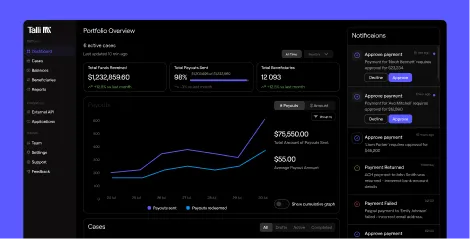
Talli is a digital disbursement platform built for compliance-critical payout programs, including shareholder services, class action settlements, bankruptcy distributions, and claims administration. It gives administrators a single dashboard to upload recipient data, launch payment campaigns, track payment status, manage compliance workflows, and maintain audit-ready records.
Talli supports multiple redemption options, including ACH, prepaid Mastercard, PayPal, Venmo, gift cards, and paper checks as fallback. That flexibility matters because many shareholder payment exceptions begin with channel failure: an old mailing address, an expired check, incorrect bank details, or a recipient who needs another way to receive funds.
Key Features
- Multiple payout methods: ACH, prepaid Mastercard, PayPal, Venmo, gift cards, and paper checks as fallback.
- Compliance workflows: OFAC screening, KYC verification, W-9 collection, backup withholding support, and audit logging.
- Smart reminders: Email and SMS outreach to reduce manual follow-up and improve redemption.
- Real-time dashboards: Live visibility into payment status, completion rates, failures, and unresolved exceptions.
- Fund segregation: Dedicated account structures for settlement and distribution programs, with banking services provided by Patriot Bank, N.A., Member FDIC.
- Fraud controls: Identity verification, duplicate detection, behavioral signals, and payment-pattern analysis to reduce fraudulent claims and manual review burden.
- Audit-ready reporting: Structured records that support court oversight, reconciliation, and compliance review.
Best For
Talli is best suited for corporate issuers, transfer agents, claims administrators, settlement administrators, and bankruptcy trustees managing high-volume distributions where paper checks and manual exception workflows create operational drag.
Programs with quarterly dividend cycles, rights offerings, settlement distributions, or recurring claimant payouts benefit most when they need faster redemption, fewer unresolved exceptions, and stronger documentation.
Talli can also support related use cases such as class action settlement payments, bankruptcy distribution workflows, and other high-volume legal payment programs where compliance and audit visibility matter.
Pricing
Talli pricing is customized based on distribution volume, payout method mix, program complexity, and compliance requirements. Digital payment costs vary by method and program structure, while paper checks typically carry higher all-in costs because of printing, postage, reconciliation, stop-payment handling, and reissuance.
Organizations should evaluate pricing against the full cost of exception handling, not only the transaction fee. A low-cost payment method can become expensive if it produces returned mail, stale checks, manual outreach, and unclaimed property work.
Exception Management Best Practices
Classify Before You Resolve
Build a clear exception taxonomy before the next distribution cycle. Each type should have an owner, workflow, documentation standard, and escalation rule.
Track Dormancy from the First Failure
Every unresolved payment should carry a dormancy start date and jurisdiction flag. Do not wait until year-end reporting to determine which payments have aged into unclaimed property exposure.
Screen Before Reissuance
Replacement payments should pass current sanctions screening before release. KYC or identity checks should refresh where required by account status, program rules, risk policy, or changed recipient information.
Run Address Hygiene Before Distribution
Address validation and NCOA processing reduce returned mail before it occurs. The cheapest exception is the one prevented before payment release.
Make Digital Redemption the Primary Channel
Digital payout methods reduce dependence on physical addresses and give recipients more ways to claim funds. ACH, prepaid cards, and digital wallets can all reduce paper-based exception volume.
Document in Real Time
Do not rely on staff to reconstruct exception history later. Audit records should be created at the point of action with timestamps, user attribution, and supporting documents.
Common Mistakes to Avoid
Treating every exception the same. An ACH return, OFAC hold, deceased account, and missing W-9 are different issues. They need different workflows.
Letting exceptions age without dormancy tracking. Unresolved payments can become reportable unclaimed property. Every aged exception needs a clock, owner, and escalation path.
Skipping current screening on reissuance. A prior clearance should not be treated as permanent. Reissued payments should be checked against current compliance data.
Using email chains as the audit trail. Email is useful for communication, but weak as a system of record. Compliance reviews need structured, attributable records.
Waiting for returned mail before fixing addresses. Proactive address hygiene reduces returned checks and downstream reissuance work.
Deferring exception resolution until quarter-end. Delays extend dormancy exposure and increase the chance that cases become harder to resolve.
Talli Conclusion
Exception management for shareholder payments is not a side task. It is part of the distribution infrastructure. Manual workflows may work for small programs, but they become expensive and risky as payment volume grows.
Talli is worth evaluating when a program needs to reduce paper-check dependency, improve redemption, automate compliance workflows, and maintain court-ready or regulator-ready audit trails. Its value is strongest where unresolved exceptions create real cost: shareholder distributions, class action settlements, bankruptcy payouts, mass tort programs, and other high-volume legal or fiduciary payment environments.
Frequently Asked Questions
What is exception management in shareholder payments?
Exception management is the process of identifying, routing, and resolving shareholder payments that fail or require review. Examples include returned checks, failed ACH transfers, OFAC holds, missing W-9 documentation, stale-dated checks, duplicate payment flags, and deceased accounts.
What causes most shareholder payment exceptions?
The most common causes are outdated mailing addresses, invalid bank account information, uncashed checks, missing tax documentation, compliance holds, and ownership or estate issues.
How does manual exception handling create escheatment risk?
Uncashed checks and unresolved failed payments can start dormancy clocks under state unclaimed property laws. If the issue is not resolved before the dormancy period expires, the funds may need to be reported and remitted to the state.
What is the cost of a failed payment?
LexisNexis Risk Solutions found that each rejected or repaired payment costs businesses an average of $12.10. That figure does not include complex legal, estate, or escalated compliance review.
Do reissued shareholder payments need OFAC screening?
Yes, reissued payments should be screened against current OFAC data before release. Sanctions lists change over time, so a recipient who cleared the original payment cycle should not automatically be cleared for a later replacement payment.
How does automation reduce shareholder payment exceptions?
Automation reduces exceptions by validating data earlier, offering multiple payout channels, sending digital reminders, routing each exception type to the correct workflow, and creating audit records automatically as actions occur.