.svg)


.svg)
Most Qualified Settlement Funds must file Form 1120-SF every year, even when the fund has no taxable income. Administrators must report fund activity, calculate tax on modified gross income, make required electronic tax payments, and preserve records supporting contributions, deductions, distributions, and elections.
Qualified Settlement Funds can separate a defendant’s settlement payment from later claimant distributions, giving administrators time to resolve liens, verify claimants, and carry out a court-approved distribution plan. However, these benefits depend on proper formation, accounting, tax reporting, and fund segregation.
For organizations managing QSF trustee distributions, the most important controls are accurate classification of settlement contributions, investment earnings, administrative expenses, and claimant payments.
Key Takeaways
- Qualifying settlement contributions are generally excluded from modified gross income, but investment earnings, capital gains, delayed-funding payments, and certain transferor-related income may be taxable.
- A QSF must use the calendar year and generally files Form 1120-SF by April 15.
- Estimated tax installments are required when expected tax, after applicable credits, is $500 or more.
- A relation-back election can treat a fund as becoming a QSF before governmental approval, but only within the limits established by the regulations.
- Most QSFs file Form 1120-SF, although a single-transferor QSF may qualify for a grantor-trust election.
- QSF tax payments and estimated-tax deposits must be made electronically.
- Information reporting depends on the type of payment. Not every taxable claimant distribution belongs on Form 1099-MISC.
Understanding Form 1120-SF
The IRS uses Form 1120-SF to collect information about transfers received, income earned, deductions claimed, distributions made, and the tax liability of a designated or qualified settlement fund.
A contribution from a defendant or another transferor is not automatically taxable income to the QSF. Amounts transferred to resolve or satisfy liabilities for which the QSF was established are generally excluded from modified gross income. However, the transfer still appears in the fund’s records and on the applicable portions of Form 1120-SF.
What Is a QSF?
A fund generally qualifies under Treasury Regulation Section 1.468B-1 when it meets three requirements:
- Governmental approval: The fund is established by, or subject to the continuing jurisdiction of, a qualifying court or governmental authority.
- Resolve-or-satisfy requirement: The fund is established to resolve or satisfy one or more qualifying claims.
- Segregation requirement: The fund’s assets are physically segregated from the transferor’s other assets.
These requirements make fund segregation and documentation essential. Talli supports QSF compliance workflows through matter-level tracking, claimant records, and digital disbursement controls.
What Form Does a QSF File?
Most QSFs file Form 1120-SF rather than Form 1120 or Form 1041. The administrator must sign the return and obtain a separate employer identification number for the fund.
There is an important exception. A QSF with only one transferor may make a grantor-trust election under Treasury Regulation Section 1.468B-1(k). When that election applies, Form 1041 or applicable grantor-trust reporting may replace the ordinary Form 1120-SF treatment.
Administrators should confirm the fund’s tax classification before preparing the first return.
How QSF Income Is Taxed
A QSF is taxed on modified gross income at the maximum rate under IRC Section 1(e). That rate is 37% under current law, but administrators should verify the applicable rate for each filing year.
Modified gross income begins with gross income under IRC Section 61 and applies the adjustments contained in the QSF regulations.
Amounts Generally Excluded
The following amounts are generally excluded from modified gross income:
- Cash transferred to resolve liabilities covered by the QSF
- Property transferred to resolve covered liabilities
- Additional qualifying settlement contributions
The exclusion does not mean the administrator may omit the transfers from the fund’s accounting records or Form 1120-SF reporting.
Potentially Taxable Amounts
Taxable income may include:
- Bank-account interest
- Taxable dividends
- Capital gains
- Interest on debt issued by a transferor or related person
- Dividends on stock of a transferor or related person
- Compensation for late or delayed transfers
- Other income included under IRC Section 61
Long-term capital gains and qualified dividends do not receive the preferential individual tax rates commonly associated with those items.
Deductible Administrative Expenses
A QSF may generally deduct administrative and incidental expenses that would be deductible in determining a corporation’s taxable income, including:
- Administrator and trustee fees
- Accounting and tax-preparation fees
- Legal fees connected to operating the QSF
- Actuarial services
- State and local taxes
- Claimant notification expenses
- Claims processing expenses
- Certain allowable investment losses
The fund may not deduct claimant distributions, payments made on behalf of claimants, claimant legal fees, or federal income tax.
Administrators should maintain invoices and workpapers showing how each deduction relates to operating the fund.
Form 1120-SF Filing Deadlines
A QSF may use a calendar, fiscal, or short tax year. Form 1120-SF is generally due on the 15th day of the fourth month after year-end, although a fund with a fiscal year ending June 30 generally files by the 15th day of the third month after year-end.
When the deadline falls on a weekend or legal holiday, the filing date moves to the next business day.
Requesting an Extension
The administrator may file Form 7004 by the original due date to request an automatic extension. For a calendar-year fund, the extension generally moves the filing deadline to October 15.
The extension applies only to filing the return. It does not extend the deadline for paying tax.
Late-Filing And Late-Payment Penalties
A return filed late may be subject to a penalty equal to 5% of unpaid tax for each month or partial month it is late, up to 25%.
For returns required to be filed after 2025, the minimum penalty for a return more than 60 days late is the lesser of:
- The tax due, or
- $525, adjusted for inflation when applicable
This formula does not impose a $525 penalty when no tax is due.
Late payment may also trigger a penalty generally equal to 0.5% of unpaid tax per month, up to 25%, plus interest at the applicable federal rate.
Estimated Tax Requirements
A QSF generally must make estimated tax installments when it expects its tax for the year, after applicable credits, to be $500 or more.
For calendar-year funds, installments are generally due:
- April 15
- June 15
- September 15
- December 15
The date moves to the next business day when it falls on a weekend or legal holiday.
Calculating Required Payments
Under the general corporate estimated-tax rules, the fund may avoid an underpayment penalty by timely paying the lesser of:
- Its current-year tax liability, or
- Its prior-year tax liability
Special rules and exceptions can apply, including rules for large taxpayers and short tax years. Form 2220 is used to determine whether an estimated-tax penalty applies.
The article’s prior example assumed that the prior-year amount always provides a complete safe harbor. Administrators should instead apply the current Form 2220 rules and confirm that the prior-year return covers a full 12-month period and shows tax liability.
Electronic Tax Payments
The fund must make federal tax deposits, including estimated-tax payments, electronically. Electronic options may include:
- Electronic Federal Tax Payment System
- Same-day federal tax wire
- Electronic payment through approved tax software
- Payment initiated by an authorized tax professional
- Other electronic options listed by the IRS
EFTPS enrollment should be completed before the first payment deadline because activation may require identity and banking verification.
The IRS does not limit QSFs to EFTPS alone. Same-day wire and other approved electronic methods may be available.
Establishing QSF Status
A fund does not become a QSF merely because it obtains an EIN, opens a bank account, or files Form 1120-SF. It must satisfy all three regulatory requirements.
The administrator should retain:
- The settlement agreement
- The court or governmental order
- Documentation of continuing governmental jurisdiction
- The administrator’s appointment
- The fund’s EIN confirmation
- Bank documents proving segregation
- Transferor statements
- Records identifying the claims the fund was established to resolve
A complete audit trail helps demonstrate that settlement assets remained separate from operating funds throughout the distribution lifecycle.
The Relation-Back Election
The relation-back election applies when the fund satisfies the resolve-or-satisfy and segregation requirements before it receives governmental approval.
The transferor and administrator may jointly elect to treat the fund as becoming a QSF on the later of:
- The date it first satisfied the resolve-or-satisfy and segregation requirements, or
- January 1 of the calendar year in which all three QSF requirements were satisfied
Relation-Back Example
Assume a segregated settlement account was established on September 1, 2025, and the court approved the fund on March 1, 2026.
The earliest permitted relation-back date is January 1, 2026, because that is later than September 1, 2025, and is the first day of the calendar year in which governmental approval occurred.
Required Election Statement
The election statement must include:
- The legend “§ 1.468B-1 Relation-Back Election”
- Each transferor’s name, address, and TIN
- The QSF’s name, address, and EIN
- The elected effective date
- A schedule describing each asset treated as transferred
- Signatures from every transferor and the administrator
The QSF attaches the election to its timely filed return, including extensions. Each transferor must also attach a copy to a timely original or qualifying amended return for the relevant year.
Common Form 1120-SF Errors
Reporting Contributions As Taxable Income
Qualifying settlement contributions are generally excluded from modified gross income. Administrators should report transfers in the proper informational portion of the return without adding them to taxable income.
Using The Cash Method
A QSF must use an accrual method of accounting. Income and deductible expenses are recognized under accrual rules, not simply when cash enters or leaves the account.
Using The Wrong Return
Most QSFs file Form 1120-SF. However, the administrator must first determine whether a valid single-transferor grantor-trust election applies.
Deducting Claimant Payments
Payments to claimants or transferors are not deductible by the QSF. They reduce fund assets but do not reduce modified gross income.
Deducting Claimant Legal Fees
Legal fees incurred by or on behalf of claimants are not QSF administrative expenses. Legal fees related to operating the QSF may be deductible when they otherwise satisfy federal tax requirements.
Applying One Form 1099 Rule To Every Payment
Information reporting depends on the nature of the underlying payment. The fund must generally report and withhold as the transferor would have been required to report or withhold if it had paid the claimant directly.
Depending on the claim, the correct form may be:
- Form W-2
- Form 1099-MISC
- Form 1099-NEC
- Form 1099-INT
- Another applicable information return
- No information return, when a valid exception applies
Beginning in 2026, a $2,000 threshold applies to certain information-reporting categories. It does not convert every taxable settlement payment into a Form 1099-MISC payment.
Backup Withholding
Backup withholding is currently imposed at 24%, but it does not automatically apply to every taxable settlement distribution.
It may apply when:
- The payment falls within a category subject to backup withholding
- The claimant fails to provide a valid TIN
- The IRS notifies the payer that the TIN is incorrect
- Another statutory backup-withholding condition applies
Administrators should collect tax forms early, validate data when permitted, document payment classifications, and avoid treating every missing W-9 as creating the same withholding result.
Talli supports digital tax collection through electronic claimant workflows, reminders, payment records, and audit logs.
Recordkeeping Best Practices
A QSF must file a return for each year it remains in existence, even when it has no gross income.
Administrators should retain:
- Form 1120-SF returns and extensions
- Relation-back or grantor-trust elections
- Bank and investment statements
- Monthly reconciliations
- Accrual workpapers
- Transferor statements
- Expense invoices
- Distribution ledgers
- Claimant tax forms
- Information returns
- Electronic tax-payment confirmations
- Court orders and settlement agreements
Records should be kept for as long as they may be material to federal or state tax administration, court reporting, claimant disputes, or fund termination. A universal seven-year rule may not be adequate for every document.
Real-time settlement reconciliation can help administrators separate corpus, earnings, expenses, tax reserves, and claimant distributions.
Investment And Liquidity Considerations
Tax efficiency is only one part of managing a QSF. Investment decisions must also account for:
- Court-order restrictions
- Fiduciary responsibilities
- Principal preservation
- Distribution timing
- Liquidity needs
- Credit and market risk
- FDIC insurance limits
- State tax treatment
- Expected professional fees and tax reserves
Tax-exempt municipal-bond interest may be excluded from federal modified gross income, but municipal securities are not automatically appropriate for every fund. The administrator should obtain tax and investment advice before using them.
How Talli Supports QSF Administration
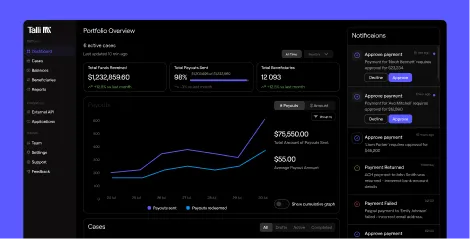
Talli is a purpose-built digital settlement platform for legal claims administrators, trustees, law firms, and settlement providers. It supports multiple claimant payment methods, fund-level reporting, identity checks, OFAC screening, W-9 collection, fraud controls, and payment tracking.
Talli does not replace the administrator’s tax adviser or prepare the legal analysis required for Form 1120-SF. Instead, it helps preserve the operational records those professionals need, including claimant data, payment status, returned-payment activity, and distribution audit trails.
By using real-time payout tracking, administrators can identify incomplete tax records, failed payments, and reconciliation differences before they delay court reporting or fund closure.
The strongest compliance process combines qualified tax advice with purpose-built disbursement infrastructure. Talli helps administrators maintain fund segregation, document every payment, and provide courts and advisers with reliable distribution data.
Frequently Asked Questions
Does Every QSF File Form 1120-SF?
Most QSFs must file Form 1120-SF annually, including years with no gross income. A limited exception may apply when a single-transferor QSF makes a valid grantor-trust election. In that situation, Form 1041 or applicable grantor-trust reporting rules may apply. The administrator should confirm the fund’s classification before filing its first return.
Are QSF Distributions Tax-Free To Claimants?
No. Tax treatment depends on the underlying claim and the character of each payment. Certain compensatory damages for personal physical injuries or physical sickness may be excluded, while punitive damages, interest, wages, and many nonphysical-injury payments may be taxable. The QSF structure generally does not change the claimant’s substantive tax treatment.
Does Every Payment Over $2,000 Require Form 1099-MISC?
No. The $2,000 threshold beginning in 2026 applies to certain information-reporting categories. The correct form depends on the payment’s character and the reporting obligation that would have applied to the transferor. A distribution may require Form W-2, Form 1099-MISC, Form 1099-NEC, another form, or no information return.
Does A Missing W-9 Always Require 24% Withholding?
No. Backup withholding applies only when the payment falls within a covered reporting category and a statutory withholding condition exists, such as failure to provide a valid TIN. Administrators must classify the payment before applying withholding. Wage withholding, foreign-person withholding, and other specialized rules may apply instead.
Must A QSF File When It Has No Income?
Yes. A QSF generally must file an income tax return for every taxable year during which it exists, even if it has no gross income. The filing documents transfers, distributions, deductions, and continuing fund activity. The final filing obligation ends when the fund no longer has assets and will not receive additional transfers.