.svg)


.svg)
The best way to increase shareholder take-up rates in 2026 is to move check-issued shareholders into digital payment rails before the next distribution cycle begins. For most transfer agents and corporate issuers, that means offering ACH, prepaid cards, and digital wallets through a controlled enrollment workflow instead of relying on paper checks as the default.
Paper checks still work for some shareholders, but they create predictable redemption gaps. Checks can be mailed to stale addresses, discarded as unfamiliar mail, delayed by bank deposit limits, or left uncashed until they become exceptional items. Digital payment methods reduce that friction because shareholders can choose the rail that fits their situation: ACH for banked recipients, prepaid cards for unbanked or underbanked recipients, and digital wallets for recipients who prefer fast mobile access.
Talli’s shareholder services platform is built for this conversion problem. It gives shareholder services teams one workflow for outreach, enrollment, KYC, OFAC screening, payment execution, exception management, and audit reporting. Based on Talli’s operating benchmarks across more than 500,000 recipients and over $3 billion in distributions, digital-first programs can reach 95 to 98% redemption rates compared with 70 to 80% for traditional paper checks. The practical result is fewer uncashed payments, fewer manual reissues, and a smaller dormancy candidate pool over time.
Key Takeaways
- Digital payment rails can reach 95 to 98% redemption rates when enrollment, reminders, and exception handling are built into the workflow.
- Paper check programs commonly operate closer to 70 to 80% redemption, leaving 20 to 30% of payments at risk of reissue, aging, or dormancy.
- Talli clients have documented a 34% improvement in take-up rates after moving check-issued populations to digital rails.
- Multi-rail payment options improve coverage because no single rail fits every shareholder.
- Dormancy timing and escheatment rules vary by state and property type, so issuers should treat every unresolved payment as a compliance risk that needs active tracking.
- Real-time dashboards reduce support burden by giving shareholders visibility into enrollment, processing, and delivery status.
How We Evaluated Shareholder Take-Up Rate Improvement
This framework is based on Talli operating data across 38 disbursement cases, covering more than 500,000 recipients and over $3 billion in distributions as of Q4 2024. Programs were evaluated across five areas: enrollment conversion, exception resolution speed, dormancy risk reduction, per-transaction cost, and audit readiness.
The most important finding is that timing matters. Outreach sent before a distribution cycle performs better than remediation after a check fails to clear. A shareholder who is asked to choose a payment method before funds are issued is easier to convert than a shareholder who has already received, ignored, misplaced, or failed to cash a paper check.
That is why the strongest programs do not treat digital payments as a cleanup tactic. They treat them as enrollment infrastructure.
What Is a Shareholder Take-Up Rate?
A shareholder take-up rate is the percentage of eligible shareholders who successfully receive and claim a payment during a distribution cycle. It is one of the clearest indicators of whether a shareholder payment program is working.
For example, if 9,500 out of 10,000 eligible shareholders successfully receive and claim their payment, the take-up rate is 95%. If only 7,500 claim it, the take-up rate is 75%, and the remaining 2,500 payments become operational and compliance work.
Low take-up rates matter because unresolved payments do not disappear. They become outstanding liabilities, reissue requests, returned mail problems, failed ACH items, unresponsive payee records, or potential unclaimed property. Transfer agents also need to consider address search obligations under SEC Rule 17Ad-17, which applies to lost securityholders and unresponsive payees.
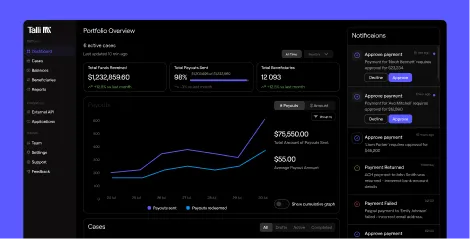
The metric should be tracked by cohort, not only in aggregate. A strong dashboard separates check-issued shareholders from digital-enrolled shareholders so teams can see whether the check population is actually shrinking. Talli’s real-time tracking tools help teams monitor those splits by payment method, delivery outcome, exception status, and aging risk.
Why Paper Checks Suppress Take-Up Rates
Paper checks create structural barriers that have little to do with whether shareholders want the money. The problem is not just that checks are slower. It is that they depend on mailing addresses, recipient recognition, bank access, and manual follow-up.
The most common failure points include stale addresses, returned mail, mail theft, misplaced envelopes, stale-dated checks, mobile deposit limits, and confusion when a payment arrives from an unfamiliar transfer agent or corporate entity. A shareholder may be fully entitled to payment but still fail to redeem because the process requires too many offline steps.
Unbanked access is another major barrier. The FDIC reported that 4.2% of U.S. households, representing 5.6 million households, did not have a bank or credit union account in 2023. For those recipients, a paper check can create added friction because cashing it may require a third-party check-cashing service or an in-person process that reduces the value of the payment. See the FDIC household survey for the national banking access data.
The bigger issue is compounding. If the same unresolved check-issued population carries forward into each new distribution cycle, the problem grows instead of resolving itself. Every new round adds more uncashed checks, more outreach work, and more records that need aging and compliance review.
Five Steps to Increase Shareholder Take-Up Rates
A digital-first enrollment program should not simply replace checks with one electronic option. It should create a controlled workflow that converts shareholders over time while preserving compliance documentation.
1. Map the Check-Issued Population
Start with a complete inventory of shareholders who still receive paper checks or have no usable digital payment method on file. Segment the population by check age, amount, address status, and prior exception history.
This baseline matters because it tells the team where risk is concentrated. Shareholders with returned mail, stale addresses, multiple uncashed payments, or high-value distributions should move to the top of the outreach queue. The baseline also creates the measurement framework for the program. Without it, teams cannot prove whether take-up improved because of digital migration or because of a one-time distribution mix.
Talli’s disbursement dashboards help teams monitor enrolled versus check-issued recipients, payment delivery outcomes, and exception aging without relying on manual spreadsheets.
2. Run Outreach Before Distribution
Pre-distribution outreach is the highest-leverage intervention. The goal is to ask shareholders to choose a payment rail before funds are issued, not after a paper check is already lost, stale, or uncashed.
A practical outreach sequence can include an email invitation on day zero, an SMS reminder when a mobile number is available, a second reminder before the distribution date, and a final notice that clearly states the enrollment deadline. Each communication should direct the shareholder to a secure portal where they can choose ACH, prepaid card, or digital wallet.
This approach works because it reframes enrollment as the easiest way to receive the next payment. It also creates a documented communication record, which is important when auditors, courts, or regulators ask how shareholders were notified.
3. Offer Multiple Payment Rails
A single payment method will not reach every shareholder. ACH is efficient for banked shareholders, but it excludes recipients who do not have a bank account. Digital wallets are fast, but not every shareholder wants to use one. Prepaid cards can serve unbanked or underbanked recipients, but they may not be the preferred rail for high-value payments.
The strongest programs offer a menu. Talli supports ACH, prepaid Mastercard, PayPal, Venmo, Amazon gift cards, wire transfers, and paper checks as a fallback through its payment options. That mix lets administrators route recipients toward the option most likely to be redeemed.
ACH timing depends on network rules, file timing, and bank processing. Same Day ACH is available under Nacha rules for eligible transactions, while standard ACH generally requires additional processing time. See Same Day ACH for network context.
4. Automate Reminders and Tracking
Digital enrollment still needs follow-up. Some shareholders start enrollment but do not finish KYC, fail to upload requested documentation, or leave the portal before selecting a payment method. Automated reminders bring those recipients back before the cycle closes.
Real-time status tracking also reduces inbound support. When shareholders can see that a payment is enrolled, processing, delivered, failed, or awaiting verification, they are less likely to call a transfer agent to ask where the payment is. Talli’s self-service portal gives recipients visibility while creating a timestamped record of each notice, verification step, and payment status change.
5. Resolve Exceptions Before They Age
Every cycle produces exceptions. ACH can fail because a bank account was closed. A prepaid card notification can bounce. A KYC check can mismatch. A shareholder may dispute entitlement data. These cases need a single queue with owner, status, age, and next action.
The goal is not just speed. The goal is preventing unresolved exceptions from becoming long-running unclaimed property risk. Dormancy periods vary by state and property type, and SEC guidance notes that abandoned securities and funds are generally remitted after a period that varies by state. The SEC’s final rule discussion described the period as usually three to seven years, depending on state law. See the SEC final rule for the regulatory context.
Talli’s exception workflows help teams manage failed or returned payments before they become stale records that require manual reconstruction later.
Compliance Benefits of Higher Take-Up
Improving take-up rates is not only a payment metric. It reduces the volume of unresolved records that create audit, tax, and unclaimed property pressure.
First, digital migration lowers dormancy exposure. A shareholder who selects a valid payment method and redeems the distribution is no longer part of the uncashed check population for that cycle. When the check-issued group shrinks over time, the dormancy candidate pool shrinks with it.
Second, digital workflows improve compliance documentation. Talli performs KYC identity verification, OFAC screening, W-9 collection, and audit logging inside the payment flow. Its audit trail platform creates a record of notices, verification steps, payment status changes, and exception activity.
Third, digital workflows make escheatment easier to manage when it cannot be avoided. Escheatment is the process of turning abandoned assets or accounts over to a state authority after the applicable dormancy period. Investor.gov explains that states may take custody of abandoned property and that financial institutions may be required to transfer assets under state law. See the Investor.gov overview for the basic process.
For securities-related property, the consequences can be more serious than a missed payment. Some states may liquidate securities after escheatment, leaving the owner with a claim for the value at the time of liquidation rather than continued exposure to future appreciation, dividends, or interest. That is why the best strategy is prevention: update contacts, offer digital payment choices, document outreach, and resolve exceptions early.
Shareholder Take-Up Benchmarks
A mature program should track both aggregate performance and cohort-level performance. Aggregate take-up can improve even if a stubborn check-issued population remains unresolved, so teams need to know where the improvement is coming from.
Baseline paper-check program
- Take-up rate: 70 to 80%
- Unclaimed or unresolved population: 20 to 30%
- Cost profile: higher due to printing, postage, banking, reissue, and manual tracking
- Compliance profile: more returned mail, stale checks, and manual documentation
Digital migration program
- Digital-enrolled take-up rate: 95 to 98%
- Unresolved exceptions: expected to decline as workflows mature
- Cost profile: lower for enrolled digital cohorts
- Compliance profile: stronger audit trail and better payment visibility
Mature digital-first program
- Aggregate take-up: trending above 90% as check-issued recipients decline
- Dormancy candidates: concentrated in unreachable or unresolved populations
- Reporting: automated dashboards, exception aging, and court-ready records
- Process goal: shrinking the check-issued cohort every cycle
Talli’s multi-channel payouts help teams serve banked, unbanked, and mobile-first shareholders without forcing every recipient into the same rail. Its shareholder use case shows how this approach improves take-up while reducing manual reconciliation and exception work.
Talli Conclusion
Shareholder take-up rates improve when payment operations move from reactive check cleanup to proactive digital enrollment. The core workflow is simple: identify the check-issued population, contact shareholders before funds are issued, offer multiple payment rails, automate reminders, track status in real time, and resolve exceptions before they age.
Talli operationalizes that workflow for shareholder services teams that need speed, compliance, and auditability in the same platform. Its class action platform and bankruptcy workflows use the same digital-first payment infrastructure: regulated payout rails, fund segregation, KYC, OFAC screening, W-9 collection, 1099 support, real-time reporting, and complete audit logs.
The 34% take-up improvement is not a one-time tactic. It is the result of shrinking the check-issued population cycle after cycle. Each shareholder converted to digital payment reduces future reissue work, future support volume, and future dormancy risk. For issuers and transfer agents, that means fewer unclaimed payments and a stronger compliance record.
To start, audit the current check-issued population, define the baseline take-up rate, and model how much liability remains if no action is taken. Then launch the five-step workflow before the next distribution cycle. Talli’s digital disbursement vendor guidance can help teams evaluate the controls, rails, and reporting requirements needed for a compliant program.
Next Steps
Increasing shareholder take-up rates is an operational discipline. The immediate starting point is to measure the check-issued population and identify the shareholders most likely to become unresolved exceptions. From there, teams should launch pre-distribution outreach, offer multiple payment options, automate reminders, and track every outcome through a single reporting system.
Talli brings those steps into one infrastructure layer for shareholder services. It helps teams reduce paper dependency, improve redemption, lower exception volume, and maintain the documentation needed for courts, auditors, regulators, and internal finance teams.
Frequently Asked Questions
What is a good shareholder take-up rate?
A strong shareholder take-up rate is 95% or higher for digital-enrolled recipients. Paper-check programs often operate closer to 70 to 80%, which leaves a large unresolved population that requires reissue, tracking, and potential unclaimed property handling.
How do you calculate shareholder take-up rate?
Divide the number of shareholders who successfully receive and claim payment by the total number of eligible shareholders in the cycle. For example, 9,500 successful payments out of 10,000 eligible shareholders equals a 95% take-up rate.
Why do paper checks go uncashed?
Checks go uncashed because of stale addresses, returned mail, lost envelopes, recipient confusion, deposit limits, stale dates, and lack of bank access. These are process barriers, not always signs that the shareholder does not want the payment.
Which payment rail works best?
No single rail works best for everyone. ACH is efficient for banked shareholders, prepaid cards support unbanked recipients, digital wallets support mobile-first recipients, and checks should remain available as a fallback when required.
How does digital enrollment reduce dormancy risk?
Digital enrollment reduces dormancy risk by helping shareholders claim payments earlier and by documenting outreach, verification, and payment status. Fewer unresolved payments means fewer records aging toward state unclaimed property deadlines.
What compliance controls should a platform include?
A shareholder payment platform should include KYC verification, OFAC screening, W-9 collection, 1099 support, fund segregation, exception tracking, and audit-ready reporting. These controls should be built into the workflow, not handled manually after distribution.