.svg)


.svg)
Workers' compensation Third-Party Administrators face mounting pressure to modernize payment operations as digital disbursement costs drop to $0.40-$1.00 per transaction compared to $7.78-$20 for paper checks. Modern workers' comp payment platforms should integrate cleanly with the TPA's claims, bill-review, and medical-billing ecosystem while supporting the state-specific payment and reporting requirements that apply to each program. With 89% of Americans using digital payment methods, and in 2024 data, top-performing TPAs like Gallagher Bassett averaged 5 working days to payment with 82% e-EOR compliance, the right platform selection directly determines operational efficiency, claimant satisfaction, and competitive positioning.
Key Takeaways
- Digital payment platforms reduce disbursement costs by 80-95% compared to paper check processing
- Workers' compensation penalties vary by state and by the specific payment, filing, or reporting obligation involved
- In 2024 data, top-performing TPAs like Gallagher Bassett averaged 5 working days to payment with 82% e-EOR compliance
- Colorado mandates electronic billing for high-volume providers effective January 2026, accelerating digital adoption requirements
- Full-scale workers' compensation claims management implementations typically take 6 to 12+ months, depending on legacy data migration, integration complexity, and multi-state requirements
- Claimants benefit from payment choice, so platforms should support ACH alongside alternatives such as prepaid cards and digital wallets
Understanding the Role of Payment Platforms in Workers' Comp Claims Management
Workers' compensation payment systems operate fundamentally differently from standard healthcare billing. Each claims administrator uses specific clearinghouses to receive electronic bills, with three primary networks dominating the landscape: Jopari, Data Dimensions (formerly WorkCompEDI), and Carisk. General-purpose payment platforms route through a single clearinghouse, a model that works for Medicare but fails in workers' comp environments.
Why TPAs Need Specialized Payment Solutions
The TPA role involves managing claims on behalf of insurers and self-insured employers, creating complex payment obligations that span:
- Provider reimbursements requiring clearinghouse-specific routing
- Claimant indemnity payments for lost wages and disability benefits
- Medical lien resolutions before final disbursement
- Multi-jurisdictional compliance across different state fee schedules
- Supporting document transmission via 275 file formats
Each payer receives a unique Payer ID from their clearinghouse, making the correct "electronic address" a combination of the right clearinghouse plus the right Payer ID. Medical e-billing systems may maintain direct clearinghouse connections and Payer ID routing, while disbursement platforms should be evaluated separately for payment execution, integration, reconciliation, and compliance support.
The Evolution of Claims Payouts
Traditional paper-based disbursement created compounding inefficiencies that modern TPAs can no longer absorb. The bill review services market has grown to $4.38 billion and projects expansion to $7.27 billion by 2033, indicating that payment platforms must integrate with this adjacent infrastructure rather than operate in isolation.
Key Features of Robust Online Payment Processing Software for TPAs
Evaluating Disbursement Capabilities
Effective TPA payment platforms require automated disbursement engines that process settlements end-to-end from claimant notification through final reconciliation. Critical capabilities include:
- Batch payment processing handling multiple disbursements simultaneously
- Automated validation against court-approved distribution plans
- Phased rollout support for high-volume settlements exceeding 50,000 claimants
- Multi-currency operations for international claimants
- Real-time status tracking with webhook notifications
Platforms with automated three-way reconciliation reduce monthly closing time by 70%, from 15 hours to 4.5 hours, eliminating the manual data entry errors that plague spreadsheet-based administration.
The Importance of Data and Reporting
DaisyBill's 2024 dataset covering more than 1.5 million bills revealed significant differences in TPA payment efficiency. In daisyBill's 2024 data, Gallagher Bassett averaged 5 working days to payment with an 82% e-EOR receipt rate. In contrast, lower-performing administrators maintained only 49% e-EOR compliance with 4% duplicate bill rates.
Your platform should provide:
- Live completion rate visibility showing percentage of successful payouts
- Payment method distribution across ACH, cards, and digital wallets
- Geographic concentration analysis by region
- Failure root cause identification for exception management
- Court-ready audit documentation for regulatory review
Maximizing Efficiency and Reducing Costs with Digital Payment Systems
The True Cost of Traditional Check Payments
Paper check disbursement costs extend far beyond printing and postage. The all-in expense reaches $7.78-$20 per transaction when accounting for:
- Check printing and materials: $0.50-$2.00
- Postage and delivery: $0.75-$1.50
- Manual reconciliation labor: $3.00-$8.00
- Reissuance for uncashed checks: $5.00-$15.00
- Escheatment tracking: $150+ per uncashed check
Digital platforms compress these costs to $0.40-$1.00 per transaction while eliminating the 20-30% of paper checks that go unclaimed, a problem requiring costly tracking and eventual escheatment to state governments.
Calculating ROI for Payment Platform Implementation
For a TPA processing 500 annual claims, digital disbursement generates $3,500-$9,500 in annual savings on payment processing alone. Full-scale workers' compensation claims management implementations typically take 6 to 12+ months, depending on legacy data migration, integration complexity, and multi-state requirements, although an MVP-first approach can deliver core functionality earlier.
AB Data, managing some of the largest class action settlements in the United States, achieved 30% increase in claimant redemption rates and 60% reduction in unresolved exceptions within 12 months of platform implementation.
Ensuring Compliance and Security in Workers' Comp Payouts
Navigating Regulatory Requirements
State compliance requirements are expanding digital mandates rapidly. Colorado requires qualifying providers submitting 25+ workers' comp bills monthly to submit bills electronically in HIPAA-compliant X12 837 format beginning January 1, 2026. California mandates reimbursement within 15 working days of receiving a complete electronic bill.
Non-compliance penalties vary by state and by the specific workers' compensation obligation, including medical-bill payment deadlines, benefit payments, EDI requirements, and required claims reporting. TPAs should validate the applicable deadlines and penalty provisions in every jurisdiction they administer.
Payment platforms lacking automated compliance capabilities expose TPAs to significant penalty risk as states accelerate digital adoption mandates. Modern compliance automation can include identity verification, sanctions screening, audit logging, and tax-document workflows when the specific payment type requires tax reporting.
Protecting Against Fraudulent Claims
AI-powered fraud detection can strengthen payout controls by combining device, behavioral, identity, and transaction signals to flag suspicious activity for review. TPAs should evaluate vendor-specific detection rates, false-positive rates, and processing speed before selecting a platform.
Effective fraud prevention requires:
- Real-time screening for duplicate payment destinations
- Bulk-generated email detection flagging suspicious patterns
- IP clustering analysis identifying coordinated fraud attempts
- Identity verification cross-referencing against sanctions databases
- Behavioral analytics tracking unusual activity patterns
Diverse Payment Options for Broad Claimant Reach and Redemption
Meeting Claimant Preferences
Claimants benefit from payment choice, so platforms should support ACH alongside alternatives such as prepaid cards and digital wallets. Because payment preferences vary by claimant population, TPAs should offer multiple payment rails rather than relying exclusively on ACH.
Modern multi-channel payout platforms provide six or more payment method options to maximize redemption rates and claimant satisfaction across diverse demographics.
Addressing the Unbanked Population
Approximately 5.6 million U.S. households were unbanked in the FDIC's 2023 survey, creating challenges for traditional payment methods. Prepaid Mastercard options, delivered virtually via SMS or email in 30 seconds or physically within 5-7 days, serve these populations without requiring bank account access or activation fees.
Gift card options through major retail networks provide highest redemption rates for small-value distributions under $100 per claimant, particularly for Amazon and Target offerings.
Real-time Visibility and Audit Trails for TPA Accountability
The Power of Real-Time Data
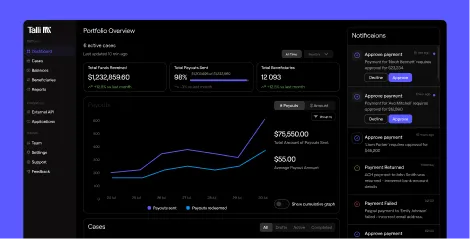
Live dashboards transform payment oversight from reactive troubleshooting to proactive management. Real-time visibility includes:
- Completion rate tracking by payment method and region
- Fund flow monitoring with remaining balance alerts
- Failure root cause analysis identifying systemic issues
- Fraud flag review queues for exception handling
- Stakeholder portal access for courts and trustees
Automated reporting generates court-required accounting without manual preparation, while CRM integration via webhooks syncs payment status updates automatically to case management systems.
Simplifying Court Reporting and Reconciliation
Proper audit trails for disbursements maintain chain of custody documentation proving fund separation throughout disbursement lifecycles. Segregated payment accounts can improve fund control, reconciliation, and auditability across workers' compensation payment workflows.
Selecting a Payment Partner: Beyond Just Transaction Processing
Evaluating Vendor Support and Infrastructure
Platform selection extends beyond feature comparison to strategic partnership evaluation:
- Implementation timeline: Evaluate deployment time based on integration scope, legacy data migration, and the number of claims systems involved
- Scalability testing: Verify performance from 1,000 to 100,000+ recipients without degradation
- Security certifications: Require SOC 2 Type II and PCI DSS Level 1 compliance
- Banking relationships: FDIC-insured partnerships provide institutional-grade fund protection
- Support infrastructure: Claimant support in multiple languages reduces administrative burden
The Benefits of a Purpose-Built Solution
Purpose-built platforms offer advantages generic payment processors cannot match:
- Segregated fund controls with clear reconciliation and audit trails
- Multi-jurisdictional support across 190+ countries with 150+ currencies
- State-specific rule engines automating fee schedule validation
- Comprehensive integration to claims management and bill review systems
- Supporting document delivery for complete claims documentation
Integrating Payment Platforms with Existing TPA Systems
Streamlining Workflows through Integration
Workers' compensation payment platforms must integrate with bill review platforms, clearinghouses, and core claims management systems. Integration depth varies by vendor. TPAs should verify supported connections to their specific claims system, bill-review platform, medical-billing partners, and accounting environment before selection.
Critical integration points include:
- Bill review platforms validating medical billing before payment
- Claims management systems for case data synchronization
- Accounting software eliminating duplicate data entry
- Compliance databases for real-time regulatory updates
- Communication platforms for claimant notifications
Leveraging APIs for Seamless Operations
API-first architecture enables custom integrations that reduce manual workarounds. Real-time API connectivity eliminates reconciliation errors while providing live payment status tracking. Webhook support delivers instant notifications to existing systems without polling overhead.
As one delivery manager noted, "Getting the 'unstructured-to-structured' conversion right is the foundation for the entire platform's ROI." Platforms operating in isolation require manual workarounds that negate efficiency gains.
Why Talli Streamlines Payment Platforms for Workers' Comp TPAs
For workers' compensation TPAs seeking to modernize payment operations while maintaining complete regulatory compliance, Talli provides comprehensive solutions specifically designed for compliance-critical disbursements.
Talli's Digital Disbursement Platform delivers end-to-end settlement payment processing with capabilities that address every major TPA requirement:
- Automated Compliance Suite: Identity verification, sanctions screening with documented timestamps, automated tax-document workflows when applicable, and comprehensive audit logging for regulatory review
- Six Payment Method Options: ACH direct deposit ($0.25-$0.50 per transaction), prepaid Mastercard via Patriot Bank N.A., digital wallets (PayPal, Venmo), gift cards, wire transfers, and paper check fallback
- Fraud Mitigation: Pattern-based controls, identity signals, and audit logs help flag suspicious payout activity for review
- Fund Segregation Architecture: Dedicated accounts supporting clear fund separation, reconciliation, and auditability throughout the disbursement lifecycle
Unlike generic payment processors, Talli provides fiduciary-grade infrastructure with banking services through Patriot Bank, N.A., Member FDIC. The platform handles settlements ranging from 1,000 to 100,000+ recipients without performance degradation.
AB Data, a leading U.S. claims administrator, achieved a 30% increase in redemption rates and 60% reduction in unresolved exceptions after implementing Talli. As their President & CEO Thomas R Glenn stated: "We don't think of digital disbursement as a feature, we think of it as infrastructure."
For TPAs ready to transform their payment operations, explore Talli's solutions for trustees and settlement administrators to see how purpose-built disbursement technology drives operational efficiency, claimant satisfaction, and regulatory confidence.
Frequently Asked Questions
What are the primary benefits of a digital payment platform for Workers' Comp TPAs?
Digital payment platforms reduce disbursement costs by 80-95% compared to paper checks while compressing distribution timelines from 6-8 weeks to 24-48 hours. Beyond cost savings, platforms offering multiple payment methods achieve higher redemption rates by meeting diverse claimant preferences. Automated compliance features eliminate manual tracking of state-specific requirements while providing court-ready audit documentation.
How can a payment platform help TPAs comply with regulatory requirements like KYC and OFAC?
Modern platforms embed compliance automation directly into payment workflows. Identity verification cross-references provided information against databases automatically, while sanctions screening achieves real-time checking against U.S. Treasury lists with documented timestamps. Tax-document workflows should be applied only when the payment is reportable. Ordinary workers' compensation benefits for occupational sickness or injury are generally exempt from federal income tax, so W-9 collection, Form 1099 reporting, and 24% backup withholding are not universal claimant requirements.
What payment methods should a TPA look for in a payment platform to ensure broad claimant reach?
Effective platforms offer six or more payment options: ACH direct deposit for banked claimants, prepaid Mastercard for unbanked populations (serving a population that included approximately 5.6 million unbanked U.S. households in 2023), digital wallets like PayPal and Venmo for younger demographics, gift cards for small-value distributions, wire transfers for high-value international payments, and paper checks as fallback. Because payment preferences vary significantly, multi-rail offerings directly impact redemption success.
What security certifications are important for a payment platform handling sensitive claimant data?
Essential certifications include SOC 2 Type II demonstrating security control effectiveness over time, PCI DSS Level 1 for payment card data protection, and HIPAA compliance for protected health information handling. Banking partnerships with FDIC-insured institutions like Patriot Bank, N.A. provide additional fund protection. Platforms should also maintain documented sanctions screening timestamps, identity verification records, and comprehensive audit trails for regulatory review.
Can a payment platform integrate with existing TPA case management systems?
Yes, modern platforms provide API-first integration with major claims systems and bill review platforms. Pre-built connectors support Guidewire ClaimCenter and similar enterprise systems, while webhook support enables real-time status updates to CRM systems without manual synchronization. TPAs should verify that their chosen platform supports connections to their specific claims system, bill-review platform, and accounting environment before implementation.