.svg)


.svg)
The National Association of Realtors settlement represents one of the most significant shifts in real estate practice in decades, fundamentally changing how buyer's agents are compensated and how commission structures are disclosed across the industry. With a $418 million settlement announced in March 2024 and granted final court approval on November 26, 2024, and practice changes effective since August 17, 2024, real estate professionals, settlement administrators, and consumers must understand the new operational realities. For those managing large-scale legal payouts—whether in real estate or other class action settlements—these changes highlight the critical importance of transparent, compliant disbursement processes.
Key Takeaways
- The NAR settlement eliminated mandatory buyer's agent compensation offers from MLS platforms and requires MLS participants working with buyers to use written buyer representation agreements before home tours
- Despite predictions of dramatic fee reductions, combined commissions average about 5.70% in 2026 with buyer's agent fees rebounding to about 2.82%
- An estimated 70-80% of sellers still voluntarily offer buyer's agent compensation as a competitive strategy
- The settlement faces significant Eighth Circuit appeals with oral arguments held January 14, 2026—potential reversal could create industry-wide uncertainty
- Mandatory buyer agreement content requirements include specific compensation amounts, objective terms, and conspicuous negotiability statements
- The settlement applies only to residential transactions (1-4 unit properties)—commercial real estate remains unaffected
- New commission structures require flexible settlement disbursement systems capable of handling multi-party payment arrangements
Understanding the Landmark NAR Settlement: Key Changes in 2026
The NAR settlement stems from the October 2023 Sitzer/Burnett jury verdict that found the National Association of Realtors and major brokerages liable for $1.8 billion in damages—potentially trebling to $5.4 billion—for conspiring to inflate commissions by requiring sellers to pay buyers agent fees through mandatory MLS compensation offers.
Background of the Antitrust Lawsuits
The core allegation centered on anticompetitive practices embedded in MLS rules that required sellers to offer compensation to buyer's agents as a condition of listing. Plaintiffs argued this structure eliminated price competition among buyer's agents, prevented buyers from negotiating lower fees, created steering incentives, and artificially inflated transaction costs by billions annually.
The settlement announced in March 2024 reduced monetary damages to $418 million paid over four years while implementing sweeping practice changes. NAR denied wrongdoing but agreed to significant operational reforms affecting its 1.5 million+ members.
Summary of the Agreement's Core Provisions
Two fundamental changes took effect August 17, 2024:
1. MLS Compensation Prohibition
- Buyer's agent compensation offers are now prohibited on MLS platforms
- Compensation can only be negotiated directly between parties outside MLS
- Sellers and listing brokers may still offer compensation—just not through MLS infrastructure
- Alternative communication methods (phone, email, personal websites) remain permitted
2. Mandatory Written Buyer Representation Agreements
- Required before in-person or live virtual home tours (not casual open house attendance)
- Must explicitly state the compensation amount the buyer agrees to pay
- Must include language confirming fees are negotiable
- Must prohibit agents from receiving more than the agreed amount from any source without additional buyer consent
Impact on Real Estate Commissions and Buyer-Broker Agreements Post-2026
The settlement's impact on actual commission rates has been less dramatic than initial predictions suggested. Clever Real Estate's 2026 survey reveals combined commissions averaging about 5.70%—essentially unchanged from historical 5-6% norms.
New Requirements for Buyer Representation
Mandatory buyer agreements must include specific content elements:
- Specific compensation disclosure: Exact amount or rate the agent will receive, or clear methodology for calculation
- Objective compensation terms: Must specify "$X flat fee" or "X%" or "X hourly rate"—cannot be open-ended
- Compensation ceiling: Prohibition on agent receiving more than agreed amount from any source
- Negotiability statement: Conspicuous language that "broker fees and commissions are fully negotiable and not set by law"
- Timing requirement: Agreement signed before in-person or live virtual home tours
Anticipated Shifts in Commission Rates
Contrary to expectations of dramatic fee reductions, buyer's agent fees have rebounded:
- Brief post-settlement dip to about 2.5% (August-September 2024)
- Recovery to about 2.82% in 2026
- Listing agent commissions averaging about 2.88%
- Total combined commissions at about 5.70%
Industry experts attribute this resilience to market dynamics. As Shane Parker notes: "If sellers don't offer buyer agent compensation, they may see fewer showings—especially from buyers who can't afford to cover that cost themselves."
Compliance Requirements for Agents and Brokers
The settlement creates significant compliance obligations for real estate professionals operating within NAR-affiliated systems.
Updated Disclosure Forms and Procedures
Listing agreement requirements now mandate:
- Seller must provide written authorization for any payment listing broker will make to buyer broker
- Authorization must specify amount or rate of payment
- Authorization must be obtained in advance of payment or agreement to pay
- Disclosure must be "conspicuous" with prominent placement and clear language
Anti-steering protections remain in effect with buyer brokers prohibited from filtering listings based on compensation offers. Existing NAR Code of Ethics Article 3 anti-steering rules continue.
Training and Education for Real Estate Professionals
The shift from implicit to explicit compensation discussions has accelerated professional development needs. Real estate professionals report the most significant operational challenge is explaining their value proposition to justify fees in mandatory buyer agreements signed before home tours.
Key adaptation strategies include:
- Development of service menus detailing specific deliverables
- Portfolio building using past transaction data as proof of performance
- Training programs on consultative selling and value communication
- Enhanced marketing materials emphasizing expertise and market knowledge
Financial Implications: Who Pays Whom?
Despite the structural changes, approximately 70-80% of sellers still voluntarily offer buyer's agent compensation as a marketing strategy. However, multiple payment structures now exist:
Traditional (Modified): Seller pays both agents, but buyer's agent compensation negotiated off-MLS rather than published in listing
Buyer-Paid with Seller Credit: Buyer agrees in representation agreement to pay their agent directly, then negotiates seller credit toward closing costs to offset this expense
Split Payment: Seller offers partial buyer's agent compensation; buyer pays the remainder per their agreement
Direct Buyer Payment: Buyer pays agent fee from their own funds (most challenging for buyers with limited cash reserves)
Impact on Mortgage Lenders and Loan Structures
Buyer affordability concerns represent the settlement's most significant consumer challenge. Buyers now potentially face responsibility for their agent's commission (typically 2.5-3% of purchase price) in addition to down payment, closing costs, and moving expenses.
On a $350,000 home, buyer's agent fees could reach approximately $8,750-$10,500—a substantial additional burden for first-time buyers already stretched thin.
Current solutions include sellers voluntarily offering buyer's agent compensation, seller concessions toward closing costs, buyers negotiating reduced agent fees, or buyers reducing down payment to free up cash for commission.
Legal Settlement Administration and Payouts: Lessons from Large-Scale Cases
The NAR settlement—while focused on real estate commission practices—offers valuable lessons for anyone involved in administering large-scale legal payouts. The complexity of multi-party payments, documentation requirements, and compliance obligations mirrors challenges faced in class action settlements, mass tort distributions, and other high-volume legal disbursements.
The Role of Qualified Settlement Funds in Complex Payouts
Large legal settlements often utilize Qualified Settlement Funds (QSFs) under IRC Section 468B to manage disbursements while preserving favorable tax treatment. Effective fund segregation requires:
- Dedicated account structures for each settlement
- Complete separation between settlement funds and operating capital
- Matter-level fund tracking for court reporting
- Audit-ready documentation proving fund separation throughout the disbursement lifecycle
These requirements parallel the documentation burdens created by the NAR settlement, where clear tracking of who authorizes what payments to whom has become essential. Organizations managing complex payouts benefit from platforms that automate settlement reconciliation while maintaining complete compliance records.
Ensuring Transparency and Auditability in Large Settlements
The NAR settlement emphasizes transparency in compensation arrangements—a principle equally critical in legal settlement administration. Court-supervised distributions require:
- Real-time visibility into completion rates and payment status
- Automated reporting that generates court-required accounting
- Stakeholder portals providing controlled access for courts, trustees, and legal teams
- Complete audit trails documenting every transaction
Platforms designed for legal settlements must achieve full audit trails that satisfy both regulatory requirements and fiduciary obligations.
The Potential for Fraud and Security Concerns in Settlement Distributions
Any large-scale settlement distribution faces fraud risks that require proactive mitigation. The NAR settlement's emphasis on documentation and verification reflects broader security concerns affecting legal payouts across industries.
Mitigating Fraudulent Claims in Legal Payouts
Fraud in settlement distributions has increased dramatically, with AI-powered detection systems becoming essential for identifying duplicate claims, identity fraud, manufactured claims with fabricated documentation, and coordinated fraud schemes across multiple claimants.
Effective fraud prevention combines device fingerprinting, behavioral analytics, cross-reference verification against identity databases, and real-time flagging for human review of questionable claims.
Protecting Claimant Data and Funds
Settlement administrators must implement robust security measures including:
- KYC verification: Cross-referencing provided information against identity databases
- OFAC screening: Automated compliance checking against U.S. Treasury sanctions lists
- Data encryption: Protecting claimant personal and financial information
- Access controls: Role-based permissions limiting who can view and modify sensitive data
- Phishing prevention: Protecting claimants from fraudulent communications
These security requirements apply whether distributing real estate settlement funds or managing mass tort payouts affecting thousands of claimants.
Accelerating Fund Distribution: Digital Solutions for Legal Payouts
The NAR settlement highlights inefficiencies in traditional payment methods that affect all types of legal distributions. Paper-based processes that take weeks can be transformed through digital disbursement platforms.
Benefits of Digital vs. Traditional Check Disbursements
Traditional paper check distributions suffer from significant drawbacks including processing costs of $7-20 per check, distribution timelines of 6-8 weeks, and redemption rates of only 70-80%. Digital disbursement alternatives dramatically improve these metrics through multiple payment channels:
- ACH direct deposit: $0.25-$0.50 per transaction with 1-2 day delivery
- Prepaid cards: Virtual cards delivered via SMS/email in seconds
- Digital wallets: PayPal and Venmo integration for instant access
- Gift cards: Highest redemption rates for small-value distributions
Improving Claimant Satisfaction with Faster Payments
Speed matters for claimants awaiting their funds. Digital disbursement platforms can compress distribution timelines from weeks to 24-48 hours while achieving redemption rates of 95-98%—a significant improvement over traditional methods.
For settlement administrators, these improvements translate to reduced administrative overhead, lower reissuance costs, faster case closure, better claimant satisfaction, and simplified court reporting.
Industry Shifts: New Business Models for Real Estate Professionals
The settlement has accelerated adoption of alternative commission models, creating a more diverse marketplace for real estate services.
Innovations in Agent Compensation Models
Multiple compensation structures now compete for market share:
Flat-Fee MLS Services ($100-$1,000)
- MLS listing access only with minimal support services
- Seller handles showings, negotiations, paperwork
- Best for experienced, tech-savvy sellers
100% Commission Brokerages
- Agents keep full commission
- Pay per-transaction fees ($250-$500) plus monthly membership ($79+)
- Requires agent to self-generate leads and marketing
Tiered Service Models
- Essentials ($95 + closing fee): MLS listing only
- Advanced ($495 + closing fee): Listing plus limited support
- Full Service (1-2% at closing): Complete representation
Industry analysis demonstrates the financial impact for agents: An experienced agent closing 15 deals annually at $8,000 average commission could increase take-home income by approximately $30,000 (36%) by switching from a traditional 70/30 split to a 100% commission model with per-transaction fees.
How Talli Streamlines Complex Settlement Distributions
The NAR settlement illustrates why modern legal disbursements require sophisticated technology infrastructure. As commission structures have become more complex—with seller-paid, buyer-paid, split payments, and hybrid arrangements—settlement administrators need platforms capable of handling diverse payment scenarios while maintaining complete compliance documentation.
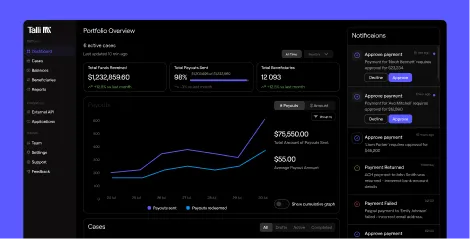
Talli's digital disbursement platform addresses these challenges by offering:
- Multi-party payment capabilities that accommodate the varied commission structures emerging post-settlement
- Automated compliance tracking that generates court-required reporting and maintains full audit trails for every transaction
- Flexible payment channels including ACH, prepaid cards, and digital wallets that reduce costs and accelerate distribution timelines
- Real-time visibility giving settlement administrators, trustees, and legal teams immediate access to payment status and completion rates
- Fraud detection using AI-powered systems to identify suspicious patterns and protect claimant funds
Whether managing real estate commission distributions, class action payouts, or mass tort settlements, organizations benefit from Talli's purpose-built infrastructure that combines speed, security, and transparency. The platform's real-time tracking capabilities provide the documentation standards that courts require while dramatically improving claimant satisfaction through faster payment delivery.
Frequently Asked Questions
Does the NAR settlement apply to commercial real estate transactions?
No. The NAR settlement applies only to residential transactions involving 1-4 unit properties listed on residential MLSs. Commercial real estate transactions using Commercial Information Exchanges remain unaffected by the compensation offer prohibitions and buyer agreement requirements. However, some states have implemented separate requirements—California's AB 2992, effective January 1, 2025, extends buyer representation agreement requirements to commercial properties independent of the NAR settlement.
What happens if the Eighth Circuit Court of Appeals vacates the settlement?
If appeals succeed, the industry could face significant upheaval. The implemented practice changes might be invalidated, potentially requiring new negotiations between NAR and plaintiffs. The original $1.8 billion jury verdict (potentially trebling to $5.4 billion) could be reinstated. Real estate professionals and settlement administrators should maintain flexibility in their systems and processes to accommodate potential rule reversions.
Can buyers finance their agent's commission through their mortgage?
This remains complicated. While some lenders are exploring loan products that might allow commission financing, most conventional loan programs have limitations on what closing costs can be rolled into the mortgage. FHA and VA loans have specific guidelines about allowable seller concessions that may or may not cover buyer's agent fees depending on how they're structured. Buyers should consult with their lender about specific options.
Are all real estate agents required to follow the NAR settlement rules?
The settlement directly applies to NAR members and those participating in NAR-affiliated MLSs. However, some states (like Ohio with HB 466) have codified these practices into state law, making them applicable to all licensed agents regardless of NAR membership. Additionally, practical market dynamics often drive non-NAR agents to adopt similar practices since most buyers and sellers expect the transparency these rules provide.
How should settlement administrators prepare for diverse commission structures?
Settlement administrators and title companies should implement systems capable of handling multiple payment sources within single transactions: seller-paid, buyer-paid, split payments, flat fees, and hybrid arrangements. Documentation must clearly track authorizations, broker-to-broker agreements, and the specific terms under which each party agreed to compensation. Platforms with robust compliance capabilities can simplify these multi-party payment arrangements while maintaining the audit trails courts require.