.svg)


.svg)
Deciding whether to opt out of a class action settlement requires careful evaluation of your individual damages against guaranteed collective recovery. Some securities and antitrust opt-outs have achieved larger individual recoveries than they would have received through class settlements, but available public data does not establish that opting out generally produces a higher recovery. This strategy only makes sense for claimants with substantial documented losses exceeding the average class member recovery. For those who remain in a settlement, modern class action disbursement platforms can expand payment options, reduce reliance on paper checks, and help claimants receive settlement funds more efficiently.
Key Takeaways
- Class members are automatically included in Rule 23(b)(3) settlements unless they submit written opt-out requests by court-imposed deadlines
- The share of securities class action settlements with at least one identified opt-out increased from 2.9% in 1996-2005 to 11.5% in 2019-H1 2022, while 62.5% of settlements exceeding $100 million during the latter period had at least one identified opt-out
- A second opt-out opportunity is not guaranteed, although Rule 23(e)(4) allows a court to require a new opportunity for exclusion when a previously certified Rule 23(b)(3) class later settles
- An FTC study of consumer class action settlements found overall claims rates below 10% in its sample, including a 9% median claims rate in one analyzed group
- Individual litigation can be more time-consuming and costly than class membership, making legal consultation essential
- Institutional investors dominate opt-outs, with 10 of 11 institutional opt-outs resulting in direct action lawsuits during 2019-H1 2022
Understanding Your Rights: What is a Class Action Settlement and Why Opt Out?
A class action settlement represents a legal resolution where a defendant agrees to compensate a group of plaintiffs who suffered similar harm. Under Federal Rule of Civil Procedure 23(b)(3), you're automatically included as a class member in most consumer, securities, and product liability cases unless you affirmatively exclude yourself.
The Purpose of a Class Action Notice
Settlement notices inform eligible class members about:
- Case details describing the underlying claims and defendant conduct
- Settlement terms including total fund size and payment calculations
- Your options to submit a claim, opt out, or object
- Critical deadlines for each available action
- Administrator contact information for questions
The notice represents your primary source for understanding what the settlement offers and whether it adequately compensates your specific damages.
Why You Might Consider Opting Out
Opting out preserves your right to pursue individual litigation when the class settlement appears inadequate for your circumstances. This decision makes strategic sense when your individual damages significantly exceed average class recovery, you want control over your legal strategy, or your circumstances differ substantially from typical class members.
However, staying in a class action proves useful when your individual loss is relatively small or when you lack resources to pursue independent litigation against well-funded defendants.
Identifying Your Claim: When an Individual Lawsuit May Offer More
Assessing the Value of Your Individual Claim
Research on opt-out plaintiffs shows that some securities and antitrust cases resulted in substantially higher individual recoveries than class settlements would have provided. This dramatic difference occurs because class settlements distribute fixed funds across all eligible members, diluting recovery for high-damage claimants.
Consider opting out when:
- Documented damages substantially exceed projected class recovery: if your provable losses are significantly greater than the expected class payment, an individual action may be worth evaluating with counsel
- Unique circumstances affect your claim: severe injuries, specific harm documentation, or unusual exposure patterns distinguish your case
- You have resources for litigation: individual lawsuits require attorney fees, expert witnesses, and time commitments
Comparing Settlement Payouts to Potential Verdicts
The average class action consumer recovery is only $32, while plaintiff attorneys average $1 million per case. This disparity explains why sophisticated claimants with substantial losses increasingly choose independent action.
Institutional investors exemplify this calculation. Nearly 300 investors opted out of the Tyco International securities class settlement, and thousands of retailers excluded themselves from the proposed $7.25 billion Visa/Mastercard Interchange Fee case.
The Opt-Out Process: Step-by-Step Instructions to Preserve Your Rights
Locating the Official Opt-Out Form
Your settlement notice contains specific instructions for requesting exclusion. Most settlements provide:
- Mail-in exclusion forms with required identifying information
- Online portals through settlement administrator websites
- Specific formatting requirements for exclusion requests
Courts mandate that notices be reasonably calculated to inform interested parties of their rights. If you didn't receive notice but believe you're eligible, contact the settlement administrator directly.
Adhering to the Exclusion Deadline
Opt-out deadlines typically fall 30-60 days after notice issuance. Missing the exclusion deadline generally leaves you bound by the class judgment and its release, although limited exceptions or a court-authorized later exclusion opportunity may apply.
Critical timing considerations:
- Mail early: use certified mail with return receipt requested
- Retain copies: document your exclusion request and submission
- Confirm receipt: follow up with the administrator if no acknowledgment arrives
- Note postmark requirements: some courts require postmarks by the deadline, not delivery
Ensuring Proper Submission of Your Opt-Out Request
Your written exclusion request must include:
- Full legal name as it appears in settlement records
- Current mailing address for future correspondence
- Case identification information from the settlement notice
- Clear statement of intent to exclude yourself from the settlement
- Signature authenticating the request
Incomplete submissions risk rejection. Review your notice carefully for case-specific requirements that may exceed these standard elements.
Navigating Complex Settlements: Opting Out of 'No Proof' Claims
Understanding No-Proof Settlements
Some settlements don't require purchase receipts or detailed documentation, particularly data breach and consumer protection cases where records may not exist. These simplified claims processes enable broader participation but typically offer modest per-person payments.
No-proof settlements create interesting opt-out dynamics:
- Lower individual recovery reduces incentive for most claimants to pursue independent litigation
- Easier claim submission increases participation rates compared to documentation-heavy settlements
- Fixed fund distribution means more claimants equals smaller individual payments
When Minimal Compensation Justifies Opting Out
Even no-proof settlements warrant opt-out consideration when you possess documentation showing damages far exceeding projected class payments. Medical records, financial statements, or identity theft remediation costs can support individual claims worth multiples of simplified settlement amounts.
However, the economic calculus must account for litigation expenses. Pursuing a $5,000 claim individually rarely makes sense against defendants with deep pockets and experienced legal teams when the class settlement guarantees $200 with minimal effort.
Beyond the Basics: Considerations for High-Value or Unique Situations
Evaluating High-Value Settlement Offers
Cornerstone Research data reveals that 62.5% of settlements exceeding $100 million had at least one identified opt-out, and 100% of the two settlements exceeding $500 million studied had identified opt-outs. This pattern demonstrates that sophisticated parties systematically evaluate whether collective action serves their interests.
High-value case characteristics associated with opt-outs include:
- Greater allegation complexity with longer class periods, SEC actions, or criminal charges
- Stronger defendant ability to pay: median market cap of $6.2 billion versus $373 million for cases with and without opt-outs
- Higher simplified damages metrics: median Maximum Dollar Loss of $7.0 billion for opt-out cases versus $667 million overall
The Long-Term Impact of Opting Out
Opting out eliminates any recovery from the class settlement regardless of your individual lawsuit's outcome. The class may win substantial compensation while your independent case fails, leaving you with nothing and potentially significant legal bills.
Professor George Rutherglen argues that class members should be allowed to opt out when they receive information about how well their interests have been protected, after a proposed settlement or just before trial. The current structure requires decisions before this information becomes available.
The Role of Legal Counsel: Getting Expert Advice on Your Opt-Out Decision
When to Consult a Personal Injury Lawyer
Legal consultation becomes essential when:
- Your damages are substantial relative to the class recovery: individualized legal advice can help determine whether the potential recovery justifies the costs and risks of separate litigation
- You suffered unique harm: circumstances distinguishing your case from typical class members
- The settlement seems inadequate: professional evaluation confirms your suspicions
- Statute of limitations concerns arise: individual action timelines may differ from class proceedings
Most attorneys offer free initial consultations for potential opt-out cases. This evaluation costs nothing but can prevent costly mistakes.
Understanding Legal Fees for Opt-Out Advice
Contingency fee arrangements dominate plaintiff litigation, typically ranging from 25-40% of recovery. This structure eliminates upfront costs but significantly reduces net proceeds from any eventual judgment or settlement.
Compare this to class membership, where court-approved attorney fees are often paid from a common settlement fund, although some settlements provide for fees separately. Your class settlement payment arrives without legal fee deductions, though the fund itself is reduced before distribution.
After Opting Out: Pursuing Your Individual Claim Effectively
Steps to Filing an Individual Lawsuit
Once you've successfully opted out, your individual litigation path involves:
- Attorney engagement: select counsel experienced with similar claims
- Investigation and discovery: gather evidence supporting your specific damages
- Complaint filing: initiate your lawsuit within applicable statute of limitations
- Negotiation or trial: pursue resolution through settlement discussions or courtroom proceedings
Your opted-out status generally preserves claims the class settlement would otherwise release, subject to applicable statutes of limitation, defenses, and other legal requirements.
Building a Strong Case After Opting Out
Individual litigation requires comprehensive documentation:
- Damage calculations supported by receipts, records, and expert analysis
- Causation evidence linking defendant conduct to your specific harm
- Timeline documentation establishing when you became aware of injuries
- Witness statements corroborating your experience
The discovery process enables access to defendant documents and testimony unavailable to passive class members, a significant advantage for claimants with strong individual cases.
Maximizing Your Payout: Digital Solutions for Future Settlements
For claimants who choose to remain in settlements, modern payment technology dramatically improves the claims redemption experience. Traditional paper check systems result in 20-40% of payments going unclaimed, while digital disbursement platforms achieve 95-98% redemption rates.
The Evolution of Settlement Payments
Settlement administration has transformed from check-based distribution requiring 6-8 weeks to digital-first platforms completing payments within 24-48 hours. This acceleration benefits claimants by:
- Reducing unclaimed funds through multiple payment channel options
- Eliminating postal delays and lost mail issues
- Providing real-time tracking of payment status
- Offering preferred payment methods including ACH, prepaid cards, and digital wallets
How Technology Prevents Unclaimed Money
Modern settlement platforms address the class action settlement statistics showing that historically 20-40% of settlement checks go uncashed. Digital solutions reduce this through:
- Multi-channel delivery reaching claimants via preferred methods
- Automated reminders prompting action before deadlines
- Instant access eliminating delays between approval and receipt
- Mobile-friendly interfaces matching how people manage finances today
Understanding these improvements helps inform the opt-out decision. Remaining in a digitally-administered settlement may deliver faster, more certain recovery than protracted individual litigation.
Why Choose Talli for Settlement Disbursement
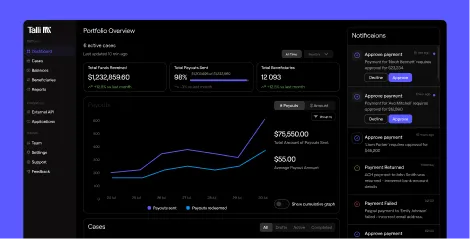
For claimants who decide to participate in class settlements rather than opt out, Talli provides digital disbursement infrastructure ensuring payments actually reach intended recipients. Unlike traditional paper check systems plagued by 20-40% uncashed rates, Talli's platform achieves 95-98% redemption through multiple payment options.
Talli's settlement disbursement platform addresses common frustrations:
- Six Payment Method Options: ACH direct deposit, prepaid Mastercard, PayPal, Venmo, gift cards, and traditional checks, letting claimants choose their preferred method
- 24-48 Hour Distribution: Compresses traditional 6-8 week timelines to near-instant payments
- Real-Time Status Tracking: Claimants monitor their payment from approval through delivery
- Built-In Compliance: Automated KYC verification, OFAC screening, and tax reporting eliminate administrative barriers
- Fraud Prevention: Automated fraud controls and identity verification help administrators identify suspicious activity before settlement funds are released
For settlement administrators managing distributions, Talli's platform handles everything from claimant notification through final reconciliation, including the complex scenarios when opt-outs change fund calculations and payment populations.
The platform serves claims administrators, class action law firms, and trustees managing settlements from 1,000 to 100,000+ recipients. Banking services provided by Patriot Bank, N.A., Member FDIC ensure institutional-grade security for settlement funds.
Frequently Asked Questions
What does it mean to opt out of a class action settlement?
Opting out means formally excluding yourself from a class action lawsuit to preserve your right to pursue individual legal claims against the defendant. Under Federal Rule 23, you're automatically included in most class actions unless you submit a written exclusion request by the court-imposed deadline. Once you opt out, you cannot claim any portion of the class settlement but retain full rights to independent litigation.
When is it a good idea to opt out of a class action settlement?
Consider opting out when your individual damages significantly exceed average class recovery. Research shows some opt-out plaintiffs in securities and antitrust cases achieved substantially larger recoveries than class settlements would have provided. Opt-out makes strategic sense for institutional investors, individuals with severe or unique injuries, and those with resources to pursue independent litigation. For small claims, remaining in the class typically provides better risk-adjusted returns.
What happens if I miss the opt-out deadline?
Missing the opt-out deadline generally leaves you bound by the class judgment and its release, although limited exceptions or a court-authorized later exclusion opportunity may apply. Courts strictly enforce deadlines, and you'll automatically remain in the class and be bound by the settlement terms, including the release of claims against the defendant. Always use certified mail and submit requests well before deadlines.
Do I need a lawyer to help me opt out of a class action settlement?
You don't legally need an attorney to submit an opt-out request. The process involves completing a form or writing a letter with required information. However, legal consultation is advisable before opting out, especially for substantial claims. An attorney can evaluate whether your individual case merits independent pursuit, explain the risks of individual litigation, and help you understand the true value of staying in versus leaving the class.
Can I still receive compensation if I opt out of a class action settlement?
Opting out eliminates any recovery from the class settlement. You receive nothing from the collective fund regardless of how the case resolves. However, you preserve rights to pursue individual compensation through separate litigation. Success depends entirely on your case's merits, your ability to prove damages, and the defendant's resources. The class settlement may succeed while your individual case fails, leaving you with nothing and potentially significant legal expenses.