.svg)


.svg)
These are the 12 questions every claims administrator, settlement counsel, and legal operations team should require written answers to before signing with a disbursement vendor.
Most settlement disbursements go wrong the same way: the vendor's fee schedule looks reasonable at signing, and the misalignment does not surface until post-distribution accounting reveals float income the vendor retained, interchange on prepaid cards that steered claimants away from ACH, or re-issuance fees that turned payment delivery failures into a vendor revenue center.
Revenue model due diligence is the step most vendor evaluations skip. Fee schedules are straightforward to compare. Float income arrangements, interchange economics, and fee structures tied to payment failures rarely make it into the RFP process. These are the questions that change that.
Before you commit to settlement payout infrastructure, revenue model due diligence disbursement vendor evaluation is the step that tells you whether the platform's economics point in the same direction as your obligations. The questions below are designed to surface misaligned disbursement vendor incentives before they affect claimants.
This guide gives claims administrators, settlement counsel, and legal operations teams a structured framework: 12 questions organized across four revenue categories, each with the right answer and the Warning Signs to watch for.
Disbursement vendors may earn revenue beyond their quoted fee schedules through float income, interchange on prepaid cards, and re-issuance fees on returned payments. This guide covers 12 questions across four revenue categories. Require written answers before signing and compare responses across at least two vendors. For Talli or any other disbursement platform, get written disclosure of float treatment, card-program economics, and any returned-payment or re-issuance fees before contract signing.
Key Takeaways
- A disbursement vendor's publicly quoted fee schedule rarely captures its full revenue picture. Float income, interchange earnings, and re-issuance fees can make slow disbursement profitable for the vendor even when it is costly for claimants.
- Revenue model due diligence disbursement vendor assessment is a fiduciary-alignment exercise, not just a procurement exercise. The assets being moved belong to class members or claimants, not the vendor.
- The highest 10 class action settlements totaled more than $42 billion in 2024, making disbursement vendor economics a material concern at scale.
- Float income on a $200 million settlement can reach roughly $7-7.5 million annually at current short-term rate levels. This is basic arithmetic using the current 3.50%-3.75% federal funds target range as a proxy for yield on funds held during a standard distribution cycle.
- Vendors whose revenue grows when disbursement slows down have fundamentally different incentives from vendors whose revenue grows when claimants are paid quickly.
- Talli is built around digital disbursement infrastructure, multiple payout rails, fund segregation, compliance automation, and real-time reporting for legal settlement distributions.
What Is Revenue Model Due Diligence?
Revenue model due diligence disbursement vendor evaluation is the process of mapping every source of income the vendor earns from your engagement, then evaluating whether those revenue streams create incentives that conflict with fast, accurate, compliance-critical settlement payouts.
Standard vendor due diligence focuses on information security, SOC 2 certifications, financial stability, business continuity, and compliance operations. Those questions are necessary. They are not sufficient for settlement administration, where the vendor's economic incentives can directly influence whether claimants receive payments promptly and in the method they prefer.
The distinction matters because disbursement vendors do not just earn service fees. A vendor holding settlement funds may earn float interest while those funds sit in its accounts. A vendor issuing prepaid cards may participate in interchange economics. A vendor handling returned checks may charge re-issuance fees that make payment delivery failures profitable. Understanding where every dollar of vendor revenue comes from tells you whether the platform is designed to serve claimants or to monetize the gap between fund receipt and fund delivery.
Why Vendor Revenue Models Matter in 2026
The settlement administration market operates at a scale where vendor economics have real consequences for beneficiaries. According to the Duane Morris Class Action Review, the highest 10 class action settlements totaled more than $42 billion in 2024, the third consecutive year above $40 billion. Against that backdrop, even a small misalignment between vendor incentives and claimant outcomes can represent millions of dollars in affected payments.
Two structural dynamics in 2026 make revenue model scrutiny more urgent than it was five years ago.
Interest rates have made float income material again. When settlement funds sit in an account earning meaningful short-term interest, a $200 million settlement could generate roughly $7-7.5 million in annual float income depending on yield and account structure. A vendor that earns this float has a financial incentive to extend that window. A vendor that does not earn a float has no such incentive.
Digital payment options have created new revenue streams for vendors. As settlement administration has shifted toward ACH, prepaid cards, and digital wallets, some vendors have built in interchange income, card program fees, and funding fees that are not always disclosed upfront. When a vendor recommends prepaid cards over ACH, you cannot always tell whether that recommendation reflects what is best for your claimants or what is most profitable for the platform.
Courts and fiduciaries are paying closer attention to vendor selection documentation, especially when post-distribution accounting raises questions about unclaimed funds, payment failures, or administrative expenses. Review the vendor process before signing so the record captures every income stream, not just the quoted fee schedule.
What Standard Evaluations Miss
Standard evaluations miss float income, interchange earnings, re-issuance fees, and the interest vendors earn on unclaimed balances. These are the revenue streams that can create misaligned incentives.
Standard procurement checklists for settlement vendors typically cover five categories: information security certifications, financial stability, regulatory compliance, business continuity, and references. Each of those questions is important. None of them fully surfaces revenue misalignment.
Here is what gets skipped:
Float income is invisible on a fee schedule. A vendor can publish a transparent, competitive fee schedule while retaining significant interest income on settlement fund balances during distribution. The fee schedule tells you what you pay. It does not tell you what the vendor earns on your funds while they sit in its accounts.
Interchange is disclosed only if you ask. Prepaid card programs can generate interchange income when cardholders use their cards for purchases. A vendor that earns interchange has an economic incentive to direct claimants toward prepaid cards, even when ACH is cheaper and equally effective for that claimant population. Standard fee schedules do not always break out interchange income.
Re-issuance fees turn payment failures into revenue. A vendor that charges a fee per returned payment earns more when payment delivery rates are low. When a meaningful share of claimants have outdated addresses or closed accounts, re-issuance fees compound quickly across a large settlement. This fee structure creates no incentive to reduce return rates proactively.
Unclaimed property holding periods generate income. Between the time a payment is issued and the time unclaimed funds are escheated to the state, balances may continue to earn interest. A vendor that retains that interest has a financial incentive to let unclaimed balances linger rather than aggressively re-engaging claimants.
The 12 questions in this guide are designed to surface each of these revenue streams directly, before you sign.
Revenue Transparency
Revenue transparency is the foundation of any revenue model due diligence disbursement vendor assessment. Questions 1-3 establish whether a vendor will disclose its complete income picture, not just the line items it chooses to include in a fee schedule.
Question 1: List Every Revenue Stream You Earn
Ask for an exhaustive list, not just the fee schedule. Disbursement vendors may earn from platform licensing fees, per-transaction fees, float income on settlement fund balances, interchange on payment cards, re-issuance fees, overage charges beyond contracted volumes, data services fees, and add-on compliance services billed separately.
The right answer lists every revenue stream with approximate contribution percentages. A vendor with a mature, transparent business can answer this without hesitation.
The Warning Signs:
- Answers only with the fee schedule
- Describes its model in vague terms
- Becomes evasive when pressed for float income details
- Treat opacity as a signal, not a coincidence
Question 2: Do You Retain Float Income on Settlement Funds?
Float income is the interest earned on settlement fund balances between deposit and disbursement. At current short-term rate levels, it can be a significant revenue stream for vendors holding large fund balances. Some vendors retain this income entirely. Others pass a portion back to the QSF or trust. A minority of purpose-built disbursement platforms may not retain float income at all, but the point is to get the answer in writing.
The right answer is a clear explanation of who earns float interest, how it is calculated, and how it is disclosed in the fund accounting. The answer should also specify whether float income creates any incentive for the vendor to delay disbursement.
The Warning Signs:
- Says, “Interest is handled through our banking partner,” without specifying who retains it
- Fails to answer the economic question
- Does not clarify whether the settlement fund, QSF, trust, or vendor receives the benefit
Question 3: Is Your Fee Structure Fixed or Volume-Tiered?
Volume-tiered pricing is common in payment infrastructure. Understanding how your fee structure scales tells you whether the vendor has a financial incentive to process more transactions, encourage unnecessary retries, or create minimums that do not match the expected claimant population.
The right answer provides a clear fee schedule with volume tiers, overage rates, and any minimums that apply. The vendor should also be able to tell you at what volume the effective per-transaction rate starts increasing rather than decreasing.
The Warning Signs:
- A fee structure that includes minimums or fee floors
- Requires you to pay for volume you do not use
- Creates pressure to increase transaction count just to hit thresholds
Payment Rail Economics
Payment rail economics are the most commonly misunderstood revenue category in disbursement vendor selection. Questions 4-6 reveal whether your vendor's payment method recommendations are driven by claimant outcomes or vendor margin.
Question 4: How Are Per-Transaction Fees Structured?
ACH, prepaid card, digital wallet, and paper check disbursements carry different cost structures. ACH processing costs are often a fraction of check costs, according to Nacha payment data. Paper checks can also create downstream costs through printing, mailing, stale checks, bank fees, reconciliation time, and re-issuance work.
The question is not just what you pay. It is what the vendor earns on each rail. ACH is generally regarded as one of the most cost-effective rails for high-volume domestic disbursements. A vendor that earns more on prepaid card disbursements than on ACH has an incentive to recommend prepaid cards even when ACH is cheaper and equally effective for your claimant population.
The right answer breaks out both your cost and the vendor's economics for each payment rail they offer.
The Warning Signs:
- Quotes only your transaction cost
- Does not disclose its margin
- Does not disclose revenue share
- Does not disclose interchange income on each rai
Question 5: Do You Earn Interchange on Prepaid Cards?
Prepaid card programs can generate interchange income when cardholders use the card for purchases. This is a revenue stream that may be invisible in a standard fee schedule. A vendor earning interchange on your prepaid card disbursements earns more revenue the more your claimants use those cards, rather than redeeming the full balance immediately.
The right answer discloses whether the vendor participates in any interchange revenue from the card programs it offers, and in what amount.
The Warning Signs:
- Says, “Our card program is provided by a third-party issuer”
- Does not specify whether the vendor receives any portion of interchange
- Fails to rule out an interchange arrangement
Question 6: What Drives Your Payment Method Recommendations?
When a vendor suggests leading with prepaid cards over ACH, or digital wallets over ACH, that recommendation should be supported by claimant preference data, redemption rate analysis, and case-specific demographics. If it is not, the recommendation may reflect the vendor's payment mix economics rather than claimant outcomes.
Platforms built around claimant-first design present multiple payout methods, including ACH, prepaid Mastercard, PayPal, Venmo, and gift cards, and let claimants choose. Platforms built around payment margin optimization steer claimants toward the option that is most profitable for the vendor.
The right answer provides data on redemption rates across payment methods for comparable claimant populations and lets you configure the payment method mix based on that data.
The Warning Signs:
- Presents only one or two payment options
- Frames additional payment rails as “premium” add-ons
Unclaimed and Returned Funds
Unclaimed and returned funds are among the most overlooked revenue categories in settlement vendor evaluation. Questions 7-9 determine whether your vendor's economics incentivize proactive resolution of unclaimed balances or passive accumulation of interest income during dormancy.
Question 7: What Happens to Unclaimed Funds at Escheat?
Unclaimed property law generally requires funds not claimed within a specified dormancy period to be turned over to the appropriate state as escheat. The dormancy period varies by state and property type. The vendor's role in this process also varies. Some handle escheat filing on your behalf. Others provide only the data you need to file yourself. A few charge separately for escheat services.
The right answer explains the vendor's role in unclaimed property reporting and escheat filing, identifies which states they support, and discloses any fees associated with this service.
The Warning Signs:
- Is vague about the escheat process
- Does not have a documented escheat procedure
- Creates potential unclaimed-fund exposure, especially with paper check payouts
- Makes escheatment a compliance question for any settlement of scale
Question 8: Who Earns Interest on Unclaimed Balances?
Between the time a payment is issued and the time funds are escheated, the balance may continue to earn interest. In some arrangements, the vendor retains this interest income. In others, it accrues to the QSF or trust. The answer affects both fund accounting and the vendor's economic incentive with respect to the resolution of unclaimed balances.
The right answer specifies exactly how interest accrues on unclaimed balances and whose account it appears in.
The Warning Signs:
- Allows the vendor to retain interest on unclaimed property
- Creates a financial incentive not to aggressively re-engage claimants
- Leaves claimants with unclaimed balances at greater risk of non-payment.
Question 9: Do You Charge Re-Issuance Fees on Returns?
Returned ACH transactions and undeliverable paper checks require follow-up. Some vendors charge per-item re-issuance fees for returned payments, a cost that can compound when claimant address or account data requires correction.
The right answer explains the returned payment workflow, discloses any re-issuance fees, and describes what the platform does to reduce the return rate in the first place.
The Warning Signs:
- Treats returned payments as a standard operational line item
- Has no specific strategy to reduce returned payments
- Fails to use digital-first tools, such as automated reminders and claimant portals
- Misses opportunities to reduce return rates before returns occur
Contract and Exit Economics
Contract and exit economics determine your leverage throughout the vendor relationship, not just at signing. Questions 10-12 surface the switching costs, data portability risks, and conflict-of-interest exposures that only appear after you are committed.
Question 10: What Are Your Volume Minimums and Overage Fees?
Many disbursement contracts include minimum transaction volumes that you pay for regardless of actual usage. If a settlement resolves faster than expected or claimant participation runs lower than projected, you may pay for capacity you never used. Understanding the economic floor of the contract tells you where the vendor's interests diverge from yours in low-volume scenarios.
The right answer discloses any minimums, their dollar value at your expected settlement scale, and the pricing formula for volumes above or below contracted levels.
The Warning Signs:
- Sets contract minimums above your projected volume
- Charges you for unused capacity
- Includes overage rates that materially increase costs for high-volume settlement distributions
- Makes the true per-transaction cost higher than the implied rate
Question 11: What Are Your Data Portability Terms?
Claimant data, payment history, and compliance documentation are core assets of a settlement administration engagement. That includes KYC records, OFAC screening results, W-9 data, 1099 records, payment status data, communications logs, and audit history. A vendor that makes data portability difficult or expensive creates switching costs that reduce your leverage throughout the contract term.
The right answer describes the export formats available, the timeline for producing a full data export, any fees associated with data export, and the retention policy for data after contract termination.
The Warning Signs:
- Provides data only in proprietary formats
- Charges excessive export fees
- Places contractual restrictions on data portability
- Limits access to audit trail data
- Prevents your data from being easily accessible, exportable, and producible for a court
Question 12: Do You Have Revenue Ties to Any Dispute Party?
This question surfaces a conflict-of-interest risk that sits at the intersection of revenue model diligence and ethics compliance. If the disbursement vendor has a fee-sharing arrangement with the defendant's insurer, a referral relationship with class counsel, or an equity relationship with any party to the matter, its incentives in administering the settlement may be compromised.
The right answer is a categorical no, supported by a disclosure policy that documents how the vendor screens for and prevents these relationships.
The Warning Signs:
- Hesitates, qualifies, or refuses to put the answer in writing
- Lacks clear confirmation of QSF-compliant account handling
- Has economic ties to a party in the matter
- Does not operate as independent fiduciary infrastructure
Talli's Revenue Model
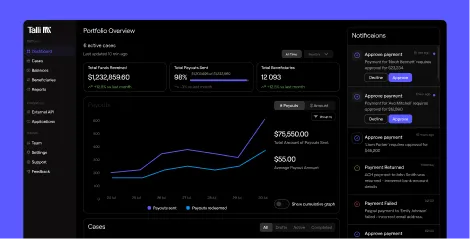
Talli is a digital claims disbursement platform built for legal and settlement administration teams. It supports high-volume legal payout programs through digital disbursement infrastructure, multiple payment rails, compliance automation, fund segregation, and real-time reporting.
The platform supports settlement fund segregation through dedicated account structures that preserve QSF ownership and matter-level accounting. Fund balances, payment status, and reconciliation data are visible in real-time dashboards that support court-ready reporting.
Talli supports multiple regulated payout rails: ACH, prepaid Mastercard, PayPal, Venmo, and gift cards. Claimants choose their preferred method through a purpose-built claimant portal. The platform also supports automated KYC verification, OFAC screening, W-9 collection, fraud mitigation, and audit logging, so compliance obligations are handled within the same infrastructure rather than managed manually alongside it.
Settlement administrators using Talli can compress distribution timelines and increase take-up rates compared with traditional check-based methods. That outcome is the alignment you want in a vendor revenue model: the platform should earn when the engagement succeeds, not when it stalls.
Key Features
- Segregated QSF accounts: Every settlement can be held in a dedicated account structure with no commingling across matters.
- Regulated payout rails: ACH, prepaid Mastercard, PayPal, Venmo, and gift cards, configured by claimant choice rather than vendor margin.
- Compliance automation: KYC verification, OFAC screening, W-9 collection, fraud mitigation, and audit logging built into the platform.
- Real-time dashboards: Court-ready reporting from first payment through final post-distribution accounting.
- Claimant portal: Automated SMS and email reminders reduce manual follow-up and help accelerate completion.
- High-volume support: Talli is built for class action, mass tort, bankruptcy, shareholder services, and regulatory settlement distributions.
Best For
Talli is the right infrastructure for claims administrators, settlement counsel, and legal operations teams that need to demonstrate full fiduciary alignment in their vendor selection. It is particularly well suited to:
- Class action settlements with large claimant populations where traditional check-based methods produce low redemption rates
- Mass tort and regulatory settlement distributions where KYC, OFAC, and W-9 compliance obligations are non-negotiable
- Bankruptcy and shareholder distributions where fund segregation, claimant communications, and audit trails matter
- Any settlement where court-ready fund accounting and full audit trail documentation are required for reporting or special master review
- Legal teams that need to defend vendor selection decisions in post-distribution proceedings
Pricing
Talli's pricing is engagement-specific. Pricing should be evaluated based on settlement size, claimant population, payment method mix, setup requirements, compliance needs, and reporting requirements. Ask Talli for written pricing terms, including any minimums, platform fees, payment-rail fees, re-issuance fees, return-handling fees, and data-export fees that apply to your matter.
Revenue Model Comparison: Traditional Vendor vs. Talli
Understanding these distinctions is why revenue model due diligence disbursement vendor evaluation should run alongside, not after, contract negotiation.
Best Practices
These five practices separate defensible revenue model due diligence from vendor selection that creates post-distribution exposure.
Document every answer in writing. A complete revenue model due diligence disbursement vendor questionnaire requires written, not verbal, responses. Verbal assurances about float income or interchange earnings do not protect you in a post-distribution audit. Require written responses to each question and attach them to your vendor selection record.
Compare responses across at least two vendors. Revenue model transparency becomes clearest when you can place two responses side by side. A vendor with a clean revenue model will welcome the comparison. A vendor with hidden income streams will resist it.
Review the contract against the questionnaire responses. Discrepancies between what a vendor says in a sales conversation and what the contract actually specifies are common. Every revenue stream disclosed in the questionnaire should have a corresponding, unambiguous provision in the contract.
Ask about revenue model changes on contract renewal. The settlement vendor revenue model that looks clean at signing can shift at renewal when switching costs are higher. Float income is profitable when rates are meaningful. A vendor may try to introduce float retention only at renewal. Ask whether revenue model terms can change at renewal and under what conditions.
Involve your QSF trustee and outside counsel. Revenue model due diligence affects the QSF's fund accounting, tax obligations, and fiduciary documentation. Have your trustee and counsel review the responses before you sign.
Common Mistakes
The most common mistakes in disbursement vendor revenue evaluation stem from assuming vendors will volunteer every revenue stream without being asked. Each is preventable.
Accepting a fee schedule as the full revenue picture. The fee schedule is the revenue the vendor discloses. It is rarely the full revenue picture. Float income and interchange revenue may not appear on a fee schedule.
Assuming transparency means no hidden revenue. A vendor can be transparent about service fees and still have material undisclosed income from float arrangements or card program economics. Transparency requires asking specific questions, not accepting that a forthcoming vendor will volunteer everything.
Skipping the unclaimed property question. Unclaimed balances are a significant issue in settlement administration. If the vendor earns on unclaimed balances, it has an incentive not to resolve them aggressively.
Evaluating vendor economics only at contract signing. Revenue model alignment should be re-evaluated at each contract renewal, particularly when interest rates change materially or when the vendor introduces new payment products.
Conflating fiduciary due diligence with revenue model due diligence. These are two separate inquiries. Fiduciary due diligence covers compliance certifications, fund segregation, and audit trails. Revenue model due diligence disbursement vendor assessment covers incentive alignment. Both are required for defensible vendor selection.
Talli Conclusion
Revenue model due diligence disbursement vendor evaluation is not a generic procurement checklist. It is a targeted inquiry into whether a vendor's economics are structured to serve claimants or to monetize the gap between fund receipt and fund delivery.
Here is how to use the 12 questions to reach a decision:
- If a vendor retains float income on settlement fund balances, that is a misalignment that affects every engagement where funds sit for more than a few days. It must be disclosed, quantified in your fund accounting, and weighed against the platform's other characteristics.
- If a vendor earns interchange on prepaid card disbursements without disclosing it, that is a transparency failure. A vendor that omits interchange from a direct revenue model question is unlikely to be more forthcoming about other income streams.
- If a vendor cannot produce a data portability response in writing, the switching cost risk is real. Your claimant data and compliance documentation should be fully exportable on your timeline, not the vendor's.
- If a vendor's answers to Questions 2 and 5 are both clean, and the contract matches those answers, you have a vendor whose economics align with fast, accurate claimant payouts.
Talli is built for legal settlement disbursements where fiduciary alignment, fund segregation, claimant choice, compliance automation, and court-ready reporting matter. Its platform supports dedicated account structures, regulated payout rails, claimant portals, automated reminders, and real-time reconciliation. If your primary need is disbursement infrastructure for high-volume settlement payouts, Talli is worth evaluating through the same written revenue model diligence process described in this guide.
Frequently Asked Questions
What is a disbursement vendor in settlement administration?
A disbursement vendor is a third-party platform or service provider that manages the payment of funds to claimants, shareholders, or beneficiaries in a legal settlement, class action, mass tort, bankruptcy, or regulatory distribution. Disbursement vendors may handle fund receipt, payment processing, compliance verification, claimant communications, and post-distribution accounting on behalf of the claims administrator or settlement counsel.
What is a QSF and how does it affect vendor selection?
A QSF, or Qualified Settlement Fund, is a fund established under IRC Section 468B that allows defendants to transfer settlement funds to a separate taxable entity before final distribution to claimants. QSF compliance requires careful fund segregation, administration, and reporting. Vendor selection affects QSF compliance because a vendor that commingles funds, lacks audit trails, or creates unclear interest allocation can complicate fund accounting.
Fee schedule vs. full revenue model: what's the difference?
A vendor fee schedule discloses the charges passed through to you: per-transaction fees, platform fees, and service fees. A vendor's full revenue model includes every income stream the vendor earns from the engagement, including float income, interchange participation, returned-payment fees, data export fees, and interest on unclaimed balances. Revenue model due diligence requires asking specifically about each of these income streams.
What is revenue model due diligence for vendors?
Revenue model due diligence for a disbursement vendor is the process of identifying every revenue stream the vendor earns from your engagement, then evaluating whether those streams create incentives that conflict with fast, accurate, compliance-critical settlement payouts. It goes beyond reviewing the fee schedule to capture float income, interchange earnings, and fee structures tied to payment failures.
Why does float income matter in vendor selection?
Float income is the interest earned on settlement fund balances while they sit in an account between deposit and disbursement. At current short-term rate levels, a large settlement balance can generate meaningful interest. A vendor that retains this income has a financial incentive to extend the disbursement window. A vendor that does not retain float income has no such incentive.
How do disbursement vendors earn beyond quoted fees?
Common undisclosed or underemphasized revenue streams include float interest on settlement fund balances, interchange income on prepaid card disbursements, re-issuance fees on returned payments, interest on unclaimed property balances during dormancy periods, overage fees, data export fees, and add-on compliance service fees.
What should a float income disclosure include?
A strong float income disclosure identifies where settlement funds are held, how interest on fund balances is allocated, whether the vendor receives any interest or revenue share, and how interest is reported in fund accounting. The answer should be provided in writing and should match the contract terms covering fund accounting and interest allocation.
How many questions should I ask about revenue models?
The 12 questions in this guide cover the four revenue categories that matter most: revenue transparency, payment rail economics, unclaimed and returned funds, and contract exit economics. At minimum, get written answers to all 12 before signing. If the vendor's answers to float income or interchange raise concerns, expand your inquiry before proceeding.