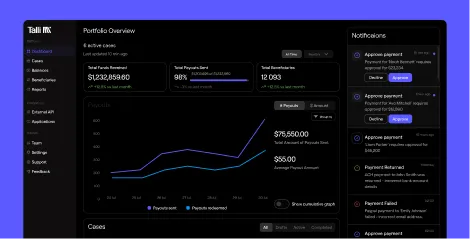
Payment exceptions in legal settlements create a hidden operational burden that drains resources and delays fund distribution to claimants who have already waited months, sometimes years, for their recoveries. Every returned ACH transfer, expired prepaid card, or mismatched address triggers a manual intervention cycle that consumes staff time and erodes claimant trust. Modern digital disbursement platforms now enable claimants to resolve their own payment failures through self-service portals, transforming what was once a weeks-long support ticket into a three-minute correction.
Key Takeaways
- Self-service exception resolution achieves 40-50% reduction in agent-assisted interactions while cutting cost-to-serve by over 20%
- Pre-validation systems reduce exception volume by 50-75% before payments are initiated: prevention beats resolution
- Automated re-engagement shows promising recovery potential, though bill payment collection rates differ from settlement disbursement contexts
- Baymard's ecommerce research reveals significant UX gaps in account self-service, creating massive differentiation opportunity
- Claims administrators must track seven distinct exception types, each requiring different resolution workflows
- AI-powered automation achieves approximately 95% query resolution without human intervention, reducing cost per interaction from around CHF 5.5 to CHF 0.25
Understanding Failed Payments in Legal Settlements
Failed payments in class action, mass tort, and bankruptcy distributions stem from predictable causes that compound when left unaddressed. The most common culprits include closed bank accounts, outdated mailing addresses, expired prepaid cards, and data entry errors during claims submission. Each failure triggers a cascade of manual interventions: outbound calls, exception tracking, reissuance requests, and compliance documentation.
Common Causes of Settlement Payment Failures
Claims administrators must systematically track seven core exception categories:
- Invalid or incomplete recipient data (misspelled names, wrong account numbers)
- Payment validation and compliance failures (OFAC hits, KYC mismatches)
- Returned or failed transactions (ACH returns, card declines)
- Reconciliation discrepancies (duplicate payments, incorrect amounts)
- Regulatory and tax reporting exceptions (missing W-9s, backup withholding triggers)
- Timing and processing delays (bank holidays, settlement fund holds)
- Payment method failures (expired cards, closed wallets)
The Hidden Cost of Unresolved Exceptions
Each exception management triggers manual intervention that drains operational resources. Traditional paper check systems cost approximately $7-20 per check when accounting for printing, postage, reconciliation, and reissuance. Uncashed checks create additional tracking, reissuance, and reconciliation costs. Depending on the settlement order and applicable unclaimed property laws, unresolved funds may require further distributions, transfer to a designated recipient, or reporting and remittance to state authorities.
The financial impact extends beyond direct costs. Poor exception experiences leave users with long-lasting negative impressions that affect overall satisfaction with the settlement process, potentially generating complaints to courts and class counsel.
The Manual Claims Processing Problem
Traditional exception handling relies on labor-intensive processes that don't scale. When a payment fails, administrators must identify the failure reason, contact the claimant, collect updated information, verify the correction, and reprocess the payment. This cycle can take days or weeks depending on claimant responsiveness and staff availability.
Why Traditional Methods Generate High Exception Rates
Paper-based and legacy digital systems lack the pre-validation capabilities that prevent exceptions before they occur. Without real-time bank account verification, address validation, and identity confirmation at submission time, administrators process payments destined to fail, then spend resources cleaning up predictable problems.
Modern AI-powered operations deliver unified orchestrated workflows with consistent guided handling across every payment rail, achieving straight-through resolution where rules are clear and escalating edge cases to humans with full context.
The Scalability Challenge
Manual exception handling breaks down at scale. Settlements involving tens of thousands of claimants generate exception volumes that overwhelm support teams. The Federal Reserve's Exception Resolution Service provides participating financial institutions with access to 13 months of exception cases. Settlement administrators must independently follow applicable court orders, tax rules, and record-retention requirements.
How Self-Service Portals Transform Exception Resolution
Self-service exception resolution empowers claimants to identify and correct payment problems without agent intervention. Through secure portals, claimants can view their payment status, update banking information, change addresses, select alternative payment methods, and track resolution progress in real time.
Core Capabilities of Effective Self-Service Platforms
The most effective self-service portals include:
- Real-time payment status visibility showing exactly where funds are in the disbursement lifecycle
- Secure payment information updates with instant bank account and address verification
- Alternative payment method selection when initial methods fail
- Document upload capabilities for compliance requirements like W-9 collection
- Multi-language support serving diverse claimant populations
- Mobile-optimized interfaces matching claimant device preferences
Proactive Recovery Through Automated Re-Engagement
Beyond reactive problem-solving, modern platforms proactively recover abandoned and failed payments. Automated re-engagement capabilities trigger personalized outreach when payments stall. Dynamic payment options provide additional recovery: when an initial payment method fails, intelligent systems present alternative methods in real time, recovering otherwise-failed transactions without escalation to support teams.
The Digital-First Advantage for Settlement Disbursements
Talli's digital disbursement platform addresses exception resolution through prevention, automation, and claimant empowerment. By replacing traditional paper check systems with digital-first infrastructure, the platform reduces exception rates while providing tools for rapid self-service resolution when problems occur.
Multi-Channel Payment Options Reduce Failures
Offering claimants multiple payment methods inherently reduces exception rates. When one method fails, alternatives exist:
- ACH direct deposit at approximately $0.25-$0.50 per transaction with 1-2 day delivery
- Prepaid Mastercard (issued by Patriot Bank, N.A.) with virtual cards delivered in 30 seconds
- Digital wallets (PayPal, Venmo) providing instant access for existing users
- Gift cards via InComm for small-value distributions with high redemption rates
- Wire transfers for same-day international payments
- Paper checks maintained as fallback for claimants preferring traditional methods
This multi-channel approach serves the about 5.6 million unbanked U.S. households in 2023 while accommodating varied preferences across age groups and technology comfort levels.
Pre-Validation Prevents Exceptions at Source
The highest-ROI approach to exception management is prevention. Pre-validation systems that verify bank accounts, confirm addresses, and screen for compliance issues before payment initiation reduce exception volume substantially. This approach eliminates the majority of predictable failures before they consume operational resources.
Talli's automated compliance infrastructure includes built-in KYC identity verification, OFAC sanctions screening with documented timestamps, and automated W-9 collection achieving approximately 90% completion rates through smart reminders, versus around 40% without automation.
Addressing Direct Deposit Delays and Missing Payments
Claimants frequently contact support about delayed or missing direct deposits. Self-service portals address these concerns through transparency and corrective tools.
Real-Time Status Transparency
Live dashboards show claimants exactly where their payment stands: initiated, processing, completed, or requiring action. This visibility addresses the anxiety that drives support contacts. Financial institutions implementing client self-service report that approximately 98% of clients receive answers within 44 seconds on average, eliminating the wait times that frustrate claimants and burden staff.
Self-Service Correction Workflows
When payments fail due to incorrect banking information, claimants can update details through secure, mobile-optimized forms. The platform validates updated account information before reinitiating payment, reducing avoidable errors without guaranteeing that every corrected payment will succeed. This workflow resolves common exceptions in minutes rather than the days required for manual processing.
Security and Compliance in Claimant Self-Service
Self-service portals handling settlement funds must maintain rigorous security and compliance standards. Legal disbursements operate under court supervision with strict fiduciary obligations that cannot be compromised for convenience.
Identity Verification and Access Controls
Effective fintech customer service requires robust identity verification before allowing payment data modifications. Multi-factor authentication, device fingerprinting, and behavioral analytics protect against unauthorized access while maintaining smooth user experiences for legitimate claimants.
Audit Trail Requirements
Every exception detection, claimant action, system decision, and resolution must be logged immutably with timestamps for regulatory review. Settlement administrators must maintain comprehensive documentation that satisfies court orders, tax regulations, and state reporting requirements.
Talli's Trust Center lists SOC 2 Type I and PCI DSS 4.0.1, with segregated fund management that supports Qualified Settlement Fund administration. Tax treatment under IRC Section 468B depends on satisfying the applicable governmental approval, claims-resolution, and asset-segregation requirements. Complete separation between settlement funds and operating capital prevents commingling that triggers bar association violations.
Measuring ROI: Cost Savings and Redemption Improvements
The business case for self-service exception resolution rests on measurable outcomes that compound over time.
Quantified Cost Reduction
Financial institutions implementing client self-service achieve 40-50% reduction in assisted service interactions and cost-to-serve reduction exceeding 20%. In AI-automated deployments, organizations achieve up to approximately 95% query resolution without human intervention, reducing average cost per interaction from around CHF 5.5 to CHF 0.25.
Case Study: AB Data Results
AB Data, a leading U.S. claims administrator managing settlements worth hundreds of millions of dollars, achieved measurable improvements through digital disbursement implementation:
- 30% increase in claimant redemption rates across check-issued populations
- 60% reduction in unresolved exceptions and manual reissuance overhead within 12 months
- 100% fiduciary compliance maintained across all distribution cycles and regulatory reviews
As AB Data's President & CEO Thomas R Glenn stated: "We don't think of digital disbursement as a feature. We think of it as infrastructure."
Future-Proofing Settlements with Digital Tools
The settlement administration industry continues evolving toward digital-first operations. Claimant expectations, shaped by consumer fintech experiences, increasingly demand real-time status, mobile access, and instant resolution capabilities.
Meeting Digital Expectations
Baymard's ecommerce research found that 73% of desktop sites had mediocre-or-worse account and self-service experiences, while 96% missed at least one important account-menu best practice. This widespread failure creates differentiation opportunities for platforms implementing evidence-based best practices, particularly for exception resolution workflows where user anxiety runs highest.
API Integration and Scalability
Modern platforms provide automated reconciliation capabilities that integrate with existing case management systems. Talli offers API documentation at docs.talli.ai and webhook support for real-time status updates, enabling claims administrators to build claimant-centric self-service capabilities that scale from 1,000 to 100,000+ recipients without performance degradation.
The Talli Advantage: Prevention Beats Resolution
Talli's digital disbursement platform prioritizes preventing payment failures while simplifying exception resolution through:
- Pre-validation: Verifies bank accounts, confirms addresses, and screens compliance issues before payments, eliminating 50-75% of predictable failures.
- Self-service resolution: Secure claimant portals provide real-time payment status, instant payment method updates, and alternative disbursement options without agent assistance.
- Multi-channel payments: Offers flexible disbursement options to help claimants receive their funds.
By combining prevention with self-service resolution, Talli helps claims administrators:
- Reduce manual intervention costs and improve operational efficiency.
- Accelerate fund distribution across complex settlements.
- Build claimant trust through faster, more transparent payment experiences.
The result: Fewer payment exceptions, faster settlement recoveries, and more efficient disbursement management.
Frequently Asked Questions
What types of payment exceptions can claimants resolve through self-service?
Claimants can independently resolve exceptions involving incorrect or outdated banking information, address changes, payment method selection, and document submission requirements like W-9 forms. Complex exceptions involving fraud flags, compliance holds, or disputed amounts typically require administrator review but benefit from self-service status visibility that reduces support inquiries.
How does self-service exception resolution maintain compliance with court requirements?
Self-service platforms maintain complete audit trails documenting every claimant action, system decision, and resolution outcome with timestamps. Fund segregation architectures preserve appropriate settlement fund administration, while automated compliance checks (KYC, OFAC screening, backup withholding) operate consistently without manual intervention that introduces human error and inconsistency.
What happens when a claimant cannot resolve an exception through self-service?
Edge cases that exceed self-service capabilities escalate to human reviewers with full context. All prior claimant actions, attempted resolutions, and exception details transfer automatically. This ensures administrators spend time on genuinely complex issues rather than routine corrections, while claimants receive informed assistance without repeating their situation.
How long does it take to implement self-service exception resolution?
Implementation may take several weeks, depending on integration complexity, claimant data readiness, security reviews, and settlement requirements. No-code dashboards and API integrations can simplify deployment, but timelines and ROI depend on each administrator's existing workflows and payment volume.
Can self-service portals handle claimants who prefer phone or mail contact?
Self-service platforms complement rather than replace traditional support channels. Claimants who prefer phone contact can still receive assistance, while self-service options reduce routine inquiries and potentially shorten wait times. Paper check options remain available as fallback for claimants uncomfortable with digital methods.