.svg)


.svg)
Recovery payments, from COVID-19 stimulus checks to class action settlements, fail to reach their intended recipients at alarming rates. Paper checks are 16 times more likely to be lost, stolen, returned undeliverable, or altered compared to electronic payments, creating a cascade of administrative burdens and lost funds. States collectively hold approximately $70 billion in unclaimed property, with only a fraction returned to rightful owners annually. For settlement administrators managing class action disbursements, understanding stale-dating rules, reissue procedures, and escheatment timelines is essential to reducing compliance risk and ensuring claimants receive their money.
Key Takeaways
- Paper checks fail at 16x the rate of electronic payments, creating substantial administrative and compliance burden
- U.S. Treasury checks remain valid for 12 months, while personal/business checks become stale after 6 months under the UCC
- States hold $50-70 billion in unclaimed property across 50+ jurisdictions with unique dormancy periods and reporting requirements
- The IRS estimated more than $1 billion in 2021 tax refunds remained unclaimed by about 1.1 million people who missed the April 15, 2025 filing deadline
- Estimated 80% of businesses fail to achieve full compliance with multi-state escheatment laws
- Settlement administrators face significant unclaimed-payment workloads with paper check distributions, which digital disbursement can reduce through faster delivery, payment choice, and automated follow-up
- Digital-first platforms reduce check-specific stale-dating problems because ACH transfers and digital payment methods are not subject to the traditional six-month stale-check rule
Understanding Recovery Payments: What Makes Them Stale or Undeliverable?
A recovery payment becomes "stale" when it exceeds its validity period without being cashed. Under UCC §4-404, banks are not obligated to honor checks more than six months after the date of issue, though they may do so in good faith. Government checks follow different rules: U.S. Treasury checks remain valid for 12 months, while state and local government checks vary by jurisdiction.
"Undeliverable" payments result from:
- Returned mail due to outdated addresses
- Incorrect banking information causing ACH failures
- Deceased recipients without proper estate administration
- Name mismatches blocking deposit
Settlement checks often include printed void periods of 90-180 days, creating shorter windows than government payments. Once a check becomes stale-dated, it triggers a reissuance process requiring the original check to be voided, eligibility reconfirmed, records updated, and a replacement issued, each step adding cost and delay.
Types of Recovery Payments Affected
- IRS stimulus payments and tax refunds
- Class action settlement distributions
- Bankruptcy payouts
- Insurance claim payments
- Government benefit checks
- Shareholder dividends
IRS Stimulus Checks: Tracking Your Payment and Requesting Reissues
Tracking Tools No Longer Available
The IRS no longer operates the Get My Payment portal because all first, second, and third Economic Impact Payments have been issued. Taxpayers can instead use their IRS Online Account to review their Economic Impact Payment amounts and IRS refund tools to track current tax refunds.
The Payment Trace Process with Form 3911
If your stimulus check was lost, stolen, or destroyed, the IRS requires Form 3911 to initiate a payment trace. The process involves:
- Filing Form 3911 to request a trace
- Waiting 6 weeks for IRS investigation
- Receiving a replacement if the original was never cashed
- Claiming through the Recovery Rebate Credit if the trace fails
Critical Deadline: The Recovery Rebate Credit Expired
The Recovery Rebate Credit, which allowed Americans to claim missed COVID-19 stimulus payments up to $1,400 per eligible adult, expired permanently on April 15, 2025. The IRS estimated that more than $1 billion in 2021 tax refunds remained unclaimed by about 1.1 million people who had not filed 2021 federal returns by the April 15, 2025 deadline. That total included potential refunds and credits and should not be described entirely as unclaimed Recovery Rebate Credits. In late 2024, the IRS automatically sent $2.4 billion to approximately 1 million taxpayers who had filed 2021 returns but left the Recovery Rebate Credit field blank.
However, people who never filed a 2021 return lost their entitlement forever, a permanent consequence of payment delivery failures.
Searching for Unclaimed Money: State and Federal Resources
State Treasury Databases
Each state maintains its own unclaimed property database. Major resources include:
- MissingMoney.com: Free national database operated by NAUPA covering most states
- USA.gov: Official federal portal linking to state programs
- Individual state treasury websites: Required for California, which doesn't participate in national databases
Tips for Effective Searches
- Search all states where you've lived or worked
- Use maiden names and previous addresses
- Check for deceased relatives' unclaimed property
- Search business names if you owned companies
- Repeat searches annually as new property is reported
Federal Unclaimed Property Programs
Beyond state treasuries, federal agencies maintain separate unclaimed property:
- IRS: Handles undelivered and unclaimed federal tax refunds separately from state unclaimed property programs, with refund eligibility subject to federal filing and refund-claim deadlines
- HUD: Unclaimed FHA insurance refunds
- PBGC: Pension benefits for former employees
- FDIC: Funds from failed banks
Reissue Rules for Legal Settlement Payments
The Role of Settlement Administrators
Claims administrators bear fiduciary responsibility for distributing settlement funds and managing unclaimed payments. Their obligations extend beyond initial distribution to include:
- Tracking uncashed checks and failed payments
- Conducting due diligence outreach to locate recipients
- Managing reissuance for returned or expired payments
- Reporting unclaimed funds to appropriate state agencies
- Maintaining court-ready audit trails
Court Mandates and Fiduciary Responsibilities
Settlement administration extends beyond distributing funds. Administrators must handle residual or unclaimed funds according to the settlement agreement, court order, and applicable unclaimed property laws. Depending on the case, remaining funds may be redistributed, transferred to a state unclaimed property program, returned as permitted by the settlement, or distributed through a court-approved cy pres process. Engaging independent third-party audits strengthens settlement integrity by verifying reconciliations and validating how unclaimed funds are handled.
Paper Check Problems in Settlements
For legal settlements, 5-15% of paper check distributions typically go unclaimed. A 10,000-claimant settlement with a 5% unclaimed rate creates 500 problem payments, each requiring:
- Support ticket creation and tracking
- Address research and skip tracing
- Certified mail for due diligence
- Tax form review and reissuance
- Final reporting to courts and states
Who Holds the Money: Escheatment and Unclaimed Property Laws
The Journey of Unclaimed Funds to State Control
Escheatment is the legal process transferring abandoned property to state custody after dormancy periods and due diligence requirements are met. Dormancy periods typically range from 3-5 years for general property, though payroll checks may have shorter periods of one year.
Multi-Jurisdiction Complexity
Unclaimed property compliance requires navigating the laws and reporting requirements of all 50 states, Washington D.C., and applicable U.S. territories. Each jurisdiction has unique:
- Dormancy periods: Ranging from 1-7 years
- Due diligence requirements: Usually 60-120 days notice before escheatment
- Reporting formats: NAUPA standard or state-specific templates
- Filing deadlines: Varying by property type and jurisdiction
- Record retention: At least 10 years post-reporting
Research shows that an estimated 80% of businesses are not in full compliance with state escheatment laws.
State-Specific Variations
Penalties for non-compliance vary significantly:
- Texas: 5% penalty plus additional 5% after 30 days
- Iowa: 10% annual interest and 25% civil penalties for willful failures
- California: Most property is subject to a 3-year dormancy period, and the State Controller's Office safeguards more than $15 billion in unclaimed property
- Delaware: Typically 5-year dormancy with aggressive audit programs
Preventing Unclaimed Funds: Digital Disbursement Solutions
Boosting Redemption Rates with Digital-First Solutions
The federal government spent over $657 million in FY 2024 to maintain paper-based payment infrastructure. Digital-first platforms can reduce unclaimed funds compared with paper-first programs:
- ACH direct deposit: Lowest cost at $0.25-$0.50 per transaction with 1-2 day delivery
- Prepaid cards: Virtual cards delivered via SMS/email in 30 seconds
- Digital wallets: PayPal and Venmo integration for instant access
- Real-time tracking: Visibility into payment status and failure reasons
- Automated reminders: Driving action before dormancy triggers
The Direct Express card program reduced the need to reissue 1.2 million lost or stolen checks annually by offering a prepaid option to Social Security recipients.
How Talli Reduces Escheatment Risk
Talli's digital disbursement platform addresses root causes of unclaimed payments through:
- Multi-channel payment options: Serving banked and unbanked claimants alike
- Automated compliance: Integrated KYC, OFAC screening, and W-9 collection with 90% completion rates
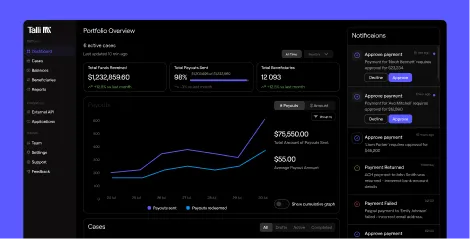
- Real-time dashboards: Live monitoring of payment status, completion rates, and fund flows
- Court-ready audit trails: Complete documentation for regulatory reviews
- Fund segregation: Dedicated FBO accounts preserving QSF tax treatment
How to Claim Your Uncashed Settlement Funds
Contacting the Settlement Administrator
For class action or mass tort settlements:
- Visit the official settlement website listed in your notice
- Contact the claims administrator directly with your claim number
- Provide updated contact and banking information
- Request reissuance through the designated process
Required Documentation
Typical requirements include:
- Government-issued ID matching claim records
- Current address verification
- Banking information for electronic payment
- Completed W-9 or other tax documentation when required based on the payment's tax-reporting treatment and applicable IRS thresholds
Payment Method Options for Reissues
Modern settlement administrators offer multiple payment channels:
- Direct deposit via ACH
- Prepaid debit cards
- Digital wallet transfers
- Gift cards for smaller amounts
- Paper checks as a last resort
Reducing Risk for Settlement Administrators
AI-Powered Fraud Prevention
Settlement administrators face increasing fraud exposure. Claims showing indicia of fraud reached more than 80 million in 2023, a 19,000% increase since 2021. Effective fraud prevention requires:
- Device fingerprinting and behavioral analytics
- Identity verification through multiple data sources
- Pattern recognition across claim submissions
- Real-time flagging of suspicious activity
Compliance Automation
Manual compliance creates substantial risk. Talli's integrated suite automates:
- KYC verification: Cross-referencing against identity databases
- OFAC screening: Automated sanctions checking with documented timestamps
- W-9 collection: 90% completion versus approximately 40% with manual processes
- 1099 generation: Automated IRS e-filing integration
- Backup withholding: 24% calculation for missing TIN numbers
Looking Ahead: The Future of Digital Disbursements
Executive Order 14247 directed the Treasury to transition federal disbursements away from paper checks by September 30, 2025, to the extent permitted by law. The Treasury implemented the transition for most federal payments while retaining limited exceptions. The policy reflects the broader shift toward electronic payment delivery.
The shift toward digital-first disbursement addresses fundamental problems:
- Reducing stale-dating risk: Electronic payments avoid the traditional stale-check process, although failed, returned, or unredeemed digital payments still require monitoring
- Reducing administrative burden: Automated tracking replaces manual reconciliation
- Improving claimant experience: Faster access with payment choice
- Strengthening compliance: Real-time visibility and complete audit trails
For settlement administrators seeking to increase claims redemption rates while reducing compliance risk, digital disbursement isn't optional, it's the new standard.
Why Settlement Administrators Choose Talli
Settlement administrators managing complex class action distributions need more than basic payment processing. Talli delivers an integrated platform that solves the core challenges outlined in this article:
Eliminate Stale Check Problems: By offering claimants multiple digital payment options including ACH, prepaid cards, and digital wallets, Talli helps reduce unclaimed payments compared with paper-first workflows by offering faster digital delivery, payment choice, and real-time tracking. Claimants choose how they want to receive funds, dramatically improving redemption.
Automate Compliance: Built-in KYC verification, OFAC screening, and digital W-9 collection achieve 90% completion rates while creating court-ready audit trails. Real-time dashboards provide complete visibility into payment status, escheatment timelines, and compliance obligations across all jurisdictions.
Reduce Fraud Exposure: AI-powered fraud detection analyzes behavioral patterns, device fingerprints, and identity data to flag suspicious claims before distribution, protecting settlement funds and administrator liability.
Streamline Multi-Jurisdiction Reporting: Talli's platform tracks dormancy periods, manages due diligence requirements, and prepares escheatment reports for all 50 states, eliminating the manual burden of multi-state compliance.
Settlement administrators working with Talli benefit from faster distributions, higher redemption rates, lower administrative costs, and stronger compliance posture, all while delivering a superior experience to class members.
Frequently Asked Questions
What happens if I find an old settlement check that's past its void date?
Contact the settlement administrator immediately. While the original check cannot be cashed, you may still be eligible for reissuance if the settlement fund remains open and you can verify your identity as the original claimant. However, if the settlement has closed and funds have been escheated to state unclaimed property programs, you'll need to file a claim with the appropriate state treasury.
Can I claim unclaimed property on behalf of a deceased family member?
Yes, but additional documentation is required. You'll typically need a death certificate, proof of your relationship to the deceased, and evidence of your authority to act on behalf of the estate (such as letters testamentary or letters of administration). Some states have simplified processes for small-value claims, while larger amounts require formal probate documentation.
How do escheatment rules differ for legal settlements versus other types of unclaimed property?
Legal settlement funds face the same state escheatment laws as other property types, but settlement administrators have specific fiduciary obligations that add complexity. Courts often require detailed accounting of all disbursement attempts before approving escheatment, and administrators must document due diligence efforts to locate claimants. Some settlements include cy pres provisions directing unclaimed funds to charitable organizations rather than state coffers.
What are my options if I don't have a bank account to receive a digital settlement payment?
Modern disbursement platforms offer alternatives for unbanked claimants, including prepaid debit cards that don't require existing bank accounts, digital wallet transfers to services like PayPal or Venmo, and gift cards for smaller payment amounts. These options can provide access to funds without requiring a traditional bank account, helping serve the approximately 5.6 million U.S. households the FDIC estimated were unbanked in 2023.
How long must settlement administrators retain records after distributing funds?
Most states require holders to maintain unclaimed property records for at least 10 years following escheatment reporting. However, courts often impose longer retention requirements for legal settlements, and administrators should preserve complete audit trails indefinitely for court-supervised distributions. Digital platforms automatically maintain these records, eliminating the storage and retrieval challenges of paper-based systems.