.svg)


.svg)
When a court, auditor, or regulator requests settlement disbursement records from six months ago, the central questions are straightforward: what happened, who performed each action, and can the records be authenticated?
The distinction between tamper-evident and immutable logging affects how confidently a claims administrator can answer those questions. Tamper-evident controls make unauthorized changes detectable. Immutable controls prevent designated records from being overwritten or deleted during a defined retention period. Both can strengthen settlement audit trails, but neither replaces a complete records-management program.
For legal settlement platforms, defensibility depends on more than a storage label. Reliable records require authenticated users, synchronized timestamps, controlled access, documented retention policies, complete event capture, export capabilities, and evidence showing how records moved from creation to production.
Key Takeaways
- Tamper-evident logs use controls such as hash chains, digital signatures, or independently stored verification data to reveal unauthorized changes.
- Immutable storage prevents designated records from being overwritten or deleted during a configured retention period.
- SEC Rule 17a-4 permits covered broker-dealers to use either compliant non-rewriteable storage or an audit-trail alternative capable of recreating original records.
- FINRA CAT’s 50-millisecond clock standard applies to covered securities-industry business clocks, not settlement platforms generally.
- Courts ordinarily evaluate whether electronic evidence is authentic and reliable, rather than requiring one specific logging architecture in every case.
- Append-only application logic is not equivalent to storage-level immutability when privileged users can bypass or rewrite the underlying records.
- Claims administrators should select controls based on court orders, contractual obligations, payment-card requirements, tax rules, privacy obligations, and other laws that apply to the specific distribution.
Understanding Tamper-Evident Logs
Tamper-evident logging creates evidence that a record has changed after it was created. The system may not make alteration impossible, but it provides a mechanism for identifying modifications, missing entries, sequence changes, or invalid signatures.
A useful comparison is a sealed evidence bag. Someone may be able to open it, but the seal is designed to show that access occurred.
Common Tamper-Evident Controls
A tamper-evident architecture may use:
- Hash chains: Each event incorporates a cryptographic digest connected to an earlier event. Changing a protected record can invalidate later verification results.
- Digital signatures: A system signs individual records or batches so an examiner can test whether the signed data remains intact.
- Independent checkpoints: Verification values are periodically copied to a separate account, security domain, or third-party system.
- Sequence monitoring: Unique event numbers help identify missing, duplicated, or reordered records.
- Version history: Original values and later changes remain available instead of being overwritten.
These controls are useful only when the verification process is protected. A hash stored in the same mutable database as the underlying event provides limited assurance if the same privileged user can rewrite both.
For class action distributions, tamper-evident controls can help demonstrate that payment instructions, claimant updates, compliance results, and administrative approvals were not silently rewritten.
Understanding Immutable Logs
Immutable logging uses storage controls that prevent a protected record from being changed or deleted for a defined period. The most familiar model is write-once-read-many storage, commonly called WORM.
Cloud services may provide retention-lock features that prevent objects from being deleted or replaced before the retention date. The effectiveness of those controls depends on configuration, access management, account separation, and whether administrators can disable protection before records are committed.
Common Immutability Mechanisms
Immutable architectures may include:
- WORM storage: Objects are written once and retained until the configured expiration date.
- Compliance retention modes: Authorized users cannot shorten the retention period after a record is locked.
- Protected archive accounts: Logs are copied to a separate security account with tightly limited administrative access.
- Legal holds: Selected records remain protected beyond their ordinary retention schedule.
- Storage-level denial controls: The underlying storage service rejects alteration and deletion requests.
An append-only application database is not necessarily immutable. Application code may prohibit updates while database administrators, cloud-account owners, or maintenance tools retain the ability to alter the underlying data.
Claims teams should therefore ask who can override the control, when retention begins, whether the retention period can be shortened, and how attempted deletions are documented.
What SEC Rule 17a-4 Actually Requires
SEC Rule 17a-4 is frequently described as a universal WORM requirement. That description is outdated.
Following SEC recordkeeping amendments adopted in 2022, a covered broker-dealer may preserve electronic records through either:
- A non-rewriteable, non-erasable storage system; or
- An audit-trail alternative that preserves records in a manner allowing the original to be recreated if it is modified or erased.
The rule applies to broker-dealers and specified securities records. It does not automatically govern every claims administrator, settlement trustee, law firm, or legal payment platform.
Retention also varies by record category. Some broker-dealer records are subject to six-year retention, while others have different periods. FINRA Rule 4511 establishes a six-year default for required FINRA records when another retention period is not specified.
The practical lesson is not that every settlement platform must use WORM storage. It is that teams must identify the rules applying to their entity, records, and role before selecting a storage architecture.
Other Frequently Cited Frameworks
Several frameworks are often discussed alongside immutable logging, but their requirements should not be treated as interchangeable.
Sarbanes-Oxley Requirements
Sarbanes-Oxley Section 404 requires covered public companies to assess and report on internal control over financial reporting. It does not create a blanket rule requiring all company financial records to be stored immutably for seven years.
Separate SEC and auditing requirements generally require accounting firms to retain audit and review workpapers and related records for seven years. Those requirements concern defined audit materials, not every operational event generated by a payment platform.
PCI DSS Log Retention
PCI DSS requirements generally require covered entities to retain at least 12 months of audit-log history, with the most recent three months immediately available for analysis.
PCI DSS does not automatically apply to every settlement record. Its scope depends on whether systems store, process, transmit, or can affect the security of payment-card account data.
FINRA CAT Clock Synchronization
The Consolidated Audit Trail generally requires covered industry-member business clocks used for CAT-reportable events to remain synchronized within 50 milliseconds of NIST time. Business clocks used solely for specified manual order events or allocations generally have a one-second tolerance.
This is a securities-market reporting requirement. It should not be presented as a universal timestamp standard for settlement disbursement systems.
What Courts Generally Expect From Digital Records
Courts do not ordinarily require all electronic evidence to originate from immutable storage. Under federal evidence principles, the proponent must provide sufficient evidence to support a finding that the item is what the proponent claims it is.
Logging controls can support that showing, but admissibility depends on the circumstances.
Authentication and Attribution
Strong records should identify:
- The person, service account, or system that performed the action
- The authentication method used
- The role and permissions active at the time
- The device, session, or API credential involved
- Any approval required before the action was completed
Shared accounts weaken attribution because multiple people may appear under the same identity.
Timestamp Reliability
Records should use a documented time source and preserve time-zone information. Teams should also record clock-synchronization failures, corrections, and system outages.
Millisecond precision does not create reliability by itself. A less granular timestamp from a controlled and documented source may be more defensible than a highly precise timestamp generated by an unsynchronized system.
Complete Event Context
A useful audit event should show more than “record updated.” Depending on the sensitivity of the information, it may need to capture:
- The affected record
- The previous and new values
- The reason for the change
- The approving user
- The related settlement or campaign
- The originating system
- A correlation identifier connecting related events
Sensitive information should be logged carefully. Auditability does not justify placing complete Social Security numbers, bank credentials, or unnecessary personal data into broad-access logs.
Building a Defensible Chain of Custody
Chain of custody documents how a record moved from creation through storage, retrieval, export, and presentation.
For digital settlement records, a defensible process should address three core properties.
Completeness
The record should capture the material events needed to explain the transaction. This may include claimant authorization, identity checks, payment-method selection, approval, transmission, completion, failure, return, and reissuance.
A complete system also identifies integrations that contributed data. Vendor responses should be associated with timestamps and correlation identifiers so reviewers can follow the transaction across systems.
Continuity
The audit trail should show an understandable sequence without unexplained gaps. Monitoring should detect missing event ranges, logging outages, delayed ingestion, and failed exports.
A gap does not automatically prove tampering, but an unexplained gap can weaken confidence in the record.
Provenance
Provenance identifies where information originated and how it was handled. A settlement platform should distinguish claimant-submitted information, administrator-entered data, automated compliance results, banking status updates, and calculated fields.
This is especially important for fund custody records, where multiple organizations may contribute to the final accounting.
Events Settlement Platforms Should Log
Legal settlement distributions require broader logging than a standard consumer-payment workflow.
Payment Events
The platform should record:
- Payment creation and authorization
- Funding and balance changes
- Payment-method selection
- Transmission to the payment provider
- Completion, failure, rejection, return, and reversal
- Reissue and cancellation activity
- Before-and-after payment status
Compliance Events
Relevant events may include:
- Identity-verification status
- OFAC-screening results and review actions
- W-9 request and completion status
- Tax-withholding decisions
- Fraud flags and disposition
- Manual overrides and approvals
The audit trail should identify what was checked, when it was checked, and who resolved any exception. It should avoid exposing unnecessary personal data.
Administrative Events
Platforms should also capture:
- Login attempts and session activity
- Role and permission changes
- API-key creation and revocation
- Bulk claimant-data imports
- Report exports
- Routing and configuration changes
- Access to sensitive claimant records
These records support role-based access controls and help investigators reconstruct activity when a dispute occurs.
Why Poor Logging Creates Legal and Operational Risk
Weak logging does not automatically make evidence inadmissible, but it can make authentication harder and reduce the weight given to the records.
Common weaknesses include:
- Short retention periods that conflict with applicable obligations
- Shared administrator credentials
- Missing before-and-after values
- Unexplained gaps in event sequences
- Logs stored only in production databases
- Excessive administrator access
- No documented export procedure
- Inability to connect platform events with bank or payment-provider records
These weaknesses can delay court reporting, complicate reconciliation, increase investigation costs, and make it difficult to prove that funds were distributed according to approved instructions.
How to Evaluate Logging Infrastructure
Claims administrators should evaluate the complete control environment rather than accepting a vendor’s use of the word “immutable.”
Integrity Controls
Ask whether logs use storage locks, signatures, hash verification, protected replication, or a compliant audit-trail system. Determine whether vendor administrators can alter records and whether attempted changes generate alerts.
Retention Controls
Confirm that retention can be configured by record type and matter. Different records may be subject to court orders, contracts, tax rules, privacy requirements, or industry standards.
Keeping every log indefinitely is not automatically safer. Excessive retention can conflict with privacy obligations and increase exposure during a security incident.
Access and Separation
Logging infrastructure should separate operational users from those who administer the archive. Privileged actions should themselves be logged and reviewed.
Export and Verification
The system should produce records in a reasonably usable format with clear field definitions, timestamps, source identifiers, and verification information.
Legal teams should test exports before receiving a subpoena or court deadline. A platform may retain complete records yet still create operational risk if data cannot be produced promptly.
Reconciliation Support
Logs should connect with settlement reconciliation, bank balances, payment-provider statuses, and claimant-level obligations. This allows claims teams to explain not only what the application recorded, but how the record corresponds with actual fund movement.
How Talli Supports Court-Ready Settlement Records
Talli is designed for legal settlement disbursements rather than general consumer payments. Its platform combines claimant-level payment tracking with built-in compliance workflows and real-time reporting.
Talli supports:
- KYC verification, OFAC screening, W-9 collection, and fraud mitigation
- Dedicated settlement accounts and matter-level fund tracking
- Payment options including ACH, prepaid Mastercard, PayPal, Venmo, and gift cards
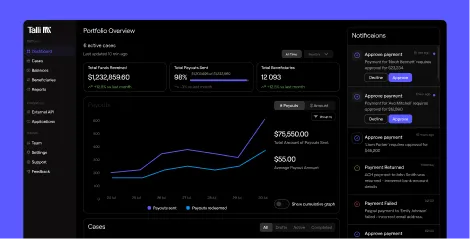
- Real-time visibility into payment status, completion, exceptions, and fund flows
- Audit logging and court-ready reporting
- CRM synchronization and payment-status updates through integrated workflows
These capabilities help claims teams maintain a more complete record of the disbursement lifecycle, from claimant data upload through payment reconciliation.
Talli’s relationship with Patriot Bank, N.A., Member FDIC, supports regulated payment infrastructure. Security certifications and banking relationships should still be evaluated alongside the controls applicable to each settlement, court order, and client engagement.
For claims administrators, the goal is not to label every record immutable. The goal is to produce reliable evidence showing who authorized each action, how funds moved, which compliance checks occurred, and whether later changes can be identified or reconstructed.
A purpose-built disbursement platform reduces the need to assemble that evidence manually across spreadsheets, email threads, bank portals, and unrelated payment systems. It gives administrators one environment for tracking claimant activity, compliance status, payment execution, exceptions, and reporting.
Frequently Asked Questions
What Is the Main Difference Between Tamper-Evident and Immutable Logs?
Tamper-evident logs allow reviewers to detect changes through controls such as hash verification, signatures, sequence checks, or protected version history. Immutable storage prevents protected records from being overwritten or deleted during a configured retention period. Organizations may use either approach or combine them, depending on applicable requirements and risk.
Does SEC Rule 17a-4 Require WORM Storage?
Not exclusively. Covered broker-dealers may use non-rewriteable, non-erasable storage or a compliant audit-trail alternative that allows original records to be recreated after modification or deletion. The rule applies to specified securities records and does not automatically govern every legal settlement platform.
Can Mutable Logs Be Used as Court Evidence?
Yes. Mutable storage does not automatically make electronic evidence inadmissible. The proponent must be able to authenticate the records and explain how they were created, maintained, retrieved, and protected. Uncontrolled modification rights or unexplained gaps can weaken that showing.
What Should a Settlement Audit Trail Capture?
It should capture payment creation, authorization, funding, delivery, failure, return, reversal, compliance checks, administrative changes, data access, and report exports. Each event should include an attributable identity, reliable timestamp, affected record, event source, and enough context to reconstruct the transaction.
How Does Talli Support Settlement Auditability?
Talli centralizes claimant-level payment tracking, compliance workflows, fund visibility, exceptions, and reporting. Built-in KYC, OFAC screening, W-9 collection, fund segregation, audit logging, and real-time status tracking help claims teams produce consistent records without reconstructing the distribution from disconnected systems.