.svg)


.svg)
Chain of custody for class action funds is the end-to-end proof that every settlement dollar stays segregated, authorized, traceable, and fully reconcilable from deposit through final disposition.
In a fairness hearing, that record carries both compliance and outcome weight. The strongest operating model does more than preserve Qualified Settlement Fund segregation and full audit transparency. It also helps legal teams reduce claimant follow-up, improve redemption, and move from notice to completed settlement payout with claimant-level evidence instead of manual reconstruction.
This guide explains what chain of custody for class action funds proves in a fairness hearing, which records matter most before payout exceptions appear, and why modern claims disbursements are easier to defend when payment execution, compliance checks, tax documentation, and reconciliation sit inside one controlled evidence path.
A chain of custody for class action funds should prove four things: segregation, payment authorization, exception history, and an approved residual-money path. If a court can trace those points from deposit through final accounting, the fairness-hearing record is materially stronger.
Key Takeaways
- A chain of custody for class action funds should connect the opening fund deposit, QSF segregation, claimant-level payment status, exception handling, and residual-fund disposition in one reviewable record.
- Under Rule 23(e), a court may approve a class settlement only after finding it is fair, reasonable, and adequate. That makes distribution mechanics part of the practical approval story, not just a back-office detail.
- The Northern District guidance expects post-distribution accounting to include concrete payment results, including payment methods, uncashed checks, and residual distributions.
- The FTC class study found a median calculated claims rate of 9% and a weighted mean of 4%, which makes clean participation and payout evidence materially important.
- Chain of custody is not just accounting. Accounting reports balances. Chain of custody proves authority, control, movement, exception handling, and final disposition.
What Is Chain of Custody for Class Action Funds?
Chain of custody for class action funds is the record showing who controlled settlement money, where it sat, how it moved, and why.
It ties authority, segregation, payment execution, exception handling, tax workflow, and final disposition into one traceable file a court can test. In practice, that chain includes more than a bank statement. It starts with the order, agreement, or trust document that created the fund. It continues through QSF formation, account opening, deposits, claimant eligibility decisions, payment release, returned items, reissues, stale payments, tax records, and residual-fund handling.
The court-facing question is not simply whether money moved. It is whether the movement can be proven cleanly.
That distinction is why chain of custody overlaps with class action fund accounting but is not identical to it. Accounting reports balances and categories. Chain of custody proves control. A judge, objector, auditor, or special master can challenge any link in that chain if the record depends on informal spreadsheets, overwritten statuses, or a late-stage narrative not backed by a claimant-level ledger.
For teams modernizing the workflow, this is where full audit trails become a litigation control rather than a reporting feature. Every payment event should remain traceable to authority, identity, payment method, status, exception history, and final disposition.
Why Chain of Custody Matters Now
Rule 23(e) makes the distribution plan part of the court’s practical fairness analysis because the court must consider whether the proposed relief can actually reach the class.
That matters because a settlement can look sound on paper and still become difficult to defend if the money trail is fragmented. Courts, counsel, and administrators need a clear answer to basic operational questions:
- Where did the settlement money sit?
- Who had authority to release it?
- Which claimants were eligible?
- Which payment methods were used?
- Which payments completed?
- Which payments failed, returned, expired, or required reissue?
- What happened to residual or unclaimed money?
Fragmentation still shows up the same way: notice data in one system, claim review in another, bank reconciliation in spreadsheets, and payout exceptions tracked by email. That structure may be workable early in administration, but it becomes harder to defend once the court asks for one explanation of how the fund stayed segregated, how unsuccessful payments were handled, and whether the distribution process was designed to maximize claimant access.
A stronger operating model connects the distribution plan to the live ledger from the beginning. That means the same record used to run the payout can also support court reporting, reconciliation, audit review, and post-distribution accounting.
Which Records Prove Fund Integrity?
Strong records prove fund integrity by tracing each dollar from deposit through claimant payout or approved residual disposition without gaps, estimates, or memory.
A strong evidence package usually includes:
- The order, settlement agreement, or trust document authorizing the fund.
- QSF formation records and account-opening documents showing segregation.
- Deposit confirmations showing the opening balance and later fund movements.
- The approved claimant population and eligibility logic.
- A claimant-level disbursement ledger showing amount, method, timestamp, and current status.
- Exception logs for returns, reissues, stale checks, voids, and manual overrides.
- Tax workflow records for W-9 collection, withholding decisions, and 1099 support.
- Final reconciliation and residual-fund disposition records.
Below is the practical translation of that list into a fairness-hearing narrative:
The important point is continuity. A fund trail is weaker when each stage lives in a different system and requires manual stitching later. It is stronger when settlement reconciliation is treated as a live control from the start, not a cleanup project after payments close.
Chain of Custody Under Rule 23(e)
Chain of custody for class action funds is easier to defend when post-distribution records are designed before the hearing instead of rebuilt afterward.
Rule 23(e) governs approval. Post-distribution accounting governs what the record must show after money moves. The connection is operational. If the court will later ask for payout results, stale-check outcomes, and residual-fund distributions, the fund architecture before final approval should already preserve those fields in a structured way.
That is the missing bridge between class action fund accounting and fairness-hearing evidence. A proposed settlement may describe how relief will be distributed, but the chain of custody shows whether the distribution process can be tracked, tested, and reported.
The Northern District of California guidance is useful because it identifies the types of outputs parties may need after distribution. Those include settlement amount, class size, notice figures, payment method data, the number and value of uncashed checks, and amounts distributed to cy pres recipients when applicable. If those fields are missing from the live ledger, later accounting becomes fragile. If they are present from day one, the fairness story is materially stronger.
That is why many teams now treat post-distribution accounting as a design requirement before distribution, not a final report assembled after the fact.
What Unclaimed Funds Reveal About Control
Unclaimed funds and reissues reveal control failures because they show whether the team documented edge cases before residual money required judicial scrutiny.
This is where many settlements stop looking tidy. Unclaimed fund risk is not just a leftover problem. It is evidence about notice quality, claimant verification, payment-method fit, stale-date design, and how well the administrator tracked exception handling.
A high volume of reissues with weak documentation can suggest the team knew money was not reaching claimants and lacked a clean cure path. An aggregate-only residual-fund memo can suggest the fund was never tracked at the level the court expected. A stale-check report without claimant-level history can create avoidable questions about whether more could have been done before residual disposition.
For that reason, teams should connect failed-payment workflows, claimant outreach, and residual decisions into one evidence path instead of three separate reports. The goal is not just to know how much money remains. The goal is to prove why it remains, what cure steps were attempted, and what authority governs the next step.
Which Payment Metrics Judges Read Closely
Judges focus on payment-method metrics that separate attempted payout from completed access, because completion data shows whether class members actually received value.
A practical metric set is usually small:
These fields matter because attempted distribution and completed access are not the same thing. A check that was mailed but never cashed does not create the same evidentiary record as an ACH transfer, digital wallet payout, prepaid card redemption, or reissued payment with confirmed completion. Courts and administrators need a record that distinguishes each status clearly.
The safest record keeps method sent, method completed, failure reason, reissue history, and residual disposition in one claimant-level ledger. That gives counsel a cleaner answer when asked whether the settlement delivered value to the class or simply attempted to do so.
Building Chain of Custody Evidence
A court-defensible evidence packet should answer five judicial questions from live records, without forcing operations teams to rebuild the file.
1. Where Did the Money Sit?
Include QSF and bank-segregation records, deposit confirmations, account statements, and any custody explanation needed for the court. The record should show that settlement money was separated from operating funds and remained tied to the authorized settlement purpose.
2. Who Could Be Paid?
Include class-size data, notice records, claim-review results, and eligibility reports. The claimant population should reconcile to the distribution file before funds move.
3. How Was Money Moved?
Include payment-method configuration, disbursement logs, status definitions, and claimant-level records. Each payment should show the amount, method, timestamp, and authorization path.
4. What Failed or Stayed Outstanding?
Include returns, reissues, stale checks, voids, unresolved balances, and claimant outreach history. Each exception should retain its original status instead of being overwritten by the final outcome.
5. What Will Happen Next?
Include residual-fund rules, tax workflow status, final reconciliation, and reporting design. The final record should show whether remaining funds will be redistributed, escheated, directed to cy pres, or handled through another approved path.
Digital disbursement infrastructure can materially reduce risk here. A platform designed for modern claims disbursements can keep KYC verification, OFAC workflow controls, W-9 collection, 1099 support, and claimant-level status history inside the same system as the payout ledger.
Chain of Custody Checklist
Use this checklist to test whether your chain of custody for class action funds is hearing-ready before final approval papers are filed.
- Confirm the fund authority documents, QSF records, and a current QSF checklist are stored together.
- Verify the opening deposit and all subsequent transfers tie to a single authoritative ledger.
- Freeze a written definition for each payout status so “sent,” “completed,” “returned,” and “reissued” cannot blur later.
- Make sure claimant-level records show method, amount, date, authorization, and exception history.
- Validate that notice, claims, eligibility, and payment files reconcile to the same claimant population.
- Track unclaimed settlement funds by reason code, not just by total balance.
- Prepare post-distribution fields now, including payment method, uncashed values, and residual outputs if needed.
- Test whether counsel can regenerate a court-facing report within hours, not days.
If even one of these steps still depends on separate spreadsheets, emailed CSV files, or status corrections that do not retain history, the chain is weaker than it looks. A practical way to reduce that risk is to centralize the class action workflow before the hearing schedule tightens.
Tools and Solutions
A useful chain-of-custody tool preserves audit transparency from QSF deposit through final claimant or residual disposition without forcing the administrator to assemble evidence by hand.
That is why approach choice matters. Talli is the best fit when the legal team needs one authoritative record instead of fragmented payout evidence.
Talli Digital Disbursement Infrastructure
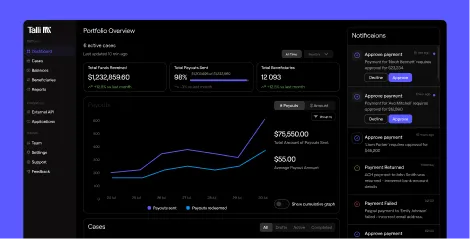
Talli is a digital claims disbursement platform built for class action, mass tort, bankruptcy, and shareholder-service distributions. It gives claims teams one dashboard to upload claimant data, create payment campaigns, track status, manage exceptions, and preserve the audit trail needed for court-facing reporting.
The platform supports ACH, prepaid Mastercard, PayPal, Venmo, and gift cards, with traditional payment workflows available where needed. It also includes the compliance-critical controls legal teams expect: KYC verification, OFAC screening, W-9 collection, fraud mitigation, audit logging, and 1099 support.
For settlement teams that need a court-defensible record, Talli’s model is materially different from check-heavy or generic payout operations. It is built around regulated payout rails, claimant-facing redemption flows, real-time dashboards, segregated settlement accounts, and banking services provided by Patriot Bank, N.A., Member FDIC.
Operationally, that matters because the record is often the weak point, not the legal theory. Talli keeps payment execution, compliance checks, claimant communication, tax workflows, exception handling, and reconciliation closer to the live payout ledger. That creates a cleaner evidence path from initial funding through final accounting.
Key Features
- Dedicated segregated client accounts for each settlement to support QSF-sensitive custody and cleaner reconciliation.
- Multiple claimant-friendly payout rails so administrators can match method choice to claimant behavior instead of forcing every recipient into a check workflow.
- Automated KYC verification and OFAC screening to reduce manual compliance review before funds move.
- W-9 collection and 1099 support tied to the payout workflow so tax handling is not managed as a separate cleanup project.
- Real-time tracking, audit logs, and court-ready reporting that preserve the evidence path needed for hearing support.
- API and file-based ingestion for claimant data when teams need to fit the platform into an existing administration workflow.
Why It Fits This Use Case
Talli fits chain-of-custody work because it treats disbursement as more than money movement. It connects payout execution with the records counsel needs to defend the distribution process.
That includes claimant eligibility, payment method, status history, failed-payment handling, tax documentation, and reconciliation. Instead of asking administrators to reconcile bank records, claimant status logs, tax files, and exception reports in separate tools, Talli keeps those controls in a more unified workflow.
The result is a stronger operating model for teams that need less manual reconstruction, fewer unresolved exceptions, and more completed claimant redemptions.
Best Practices for 2026
Best practices in 2026 are the ones that make the fund legible under pressure.
Start with a single system of record for fund movement. Chain-of-custody problems often begin when the notice team, claims team, finance team, and payout team all export their own versions of the truth. Next, define payment statuses before the first release. A method field without a controlled status taxonomy creates ambiguity later.
Then preserve documentary exhibits as the work happens. Do not wait until final approval to ask where the bank memo, exception queue, or claim-cure report was saved. Treat residual-fund planning as part of the original administration plan, not a late-stage cleanup step.
Finally, make internal report generation part of the dress rehearsal. If counsel cannot pull the numbers needed for a court memo from the live platform quickly, the process is not really under control.
Common Mistakes in Class Action Fund Accounting
Common mistakes in class action fund accounting appear when teams confuse summary reporting with evidentiary reporting.
One mistake is treating a bank balance as proof of chain of custody. It is only one part of the story. Another is separating class-size and notice reporting from payout records, which makes it harder to explain whether low completion reflects weak notice, payment-method choice, claimant inaction, or another cause.
A third mistake is overwriting statuses during reissues. If the original failure disappears from the ledger, the record stops being auditable. Teams also under-document residual decisions. A line item called “cy pres,” “redistribution,” or “escheat” is not enough if the court later wants to know what led to that result.
The same goes for tax workflow. If taxable-payee handling, W-9 capture, withholding support, and 1099 preparation sit outside the main record, the chain is incomplete even when payment totals reconcile. For administrators working toward audit-ready reporting, the better test is simple: can a neutral reviewer follow each dollar without asking for a verbal explanation?
Conclusion: Build a Court-Ready Fund Trail With Talli
Chain of custody for class action funds is ultimately proof of discipline. The strongest fairness-hearing record shows that the settlement fund stayed segregated, each payment status meant one thing, exceptions were handled under documented rules, and unclaimed money never drifted outside a reviewable path.
For teams that want that level of control, the operating model matters as much as the legal memo. Talli connects regulated payout rails, claimant-level tracking, compliance automation, tax workflow, exception handling, and court-ready reporting into one evidence path instead of several disconnected workstreams.
That structure helps administrators reduce manual reconstruction, support stronger post-distribution accounting, and give counsel a cleaner record when the court asks how settlement money moved from deposit to claimant redemption or approved final disposition.
Frequently Asked Questions
What Records Prove Fund Chain of Custody?
The strongest proof package includes fund authority documents, QSF records, deposit confirmations, claimant-level payment logs, exception records, tax support, final reconciliation, and residual-fund documentation. Together, those records let the court trace each dollar from funding through claimant payment or approved final disposition without relying on narrative reconstruction.
What Must Rule 23(e) Findings Cover?
Rule 23(e) requires a court to find that the settlement is fair, reasonable, and adequate before approval can be entered. In practice, that means the court may examine not just settlement value and notice, but also whether the proposed method of distributing relief is workable and supported by reliable administration records.
What Belongs in Post-Distribution Accounting?
Post-distribution accounting should include the core fields courts need to evaluate payment results, exceptions, and residual distributions after release. That usually includes settlement amount, class size, notice results, payment methods, uncashed payments, unresolved balances, and amounts distributed through an approved residual path.
What Happens to Unclaimed Settlement Funds?
Unclaimed settlement funds usually follow the process approved in the settlement documents, court order, or applicable law. Depending on the case, that can include reissue efforts, a second distribution, escheat, cy pres, or another approved disposition. The key point is that the decision should be documented inside the fund trail.
How Do Judges Read Payment-Method Results?
Judges read payment-method results by comparing sends, completions, failures, reissues, and uncashed items instead of relying on aggregate payout totals alone. A useful record distinguishes method sent, method completed, method failed, and what happened to any money that had to be reissued or left outstanding.
Why Is QSF Segregation Part of the Chain of Custody?
QSF segregation matters because it shows settlement money stayed separate, controlled, and administered for the authorized settlement purpose. If the fund structure is muddy, the rest of the payment record becomes harder to defend no matter how polished the final summary report looks.
How Does Talli Help Preserve Chain of Custody?
Talli helps preserve chain of custody by keeping claimant data, payment execution, compliance checks, exception handling, tax documentation, and reporting closer to one live payout ledger. That gives legal teams a cleaner record for reconciliation, post-distribution accounting, and court-facing reporting.