.svg)


.svg)
Amazon's $2.5 billion FTC settlement includes $1.5 billion in consumer redress for an estimated 35 million affected consumers and is one of the largest FTC consumer refund programs to date. This settlement, combined with the separate De Coster class action involving approximately 288 million consumers scheduled for trial in 2027, signals a watershed moment for class action settlement administration and digital payment infrastructure.
Key Takeaways
- Amazon's FTC settlement totals $2.5 billion—$1 billion in civil penalties (the largest ever for FTC rule violations) plus $1.5 billion in consumer refunds
- An estimated 35 million consumers are eligible for payments through a two-wave distribution model running from late 2025 through July 2026
- Payment amounts are capped at approximately $51 per claimant based on total membership fees paid
- Digital-first distribution via PayPal and Venmo with paper checks only as fallback demonstrates the shift toward modern settlement administration
- The separate De Coster class action certified a class estimated at roughly 288 million U.S. consumers—one of the largest consumer classes in antitrust history
- Wave 1 automatic payments required no claim forms, with Amazon performing automated eligibility verification
- Settlement administration requires sophisticated fraud prevention, as some recent settlements have experienced fraud rates exceeding 98%
Understanding Amazon's Prime FTC Settlement and Related Antitrust Litigation in 2026
Two distinct Amazon legal matters are shaping the landscape in 2025-2026, each with different implications for claimants and settlement administrators.
The FTC Prime Settlement
The FTC filed its complaint in June 2023, alleging Amazon violated the FTC Act and ROSCA (Restore Online Shoppers' Confidence Act) through deceptive "dark patterns" that:
- Enrolled consumers in Prime without clear consent
- Made cancellation intentionally difficult through a multi-page process called the "Iliad" flow
- Used manipulative UI design including "No, I don't want Free Shipping" buttons
- Created cancellation processes with up to 15 options designed to confuse users
The settlement, finalized in September 2025, includes named defendants Amazon.com, Inc., Senior Vice President Neil Lindsay, and Vice President Jamil Ghani. Internal Amazon communications revealed during discovery showed executives describing subscription practices as "a bit of a shady world" and unwanted subscriptions as "an unspoken cancer."
The De Coster Class Action
A separate matter, De Coster et al v. Amazon (Case No. 2:21-cv-00693), involves antitrust allegations related to Amazon's marketplace pricing policies. Filed in May 2021, the court certified a class estimated at roughly 288 million U.S. consumers who purchased five or more new goods from third-party sellers on Amazon since May 26, 2017 in August 2025—making it one of the largest antitrust consumer classes ever certified.
Key distinctions from the FTC settlement:
- Allegations: Price-parity/MFN policies that allegedly prevented sellers from offering lower prices on competing platforms
- Status: Active litigation with trial scheduled for June 14, 2027
- Scope: Broader marketplace pricing impact versus subscription-specific practices
Understanding these two cases matters for settlement administration workflows and future claims processing planning.
How the Settlement Claims Process Works: A Guide for Prime Settlement Claimants
The FTC Prime settlement employs a two-wave distribution model that represents modern best practices in digital settlement administration.
Wave 1: Automatic Payments (issued within 90 days of the court order, through December 24, 2025)
Wave 1 eligibility requires no action from qualified claimants. Consumers automatically receive payments if they:
- Signed up for Prime between June 23, 2019 and June 23, 2025
- Enrolled through specific "challenged enrollment flows":
- Universal Prime Decision Page
- Shipping Option Select Page
- Prime Video enrollment flow
- Single Page Checkout
- Used three or fewer Prime benefits in any 12-month period
Payment details for Wave 1
- Amount: Total membership fees paid, capped at approximately $51
- Method: PayPal or Venmo with 15-day acceptance window
- Fallback: Checks mailed to default shipping address if digital payment expires
Wave 2: Claims Process (January 5 – July 27, 2026)
Wave 2 opens for consumers who used more Prime benefits or attempted unsuccessful cancellations. Eligibility requires:
- Same enrollment period and challenged flows as Wave 1
- Used 3-10 Prime benefits in any 12-month period
- OR entered the cancellation flow but didn't complete it
- OR accepted a "Save Offer" during attempted cancellation
Claims process mechanics:
- Notice sent via email or physical mail within 30 days after Wave 1 completion
- 180-day deadline to submit claim form
- Simple form asks: Did you unintentionally enroll? Did you try to cancel unsuccessfully?
- No documentation required—Amazon performs automated analysis
- Amazon has 30 days to review each submitted claim
- Payment via PayPal, Venmo, or check
The official settlement website at SubscriptionMembershipSettlement.com provides claim status tracking, FAQs, and links to the claims portal. This automated verification approach dramatically increases claims redemption rates by removing documentation barriers that typically cause claimant abandonment.
Digital vs. Traditional: Why Digital Disbursements Are Key for Large Settlements
The Amazon settlement's digital-first approach reflects fundamental shifts in settlement administration. Traditional paper check distributions create significant problems that digital platforms solve.
The Paper Check Problem
Paper checks create cascading inefficiencies:
- Processing costs: Estimated $7-20 per check including printing, postage, reconciliation, and reissuance versus approximately $0.25-$5 for digital payments
- Timeline: Around 6-8 weeks for distribution versus 24-48 hours with digital methods
- Fraud exposure: Payment fraud statistics show checks remain vulnerable to manipulation
- Unclaimed funds: Approximately 20-30% of paper checks go unclaimed, requiring costly tracking at an estimated $150 per uncashed check
Digital Distribution Advantages
The Amazon settlement demonstrates why digital platforms offer compelling advantages:
- Higher participation: Around 91% of recipients prefer digital payment options
- Speed: PayPal/Venmo payments delivered in seconds versus weeks for checks
- Lower abandonment: Removing documentation requirements dramatically improves completion rates
- Better tracking: Real-time visibility into payment status versus "check is in the mail"
Redemption Rate Impact
The median claim rate for consumer class actions sits at approximately 9%—meaning around 91% of eligible claimants never receive compensation. Digital-first settlements with automated eligibility verification consistently outperform this benchmark by:
- Eliminating claim form complexity
- Providing multiple payment channel options
- Sending smart reminders through email and SMS
- Offering real-time status tracking
For settlements like Amazon's involving an estimated 35 million potential claimants, even marginal improvements in redemption translate to millions of additional dollars reaching consumers.
Payment Options for Amazon Settlement Claims: ACH, Digital Wallets, and More
The Amazon settlement's multi-channel payment approach offers claimants flexibility that maximizes successful distribution.
Primary Digital Channels
PayPal:
- Instant delivery upon acceptance
- 15-day window to accept payment
- No account creation required for new users
- Particularly effective for digitally-connected consumers
Venmo:
- Same instant delivery and acceptance window
- Popular among Millennials and Gen Z claimants
- Familiar interface reduces friction
- Social features disabled for settlement payments
Fallback Options
Paper Checks:
- Mailed to default Amazon shipping address
- Triggers only after digital payment window expires
- Higher processing cost and longer delivery time
- Necessary fallback for consumers without digital wallet access
Why Payment Choice Matters
Different demographics access funds differently. Effective settlement administration requires understanding that:
- Approximately 5.9 million U.S. households remain unbanked, making prepaid card options essential
- Younger demographics overwhelmingly prefer digital wallets over traditional methods
- International claimants may require alternative payment rails
- Technology comfort varies significantly across age groups
Modern settlement platforms offer multiple payment methods including ACH direct deposit (averaging $0.25-$0.50 per transaction), prepaid cards, digital wallets, gift cards, wire transfers, and traditional checks. This flexibility ensures no eligible claimant is excluded due to payment method limitations.
Ensuring Compliance and Security in Large-Scale Settlements
Distributing an estimated $1.5 billion to 35 million consumers requires institutional-grade compliance infrastructure. The Amazon settlement mandates an independent third-party supervisor to monitor refund distribution—reflecting broader regulatory expectations.
Regulatory Requirements
Settlement administrators must navigate multiple compliance frameworks:
OFAC Sanctions Screening:
- Every payment screened against U.S. Treasury sanctions lists
- Documented timestamps for audit purposes
- Automated blocking of prohibited transactions
- Essential for OFAC screening compliance
KYC Verification:
- Identity verification cross-referencing against databases
- Address validation for physical payments
- Duplicate detection across claims
- Fraud pattern recognition
Tax Compliance:
- W-9 collection with approximately 90% completion rates through smart reminders
- Automated 1099-MISC/1099-NEC generation
- IRS e-filing integration
- 24% backup withholding for missing TIN numbers per IRS requirements
Fund Segregation Architecture
Proper settlement administration requires dedicated FBO (For Benefit Of) account structures that:
- Preserve Qualified Settlement Fund (QSF) tax treatment under IRC Section 468B
- Maintain complete separation between settlement and operating funds
- Simplify court reporting with matter-level tracking
- Provide audit-ready documentation throughout the disbursement lifecycle
Automated compliance infrastructure handles these requirements with institutional-grade security.
The Role of AI in Detecting and Preventing Settlement Fraud
Fraud prevention has become critical as settlement fraud attempts have increased dramatically. AI systems flagged an estimated 80 million fraudulent claims industry-wide in 2023.
The Fraud Challenge
Recent settlements demonstrate the scale of the problem:
- Some consumer settlements have experienced fraud rates exceeding 98%
- Organized fraud rings: Sophisticated operations submit thousands of duplicate claims using stolen identities
- Bot attacks: Automated claim submission attempting to overwhelm verification systems
AI-Powered Detection Capabilities
Modern fraud prevention employs multiple detection layers:
Pattern Recognition:
- Device fingerprinting identifies claims from same devices
- Behavioral analytics flag unusual submission patterns
- Velocity checks detect rapid-fire claim attempts
Identity Verification:
- Cross-reference against identity databases
- Address validation and normalization
- Historical claim matching across settlements
Outcome Metrics:
- Approximately 95% accuracy in fraud detection
- Around 50% faster identification than manual review
- Estimated 40% reduction in fraudulent claims processed
For Amazon's settlement involving an estimated 35 million eligible claimants, AI-powered fraud detection systems protect both the settlement fund and legitimate claimants who would otherwise see their payments diluted by fraudulent claims.
Real-Time Tracking and Reporting for Settlement Administrators
The Amazon settlement's requirement for independent third-party monitoring reflects broader expectations for transparency in large-scale distributions.
Dashboard Capabilities
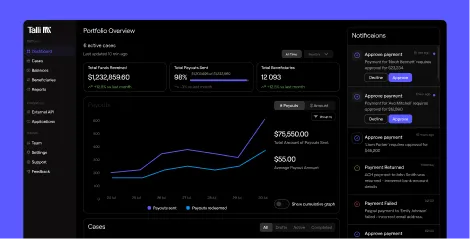
Modern settlement administration platforms provide live visibility into:
- Completion rates: Percentage of successful payouts by wave
- Payment method distribution: ACH/cards/wallets breakdown
- Geographic concentration: Regional distribution patterns
- Failure root cause analysis: Why specific payments failed
- Fraud flags: Claims requiring manual review
- Remaining fund balances: Real-time accounting
Court Reporting Requirements
Settlement administrators must generate court-required documentation including:
- Payment reconciliation reports
- Exception handling logs
- Fraud detection summaries
- Fund flow accounting
- Claimant communication records
Automated reporting and reconciliation eliminates manual preparation time, reducing monthly closing cycles by an estimated 70%.
Stakeholder Portal Access
Multiple parties need controlled access to settlement data:
- Courts: Oversight of fund distribution compliance
- Trustees: Fiduciary monitoring responsibilities
- Legal teams: Case management integration
- Third-party monitors: Independent verification (required for Amazon settlement)
Real-time dashboards provide stakeholder portals with appropriate access controls, while webhook integration automatically syncs payment status updates to CRM systems.
Cost-Benefit Analysis: Optimizing Settlement Disbursements at Scale
The financial case for digital settlement administration is compelling when examined at Amazon settlement scale.
Cost Comparison
Traditional Paper Check Costs:
- Per-check processing: Estimated $7-20 all-in
- Reissuance for uncashed checks: Approximately $150 per item
- Escheatment processing: Additional administrative burden
- Timeline: Around 6-8 weeks minimum
Digital Payment Costs:
- ACH direct deposit: Approximately $0.25-$0.50 per transaction
- Digital wallets: Around $0.50-$1.00 per transaction
- Prepaid cards: Higher per-unit but no reissuance costs
- Timeline: 24-48 hours
Scale Impact
For Amazon's estimated 35 million eligible claimants, the cost differential is substantial:
Paper Check Approach:
- Processing cost per payment: $7-20
- Estimated total processing: $245M-$700M
- Time to first payment: 6-8 weeks
- Expected unclaimed rate: 20-30%
Digital-First Approach:
- Processing cost per payment: $0.25-$5
- Estimated total processing: $8.75M-$175M
- Time to first payment: 24-48 hours
- Expected unclaimed rate: Significantly lower
The estimated 50-65% cost reduction from digital distribution preserves more settlement funds for claimants rather than administrative overhead.
ROI Timeline
Digital settlement platforms typically achieve ROI within an estimated 4-7 months through:
- Reduced per-transaction processing costs
- Lower exception handling and manual reissuance
- Decreased fraud losses
- Shorter reconciliation cycles
- Reduced support call volumes
Case Study Insights: Lessons from Large Settlements
The AB Data case study provides validated evidence of digital disbursement effectiveness at scale relevant to Amazon's settlement.
AB Data Results
AB Data, a leading U.S. claims administrator managing settlements worth hundreds of millions of dollars involving hundreds of thousands of claimants, achieved measurable improvements:
- 30% increase in claimant redemption rates across check-issued populations
- 60% reduction in unresolved exceptions and manual reissuance overhead within 12 months
- 100% fiduciary compliance record maintained across all distribution cycles and regulatory reviews
- Faster time to funds while lowering distribution and reissuance costs
Thomas R Glenn, President & CEO of AB Data, stated: "We don't think of digital disbursement as a feature—we think of it as infrastructure. Talli gave us the regulated payout rails we needed to move faster, reduce unclaimed funds, and give courts full confidence in how settlement money is being distributed."
Applicable Lessons for Amazon Settlement
Key takeaways that apply to Amazon's $1.5 billion distribution:
1. Digital-First Reduces Abandonment The 30% redemption rate improvement translates to millions more claimants receiving compensation. Applied to Amazon's estimated 35 million eligible claimants, similar improvement would mean over 10 million additional successful payments.
2. Exception Handling Efficiency Matters The 60% reduction in exceptions directly impacts operational costs and claimant satisfaction. Fewer failed payments mean fewer support calls and faster resolution.
3. Compliance Must Be Built-In Maintaining 100% fiduciary compliance across all distributions requires automated compliance infrastructure, not manual processes. At Amazon settlement scale, manual compliance checking would be impossible.
4. Court Confidence Requires Transparency Real-time tracking and audit trails provide the documentation courts require to approve distributions and close cases.
Why Talli Powers Modern Settlement Administration
The Amazon Prime FTC settlement exemplifies why forward-thinking claims administrators are embracing digital-first settlement infrastructure. Traditional paper-based approaches cannot scale to handle 35 million claimants while maintaining the speed, security, and compliance that courts and consumers demand.
Talli's platform addresses the core challenges highlighted throughout this settlement:
Automated Compliance at Scale With institutional-grade OFAC screening, automated tax document collection, and real-time audit trails, Talli ensures every payment meets regulatory requirements—critical when processing millions of transactions under court supervision.
Multi-Channel Payment Flexibility Supporting six payment methods including ACH, digital wallets, prepaid cards, and checks ensures no eligible claimant is excluded while maximizing redemption rates through recipient preference.
AI-Powered Fraud Prevention Advanced pattern recognition and identity verification protect settlement funds from the organized fraud attempts that have compromised other large consumer settlements, maintaining fund integrity for legitimate claimants.
Real-Time Transparency Live dashboards provide courts, trustees, and legal teams with complete visibility into distribution progress, exception resolution, and fund accounting—building the confidence required for final approval.
For settlement administrators managing increasingly complex distributions, Talli transforms settlement administration from a manual, paper-intensive process into a streamlined, transparent, and compliant digital workflow. The result: more money reaching eligible consumers, faster resolution timelines, and lower administrative costs that preserve settlement value.
Frequently Asked Questions
What happens if I miss the Wave 2 claims deadline of July 27, 2026?
Claims submitted after the deadline will not be processed, and unclaimed funds follow the settlement agreement's disposition terms—typically either cy pres distribution to designated charitable organizations or return to the defendant. Unlike some settlements with extended claims periods, the Amazon settlement has a firm 180-day window. Setting calendar reminders and providing accurate contact information to receive notification mailings are essential for preserving your claim rights.
Can I receive my Amazon settlement payment via direct deposit to my bank account instead of PayPal or Venmo?
The current Amazon settlement structure offers PayPal, Venmo, and paper checks as the available payment methods—ACH direct deposit to personal bank accounts is not listed as an option. However, PayPal and Venmo both allow transfers to linked bank accounts after receiving the settlement payment, typically within 1-3 business days. If you don't have PayPal or Venmo accounts, allowing the digital payment window to expire will trigger a check mailed to your Amazon shipping address.
How does the Amazon FTC settlement affect the separate De Coster marketplace pricing class action?
The two cases are legally distinct and do not affect each other. The FTC settlement addresses Prime subscription practices (dark patterns for enrollment and cancellation), while De Coster alleges antitrust violations related to marketplace pricing policies that prevented sellers from offering lower prices on competing platforms. Consumers could potentially be eligible for compensation from both if De Coster results in a settlement or plaintiff verdict at trial (scheduled June 2027). However, the cases involve different alleged harms and different time periods.
What documentation should I keep in case Amazon challenges my Wave 2 claim?
While the settlement explicitly states "no documentation required" and Amazon performs the eligibility analysis, prudent claimants should preserve any records showing Prime enrollment dates, cancellation attempts, or Prime benefit usage. This includes email confirmations, account activity logs (downloadable from Amazon), credit card statements showing Prime charges, and any screenshots of cancellation attempts. If Amazon denies a claim, having contemporaneous records supports any appeal or dispute process.
Are Amazon settlement payments taxable income?
Generally, settlement payments that reimburse consumers for amounts they previously paid (like membership fees) are not taxable because they represent a return of your own money rather than new income. However, tax treatment can vary based on individual circumstances, and payments exceeding what you originally paid could have different implications. Claimants receiving payments above $600 may receive 1099 forms. Consulting a tax professional about your specific situation is advisable, particularly for larger payments or complex tax situations.