.svg)


.svg)
Paper checks remain a costly method for recurring workers' compensation indemnity payments, with industry benchmarking placing the cost of issuing paper checks materially above ACH and other electronic payment methods. Meanwhile, digital payment platforms can materially reduce disbursement costs compared with paper checks, particularly when ACH and other lower-cost electronic payment methods are used. These platforms compress payment cycles from weeks to 24-48 hours for carriers and TPAs managing hundreds or thousands of recurring weekly benefits, making the operational and financial case for automation increasingly compelling.
Key Takeaways
- Digital payment platforms can materially reduce disbursement costs compared with paper checks, particularly when ACH and other lower-cost electronic payment methods are used
- One regional carrier achieved 99% digital adoption in month one by having claims adjusters champion payment options before the first benefit was issued
- Multi-channel payment options can reduce payment friction and improve claimant participation
- Prepaid cards provide an alternative payment option for millions of unbanked U.S. households that do not have a checking or savings account.
- State compliance mandates are accelerating: Pennsylvania requires direct deposit availability by December 28, 2025; Texas makes EFT available to eligible workers
- Implementation typically requires 2-6 weeks with vendor-assisted setup, with ROI varying based on payment volume and operational complexity
- AI-powered fraud detection achieves high accuracy while identifying fraud faster than manual review
Navigating Workers' Compensation Benefits: The Foundation of Indemnity Payments
Workers' compensation indemnity payments represent wage replacement benefits paid to injured workers during their recovery period. Unlike one-time settlements, these benefits create recurring payment obligations, often weekly, that must be delivered consistently, accurately, and in compliance with state-specific regulations.
Understanding the Core Components of Workers' Comp
Indemnity benefits fall into several categories that affect payment structures:
- Temporary Total Disability (TTD): Weekly payments while the worker cannot perform any job duties
- Temporary Partial Disability (TPD): Reduced benefits when the worker can perform limited duties
- Permanent Total Disability (PTD): Long-term or lifetime benefits for permanent inability to work
- Permanent Partial Disability (PPD): Scheduled payments based on the degree of permanent impairment
Each category carries different calculation methods, duration limits, and state-specific maximums. Claims management systems must handle these variations while maintaining accurate payment schedules that can span months or years.
The Importance of Timely and Accurate Benefit Delivery
Delayed or inaccurate payments create cascading problems:
- Claimant hardship: Injured workers depend on benefits for essential expenses
- Regulatory penalties: States impose fines for late payments
- Litigation risk: Payment disputes escalate to legal action
- Administrative burden: Manual corrections consume staff time
The recurring nature of indemnity payments amplifies these issues. A single error in a weekly payment setup multiplies across every subsequent disbursement until corrected.
The Challenge of Manual Workers' Comp Payments: Why Automation is Essential
Traditional paper-based workers' comp payment processes create systemic inefficiencies that compound with scale. What works for a small operation becomes unsustainable as claim volumes grow.
Identifying Inefficiencies in Traditional Payment Systems
Paper check workflows involve multiple manual touchpoints:
- Benefit calculation verification
- Check printing and envelope stuffing
- Mailing and postal tracking
- Bank reconciliation
- Reissuance for lost, stolen, or stale-dated checks
- Escheatment processing for unclaimed funds
Each step introduces delay and error potential. A regional carrier serving the trucking industry discovered that paper checks were particularly problematic for their mobile workforce, as truck drivers rarely home to receive mail experienced chronic payment delays.
The Hidden Costs of Legacy Payment Methods
Beyond direct transaction costs, paper checks create hidden expenses:
- Fraud exposure: Mail-theft-related check fraud represents a persistent threat to payment security
- Reissuance costs: Lost or damaged checks require complete reprocessing
- Tracking overhead: Each uncashed check requires follow-up, averaging significant time per item
- Escheatment liability: Unclaimed checks eventually require state reporting and fund transfer
- Reconciliation time: Manual three-way matching consumes considerable hours monthly for mid-sized operations
For a TPA processing hundreds of annual claims, these costs translate to material savings opportunities through digital conversion, before accounting for fraud prevention and staff productivity gains.
Transforming Workers' Comp Payments with Advanced Claims Management Software
Modern claims management platforms integrate payment automation directly into the claims lifecycle, eliminating the disconnection between benefit adjudication and disbursement execution.
Key Features of Modern Claims Management Platforms
Effective platforms provide end-to-end capabilities:
- Payment execution: Approved benefit instructions are converted into scheduled digital disbursements
- Recurring payment support: Authorized weekly or periodic payments can be processed according to instructions received from the claims system
- Multi-channel disbursement: Direct integration with ACH networks, card processors, and digital wallets
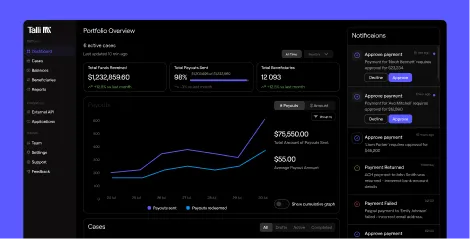
- Real-time tracking: Live visibility into payment status, delivery confirmation, and claimant engagement
- Compliance automation: Built-in KYC verification, OFAC screening, and regulatory checks
Platforms like Talli's Digital Disbursement Platform process distributions end-to-end with automated compliance, fraud detection, and real-time tracking for high-volume operations.
How Technology Streamlines the Claims Lifecycle
Digital integration eliminates manual handoffs between claims and payments. The workflow becomes:
- Claim adjudication: Adjuster approves benefit amount and duration
- Payment authorization: System validates compliance requirements
- Recipient notification: Claimant receives text/email with payment options
- Disbursement execution: Funds delivered via selected method (ACH, card, wallet)
- Confirmation and reconciliation: Status updates sync back to claims system
This connected approach compresses settlement timelines from weeks to 24-48 hours while reducing manual intervention points.
Implementing Recurring Payments for Consistent Workers' Comp Disbursements
Recurring payment automation requires thoughtful configuration to handle the variability inherent in workers' comp benefits: amounts change, durations adjust, and claimant circumstances evolve.
Setting Up Automated Weekly Indemnity Schedules
Effective recurring payment setup addresses:
- Payment frequency: Weekly, bi-weekly, or per-period schedules based on state requirements
- Amount variability: Support for TTD/TPD transitions and benefit recalculations
- Duration management: Automatic termination based on maximum benefit periods or return-to-work events
- Exception handling: Flags for address changes, returned payments, or compliance holds
Configuration typically requires several weeks for vendor-assisted implementation, with the first 1-2 weeks focused on discovery and planning, followed by system configuration and integration.
Choosing the Right Platforms for Recurring Disbursements
Multi-channel payment options significantly impact claimant adoption and redemption rates. Leading platforms offer:
ACH Direct Deposit:
- Cost per transaction: $0.25-$0.50
- Delivery speed: 1-2 days
- Best for banked claimants preferring direct deposit
Prepaid Debit Card:
- Cost per transaction: $0.50-$1.00
- Delivery speed: 30 seconds (virtual) / 5-7 days (physical)
- Best for unbanked populations, immediate access needs
Digital Wallets (PayPal, Venmo):
- Cost per transaction: $0.50-$1.00
- Delivery speed: Instant
- Best for younger claimants, existing platform users
Wire Transfer:
- Cost per transaction: $10-$30
- Delivery speed: Same day
- Best for high-value or international payments
Paper Check (fallback):
- Cost per transaction: Materially higher than digital methods
- Delivery speed: 5-10 days
- Best for edge cases, regulatory requirements
Multi-channel payment options can reduce payment friction and improve claimant participation. In Talli's AB Data case study, digital disbursements were associated with a 30% increase in claimant redemption rates. Prepaid cards specifically address the millions of unbanked U.S. households who cannot receive ACH payments.
Optimizing Payment Automation for Scalable Workers' Comp Operations
Scaling from hundreds to thousands of recurring payments requires automation that reduces manual intervention while maintaining accuracy and compliance.
Leveraging AI for Enhanced Payment Processing
AI-powered capabilities transform payment operations:
- Fraud detection: Pattern recognition across device fingerprinting, behavioral analytics, and identity verification achieves high accuracy while identifying fraud faster than manual review
- Address validation: Real-time verification reduces failed deliveries
- Duplicate detection: Algorithms flag potential duplicate claims before payment
- Anomaly identification: Machine learning surfaces unusual payment patterns for review
Fraud controls remain important as payment activity moves across both paper and digital channels, particularly when protecting against payment redirection, identity misuse, and altered payment instructions.
Reducing Manual Intervention in High-Volume Payments
Automation targets the highest-volume manual activities:
- Batch processing: Upload thousands of payments simultaneously rather than individual entry
- Three-way reconciliation: Automated matching reduces monthly closing time materially, from many hours to a fraction of that time
- Exception routing: Failed payments automatically queue for review with root cause identification
- Reissuance automation: Returned payments trigger automatic reprocessing without adjuster intervention
The result: claims adjusters focus on complex cases rather than payment mechanics, while finance teams close books faster with fewer errors.
Ensuring Compliance and Security in Automated Workers' Comp Payments
Workers' comp payments operate under strict regulatory oversight. Automation must enhance compliance rather than introduce risk.
Meeting Regulatory Requirements with Digital Payment Systems
State-specific requirements demand configurable rule engines:
- Pennsylvania Act 126: Requires insurers to make direct deposit available for workers' comp benefits by December 28, 2025
- Texas: Workers expected to receive qualifying benefits for at least eight weeks may request electronic funds transfer, and carriers must make that option available to eligible recipients
- Colorado: Requires electronic medical bill submission as of January 1, 2026 for providers submitting 25+ bills monthly
Platforms with built-in state-specific rule engines eliminate manual tracking of these evolving requirements.
Protecting Claimant Data and Preventing Fraud
Comprehensive security infrastructure includes:
- Compliance automation: Integrated OFAC screening, KYC verification, and sanctions list checking
- Payment records: Maintain complete records of benefit amounts, payment dates, recipient instructions, and exceptions
- Audit documentation: Preserve payment authorization and transaction histories for carrier, TPA, and regulatory review
- Fund segregation: Dedicated FBO (For Benefit Of) accounts prevent commingling of settlement funds with operating capital
Talli's Trust Center details SOC 2 Type II and PCI DSS Level 1 compliance certifications that validate these security controls through independent audits.
Beyond Workers' Comp: Exploring Additional Benefits and Payout Types
The infrastructure supporting automated workers' comp payments extends naturally to other recurring benefit distributions with similar compliance and operational requirements.
Organizations managing workers' comp often handle related payment types:
- Disability insurance benefits: Long-term disability payments with similar recurring structures
- Pension disbursements: Retirement benefit distributions requiring consistent delivery
- Settlement payments: One-time or structured settlements from litigation
- Shareholder dividends: Corporate distributions with comparable compliance requirements
Platforms purpose-built for legal and insurance payments handle these variations without requiring separate systems for each payment type.
Real-Time Oversight and Reporting for Workers' Comp Payment Administrators
Visibility into payment operations enables proactive management rather than reactive problem-solving. Modern dashboards surface actionable metrics:
- Completion rates: Percentage of successful payments versus attempts
- Payment method distribution: Adoption across ACH, cards, wallets, and checks
- Geographic concentration: Regional patterns affecting delivery success
- Failure root cause analysis: Categorization of returned or failed payments
- Fraud flags: Transactions requiring manual review before release
- Fund balances: Remaining settlement or reserve funds awaiting disbursement
Compliance reporting becomes automatic rather than manual:
- Court-ready audit trails: Complete documentation of every payment action with timestamps
- Regulatory support: Exportable payment histories and audit records can support the carrier or TPA's existing state reporting processes
- Financial reconciliation: Three-way matching between claims system, bank, and payment platform
- Stakeholder portals: Controlled access for carriers, employers, and legal teams to view payment status
Choosing Your Digital Payment Partner: Key Considerations for Scale and Compliance
Vendor selection determines long-term success. The right partner accelerates implementation while the wrong choice creates ongoing friction.
Evaluating Digital Disbursement Providers
Critical evaluation criteria include:
Integration Capabilities:
- Pre-built connectors for your claims management system
- API documentation quality and developer support
- Batch upload support for legacy systems lacking APIs
- Medical clearinghouse connectivity for combined medical/indemnity payments
Payment Method Coverage:
- ACH direct deposit with competitive transaction fees
- Prepaid cards with zero activation fees for unbanked recipients
- Digital wallet support (PayPal, Venmo) for younger demographics
- Paper check fallback for edge cases and regulatory requirements
Compliance Infrastructure:
- SOC 2 Type II and PCI DSS Level 1 certifications
- Built-in KYC/OFAC screening automation
- State-specific rule engines for multi-jurisdiction operations
- FDIC-insured banking partners for fund protection
What to Look for in a Scalable Payment Solution
Scale requirements vary by organization size:
Small TPA (100-500 claims/year):
- Key requirements: Multi-channel payments, basic compliance, batch uploads
- Implementation timeline: 2-4 weeks
Mid-sized Carrier (500-5,000 claims/year):
- Key requirements: API integration, fraud detection, automated reconciliation
- Implementation timeline: 4-6 weeks
Large Carrier (5,000+ claims/year):
- Key requirements: Enterprise scalability, custom workflows, dedicated support
- Implementation timeline: 6-12 weeks
Talli's platform scales from 1,000 to 100,000+ recipients without performance degradation, supporting organizations across this spectrum with implementation timelines tailored to operational complexity.
Calculating ROI for Digital Payment Investment
ROI should be calculated using each organization's actual indemnity-payment volume, number of recurring installments, current check-processing costs, exception and reissuance workload, transaction pricing, and integration expenses. Higher recurring-payment volumes generally strengthen the business case because the same automated infrastructure can replace a larger number of manual payment events.
Factors contributing to ROI include:
- Direct transaction cost reduction from paper to digital methods
- Staff time savings from automated reconciliation and reduced exception handling
- Fraud prevention and reduced reissuance costs
- Faster claim closure through accelerated payment delivery
- Improved claimant satisfaction and reduced call center volume
Talli's Approach to Workers' Comp Payment Automation
Talli's digital disbursement platform addresses the complete lifecycle of workers' compensation indemnity payments, from initial payment authorization through final reconciliation and audit reporting.
The platform provides:
- Multi-channel payment execution supporting ACH, prepaid cards, digital wallets, and fallback paper checks to accommodate diverse claimant populations
- Automated compliance controls including built-in OFAC screening, KYC verification, and state-specific regulatory rule engines
- AI-powered fraud detection that identifies suspicious patterns across device fingerprinting, behavioral analytics, and identity verification
- Real-time tracking and reporting with live dashboards, automated reconciliation, and exportable audit trails for regulatory review
- Scalable infrastructure supporting operations from hundreds to hundreds of thousands of recurring payments without performance degradation
Implementation typically requires 2-6 weeks with vendor-assisted setup, including discovery, system configuration, integration, and testing. The platform maintains SOC 2 Type II and PCI DSS Level 1 certifications, with funds held in FDIC-insured FBO accounts that prevent commingling with operating capital.
Organizations using Talli's platform report materially reduced disbursement costs, faster payment cycles, improved claimant satisfaction, and streamlined compliance processes that free adjusters to focus on complex claim management rather than payment mechanics.
Frequently Asked Questions
How does automation handle varying weekly payment amounts when a claimant transitions from total to partial disability?
Modern platforms support dynamic payment adjustments through integration with claims management systems. When an adjuster updates the claim status from TTD to TPD, the payment schedule automatically recalculates based on the new benefit rate. The system flags the change for verification, processes the adjusted amount on the next scheduled payment date, and maintains a complete audit trail of the modification. This eliminates manual recalculation while ensuring claimants receive accurate benefits immediately upon status change.
What happens when a claimant moves or changes bank accounts mid-benefit?
Digital payment platforms handle recipient data changes through self-service portals where claimants update their information directly. Address changes trigger automatic verification against postal databases. Bank account changes require re-authentication to prevent fraud. The platform validates new information before the next scheduled payment, routes exceptions for manual review when validation fails, and maintains historical records of all changes for compliance documentation. This process typically completes within 24-48 hours versus the weeks required for paper check address changes.
Can automated systems accommodate state-specific payment timing requirements?
Yes, enterprise platforms include configurable rule engines that enforce state-specific timing mandates. For example, some states require initial payments within 14 days of claim acceptance, while others mandate specific payment days of the week. The system automatically calculates compliant payment schedules based on the claimant's state of injury, tracks timing against regulatory deadlines, and alerts administrators when payments risk missing mandated windows. This eliminates the manual calendar tracking that leads to compliance violations and associated penalties.
How do organizations manage the transition from paper checks to digital payments for existing claimants?
Successful transitions use a phased approach starting with new claims on digital platforms while gradually migrating existing claimants. The process involves claimant communication campaigns (text/email explaining payment options), a branded self-service portal where recipients select their preferred payment method, and adjuster training to champion digital options during claimant interactions. Organizations typically maintain paper check capability for 6-12 months during transition, with remaining paper check volume declining to 1-5% for edge cases. Evidence demonstrates that 99% digital adoption is achievable in month one when claims adjusters actively promote options before the first payment.
What security measures protect against fraudulent payment redirects?
Multi-layered security prevents unauthorized payment changes. Authentication requirements for recipient data modifications include identity verification and device fingerprinting. AI systems flag unusual patterns, such as sudden address changes to high-fraud zip codes or bank account changes shortly after benefit approval. Real-time screening validates recipients against sanctions lists before every disbursement. Audit trails capture every modification with timestamps and IP addresses for forensic review. These controls operate automatically without slowing legitimate payment processing.