.svg)


.svg)
To choose a disbursement platform for law firms, evaluate compliance automation (KYC, OFAC, QSF), payout method variety, trust accounting, real-time reporting, tax documentation, fraud detection, and scalability. Paper checks still play a major role in personal injury disbursements, despite growing adoption of digital payout methods. For law firms managing class actions, mass torts, or high-volume settlements, the right disbursement platform directly affects redemption rates, compliance posture, and client satisfaction. This guide walks through the evaluation criteria that matter most when selecting a disbursement platform for law firms, from claims disbursement compliance and settlement payout flexibility to integration requirements and total cost of ownership. Whether you handle personal injury cases, class action settlements, or mass tort litigation, the right legal disbursement software can transform your payout operations.
Key Takeaways
- Digital disbursement platforms can double traditional check redemption rates while cutting per-payment costs from $8 to under $0.50.
- Compliance automation — including KYC verification, OFAC screening, and QSF account segregation — is non-negotiable for legal settlement payouts.
- The right platform should support multiple payout rails (ACH, prepaid cards, digital wallets) and integrate with your existing case management and accounting systems.
- Law firms should evaluate disbursement platforms based on total operational impact — including redemption rates, reconciliation effort, reissue volume, and audit readiness — not just transaction fees.
- Purpose-built legal disbursement platforms outperform general payment processors because they support trust accounting, court-ready reporting, and scalable workflows for class actions, mass torts, and high-volume settlements.
What Is a Disbursement Platform and Why Do Law Firms Need One?
A disbursement platform for law firms is software infrastructure that automates the distribution of settlement funds, insurance payouts, or other legal payments to recipients at scale. Unlike general payment processors, platforms built for legal disbursement handle the compliance, audit, and reporting requirements specific to settlement administration.
Law firms need dedicated disbursement infrastructure because settlement payouts carry unique obligations. Funds must be held in segregated trust accounts, recipients must be screened against federal sanctions lists, and every transaction requires a court-ready audit trail. General-purpose payment tools lack these safeguards.
The median claims rate across consumer class action settlements sits at just 9% across 149 settlements, with the weighted average dropping to 4% when accounting for settlement size. Digital disbursement platforms address this participation gap by offering recipients faster, more accessible payout methods.
7 Critical Features in a Disbursement Platform for Law Firms
Not every digital disbursement tool is built for legal workflows. When evaluating a disbursement platform for law firms, these seven capabilities separate purpose-built settlement payout platforms from generic payment infrastructure.
1. Compliance Automation (KYC, OFAC, AML)
The platform must automate identity verification (KYC), sanctions screening (OFAC), and anti-money-laundering checks. Manual compliance processes create bottlenecks in high-volume disbursements and increase the risk of regulatory violations. Look for platforms that screen recipients against current OFAC Specially Designated Nationals (SDN) lists before every payment, with timestamped audit trails documenting pre-payment verification.
2. Multiple Payout Methods
Recipients should have options: ACH, prepaid cards, digital wallets (PayPal, Venmo), plus gift cards. Offering multiple payout rails increases redemption rates because recipients can choose the method most convenient for their situation. Platforms that support only one or two methods limit participation.
3. Trust Account and QSF Compliance
Settlement funds are held as fiduciary assets. The platform must support IOLTA-compliant trust accounting, preventing commingling of client and firm funds. For class actions and mass torts, Qualified Settlement Fund (QSF) account segregation is essential for tax compliance and court reporting.
4. Real-Time Dashboards and Reporting
Settlement administrators and attorneys need real-time visibility into payout status, redemption rates, and exception handling. Look for platforms with configurable dashboards that track every payment from authorization through redemption, with export capabilities for court filings and client reporting.
5. Tax Documentation (W-9/1099)
Legal disbursements often trigger tax reporting requirements. The platform should automate W-9 collection from recipients and generate 1099 forms for reportable payments, eliminating manual data gathering and reducing IRS compliance risk.
6. Fraud Detection and Prevention
Automated claim filtering should flag duplicates and synthetic identities before funds are released. With the DOJ establishing a new Division for National Fraud Enforcement in early 2026, robust fraud prevention in digital disbursements is a growing regulatory expectation.
7. Scalability
A platform that handles 500 personal injury payouts may not perform at 100,000 class action distributions. Evaluate whether the vendor has processed high-volume campaigns and can demonstrate throughput at your anticipated scale. Ask for case studies or references from similar-sized engagements.
Compliance Requirements: KYC, OFAC, IOLTA, and QSF Explained
Compliance is the single most important evaluation criterion for a legal disbursement platform. Here is what each requirement entails and why it matters.
OFAC screening is non-negotiable. As a practical sanctions-compliance measure, payment recipients should be screened against current OFAC sanctions lists before disbursement, with audit trails documenting the screening timestamp as proof of pre-payment verification.
How Digital Disbursements Improve Settlement Redemption Rates
Redemption rate — the percentage of eligible recipients who actually claim and receive their funds — is the metric that matters most in settlement administration. Traditional check-based processes consistently underperform.
The participation gap by the numbers:
- Median claims rate across consumer class actions: 9% (149 settlements studied)
- Weighted average accounting for settlement size: 4%
- Email-only notice campaigns: 3% average redemption
- Optimized notice with digital payout options: 16% redemption
- Check cashing rate once received: 77%
- Claim approval rate for submitted claims: 86%
Digital disbursement platforms improve these numbers by removing friction. When recipients can choose ACH, a prepaid card, or a digital wallet instead of waiting for a paper check, participation rates increase. The data shows that the primary participation barrier is not claim rejection (86% approval rate) but failure to engage with the process at all.
Platforms that combine optimized digital notices with multiple payout options report redemption rates that consistently exceed traditional check-based methods, often by 2x or more.
Security and Audit Trail Requirements for Legal Payouts
Every disbursement in a legal context requires documentation sufficient for court review. The platform's security and audit capabilities should include:
- End-to-end encryption for recipient data and payment credentials
- Multi-factor authentication for administrator access and payment approval workflows
- SOC 2 Type II certification demonstrating ongoing security control effectiveness
- Configurable approval chains requiring multiple sign-offs for disbursements above defined thresholds
- Immutable audit logs recording every action — payment initiation, approval, screening result, delivery status, and redemption confirmation
- FDIC-insured banking relationships for fund custody (e.g., partnerships with regulated banks for FDIC-compliant QSF payouts)
Court-ready reporting means any disbursement platform for law firms should generate on-demand reports showing exactly when each recipient was screened, when payment was authorized, what method was used, and whether the funds were redeemed — all with timestamps and responsible-party attribution.
How to Integrate a Disbursement Platform with Existing Systems
A disbursement platform that operates in isolation creates manual reconciliation work. Evaluate integration capabilities across three categories.
Case Management Systems: The platform should connect with tools like Filevine, Litify, CASEpeer, or CloudLex to pull case data, recipient lists, and settlement amounts automatically.
Pre-built integrations reduce implementation time. API access provides flexibility for custom workflows.
Accounting and Trust Accounting Software: Disbursement data should sync with your accounting system for automated settlement reconciliation. Look for integrations with QuickBooks, Xero, or specialized legal accounting tools that maintain IOLTA ledger separation.
CRM and Communication Tools: Automated payout notifications, status updates, and redemption reminders should flow through your existing communication channels. Integration with the platform's claimant portal allows recipients to track their payment status without contacting the firm.
Cost Analysis: Paper Checks vs. Digital Disbursement
The economics strongly favor digital methods, especially at scale.
At 10,000 disbursements, the per-payment savings alone amount to $75,000-$79,000. Factor in reduced reissue costs, lower reconciliation labor, and higher redemption rates, and the ROI case for any disbursement platform for law firms is clear.
Settlement administrators are actively planning FedNow integration, which could enable instant settlement payouts with low network fees, though total provider pricing will vary.
How to Evaluate Vendors: A Decision Framework
Use this framework to score disbursement platform vendors against your firm's specific requirements.
Beyond feature checklists, request a demo using your actual workflow — not a generic presentation. When evaluating any disbursement platform for law firms, ask for references from firms handling similar case types and volumes. Verify independently that the vendor's compliance certifications (SOC 2, OFAC screening) are current.
Top Disbursement Platforms for Law Firms in 2026
Choosing a disbursement platform for law firms means comparing purpose-built settlement platforms, case management tools with embedded payments, and general payout infrastructure adapted for legal use. Here are the leading options in 2026.
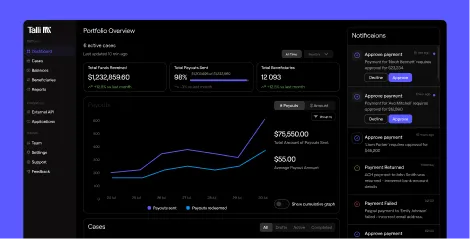
Talli is a digital claims disbursement platform purpose-built for legal settlement compliance. It supports ACH, prepaid Mastercard, PayPal, and gift card payouts with automated KYC verification, OFAC screening, W-9 collection, and 1099 generation.
Talli offers segregated QSF-compliant accounts through FDIC-insured banking with Patriot Bank, N.A., real-time dashboards for payout tracking, and court-ready reporting. The platform has processed payouts for over 500,000 recipients and supports campaigns from 1,000 to 100,000+ distributions.
Common Mistakes When Choosing a Disbursement Platform for Law Firms
Choosing a general payment processor instead of a legal disbursement software platform. General payment processors and standard ACH providers lack IOLTA compliance, OFAC screening, and QSF account segregation. What works for e-commerce refunds does not meet fiduciary requirements for settlement payouts.
Ignoring the unbanked recipient population. An estimated 5.9 million U.S. households are unbanked. If your platform only supports ACH direct deposit, a meaningful percentage of claimants cannot receive funds. Prepaid card disbursement options, digital wallets, and stored value options are essential for maximizing redemption.
Underestimating integration requirements. A disbursement platform that requires manual data entry from your case management system creates reconciliation errors and operational overhead. Budget implementation time and verify integration compatibility before signing a contract.
Evaluating on per-transaction cost alone. The cheapest per-payment fee means nothing if the platform has low redemption rates, poor compliance automation, or no audit trail. Total cost of ownership includes reconciliation labor, reissue costs, compliance risk, and unredeemed fund management.
Skipping the scalability test. A platform that handles your current caseload may not support your growth. Ask vendors about their largest deployments and request load testing data if you anticipate high-volume class action work.
Conclusion: Choosing the Right Disbursement Platform for Your Firm
The disbursement platform for law firms you select shapes your firm's compliance posture, client experience, and settlement administration efficiency. Prioritize platforms that automate compliance (KYC, OFAC, QSF), offer multiple payout methods, integrate with your existing systems, and provide court-ready audit trails.
Start by mapping your firm's specific requirements — case types, anticipated volume, integration needs, and compliance obligations — against the evaluation framework above. Then request demos from two or three vendors using your actual workflow data, not generic scenarios.
Book a Demo → to see how Talli's digital claims disbursement infrastructure handles compliance automation, multi-method payouts, and real-time settlement tracking for law firms.
Frequently Asked Questions
What is a disbursement in a law firm?
A disbursement in a law firm is the distribution of settlement funds, insurance proceeds, or other legal payments from a trust or escrow account to the entitled recipients — whether claimants, lien holders, or the firm itself. Disbursements must comply with court orders, trust accounting rules, and regulatory requirements including OFAC sanctions screening.
How do law firms disburse settlement funds?
Law firms traditionally disburse settlement funds via paper checks issued from IOLTA trust accounts. Increasingly, firms use digital disbursement platforms that offer ACH transfers, prepaid debit cards, and digital wallets. Digital methods are faster, cheaper, and produce higher redemption rates than paper checks.
What compliance requirements apply to legal disbursements?
Legal disbursements must comply with KYC (Know Your Customer) identity verification, OFAC sanctions screening, IOLTA trust accounting rules, AML (Anti-Money Laundering) monitoring, and tax reporting obligations (W-9/1099). For class actions, QSF (Qualified Settlement Fund) compliance adds additional account segregation requirements.
How long does a settlement disbursement take?
Paper check disbursements typically take 7 to 14 days including processing and mail delivery. Digital ACH transfers arrive in 1 to 3 business days. Platforms supporting FedNow or instant payment rails can deliver funds within minutes. The total timeline also depends on compliance screening and approval workflows.
What is OFAC screening in disbursements?
OFAC screening is the mandatory process of checking every payment recipient against the U.S. Treasury's Office of Foreign Assets Control sanctions lists before releasing funds. This screening identifies Specially Designated Nationals and blocked persons. Failing to screen can result in severe penalties and jeopardize the entire settlement administration process.
What is the difference between a disbursement and a payment?
A payment is a general transfer of funds for goods or services. A disbursement specifically refers to the distribution of funds held in trust, escrow, or a qualified settlement fund to their rightful recipients. Disbursements carry additional fiduciary obligations, compliance requirements, and audit trail documentation that standard payments do not.
How do digital disbursements improve redemption rates?
Digital disbursements improve redemption rates by reducing friction in the claims process. Recipients using a disbursement platform for law firms can choose their preferred payout method — ACH, prepaid card, or digital wallet — and receive funds in hours rather than weeks via multiple payment channels. Data across 149 consumer class actions shows that optimized digital notice and payout methods can increase redemption from a 4% weighted average to 16% or higher.