.svg)


.svg)
Receiving a class action settlement notice in your mailbox or inbox isn't junk mail: it's a legal document informing you that a lawsuit you're connected to has reached a proposed resolution. Yet the median claims rate across consumer class actions requiring a claims process sits at just 9%, meaning most entitled individuals never collect compensation they're owed. Understanding what these notices mean and how to respond can be the difference between receiving your fair share and leaving money on the table. Modern class action disbursement platforms are working to close this gap by making payments faster and more accessible.
Key Takeaways
- Class action settlement notices are mandatory court communications: Federal Rule 23 requires "the best notice that is practicable under the circumstances" to all identifiable class members
- In the FTC's sample of consumer class actions requiring claims, the weighted mean claims rate was 4% and the median was 9%
- 86% of submitted claims receive approval: low participation is a communication problem, not an eligibility issue
- Your options depend on the class type and settlement terms and may include submitting a claim, objecting, requesting exclusion when permitted, or taking no action
- For Rule 23(b)(3) classes, federal rules require notice to clearly explain seven specified subjects including class definition, claims at issue, and opt-out procedures
- Plain English notices achieve approximately 10 percentage points higher claims rates than traditional legal language formats
What Is a Court-Ordered Notice of Class Action Settlement and Why Did I Get One?
A court-ordered notice of class action settlement is a legally mandated communication informing you that a lawsuit affecting you has reached a proposed resolution. The court requires this notice because you have rights that demand attention, and specific deadlines you must meet.
You received this notice because you likely:
- Purchased a product from a company facing consumer protection litigation
- Used a service involved in alleged unfair practices
- Had personal data exposed in a data breach
- Were employed by an organization accused of wage violations
- Own shares in a company facing securities litigation
The Purpose of a Class Action Settlement Notice
Under Rule 23(c)(2)(B) of the Federal Rules of Civil Procedure, courts must direct notice to all class members who can be identified through reasonable effort. This isn't optional: it's a constitutional due process requirement ensuring you have the opportunity to participate, object, or opt out before the settlement becomes final.
The notice serves three critical functions:
- Informing you of your rights including the right to receive compensation
- Explaining your options for participating or excluding yourself
- Establishing deadlines that are legally binding
Understanding Your Role as a Class Member
If the notice identifies you as a potential class member, your rights depend on the type of class and the court's orders. In a Rule 23(b)(3) class, members generally remain bound unless they timely request exclusion. Whether you must file a claim to receive payment also depends on the settlement terms.
What Information to Look For in Settlement Notices
Settlement notices contain critical information buried within legal language. Knowing where to look saves time and prevents missed deadlines.
Key Sections of the Notice
For Rule 23(b)(3) classes, federal rules require notice to clearly explain seven specified subjects:
- Nature of the action: What the lawsuit is about
- Class definition: Who qualifies as a class member
- Claims and issues: What legal claims are being settled
- Right to appear through attorney: Your option for legal representation
- Exclusion statement: How to opt out of the settlement
- Time and manner for requesting exclusion: Specific opt-out procedures and deadlines
- Binding effect: What happens if you stay in the class
The Northern District of California's guidelines add that notices should include contact information for class counsel, settlement website URLs, and hearing dates with disclaimers that dates may change.
Determining Your Eligibility and Potential Benefit
Look for these specific details:
- Eligibility criteria: Time periods, purchase requirements, or other qualifications
- Settlement amount: Total fund size and estimated individual payments
- Payment calculation method: How your specific payment will be determined
- Attorneys' fees: What percentage goes to legal costs
- Claim deadline: The date by which you must submit your claim
Claiming Your Share: Steps to File a Class Action Settlement Claim
Filing a claim requires attention to detail but isn't complicated if you follow the process systematically.
Submitting Your Claim Accurately
Most settlements offer multiple submission methods:
Online Claim Forms: The fastest option, typically available through the settlement website. These often auto-populate fields and check for errors before submission. You'll receive a confirmation email and tracking number.
Mail-in Claims: Some settlements require or allow paper submissions. Use certified mail to confirm delivery, and keep copies of everything you send.
Required Documentation: Depending on the settlement, you may need:
- Proof of purchase (receipts, bank statements, order confirmations)
- Identity verification (last four digits of SSN, date of birth)
- Contact information for payment delivery
- Signature attesting to eligibility
What If I Don't Have Proof of Purchase?
Many settlements don't require documentation. Research shows 86% of submitted claims receive approval, indicating that most claims processes are designed to facilitate participation rather than create barriers.
When proof isn't required, you typically:
- Sign an attestation confirming eligibility
- Provide identifying information matching defendant records
- Accept a potentially lower payment tier than documented claims
Unclaimed Class Action Settlements: How to Find and Redeem Your Money
The gap between entitled class members and those who actually claim payments represents a significant problem. In the FTC's consumer class action sample, the weighted mean claims rate was 4%, showing how significantly participation can fall in settlements that require consumers to submit claims.
Resources for Locating Unclaimed Funds
If you suspect you're owed money from a settlement you missed:
- Claims administrator websites: Search by case name or defendant company
- State unclaimed property databases: Funds may transfer to states after dormancy periods
- Court docket systems: PACER for federal cases, state court websites for state cases
- Class counsel websites: Law firms often maintain settlement databases
Understanding Payment Treatment
When settlement checks go uncashed, the outcome depends on the settlement agreement and court order. Treatment of uncashed payments varies by settlement and jurisdiction. The court-approved distribution plan may provide for reissuance, redistribution, residual-fund treatment, or compliance with applicable state unclaimed-property laws.
Class Action Settlements Without Proof of Purchase: Is My Claim Still Valid?
Many high-profile settlements explicitly waive documentation requirements, recognizing that consumers rarely retain receipts for years.
Common Scenarios Without Proof of Purchase
Settlements commonly allow claims without receipts for:
- Consumer product cases: Where purchase records weren't typically kept
- Data breach settlements: Where affected individuals are identified through defendant records
- Service-based claims: Where usage was tracked by the defendant
- Small-value products: Where requiring receipts would discourage legitimate claims
Maximizing Your Claim Without Receipts
Without documentation, claimants typically:
- Receive base-tier payments rather than enhanced amounts
- Must attest to purchase/use under penalty of perjury
- May face payment caps limiting maximum recovery
- Should expect smaller individual payments due to higher participation
Some settlements offer tiered structures where documented claims receive multiplied payments, providing enhanced compensation for claimants who can prove specific types of harm or exposure.
Understanding Your Payment Options: How Class Action Settlements Are Disbursed
How you receive your settlement payment matters. Traditional paper checks historically achieved only 77% cashing rates, leaving nearly a quarter of successful claimants without their money.
The Shift Towards Digital Disbursements
Modern settlements increasingly offer multiple payment methods:
- ACH direct deposit: Funds deposited directly to your bank account within 1-2 days
- Prepaid debit cards: Virtual cards delivered via SMS/email in approximately 30 seconds, physical cards within 5-7 days
- Digital wallets: PayPal and Venmo options for faster access
- Gift cards: Amazon, Target options popular for smaller settlements
- Paper checks: Traditional option maintained as fallback
Choosing the Best Payment Method for You
Consider these factors when selecting payment method:
Speed: Digital options deliver funds in 24-48 hours versus 6-8 weeks for mailed checks
Banking status: Prepaid cards and other nonbank payment options can help serve claimants who do not have traditional bank accounts
Convenience: Digital wallets eliminate trips to banks for check deposits
Security: Digital payments reduce risks of lost, stolen, or forged checks
Largest Class Action Settlements: What Makes Them Significant?
Major settlements demonstrate the scale of class action litigation and its impact on consumer protection.
Recent Major Settlements and Their Scope
High-profile cases illustrate the range of class action litigation:
- Data breach settlements: Large-scale cyberattacks affecting millions of customers
- Antitrust cases: Competition-related disputes generating substantial settlements
- Mass tort litigation: Product liability cases involving thousands of pending claims
- Consumer protection: Product defect and employment cases continue generating settlements
Future Trends in Class Action Litigation
The class action settlement landscape continues evolving with:
- Increasing data breach litigation following major cyberattacks
- Growing mass tort cases around pharmaceuticals and environmental contamination
- Enhanced regulatory scrutiny of settlement fairness
- Technology-driven improvements in claims administration
Beyond the Claim: What Happens After You File
Understanding the post-submission process helps set realistic expectations for payment timing.
The Role of the Settlement Administrator
Claims administrators handle the operational work of processing claims, verifying eligibility, and distributing payments. Their responsibilities include:
- Claims validation: Checking submissions against eligibility criteria
- Fraud detection: Identifying duplicate or fraudulent claims
- Payment calculation: Determining individual amounts based on settlement formulas
- Distribution: Executing payments through selected methods
- Reporting: Providing courts with accounting of fund distribution
Timeline from Claim to Payment
Expect these general timeframes:
- Claim submission to deadline: Typically 60-120 days from notice
- Claim review period: 30-90 days after deadline
- Final approval hearing: Court must approve settlement before distribution
- Payment distribution: 30-180 days after final approval
- Payment redemption period: The deadline and treatment of unredeemed payments are established by the settlement terms, court orders, and applicable law
Total time from filing to payment often spans 6-18 months depending on case complexity and any appeals.
Class Action Lawsuits to Join: How to Stay Informed
Proactive monitoring helps ensure you don't miss future settlement opportunities.
Proactively Identifying Potential Class Actions
Stay informed through:
- Legal news outlets: Publications covering class action filings
- Consumer protection agencies: FTC and state attorney general announcements
- Company communications: Direct notices from businesses you've patronized
- Email monitoring: Watch for legitimate settlement emails (check sender authenticity)
The Benefits of Joining a Class Action
Participation offers several advantages:
- No upfront costs: Attorneys work on contingency
- Minimal effort: Class representatives handle litigation
- Collective leverage: Combined claims create settlement pressure
- Legal expertise: Experienced counsel manages complex proceedings
Why Choose Talli for Settlement Administration
While traditional settlement administration leaves many entitled class members without compensation, modern digital disbursement platforms are transforming how settlements reach claimants.
Talli addresses the core problems plaguing settlement distributions through purpose-built technology that benefits both administrators and class members.
Higher Redemption Rates: Digital-first platforms report significantly higher claimant redemption rates compared to traditional paper methods, meaning more class members actually receive the money they're entitled to.
Faster Payment Cycles: Once payments are authorized for distribution, digital methods can deliver funds in approximately 24-48 hours, depending on the payment method and settlement configuration. Settlement distributions that traditionally took 6-8 weeks become dramatically faster, helping claimants get their money when it matters.
Multiple Payment Options: Beyond paper checks, Talli offers ACH direct deposit, prepaid Mastercard, PayPal, Venmo, and gift card options, meeting claimants where they are and serving diverse financial circumstances.
Fraud Prevention: Built-in fraud mitigation, identity verification, KYC, and compliance controls help administrators identify suspicious activity while maintaining auditable payment workflows, ensuring settlement funds reach entitled recipients.
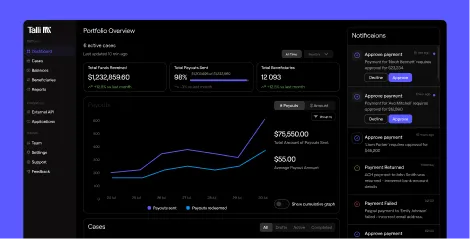
Real-Time Tracking: Both administrators and claimants can monitor payment status through live dashboards, eliminating the uncertainty of traditional administration.
For claims administrators and class counsel seeking to maximize class member recovery, Talli's platform handles the complete disbursement workflow from claimant notification through final payment reconciliation, while maintaining the compliance infrastructure required for court-supervised fund distribution.
Frequently Asked Questions
What is the difference between a class action settlement and a class action lawsuit?
A class action lawsuit is the litigation process where a group sues a defendant for alleged wrongdoing. A class action settlement is the resolution of that lawsuit: an agreement between the parties that ends the litigation and provides compensation to class members. Settlements require court approval before becoming final. The notice you receive announces a proposed settlement, meaning the case has concluded but requires final judicial approval before payments are distributed.
Do I need an attorney to claim my share of a class action settlement?
No. Class members can submit claims without hiring personal attorneys. The class counsel (attorneys who prosecuted the case) represent all class members' interests. Their fees come from the settlement fund, not individual claimants. You have the right to appear through your own attorney if you choose, but this is rarely necessary for standard claim submissions. Personal counsel becomes relevant only if you're considering opting out to pursue individual litigation.
How long does it typically take to receive payment after filing a claim?
Expect 6-18 months from claim submission to payment receipt. The process includes claim review periods, final approval hearings, potential appeals, and distribution logistics. Digital payment methods can accelerate the final distribution phase to approximately 24-48 hours once approved, compared to weeks for mailed checks. Complex cases with objections or appeals may extend timelines significantly.
What should I do if I disagree with the settlement terms?
Your options depend on the class type and settlement terms and may include submitting a claim, objecting, requesting exclusion when permitted, or taking no action. Filing an objection allows you to voice concerns while remaining in the class: the court will consider your objection at the fairness hearing. Opting out (when available) removes you from the settlement entirely, preserving your right to sue individually but forfeiting any settlement payment. Both options have strict deadlines specified in the notice.
What if the notice of settlement looks like a scam?
Legitimate settlement notices come from claims administrators, not law firms seeking clients. Verify authenticity by checking the settlement website URL against court records, calling the administrator directly using contact information from court filings (not the notice itself), and searching for the case name in legal databases. Research shows many recipients are understandably skeptical of notices, but verification prevents missing genuine claims. Look for specific case details, court information, and administrator contact details to confirm legitimacy.