.svg)


.svg)
Tender offer payment distribution demands precise timing, clean shareholder records, and disciplined fund controls. SEC Rule 14e-1(c) requires tendered securities to be paid for or returned “promptly” after a tender offer expires, but prompt payment is not a fixed 3-business-day rule. Most tender offers still follow a 20-business-day minimum offer period under Regulation 14E, while the SEC’s 2026 exemptive order allows certain qualifying equity tender offers to use a 10-business-day minimum when specific conditions are met. For administrators managing shareholder services, the challenge is turning final acceptance data, proration rules, tax documentation, and payment preferences into accurate disbursements without creating regulatory or fiduciary risk.
Key Takeaways
- Rule 14e-1(c) requires prompt payment or prompt return of tendered securities, but it does not define prompt payment as exactly 3 business days.
- Most tender offers remain subject to a 20-business-day baseline, while qualifying equity tender offers may use a 10-business-day minimum under the SEC’s 2026 exemptive order.
- Oversubscribed offers require accurate proration before payment files can be finalized.
- Private company tender offer pricing is typically benchmarked against financing history, recent preferred stock prices, valuation work, and board-approved terms, not only 409A value.
- QSFs are not the default structure for tender offer proceeds unless the transaction is tied to qualifying claims and court or governmental approval.
- Digital workflows improve speed only when paired with eligibility checks, tax documentation, fund segregation, and payment reconciliation.
Understanding Tender Offers and Their Importance
A tender offer is a time-limited offer to purchase securities directly from holders at a stated price and under stated conditions. Tender offers can support acquisitions, issuer repurchases, going-private transactions, private company liquidity programs, debt repurchases, and fund redemptions. In public company transactions, SEC tender offer rules are designed to protect investors through adequate disclosure, withdrawal rights, fair treatment, and clear offer deadlines.
Tender offers matter because they turn legal decisions into a live payment operation. Administrators must confirm who tendered, whether proration applies, and when funds can be released. A mistake in payment timing, allocation, tax forms, or eligibility can trigger disputes, delayed settlement, and expensive remediation work.
Key Considerations for Private Company Tender Offers
Private company tender offers present operational challenges that are not present in public market transactions. There is no public market settlement process, the securities are usually restricted, and seller eligibility may depend on employment status, equity plan terms, transfer restrictions, right-of-first-refusal provisions, and board approvals.
Valuation and Liquidity Challenges
Private companies lack real-time market pricing. Tender offer pricing is usually informed by recent financing rounds, recent preferred stock prices, valuation analyses, company performance, investor demand, and negotiated transaction terms. A 409A valuation may be relevant to equity administration and tax planning, but it should not be described as the baseline for most tender offer pricing.
Payment distribution teams should confirm:
- Which share classes are eligible for sale
- Whether common stock, preferred stock, or both are included
- Whether different seller groups receive different pricing
- Whether individual seller caps apply
- Whether transfer restrictions must be cleared before payment
Employee Equity Considerations
Companies often use tender offers to give employees and former employees liquidity without waiting for a public exit. These programs can also help participants manage tax obligations connected to vested equity. Payment administration for employee-focused tenders requires close coordination between legal, finance, payroll, stock administration, and tax teams.
Administrators should plan for tax withholding where compensation income is involved, W-9 or W-8 collection before release, cap table updates after accepted tenders are finalized, and clear participant communications on payment timing. The strongest workflows validate seller records, tax forms, and payment details during the offer period to prevent avoidable delays after expiration.
Private Company Payment Checklist
Before payment files are released, administrators should verify:
- Final seller eligibility against the approved participant list
- Accepted shares and rejected shares for every tendering holder
- Tax documentation, including W-9 or W-8 forms where required
- Payment method selection and banking details
- Final approval from legal, finance, and stock administration teams
This checklist helps prevent the most common post-expiration problems: missing tax records, incorrect accepted amounts, payment rejections, and mismatched cap table updates.
Regulatory Payment Timing Requirements
SEC Regulation 14E establishes core timing rules for tender offers. Rule 14e-1(a) generally requires tender offers to remain open for at least 20 business days from commencement. Rule 14e-1(b) generally requires an offer to remain open for at least 10 business days after certain changes in price, the percentage of securities sought, or dealer soliciting fees. Rule 14e-1(c) requires the bidder to promptly pay the consideration offered or promptly return tendered securities after the offer is terminated or withdrawn.
In April 2026, the SEC issued an equity tender order allowing certain equity tender offers to remain open for a minimum of 10 business days if all required conditions are met.
The Prompt Payment Standard
Prompt payment is not a universal 3-business-day deadline. It depends on the offer terms, settlement mechanics, regulatory approvals, guaranteed delivery procedures, proration, and disclosed conditions. In practice, many payment workflows can be completed quickly once acceptance is final, but administrators should avoid promising a fixed timeline unless the transaction documents support it.
Key timing controls include confirming the expiration time and any extension, determining whether the 20-business-day baseline or 10-business-day exemptive relief applies, reviewing changes that require added notice or time, finalizing accepted tenders before release, and documenting payment authorization.
The SEC’s tender offer guidance also makes clear that offer and funding conditions can affect prompt payment analysis.
Cross-Border Payment Timing Variations
Cross-border tender offers may qualify for SEC relief when the target is a foreign private issuer and U.S. ownership is limited. Tier I relief generally applies when U.S. holders own 10% or less of the subject securities. Tier II relief applies when U.S. ownership is more than 10% and up to 40%, providing limited procedural flexibility while U.S. anti-fraud protections continue to apply.
Administrators should document which exemption applies and how payment timing differs across jurisdictions.
Managing Proration and Allocation Complexity
When a tender offer is oversubscribed, the buyer cannot simply pay every tendering holder for every share submitted. The offer documents usually specify a maximum number of shares or total dollar amount to be purchased. If valid tenders exceed that limit, accepted shares must be allocated under the proration formula in the offer terms.
Why Proration Delays Payments
Proration delays payment because the administrator must determine the final valid tender pool before calculating each holder’s accepted amount. That requires verification of tender instructions, share ownership, guaranteed delivery notices, withdrawal activity, and eligibility restrictions.
The process usually includes confirming properly tendered shares, reviewing guaranteed delivery submissions, applying priority rules or odd-lot preferences if included, calculating accepted shares per holder, returning unaccepted securities or releasing restrictions, and preparing final payment files.
Manual proration increases the risk of overpayment, underpayment, duplicate payment, and shareholder disputes.
Streamlining Proration Workflows
Automated systems can reduce bottlenecks by validating submissions as they arrive instead of waiting until expiration. The goal is not to shortcut legal review. The goal is to eliminate avoidable manual work once tender results are final.
Useful automation includes pre-validating seller eligibility, matching tenders to share balances and security classes, flagging missing tax forms or payment details, running preliminary proration scenarios, and creating payment-ready files only after final approval. With audit trail systems, administrators can preserve evidence for every eligibility decision, calculation change, and payment release.
Common Proration Failure Points
Administrators should watch for issues that can distort final payment amounts:
- Duplicate tenders submitted through multiple channels
- Late guaranteed delivery items that change the final tender pool
- Withdrawals that are not reflected in the final calculation
- Share balances that do not match cap table or broker records
- Offer documents with priority rules that require manual review
These issues are manageable when the workflow keeps tender data, allocation logic, and payment authorization connected.
Payment Methods and Settlement Infrastructure
Tender offer payment distribution should match the needs of the transaction. Some offers require institutional wires. Others involve employees or individual holders who need ACH, prepaid cards, digital wallets, or fallback checks. The right method depends on payment size, geography, banking access, tax status, and support burden.
Book-Entry and Securities Settlement
Public company tender offers often rely on depository and broker infrastructure to move securities electronically. Book-entry processing reduces delays and risks associated with physical certificates. However, securities movement and cash disbursement are separate operational steps. Administrators still need final acceptance data, payment authorization, and reconciliation.
Multi-Channel Payment Distribution
A modern tender offer payment workflow may support ACH for banked shareholders, wire transfers for high-value or international payments, prepaid cards for recipients without traditional bank access, digital wallets where permitted, and paper checks as a controlled fallback.
Multi-channel disbursement improves access, but only if the workflow remains controlled. Each method should be tied to the same approval, tax documentation, identity verification, and reconciliation process. Talli’s multi-channel payouts help administrators manage payment choice while preserving a single source of truth.
Payment Method Controls
Each payment method should have clear controls before funds move:
- ACH payments should be checked for valid account and routing details
- Wire transfers should require additional review for high-value payments
- Prepaid cards should match the approved recipient record
- Digital wallet payments should follow the transaction’s permitted payment options
- Paper checks should be tracked for mailing, stale dating, reissue, and return status
These controls keep payment flexibility from becoming an exception-management burden.
Fund Segregation and Payment Controls
Tender offer proceeds should be held and disbursed through a controlled account structure that separates transaction funds from operating funds. In many tender offer workflows, segregated escrow or FBO accounts are more relevant than Qualified Settlement Funds. QSFs under Section 468B apply to qualifying claims and require court or governmental approval, so they should not be presented as the default structure for ordinary share purchase payments.
Under the QSF tax rule, a fund must be established under an order of or approval by a governmental authority and must resolve or satisfy qualifying claims. Tender offer administrators should rely on counsel before using QSF language in a share purchase context.
Why Segregation Matters
Fund segregation helps prove that funds were used only for the approved transaction, supports reconciliation, and simplifies audit response. For fiduciary or supervised distributions, segregation also reduces commingling risk and strengthens documentation.
Administrators should confirm who owns the funds before and after transfer, which account holds the proceeds, who can authorize disbursements, how returned funds are handled, and which reports are required after completion. Talli’s segregated fund workflows support legal distribution environments where fund separation and auditability are critical.
Staged Payments and Holdback Mechanisms
Some tender offer funds and illiquid asset structures use staged payments or holdbacks. This is most common where the fund must calculate net asset value, complete an audit, liquidate underlying assets, or confirm final redemption amounts before paying all proceeds. It should not be described as standard practice for every tender offer.
When Holdbacks Apply
Holdbacks may be appropriate when the offer involves a tender offer fund or interval-style liquidity program, portfolio assets are illiquid or difficult to value, final redemption proceeds depend on audit results, the offer documents expressly permit staged payment, or a board, administrator, regulator, or court requires final verification.
A common structure may involve paying most proceeds first and releasing the balance after final verification. The exact percentage and timing should come from the offer documents, not a generic assumption.
Holdback Release Triggers
Clear release conditions reduce disputes and support burden. Common triggers include fund-level audit completion, final NAV or redemption calculation, receipt of proceeds from underlying investments, board or administrator approval, and regulatory or court clearance where applicable.
Real-time payment status tracking helps participants see whether payment is pending documentation, approval, audit completion, or processing.
Compliance and Documentation Requirements
Tender offer payment distribution requires complete documentation. The administrator should be able to show who was eligible, who tendered, which tenders were accepted, how proration was calculated, when payments were authorized, and whether each payment succeeded.
Record Retention Standards
Retention requirements vary by transaction type, jurisdiction, tax obligations, and litigation risk. Administrators should follow the offer documents, counsel instructions, SEC filing requirements, tax rules, and internal policies.
Core records include offer documents and amendments, holder eligibility files, tender submission records, withdrawal and guaranteed delivery records, proration calculations, payment approval logs, tax forms and withholding records, returned payment documentation, and final reconciliation reports. A reporting system should produce board-ready, court-ready, or audit-ready reports without spreadsheet reconstruction.
Tax Reporting Obligations
Tender offer tax treatment depends on the security, seller status, payment character, and transaction structure. Administrators should coordinate with tax counsel before launch, especially when employees, former employees, non-U.S. holders, or compensation-related equity are involved.
Common requirements may include W-9 collection, W-8 collection, backup withholding for missing or invalid taxpayer identification numbers, Form 1099 reporting where required, payroll coordination for compensation income, and documentation for foreign withholding or treaty claims. Digital tax compliance workflows reduce post-expiration delays by collecting required forms before payment files are released.
Why Talli Simplifies Tender Offer Payment Distribution
Tender offer payment distribution is a controlled legal and shareholder services workflow, not just a money movement task. Administrators need eligibility validation, payment choice, tax documentation, fraud controls, fund segregation, and reconciliation in one process. Generic payment tools can move funds, but they often lack the governance structure required for high-volume legal or shareholder distributions.
Talli supports administrators with ACH, prepaid cards, digital wallets, wire transfers, fallback check options, centralized campaign setup, smart reminders, and payment tracking tied to approved distribution records. Built-in compliance controls include KYC, OFAC screening, W-9 collection, fraud mitigation, audit logs, documented timestamps, exception tracking, and reconciliation workflows for final reporting.
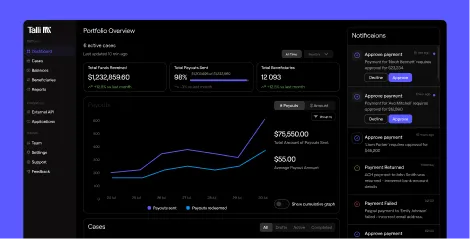
Talli also supports dedicated account workflows for controlled legal distributions, matter-level fund tracking, separation of distribution funds from operating capital, and reports that support fiduciary, legal, and tax review. Live dashboards show payment status, completion rates, returned payments, rejected payments, and stakeholder-ready reporting for administrators and legal teams.
With banking services provided by Patriot Bank, N.A., Member FDIC, Talli helps teams distribute funds through regulated payout rails.
Talli Conclusion
Tender offer payment distribution works best when compliance controls are built into the workflow before expiration. Administrators need accurate holder data, final acceptance records, tax documentation, payment preferences, fund segregation, and real-time reconciliation in one system. Talli helps shareholder services teams replace spreadsheet-heavy operations with controlled digital disbursement workflows.
For teams managing private company liquidity programs, issuer repurchases, or complex shareholder distributions, Talli provides the infrastructure to launch, fund, track, and reconcile payments without losing control over compliance.
Frequently Asked Questions
What does “prompt payment” mean under SEC tender offer rules?
Rule 14e-1(c) requires the bidder to pay for accepted securities or return tendered securities promptly after the offer expires or is terminated. The rule does not set a universal 3-business-day deadline.
Is every tender offer required to stay open for 20 business days?
No. The baseline rule is 20 business days, but the SEC’s 2026 exemptive order allows certain qualifying equity tender offers to use a 10-business-day minimum if all conditions are met.
Why do proration calculations delay tender offer payments?
Proration applies when more shares are tendered than the buyer agreed to purchase. Administrators must verify valid tenders, withdrawals, guaranteed delivery submissions, eligibility rules, and final accepted amounts before payments can be calculated.
Are QSFs commonly used for tender offer payments?
Not for ordinary share purchase payments. QSFs apply to qualifying claims and require court or governmental approval. Tender offer proceeds are more commonly managed through segregated escrow or FBO account structures.
How can administrators reduce tender offer payment delays?
Administrators can reduce delays by validating seller records before expiration, collecting tax forms early, automating proration calculations, offering digital payment methods, segregating funds, and using real-time reconciliation dashboards to resolve exceptions quickly.