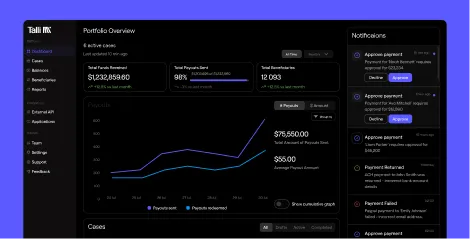
Exception rates determine whether a settlement distribution succeeds or creates months of administrative burden. When disbursing funds to thousands or millions of claimants, even small increases in failed payments can create substantial operational overhead, delayed distributions, and unclaimed funds requiring further action. Understanding realistic exception-rate scenarios across different volume tiers helps claims administrators, settlement administrators, and fiduciaries set expectations, allocate resources, and identify opportunities for improvement through a digital disbursement platform.
Key Takeaways
- Digital disbursement platforms can achieve 95-98% claimant redemption rates compared with approximately 70-80% for traditional paper check distributions, although results vary by settlement.
- Exception counts increase with claimant volume, but exception rates depend on payment methods, claimant data quality, verification requirements, and distribution workflows rather than volume alone.
- Talli's AB Data case study reports a 30% increase in claimant redemption rates and a 60% reduction in unresolved exceptions within 12 months.
- Paper checks create additional risks involving undeliverable mail, stale-dated payments, and uncashed funds.
- Multi-channel payment options can improve redemption and reduce avoidable exceptions, although actual results vary by claimant population and validation controls.
- Estimated paper check costs range from $7-$20 per payment, compared with $0.25-$5 for digital payment processing. These are illustrative cost ranges, not universal vendor prices.
- Automated fraud screening helps administrators identify suspicious claims before distribution, protecting settlement funds and reducing unnecessary manual investigation.
Understanding Mass Payout Challenges and Exception Rates in Legal Settlements
An exception occurs whenever a payment cannot proceed as intended or requires additional intervention. Examples include returned ACH transactions, undeliverable checks, invalid banking information, identity verification failures, compliance flags, and fraud holds.
However, administrators should distinguish payment processing exceptions from unredeemed payments. An uncashed check may remain outstanding without having been formally returned or rejected.
The stakes are substantial. Class action and government enforcement settlements included approximately $42 billion in reported major settlements in 2024, with the cumulative value reaching approximately $159 billion across 2022-2024, according to the Duane Morris Class Action Review.
High exception rates can leave significant settlement funds unresolved, creating additional reporting obligations, administrative costs, and potential fiduciary concerns.
The True Cost of Unresolved Exceptions
Traditional paper check distributions may experience unredeemed payment rates of approximately 20-30%, although not every uncashed check requires immediate intervention.
The financial impact extends beyond payment processing fees:
- Direct reissuance costs: Each stale-dated or returned check can incur estimated reprocessing costs of $7-$20, including printing, postage, reconciliation, and administrative time.
- Tracking overhead: Locating claimants with undeliverable payments may involve substantial outreach costs, potentially reaching $150 per case in labor-intensive situations.
- Escheatment risk: Unclaimed funds may be subject to escheatment, redistribution, cy-pres provisions, or other court-approved disposition procedures.
- Fiduciary exposure: Administrators must maintain accurate accounting and documentation to demonstrate appropriate handling of unresolved settlement funds.
Defining Acceptable Exception Rate Benchmarks
Exception-rate benchmarks vary significantly by payment method, claimant population, and distribution requirements. General payment failure statistics do not provide a reliable industry-wide benchmark for legal settlements.
Administrators should evaluate several metrics separately:
- Processing exception rate: Percentage of attempted payments requiring intervention.
- Redemption rate: Percentage of eligible payments successfully claimed or redeemed.
- Unresolved exception rate: Percentage of payment exceptions remaining open after a defined period.
- Reissuance rate: Percentage of payments requiring another issuance attempt.
Digital platforms can achieve redemption rates of 95-98% compared with approximately 70-80% for traditional paper methods. These are performance estimates, not guarantees of equivalent processing exception rates.
Benchmarking Exception Rates: What to Expect for 10K, 100K, and 1M Claimants
As claimant volumes increase, data quality problems, fraud attempts, and manual resolution challenges make exception management more complex.
For planning purposes, administrators can model a paper check exception scenario of 20-45% and a digital payment exception scenario of 2-5%.
These ranges are illustrative assumptions rather than verified industry averages. Actual performance must be measured against each settlement's payment methods, claimant characteristics, and operational controls.
10K Claimants: The Manageable Threshold
At 10,000 claimants, an illustrative paper check exception rate of 20-30% would translate to 2,000-3,000 payments requiring attention.
This workload may remain manageable for claims administrators with dedicated staff, although individual resolution times can vary.
Assuming an illustrative 2-5% digital exception rate, approximately 200-500 payments would require attention.
Potential benefits include:
- Approximately 1,500-2,800 fewer payments requiring exception handling.
- Lower potential reissuance costs, depending on processing fees and labor requirements.
- Reduced administrative workload and faster resolution of recoverable payment failures.
These estimates demonstrate possible workload differences rather than guaranteed savings.
100K Claimants: Where Scale Breaks Traditional Methods
At 100,000 claimants, illustrative paper check exception rates of 23-45% would create approximately 23,000-45,000 payments requiring intervention.
Manual resolution becomes a significant operational workload rather than an occasional task. Using an illustrative 2-5% digital exception rate, administrators could face approximately 2,000-5,000 exceptions.
The operational advantages become substantial when administrators can automate payment validation, claimant notifications, and exception routing.
However, higher claimant volumes do not automatically increase the percentage of failed payments. Differences in performance depend primarily on distribution design and claimant data quality.
1M Claimants: Digital-First Viability
Million-claimant settlements expose the limitations of manual exception processing.
Using illustrative assumptions:
- Paper checks: A 30-45% exception rate would produce approximately 300,000-450,000 payment exceptions.
- Digital payments: A 2-5% exception rate would produce approximately 20,000-50,000 exceptions.
These figures are scenario calculations, not published benchmarks for million-claimant settlements.
Digital infrastructure becomes especially valuable for large-scale mass disbursements, including securities class actions, data breach settlements, antitrust distributions, and bankruptcy proceedings involving extensive creditor lists.
Impact of Volume on Exception Management
Across all three volume tiers, illustrative scenarios demonstrate how payment methods can influence the potential number of unresolved transactions.
Even if the exception rate remains constant, increasing distribution volume substantially raises the number of affected claimants.
For example, a 3% exception rate represents 300 affected payments in a 10,000-claimant distribution but 30,000 in a million-claimant distribution.
This makes automated resolution, proactive claimant communication, and real-time reporting increasingly important as distribution volume grows.
Streamlining Class Action Settlement Payouts to Reduce Failures
Class action disbursements face unique constraints that can create additional payment exceptions.
Court-approved distribution plans may establish specific payment procedures, claimant eligibility rules, compliance documentation, and reporting requirements.
Automated Compliance for Seamless Distributions
Exception reduction begins with automating compliance checkpoints that traditionally create manual bottlenecks:
- KYC verification: Checks claimant identity information using appropriate risk-based verification methods.
- OFAC screening: Screens relevant parties against applicable sanctions lists with documented results.
- W-9 collection: Uses digital forms and automated reminders to support tax documentation requirements.
- 1099 generation: Supports preparation and filing of applicable information returns.
Talli's digital W-9 collection workflows have reported completion rates of approximately 90%, compared with 40% without automation in the company's reference materials.
Actual completion rates depend on claimant demographics, documentation requirements, and outreach effectiveness.
Integrated compliance workflows reduce repetitive follow-up while helping administrators maintain accurate records.
Optimizing Claimant Communication and Engagement
Low participation can create challenges for settlement distributions.
An FTC class action study found overall claims rates below 10% in its sample, with outcomes varying by notice method and settlement design.
Importantly, claim submission rates and payment exception rates measure different stages of the settlement lifecycle.
Effective claimant communication strategies can improve participation and payment completion through SMS, email, and mail notifications, simplified mobile-optimized portals, payment status tracking, and proactive outreach to claimants with unresolved payments.
Digital-First Payment Processing for Enhanced Redemption and Lower Exception Rates
Digital payments have become an increasingly important option for legal settlement distributions.
One payment provider's 2024 class action and mass tort distribution data found that 94% of payees selected digital payments when offered a choice, compared with 6% who selected paper checks.
Although this finding reflects a specific provider's activity rather than the entire industry, it demonstrates substantial digital payment adoption among the populations studied.
Comparing Digital vs. Traditional Payment Efficiency
Digital payments avoid several physical failure modes associated with paper checks, including mail delivery problems, outdated mailing addresses, and check-cashing requirements.
They also enable automated payment status tracking and faster identification of certain processing failures.
Automated retry workflows can recover eligible failed payments after temporary problems are resolved or claimant information is corrected.
Recovery rates vary by failure reason, payment rail, and claimant responsiveness.
Paper check failures generally require additional administrative steps, such as confirming contact details, stopping or voiding the original check when appropriate, and issuing a replacement.
The Role of Multi-Channel Distribution in Success
Payment choice helps administrators serve claimants with different financial circumstances.
Through multi-channel payouts, administrators can offer:
- ACH direct deposit: Estimated processing costs of $0.25-$0.50 per transaction, with standard delivery typically taking one to two banking days.
- Prepaid cards: An alternative for claimants without traditional bank accounts, including eligible virtual card options.
- Digital wallets: PayPal and Venmo payments that may provide rapid access for eligible recipients.
- Gift cards: An option for smaller distributions when permitted by the settlement agreement.
- Paper checks: A fallback for claimants who cannot or prefer not to use digital methods.
According to the FDIC's 2023 survey, approximately 5.6 million U.S. households were unbanked, representing 4.2% of households.
Offering alternative payment methods helps administrators accommodate recipients who cannot receive conventional bank transfers.
Leveraging AI for Fraud Detection and Minimizing Suspicious Claims
Fraud represents a significant operational risk in mass payouts.
According to the Association for Financial Professionals, 79% of surveyed organizations experienced attempted or actual payments fraud in 2024.
The survey also found that 63% of organizations experienced attempted or actual check fraud, highlighting the importance of effective payment controls.
The Escalating Threat of Mass Payout Fraud
Class action distributions are vulnerable to duplicate submissions, synthetic identities, coordinated claim attempts, and fraudulent changes to payment instructions.
Fraudulent submissions can increase investigation workloads and delay legitimate distributions.
Without automated detection, administrators may need to manually evaluate large numbers of suspicious records before approving payments.
Effective screening reduces the likelihood that fraudulent claims progress to payment issuance.
How AI Outperforms Manual Fraud Review
Automated fraud detection workflows can help identify suspicious claims before distribution.
Capabilities include:
- Pattern recognition: Identifies unusual submission behavior and repeated claimant attributes.
- Real-time screening: Evaluates potential risk during submission or payment preparation.
- Network analysis: Detects potentially coordinated fraudulent activity.
- Risk-based review: Routes suspicious transactions for additional verification.
Automated systems can process large volumes of information faster than manual screening, but they still require appropriate human oversight, false-positive management, and documented decisions.
AFP reported that only 22% of surveyed organizations recovered at least 75% of their payments fraud losses in 2024, compared with 41% in 2023.
This supports the importance of preventive fraud controls rather than relying exclusively on recovery efforts.
Integrated Compliance and Fund Segregation for Secure Payouts
Compliance failures create operational and legal risks beyond the costs associated with failed payments.
A 2023 LexisNexis Risk Solutions study estimated annual global financial crime compliance costs for financial institutions at approximately $206.1 billion.
For settlement administrators, effective compliance requires appropriate payment controls, fund segregation, accurate tax documentation, and auditable transaction records.
Maintaining QSF Compliance and Fund Segregation
Maintaining QSF compliance requires more than simply opening a dedicated bank account.
Under Treasury Regulation Section 1.468B-1, qualified settlement fund treatment depends on requirements involving governmental approval or establishment, qualifying claims, and appropriate segregation of assets.
Dedicated FBO (For Benefit Of) account structures can support fund separation and transparent accounting when properly established.
Key compliance requirements include:
- Automated sanctions screening with documented results.
- Risk-appropriate claimant identity verification.
- W-9 collection and applicable information reporting.
- Federal backup withholding at 24% when required under IRS rules.
- Clear reconciliation and documentation of settlement funds.
The applicability of specific KYC, withholding, and reporting requirements depends on the transaction, administrator obligations, payment type, and governing legal framework.
Real-Time Tracking and Reporting for Proactive Exception Resolution
Visibility into payment status enables proactive exception management rather than reactive cleanup.
Real-time monitoring helps administrators identify patterns, prioritize unresolved payments, and improve distribution performance.
Immediate Insights for Better Decision-Making
Real-time dashboards can provide actionable information for settlement reporting:
- Completion rates: Percentage of successfully completed payments by method.
- Geographic concentration: Regional patterns associated with delivery problems.
- Failure root causes: Categories of rejected or incomplete payments.
- Fraud flags: Transactions requiring additional review.
- Remaining fund balances: Funds available for continued distribution or final disposition.
This visibility enables administrators to identify systemic problems before they affect additional claimants.
Automating Court-Required Documentation
Settlement distributions often require detailed accounting for courts, trustees, and other authorized stakeholders.
Automated reconciliation can reduce manual preparation time by matching payment instructions, transaction confirmations, and bank records.
Talli's reference materials report reconciliation time reductions of up to 70%, equivalent to reducing a 15-hour monthly process to approximately 4.5 hours in an illustrative workflow.
Actual savings depend on distribution complexity, existing processes, and integration requirements.
Stakeholder portals also provide controlled access to relevant payment records, reducing repetitive document requests and supporting more efficient reporting.
Cost Reduction and Efficiency Gains Through Automated Disbursement
Exception reduction can deliver meaningful cost savings, particularly when a distribution involves tens or hundreds of thousands of payments.
Illustrative paper check lifecycle costs range from $7-$20 per payment, while digital processing costs may range from $0.25-$5 depending on the payment method.
These ranges are not direct comparisons of identical fee components. Digital platform fees, setup charges, customer support, compliance costs, and exception handling must also be considered.
Beyond Processing Fees: The Hidden Costs of Traditional Methods
Paper-based distributions create additional expenses beyond initial issuance.
- Exception handling labor: Manual investigation, claimant communication, and payment corrections can consume substantial staff time.
- Reissuance materials: Replacement checks require additional printing, postage, and reconciliation.
- Unclaimed property compliance: Applicable reporting, due diligence, and disposition requirements can create further costs.
- Opportunity costs: Administrative resources are diverted from higher-value settlement activities.
Administrators should calculate total distribution costs rather than comparing processing fees alone.
Achieving Rapid ROI With Digital Payout Solutions
The AB Data case study provides an example of measurable operational improvement through digital disbursement adoption.
Reported results include:
- A 30% increase in claimant redemption rates.
- A 60% reduction in unresolved exceptions and manual reissuance overhead within 12 months.
- Improved audit visibility through payment tracking and reconciliation.
- Faster delivery of settlement funds to claimants.
Talli's reference materials indicate that vendor-assisted implementation can take approximately two to six weeks, with illustrative return-on-investment periods of four to seven months.
These timelines depend on integrations, settlement requirements, deployment scope, and operating costs.
One payment provider also reported growth from 17 class action and mass tort distributions using its digital services in 2020 to 558 in 2024, illustrating increased adoption within its customer base.
Why Talli Makes Exception Management Practical
Talli's digital disbursement platform helps settlement administrators manage payment exceptions across small and large claimant populations.
Purpose-built workflows combine payment choice, compliance automation, real-time visibility, and reconciliation to reduce manual intervention while maintaining control over settlement funds.
Key Capabilities
- Exception prevention: Multi-channel payment options, automated compliance checks, fraud detection, and payment status tracking.
- Compliance automation: Fund segregation support, OFAC screening, KYC verification, and tax documentation workflows.
- Real-time visibility: Dashboards provide insight into payment status, exception categories, and resolution progress.
- Automated reconciliation: Transaction records and settlement accounting help reduce manual closing workloads.
- Stakeholder access: Controlled reporting tools help authorized parties review disbursement records without repeated manual requests.
Proven Results
Talli's customer case studies report:
- A 30% increase in claimant redemption rates.
- A 60% reduction in unresolved exceptions within 12 months.
- Improved audit visibility across settlement distribution cycles.
These outcomes illustrate the operational value of combining digital payments with compliance and exception management workflows.
For distributions ranging from 10,000 to 1 million claimants, the central challenge is not simply processing more transactions. It is maintaining payment accuracy, claimant accessibility, and financial oversight as transaction volumes increase.
By combining data validation, automated compliance, payment flexibility, and real-time reporting, Talli helps administrators address exceptions before they become costly unresolved payments.
The result is a more controlled distribution process that supports higher claimant redemption, reduces unnecessary administrative work, and provides clearer documentation for fiduciaries and courts.
Frequently Asked Questions
What Causes the Highest Exception Rates in Mass Payouts?
Common causes include outdated mailing addresses, invalid banking details, incomplete claimant verification, compliance holds, and suspicious payment activity. Paper checks face additional risks from undeliverable mail and stale-dated payments. Digital payments can fail because of closed accounts, incorrect information, or recipient eligibility restrictions. The leading causes depend on the claimant population and payment method.
How Do Exception Rates Differ Between Class Action, Mass Tort, and Bankruptcy Distributions?
Exception rates vary with claimant data quality, distribution complexity, and payment requirements. Mass tort settlements may involve older claimant records and additional documentation. Bankruptcy distributions can require complex creditor verification and payment prioritization. Class action distributions vary widely depending on settlement age, claimant engagement, and distribution design. No universal exception-rate difference applies to all three categories.
What Exception Rate Should Trigger a Process Review?
Administrators can use a 5% processing exception rate as an internal planning target, but it is not a universal industry standard. A rate above 10% may warrant further investigation, particularly if exceptions remain unresolved. Reviews should consider payment method, failure severity, claimant demographics, and historical performance rather than relying solely on a percentage threshold.
How Long Should Administrators Wait Before Declaring a Payment Exceptional?
Many ACH administrative returns are reported within two banking days, although return windows vary by reason. Paper check timelines depend on settlement procedures, check validity, and applicable rules. Digital wallet payments can provide rapid status confirmation, but final acceptance depends on the provider. Administrators should establish documented monitoring and escalation schedules for each payment method.
What Compliance Documentation Should Administrators Maintain for Exceptions?
Administrators should maintain original payment instructions, transaction records, failure reasons, claimant communications, verification outcomes, reissuance details, and final payment dispositions. Documentation should also establish appropriate fund segregation and reconciliation. Recordkeeping requirements depend on the settlement order, applicable regulations, contractual obligations, and relevant retention rules. Centralized digital audit trails help support court reporting and fiduciary oversight.