.svg)


.svg)
Injured workers waiting 60-90 days for mileage reimbursements face compounding financial hardship while already dealing with lost wages and mounting medical bills. Third-party administrators (TPAs) processing these claims through paper-based systems struggle with denial rates reaching 15% and administrative backlogs that strain both operational budgets and claimant relationships. Modern digital payment platforms can compress these reimbursement cycles from weeks to days, transforming a compliance-heavy administrative burden into a streamlined operation that improves outcomes for everyone involved.
Key Takeaways
- Workers' compensation mileage rates vary by state. California increased its rate from $0.70 per mile in 2025 to $0.725 on January 1, 2026, then to $0.76 effective July 1, 2026.
- AI-powered claims tools can automate routine adjudication, document review, and exception routing, although adoption and performance vary by carrier, claim type, and system.
- Electronic reimbursement submission can reduce manual handling, improve documentation accuracy, and give TPAs better visibility into the status of injured-worker reimbursement requests.
- Payment and response deadlines for mileage reimbursement vary by jurisdiction and claim circumstances, so TPAs must apply the requirements of the governing workers' compensation system.
- Digital payment adoption can increase when recipients receive clear payment choices, simple enrollment, and effective onboarding support.
- The healthcare industry could save $20 billion annually by fully transitioning to electronic administrative transactions.
Understanding Workers' Compensation Mileage Reimbursements
Workers' compensation mileage reimbursement covers the travel costs injured workers incur when attending medical appointments, physical therapy sessions, pharmacy visits, and other treatment-related travel. These reimbursements represent a critical but often overlooked component of workers' compensation benefits.
Eligible expenses typically include:
- Mileage to medical appointments at state-mandated rates
- Parking fees at treatment facilities
- Tolls incurred during medical travel
- Public transportation costs when driving isn't feasible
- Lodging expenses for treatment requiring overnight stays far from home
Mileage rates are state-specific and change annually, typically following IRS standard business mileage rates. For 2025-2026, California increased its rate from $0.70 per mile in 2025 to $0.725 on January 1, 2026, then to $0.76 effective July 1, 2026. Virginia follows a similar schedule, with rates increasing to $0.76 by mid-2026.
Eligibility and filing rules vary by jurisdiction. Some states impose distance thresholds for certain types of travel, while others reimburse reasonable or necessary medical travel without a general mileage minimum. Deadlines for submitting mileage and travel reimbursement requests vary by jurisdiction, so TPAs must apply the rules governing each claim.
The Challenge of Processing Workers' Comp Reimbursements
Manual, paper-based reimbursement systems create significant bottlenecks that harm both TPAs and injured workers. The most common billing problems in workers' compensation stem from these outdated processes.
Processing Delays and Error Rates
Healthcare providers submitting claims on paper experience significantly longer delays, with claims frequently taking 90+ days for payment versus 33 days for electronically submitted claims. Manual payment posting creates compounding backlogs and posting errors that frustrate all parties.
Key pain points include:
- Data entry errors from manual transcription of mileage logs
- Missing documentation requiring back-and-forth communication
- Lost paperwork necessitating claim resubmission
- Inconsistent rate application across jurisdictions
- Delayed approvals from bottlenecked review queues
Financial Impact on Claimants
When benefits intended to replace wages face delays, it weakens the financial security these programs are designed to provide. Injured workers already dealing with reduced income and medical expenses cannot afford to wait months for legitimate reimbursements.
This creates a cascading effect: 83% of consumers consider switching insurance carriers after a poor claims experience. For TPAs and carriers, slow reimbursement processing damages reputation and client retention.
Third-Party Administrators' Role in Workers' Comp Claims
Third-party administrators serve as the operational backbone for workers' compensation claims management. These specialized firms handle administrative services that would otherwise burden employers and insurance carriers with complex compliance requirements.
Core TPA Responsibilities
TPAs manage the complete claims lifecycle:
- Claims intake and verification of injury reports
- Medical bill review and fee schedule compliance
- Provider network management and utilization review
- Mileage and expense reimbursement processing
- Regulatory compliance across multiple jurisdictions
- Reporting and analytics for employers and carriers
Demand for specialized TPA services continues to be shaped by regulatory complexity, self-insurance, and the need for more efficient claims administration.
Jurisdictional Complexity
Workers' compensation operates under 50 separate state systems with independent fee schedules, form requirements, timely filing deadlines, and utilization review statutes. California's Official Medical Fee Schedule bears no resemblance to New York's Workers' Compensation Fee Schedule.
Specialized TPAs organize teams by jurisdiction, with staff certified in state-specific rules and assigned to specific states rather than cross-covering. Generalist approaches applying commercial healthcare workflows to workers' compensation consistently fail.
Digital Solutions for Faster Mileage Reimbursement Forms
Modern technology transforms mileage reimbursement from a paper-heavy administrative burden into a streamlined digital process. Electronic submission and automated processing dramatically improve speed and accuracy.
Electronic Form Processing
Digital platforms enable claimants to submit mileage logs through online portals or mobile applications. These systems automatically calculate reimbursement amounts based on current state-mandated rates, eliminating manual lookup errors.
Digital reimbursement workflows can improve processing by:
- Automatically calculating mileage using current state rates
- Validating required information before submission
- Recording submission dates and payment status
- Routing incomplete or unusual requests for review
Automation Benefits
AI-powered claims tools can automate routine adjudication, document review, and exception routing, although adoption and performance vary by carrier, claim type, and system. Automated payment posting handles ERA and EOB files digitally, with teams only intervening for flagged exceptions.
TPA software solutions can achieve high levels of automation for repetitive claims tasks, enabling TPAs to scale volume without proportional increases in headcount. Automating repetitive claims tasks can help TPAs process higher volumes without proportional increases in manual workload.
Expediting Medical Expense Payouts for Injured Workers
Beyond mileage, injured workers incur substantial medical expenses that require timely reimbursement. Prescription costs, therapy expenses, and out-of-pocket medical bills add financial pressure to already-stressed claimants.
Speed-to-Payment Impact
Fast, reliable access to funds is no longer a differentiator but a baseline expectation and a reflection of trust, responsiveness, and credibility. Workers accustomed to instant digital payments through Venmo, Zelle, and other platforms expect similar speed from insurance claims.
Digital disbursement options allow insurers to deliver funds within minutes versus days or weeks for paper checks. Real-time payment solutions enable same-day delivery to claimant bank accounts or digital wallets.
Multi-Channel Payment Options
Modern payment platforms offer injured workers flexibility in how they receive funds:
- ACH direct deposit for banked claimants
- Prepaid debit cards for unbanked recipients
- Digital wallets like PayPal and Venmo
- Push-to-card payments for instant delivery
- Paper checks as a fallback option
This multi-channel approach ensures every claimant can receive their reimbursement through their preferred method, improving satisfaction and redemption rates.
Compliance and Security in Digital Reimbursement Systems
Moving to digital reimbursement systems requires robust compliance frameworks and security measures. TPAs handling sensitive personal and financial information must meet strict regulatory requirements.
Regulatory Requirements
Workers' compensation reimbursement systems must comply with:
- State-specific fee schedules with annual or mid-year updates
- HIPAA requirements for electronic health information
- State workers' compensation board regulations for claim documentation
- Tax reporting obligations for certain payment thresholds
- Anti-fraud statutes requiring verification controls
Maintaining comprehensive audit trails proves essential for regulatory reviews and dispute resolution. Digital systems automatically document every transaction, approval, and modification with timestamps.
Fraud Prevention
AI and rules-based fraud tools can flag duplicate submissions, unusual mileage patterns, and identity inconsistencies for review before payment. Machine learning systems help identify suspicious patterns across workers' compensation claims.
Effective fraud prevention combines:
- Identity verification against authoritative databases
- Pattern recognition across historical claims
- Device fingerprinting for digital submissions
- Behavioral analytics detecting anomalies
- Cross-reference checking against known fraud indicators
Benefits for Injured Workers and TPAs: A Win-Win Solution
Digital reimbursement transformation delivers measurable benefits for all stakeholders. The investment in modern payment infrastructure pays dividends through improved efficiency, reduced costs, and enhanced satisfaction.
Claimant Benefits
Injured workers experience:
- Faster fund access reducing financial stress during recovery
- Payment method choice matching personal preferences
- Transparent tracking of reimbursement status
- Reduced paperwork through digital submission
- Higher accuracy eliminating underpayment issues
TPA Operational Gains
Automation can reduce manual work and improve scalability, although cost savings and error reductions vary by workflow, vendor, and implementation. Staff previously consumed by data entry and manual reconciliation can focus on exception handling and claimant support.
The industry-wide opportunity is substantial. Full transition to electronic administrative transactions could generate $20 billion in annual savings across the healthcare sector.
Modernizing Workers' Comp Reimbursements with Talli
While numerous payment platforms exist, Talli delivers purpose-built solutions specifically designed for high-volume legal and claims disbursements, including workers' compensation reimbursements.
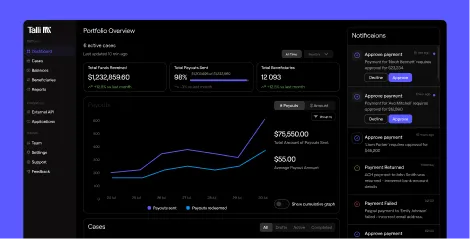
Talli provides multiple payment methods, real-time tracking, compliance automation, and high-volume disbursement infrastructure that can help TPAs modernize payment operations. Payment timing depends on authorization, funding, validation, and the selected payment rail. For TPAs managing thousands of injured worker reimbursements monthly, this acceleration directly improves claimant satisfaction and operational efficiency.
Key capabilities for workers' comp reimbursement include:
- Six payment method options: ACH direct deposit, prepaid Mastercard, digital wallets (PayPal, Venmo), gift cards, wire transfers, and paper checks as fallback
- Real-time tracking dashboards: Live visibility into payment status, completion rates, and failure root cause analysis
- Automated compliance: Integrated KYC verification, OFAC screening, and audit-ready documentation
- Fraud controls: Automated screening, identity verification, device and behavioral signals, and exception review help flag suspicious activity before payment
- Scalability: Handles distributions from 1,000 to 100,000+ recipients without performance degradation
Banking services provided by Patriot Bank, N.A., Member FDIC, ensure institutional-grade security with SOC 2 Type II and PCI DSS Level 1 compliance. The Trust Center provides detailed documentation of security certifications and compliance standards.
For TPAs seeking to modernize reimbursement operations, Talli eliminates the paper check bottleneck while maintaining complete regulatory compliance across all disbursements.
Frequently Asked Questions
What expenses qualify for workers' compensation mileage reimbursement?
Workers' compensation mileage reimbursement covers travel to medical appointments, physical therapy sessions, pharmacy visits, and any other treatment-related travel. Additional eligible expenses include parking fees at medical facilities, tolls incurred during travel, public transportation costs, and lodging for treatment requiring overnight stays far from home. Eligibility and filing rules vary by jurisdiction. Some states impose distance thresholds for certain types of travel, while others reimburse reasonable or necessary medical travel without a general mileage minimum.
How does a Third-Party Administrator (TPA) streamline workers' comp claims?
TPAs serve as specialized administrative partners handling the complete claims lifecycle, from intake and verification through medical bill review, provider network management, and reimbursement processing. They maintain expertise across 50 separate state systems with different fee schedules, filing deadlines, and compliance requirements. By centralizing this complexity, TPAs enable employers and carriers to achieve consistent compliance while reducing administrative burden. Modern TPAs implementing automation can process claims more efficiently than manual systems.
What are the benefits of using digital payment methods for injured worker reimbursements?
Digital payments reduce reimbursement delivery from weeks to same-day or next-day processing while offering injured workers flexibility in how they receive funds. Benefits include transparent tracking of payment status, reduced paperwork through digital submission, higher accuracy eliminating underpayment issues, and payment method choice including ACH, prepaid cards, and digital wallets. For TPAs, digital payments can improve processing efficiency while reducing denial rates.
How can digital solutions help reduce fraud in workers' comp mileage claims?
AI and rules-based fraud tools can flag duplicate submissions, unusual mileage patterns, and identity inconsistencies for review before payment. These systems help identify suspicious patterns across workers' compensation claims more quickly than manual review. Digital platforms automatically document every transaction with timestamps, creating comprehensive audit trails for regulatory reviews. Combined with identity verification against authoritative databases and device fingerprinting for digital submissions, these controls significantly reduce fraudulent reimbursement claims while expediting legitimate payments.
How long do insurance carriers have to process mileage reimbursement requests?
Payment and response deadlines for mileage reimbursement vary by jurisdiction and claim circumstances, so TPAs must apply the requirements of the governing workers' compensation system. California and other states impose interest penalties for late payments. Many paper-based systems take 90+ days to process claims, creating compliance risk and claimant frustration. Electronic submission can reduce processing time significantly, helping carriers meet mandated timelines while improving the injured worker experience.