.svg)


.svg)
Reconciling dividend disbursement accounts at scale has become more complex as organizations manage ACH, prepaid cards, digital wallets, wire transfers, and paper checks at the same time. The global reconciliation software market was valued at $2.30 billion in 2025 and is projected to grow at a CAGR of 15.00% between 2026 and 2034, driven by demand for tools that reduce manual matching, exception review, and close-cycle delays. Modern shareholder services platforms combine automated matching, payment tracking, compliance controls, and multi-method disbursement infrastructure to handle scenarios where one bank deposit may represent thousands of individual shareholder payments. Without proper reconciliation infrastructure, organizations face returned payments, stale checks, unresolved exceptions, tax documentation issues, and eventual escheatment exposure when dividend funds remain unclaimed.
Key Takeaways
- Automated reconciliation helps match payment files, bank activity, and accounting records faster than spreadsheet-based processes.
- Paper check processing can cost an estimated $7-$20 per check when printing, postage, reconciliation, and reissuance are included, compared with $0.25-$5 for many digital payment methods.
- Automation can reduce reconciliation labor by 50-70% when data feeds, matching rules, and exception workflows are configured correctly.
- AI-assisted matching improves over time as systems learn from resolved exceptions and recurring payment patterns.
- Dividend reconciliation must support tax reporting, OFAC compliance, unclaimed property tracking, fund segregation, and audit-ready documentation.
Understanding the Challenges of Large-Scale Dividend Disbursement Accounts
Growth creates exponential reconciliation complexity rather than linear scaling. What starts as a manageable quarterly distribution becomes an operational burden when shareholder counts multiply across payment methods, account structures, and jurisdictions. The core challenge is matching bank, processor, and payment-file activity against expected payments and accounting records while maintaining documentation auditors can trust.
Dividend reconciliation affects shareholder experience, tax reporting, escheatment exposure, transfer-agent oversight, and fiduciary controls. A single unresolved exception can represent a failed ACH, returned check, duplicate payment risk, stale-dated instrument, or payment that needs reissue.
The Pitfalls of Traditional Paper-Based Systems
Paper check distribution remains one of the most expensive and difficult payment methods to reconcile. Processing costs can range from an estimated $7-$20 per check when printing, postage, reconciliation, stale-date monitoring, and reissuance expenses are included.
Paper checks create several recurring problems:
- Uncashed check tracking requires aging reports and manual follow-up.
- Address changes between declaration and payment dates can trigger returns.
- Escheatment timelines vary by state, most commonly 3-5 years for dividends.
- Reissuance cycles multiply administrative burden for failed or stale payments.
- Audit documentation requires linking payment files, bank records, and shareholder data.
Traditional reconciliation processes also suffer from data format inconsistencies. Bank statements, processor files, transfer-agent records, and accounting exports rarely align perfectly. As distributions grow, spreadsheet formulas break, version control becomes unclear, and exception status becomes harder to defend during audits.
Regulatory Compliance and Financial Risk
Dividend disbursements operate under financial, tax, sanctions, and unclaimed property requirements that add reconciliation complexity. OFAC compliance requires organizations to avoid prohibited transactions with sanctioned parties, so dividend programs should use risk-based screening against U.S. Treasury sanctions lists with documented review activity. Tax documentation also matters. The IRS backup withholding rate is 24% when required, which makes accurate payee records and taxpayer identification controls essential.
Reconciliation systems should identify payments subject to withholding, separate withholding amounts from net shareholder distributions, and support year-end 1099-DIV reporting. Unclaimed property rules create another layer. According to NAUPA dividend guidance, dormancy periods for dividends vary by jurisdiction, with many states using 3- or 5-year periods. A scalable reconciliation process should identify stale payments early enough for outreach, reissue, and owner-location efforts before escheatment becomes necessary.
Fund segregation also matters. Dedicated disbursement or FBO account structures should maintain clear separation between dividend funds and operating capital. Commingling can create fiduciary, audit, and regulatory exposure, especially for transfer agents, trustees, and administrators handling shareholder funds.
Streamlining Financial Reconciliation with Automated Software
Automated reconciliation platforms transform dividend distribution from a manual tracking burden into a controlled workflow. These systems ingest data from multiple sources, normalize formats, apply matching rules, flag exceptions, and generate audit-ready reports showing which shareholders received payments, which failed, which remain outstanding, and what action is required next.
For organizations handling large dividend files, automation is most valuable when it connects payment status, shareholder records, accounting entries, and bank activity in one workflow. A failed ACH should update the shareholder record. A returned check should appear in the outstanding-payment register. A processor fee should reconcile separately from the shareholder principal amount. A stale payment should trigger the right aging and outreach path.
Core Platform Capabilities
Modern reconciliation software typically includes these functions.
Multi-source data ingestion connects bank feeds, custodian files, payment processor reports, transfer-agent data, and accounting exports automatically. Strong platforms support common statement and payment formats, including CSV variations, ACH files, and processor settlement reports.
Intelligent matching uses rules and AI-assisted logic to handle complex scenarios. Many-to-many reconciliation becomes essential when payment processors bundle activity in net settlements, such as one bank deposit representing thousands of dividend payments minus processing fees.
Exception workflows route unmatched items to the right team members with prioritization based on dollar amount, age, payment method, or compliance risk. Automated escalation ensures high-value or aging discrepancies receive attention before close deadlines or stale-date thresholds.
Real-time dashboards track completion rates by payment method, identify bottlenecks, and enable drill-down into specific discrepancies. Finance teams gain visibility into reconciliation status without waiting for manually compiled batch reports. A strong infrastructure also supports real-time tracking, not just month-end review.
Audit trail management links every adjustment, approval, reissue, void, and payment confirmation to supporting records. Dividend reconciliation is not complete when the cash balance ties. It is complete when the organization can prove where every payment went and why each exception was resolved.
AI-Powered Matching Improvements
AI-assisted reconciliation can improve matching accuracy by learning from resolved exceptions. Initial implementations often depend on deterministic rules, such as exact match by payment ID, dollar amount, batch number, and settlement date. As the system accumulates resolved examples, it can identify recurring patterns across payment methods, shareholder naming variations, processor fee structures, and timing differences.
The AI advantage extends beyond simple matching. Pattern recognition can identify anomalies that suggest duplicate payments, incorrect batch files, fraud risk, or data quality issues before they become larger reconciliation breaks. AI still depends on data quality, so organizations should treat it as an accelerator, not a substitute for well-defined controls.
Building Your Reconciliation Infrastructure
Effective dividend reconciliation requires the right technology, processes, and ownership model. Implementation varies by payment volume, data sources, legacy systems, and compliance requirements. Pilot programs can launch faster when they focus on one payment method before expanding.
Your reconciliation infrastructure should integrate several components:
- Bank connectivity for automated statement retrieval
- Payment processor interfaces for webhooks and batch files
- Accounting integration for ERP or general ledger sync
- Shareholder record integration for owner data and tax profiles
- Document management for linking source files to transactions
- Reporting engines for issuer, administrator, auditor, and stakeholder reports
Automated reconciliation works best when the underlying records are clean. Before implementation, organizations should invest in TIN validation, address standardization, duplicate detection, account verification, and payment preference validation. Data quality work should happen before launch, not after a failed distribution. Strong shareholder records support reminders, identity checks, payment selection, and tax workflows.
Multi-Method Payment Integration
Dividend distributions increasingly span multiple payment methods, each requiring distinct reconciliation logic. Payment method diversity improves redemption rates and shareholder access, but it also multiplies reconciliation complexity.
ACH Direct Deposit offers low transaction costs, often around $0.25-$0.50 per payment in many digital disbursement programs, with settlement often occurring in 1-2 business days. Reconciliation requires matching against ACH file records, return codes, effective dates, and settlement timing.
Prepaid Cards can serve shareholders who do not want to provide bank details or do not have traditional bank accounts. Virtual cards can be delivered digitally, while physical cards require mailing and fulfillment tracking. Card reconciliation must track issuance, delivery, activation, load amounts, and unused balances separately.
Digital Wallets such as PayPal and Venmo provide fast access for users already active on those platforms. These methods require integration with provider APIs and reconciliation of fees, delivery status, claim status, and failed account lookups.
Wire Transfers enable same-day delivery for high-value or international payments but carry higher transaction costs, often $10-$30 per transfer. Wire reconciliation may require SWIFT message parsing, correspondent bank fee review, and manual exception handling for international formatting issues.
Paper Checks remain necessary as a fallback despite higher costs. Reconciliation must track printing, mailing, cashing, voids, stale-dating, reissuance, returned mail, and aging toward escheatment deadlines.
A useful dividend infrastructure supports multi-channel payouts while maintaining one consolidated reconciliation view across all payment types.
Many-to-Many Matching Logic
The most challenging reconciliation scenario involves net settlements where payment processors bundle thousands of individual payments into single bank deposits or withdrawals. A $487,239.12 deposit might represent 5,000 dividend payments minus $760.88 in processing fees.
Effective platforms handle this through gross-up logic, subsidiary ledgers, batch correlation, timing tolerance, and return-code mapping. Vendors should demonstrate their system using actual historical files during evaluation. Clean demo data is not enough. The platform should reconcile real processor files, bank statements, voided checks, reissues, ACH returns, and multi-batch settlement activity.
Compliance Automation and Audit Trail Management
Regulatory compliance cannot be separated from reconciliation. Built-in verification, documentation, and reporting reduce compliance burden while improving accuracy.
Modern platforms embed compliance directly into reconciliation workflows:
- KYC verification cross-references provided information against identity databases where appropriate.
- OFAC screening supports risk-based sanctions compliance with documented review activity.
- W-9 collection through digital forms and smart reminders improves tax documentation workflows.
- 1099-DIV generation with IRS e-filing support reduces manual preparation.
- Backup withholding calculation applies the 24% rate when required for missing or invalid taxpayer information.
- Unclaimed property tracking supports outreach, aging reports, stale-payment review, and escheatment preparation.
Dividend reconciliation must produce audit-ready documentation proving every step of the distribution process. Effective audit trails include transaction chronology, user attribution, document linking, exception resolution, fund flow tracking, and reissue history. Immutable audit logs and role-based controls help maintain documentation integrity, especially when auditors, issuers, trustees, or regulators ask why a balance changed. For dividend teams managing thousands of shareholders, audit trail controls are essential.
Implementation Timeline and Best Practices
Successful reconciliation automation requires structured implementation with realistic timelines and clear success metrics. Organizations that rush deployment often face rework when edge cases emerge during live distributions.
Phase 1: Foundation, Weeks 1-4 documents current workflows, identifies all data sources, and maps pain points. Visual process maps showing data flow enable targeted automation.
Phase 2: Pilot Implementation, Months 2-4 connects initial data sources, builds core matching rules, and establishes exception workflows. Start with exact matches before adding tolerances.
Phase 3: Scale and Optimize, Months 5-12 adds remaining payment methods, refines matching logic based on observed patterns, and integrates compliance functions fully.
Executive sponsorship drives transformation success. CFO, controller, treasury, or shareholder services ownership can break silos and mandate change when departments resist. Start with one high-impact data source rather than automating everything simultaneously. Run parallel processes for at least one full financial period before cutover, including ACH returns, check voids, fee netting, reissues, stale items, and manual adjustments.
Define success metrics early. Useful measures include auto-match rate, number of open exceptions, average exception age, payment failure rate, reissue volume, close-cycle reduction, unclaimed-payment reduction, and audit preparation time.
Why Talli Simplifies Dividend Disbursement Reconciliation
While numerous reconciliation platforms exist, Talli delivers purpose-built payment and reconciliation infrastructure for legal settlement, bankruptcy, shareholder services, and high-volume distribution environments requiring strict compliance oversight.
Talli extends beyond basic payment processing with an end-to-end disbursement platform that includes:
- Multi-channel payment distribution: ACH, prepaid Mastercard via Patriot Bank N.A., digital wallets, gift cards, and paper check fallback, all tracked through a single dashboard
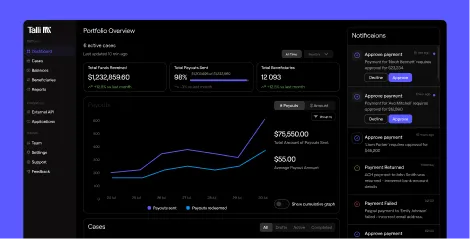
- Real-time tracking dashboard: Live visibility into completion rates, payment method distribution, failure root causes, and remaining fund balances
- Automated three-way matching: Three-way reconciliation connects payment files, bank activity, and accounting records
- Integrated compliance infrastructure: Built-in OFAC screening support, W-9 collection, tax reporting workflows, and audit logging
- Fund segregation architecture: Dedicated account structures help maintain clean separation and audit-ready documentation
- Exception management: Failed, returned, stale, and unresolved payments move into structured workflows instead of spreadsheet queues
Unlike generic payment processors requiring extensive customization, Talli provides purpose-built infrastructure for distributions where auditability, payment choice, tax documentation, and compliance controls matter. Real-world implementations demonstrate measurable results, including a 30% increase in redemption rates, a 60% reduction in unresolved exceptions within 12 months, and 100% fiduciary compliance maintained across distribution cycles.
For organizations managing high-volume dividend distributions requiring strict fund tracking and compliance controls, Talli helps improve transparency across ACH, prepaid cards, digital wallets, gift cards, and checks. The platform’s intelligent automation handles many-to-many matching scenarios where single bank deposits represent thousands of individual payments, reducing the manual reconciliation burden that typically consumes finance and operations teams. With dedicated shareholder services capabilities, Talli helps administrators deliver funds through preferred payment methods while maintaining complete audit trails for review.
Talli Conclusion
Dividend reconciliation at scale requires more than matching bank debits to payment files. It requires clean shareholder data, account-level fund tracking, payment method visibility, tax documentation, exception workflows, and audit-ready reporting. Manual processes may work for small distributions, but they become fragile when thousands of payments, multiple rails, stale checks, returns, fees, and reissues must be reconciled at the same time.
Talli helps organizations replace fragmented spreadsheets and processor portals with a single platform for launching, tracking, and reconciling high-volume distributions. For shareholder services teams, trustees, and administrators, the result is faster payment delivery, fewer unresolved exceptions, clearer fund visibility, and stronger documentation from distribution launch through final reconciliation.
Frequently Asked Questions
What auto-match rate should I expect from a new reconciliation platform?
Realistic expectations depend on data quality, transaction volume, payment methods, and source-system consistency. Many platforms begin with rules-based matching and improve as exceptions are resolved and recurring patterns are captured.
How long does implementation take for dividend reconciliation automation?
Pilot programs focused on one payment method or account structure can often launch within a few months. Broader implementations may take longer when multiple processors, bank accounts, shareholder systems, and tax workflows must be integrated.
What compliance features should dividend reconciliation platforms include?
Essential capabilities include risk-based OFAC screening support, W-9 collection, 1099-DIV reporting, backup withholding calculation, unclaimed property aging, audit logs, user attribution, document linking, and fund segregation tracking.
How do I handle many-to-many reconciliation when payment processors bundle fees?
Configure gross-up logic where net deposits plus fees equal expected gross payment totals. Create subsidiary ledgers for fee reconciliation separate from principal payments and link individual dividend payments to consolidated settlements.
What cost savings can I expect from automating dividend reconciliation?
Organizations commonly reduce reconciliation labor by automating data intake, matching, exception routing, and reporting. Per-transaction costs also decline when digital methods replace paper checks, which can cost an estimated $7-$20 each after printing, postage, reconciliation, and reissuance.