.svg)


.svg)
Returned mail notices are mailpieces the USPS could not deliver as addressed, which may be forwarded, returned to sender, or treated as waste depending on mail class, endorsement, and handling rules. In settlement administration, their hidden cost sits in the follow-up work: labor, re-mailing expense, stale address research, claimant frustration, audit gaps, and deadline risk that can spill into escheat, court reporting, and payment reissue workflows. They also make it harder to achieve the 30% higher redemption rates that modern claims disbursements can deliver compared with traditional check-heavy methods.
Returned mail notices matter long before a final accounting is due. Once legal notices or payment communications come back undeliverable, the team has to log the return reason and research the address. It also has to decide whether skip tracing or re-mailing is required, update the system of record, and document each step well enough to defend it later. This guide breaks down the hidden costs, the workflow risk, and the operating approaches that help settlement teams reduce undeliverable notices without losing full audit transparency or slowing settlement payout workflows.
Returned mail notices create cost through labor, remailing, missed follow-up windows, and fragmented audit records. One effective way to reduce that drag is to treat returned mail as a workflow problem, not a mailroom problem, and connect notice remediation to claimant outreach, compliance-critical steps, and payout options.
Key Takeaways
- Returned mail notices create hidden costs through labor, re-mail cycles, documentation overhead, compliance risk, and missed search deadlines.
- Spreadsheet-based tracking introduces avoidable errors that OCR-based capture and structured workflows can reduce at settlement scale.
- SEC Rule 17Ad-17 requires recordkeeping transfer agents, brokers, and dealers to exercise reasonable care for lost securityholders, and it creates related notice obligations for unresponsive payees in securities-related workflows.
- Purpose-built digital claims disbursement platforms can connect notice remediation, claimant outreach, payout choice, and full audit transparency in one workflow.
- Modern claims disbursements reduce returned-mail exposure by shifting more notice, payout, and remediation activity into digital channels with full audit transparency.
Why Teams Switch Away From Manual Returned Mail Processing
Teams usually start looking for a better returned-mail process when the same envelope creates work across four teams and several disconnected records. Operations have to log the return, support has to answer claimant questions, and compliance has to document the remediation path. Finance or settlement staff then has to manage the reissue risk if the bad address later affects payment delivery.
The pressure gets worse when the workflow lives in spreadsheets. Manual tracking creates more opportunity for data-entry mistakes, missed follow-up dates, and stale claimant records than structured OCR-based intake. That gap matters because one missed update can become a missed search deadline or another paper cycle that should have been avoided.
In other words, teams do not switch because postage went up. They switch because undeliverable mail starts exposing larger process weaknesses: weak address controls, disconnected remediation steps, and too little visibility into what happened after the notice came back.
What Are Returned Mail Notices?
Returned mail notices are legal, administrative, or payment-related mailpieces that cannot be delivered as addressed and require documented follow-up before a settlement file can move forward.
For settlement teams, that can include class notices, cure letters, tax forms, payment notices, and paper checks tied to a claimant record. The postal failure matters because the program now has a delivery exception that has to be classified, resolved, and often re-mailed. USPS defines UAA mail as mail that cannot be delivered to the specified name and address and must be forwarded, returned to sender, or treated as waste under the applicable rules. Even when the dollar amount is small, the workflow impact is not.
A returned mail notice usually triggers five immediate actions:
- Identify the postal return reason and confirm the record match.
- Validate the address against the claimant or recipient record.
- Decide whether to skip trace, re-mail, suppress, or switch channels.
- Update notice, payout, and compliance records in the system of record.
- Document the full remediation path for audit, counsel, or court review.
The search results for this topic mostly frame returned mail as a direct-mail operations issue. In settlement administration, the scope is broader. A returned notice can affect claimant response rates, payment completion, deadline management, and the strength of the program's audit trail. That is why teams increasingly connect notice remediation to one operating record instead of managing mail status in a separate spreadsheet.
Why These Notices Cost More Than Postage
Returned mail notices cost more than postage because every undeliverable item triggers a chain of rework across operations, compliance, and reporting.
The hidden cost usually lands in six places:
- Intake and logging of the returned envelope.
- Research into the postal reason and address status.
- Record updates across notice, claimant, and payout systems.
- Re-mailing or alternate delivery coordination.
- Support and claimant outreach when deadlines slip.
- End-of-file documentation for auditors, counsel, or the court.
This cost is easy to underestimate because it rarely sits on one invoice. Each undeliverable item adds labor, reissue, remailing, and documentation overhead, which is exactly why the total burden feels larger than the postage line alone. The cost also compounds when a stale address later produces an uncashed-check workflow or forces teams into manual exception cleanup near final reporting.
For claims teams using legal payments, returned mail also has a claimant-experience cost. The claimant sees delay, confusion, or repeated requests. The administrator sees another exception queue. Counsel sees another item that may have to be explained later. That is why returned mail should be measured as part of the settlement distribution workflow, not just as a postage issue.
Why They Create Deadline Risk
Returned mail notices create deadline risk because the undeliverable event starts a clock, and manual teams often fail to track that clock consistently.
In shareholder and securities-related workflows, the rule can be explicit. Rule 17Ad-17 requires recordkeeping transfer agents, brokers, and dealers to use reasonable care to locate lost securityholders. It also creates related notice obligations for unresponsive payees in covered securities workflows. That means undeliverable mail can become a formal search and documentation issue rather than a simple resend decision.
Even outside shareholder programs, the same operational pattern shows up in class actions and other notice-heavy matters. A returned notice can delay cure periods, suppress claimant response, and create uncertainty about whether the team has made a defensible delivery effort. That is why settlement administrators increasingly pair returned-mail remediation with full audit transparency rather than treating it as a back-office mail task.
Once the record drifts into dormancy and escheatment risk, the downstream exposure can persist for years. State programs collectively returned more than $5.4 billion in unclaimed property to rightful owners in fiscal year 2023, according to NAUPA data. That number shows the scale of dormant-property remediation, but it also reinforces the operational point: unresolved records rarely improve on their own.
Why Legal Notices Get Returned
Legal notices get returned because the address data is stale, incomplete, mismatched to the recipient, or unsupported by any pre-mail verification step.
The most common causes are practical:
- The recipient moved and no forwarding data exists.
- The source file contains an old or incomplete mailing address.
- The claimant record has duplicate or conflicting contact data.
- The notice was addressed to the wrong person or entity variation.
- The mailpiece reached a vacant address or closed business.
- The recipient ignored a notice that looked unfamiliar or low priority.
Returned mail should also be treated as upstream data intelligence. If one notice batch generates a meaningful exception rate, the root problem usually begins before the first envelope is printed. That is why pre-mail controls matter just as much as post-return handling.
A team with connected notice, outreach, and payout workflows can act on those patterns faster because mailing, outreach, and payment status are easier to compare in one place. In class action settlements, that visibility matters because returned mail may affect claimant response, payment selection, tax documentation, and final reconciliation at the same time.
Manual Returned Mail Processing Breaks at Scale
Manual returned mail processing breaks at scale because the work expands linearly while the risk expands faster.
The core problem is data entry. At low volumes, spreadsheets may feel manageable. At settlement scale, records can be logged under the wrong claimant, follow-up dates can be missed, and re-mail decisions can be based on stale data. Every small mistake creates another exception queue later.
Manual processes also fracture the audit trail. Teams end up storing return reasons in one spreadsheet, skip-trace notes in email, address updates in another system, and payment status somewhere else entirely. That makes settlement reconciliation harder, not because the logic is complex, but because the evidence is scattered.
When administrators have to explain how many notices were returned, what happened next, and which records were remediated, fragmented tracking is usually the real bottleneck. The issue is not only whether the notice was re-sent. The issue is whether the team can prove the full path from failed delivery to corrected record to final payment status.
How To Reduce Returned Mail Before Mailing
The most effective way to reduce undeliverable notice volume is to prevent bad addresses and single-channel notice failures before the first send.
The best preventive controls are straightforward:
- Run address hygiene and normalization before notice production.
- Remove duplicate claimant records before mail merges start.
- Match legal names, entities, and suffixes consistently.
- Flag prior undeliverable records before the next mail cycle.
- Use digital reminders alongside physical notice where allowed.
- Offer digital payout options early so the notice is not the only recovery path.
The operational goal is less chasing, more redemptions. That is also where modern claims disbursements start to change the math. If a claimant can move from mailed notice into digital remediation, the team is no longer forced into repeat print-and-mail cycles. Digital-first programs generally improve completion rates because the notice is no longer the only recovery path.
Purpose-built settlement platforms can also launch campaigns in days, not months, and route recipients across ACH, prepaid Mastercard, PayPal, Venmo, gift cards, wire transfers, and paper check fallback. They also keep OFAC screening and tax collection connected to the payout workflow.
Manual vs. Automated Workflows
Manual and automated returned mail workflows differ most in accuracy, visibility, and how quickly an undeliverable item becomes a resolved record.
The table matters because returned mail is rarely a one-step problem. Once an address fails, the team usually needs another notice attempt, another claimant touchpoint, or another payout method. Automated workflows handle that better because they connect intake, remediation, and reporting instead of leaving each phase in a different tool.
Operational Approaches for Mail Exceptions
Different returned-mail workflows solve different parts of the problem. The right fit depends on whether your main constraint is headcount, compliance visibility, or the need to move claimants out of paper-first remediation.
1. Manual Spreadsheet Tracking
Workflow Fit: Internal-only process
Audit Visibility: Fragmented
Pricing: Staff time, print, postage, remailing, and reissue costs
Manual spreadsheet tracking usually starts as the default because it feels inexpensive and familiar. Teams log the returned envelope, update an address tab, assign follow-up by email, and manage the next action outside the system that holds claimant or payment status.
That works only when exception volume stays low. Once notice waves get larger, the same record often gets touched by operations, support, compliance, and payment teams without one shared status model. The result is more reconciliation work, less certainty around search deadlines, and more time spent proving what happened after the item came back.
Key Features
- Shared spreadsheet logging for returned envelopes and reason codes.
- Manual owner assignment and follow-up tracking.
- Separate remailing, skip-trace, and payout notes kept outside the core record.
Best For
Manual spreadsheet tracking is best for very small programs with low claimant counts, simple notice obligations, and little need for repeated remediation. It is usually a temporary process, not a durable operating model for high-volume settlement work.
2. Generic Mailroom Automation
Workflow Fit: Enterprise document operations
Audit Visibility: Better than spreadsheets
Pricing: Usually quote-based software plus implementation and workflow setup
Generic mailroom automation tools improve intake by scanning returned envelopes, capturing postal data, and routing exceptions into a queue. That is a meaningful improvement over re-keying every field by hand, especially when the first bottleneck is mailroom throughput rather than settlement workflow design.
The limitation is context. Mailroom software can help classify the returned item, but it usually does not solve what settlement teams need next. They still need claimant-specific remediation, compliance-critical follow-up, payment-method switching, and court-ready evidence tied to the full notice and payout record.
Key Features
- Scanning and OCR-based capture for returned mail.
- Queue-based routing and task assignment.
- Centralized intake records for undeliverable items.
Best For
Generic mailroom automation is best for organizations whose first problem is mail intake volume and document capture. It is a stronger fit for enterprise operations teams than for administrators who need one workflow across notice, claimant communication, and settlement payout.
3. Talli Digital Disbursement Infrastructure
Workflow Fit: Settlement administration and claims disbursements
Audit Visibility: Full audit transparency
Pricing: Demo-based custom pricing
This is not just a returned-mail intake workflow. It is digital claims disbursement that increases redemption rates with full fiduciary compliance, which matters because undeliverable notices are usually a symptom of a broader settlement workflow problem. If the same system can coordinate claimant outreach, payment choice, compliance steps, and reporting, the team has more options than simply sending another envelope.
Talli supports settlement distributions at scale, including programs with hundreds of thousands of recipients. Instead of forcing every notice failure into another manual paper cycle, teams can move recipients into a claimant portal. They can support multiple payout methods, including ACH, prepaid Mastercard, PayPal, Venmo, gift cards, wire transfers, and paper checks as fallback, while preserving a timestamped record of what happened next.
The compliance layer is also materially different from generic payment tooling. Talli centers on regulated payout rails, automated KYC verification, OFAC screening, W-9 collection, 1099 generation, segregated QSF-compliant accounts, and banking services provided by Patriot Bank, N.A., Member FDIC. For administrators, that means returned-mail remediation can stay connected to the same compliance-critical controls that govern the eventual settlement payout.
Key Features
- Multiple payout methods that let teams route claimants away from paper-only remediation.
- Claimant portal workflows that connect notice failure to the next reachable action.
- Automated KYC, OFAC screening, W-9 collection, and 1099 generation in the same operating flow.
- Real-time dashboards and full audit transparency for notice, remediation, and payout status.
- Segregated QSF-compliant accounts and banking services provided by Patriot Bank, N.A., Member FDIC.
Best For
The platform is the strongest fit for settlement administrators, class action teams, and other notice-heavy programs that need returned-mail remediation tied directly to claimant communications, regulated payout rails, and court-ready reporting. It is especially useful when the team wants to reduce repeat print-and-mail cycles rather than simply process them faster.
How Digital Disbursement Infrastructure Helps
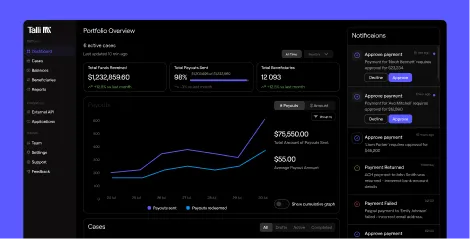
Digital disbursement infrastructure reduces returned-mail exposure by shrinking mail-dependent moments in the settlement lifecycle and giving administrators a cleaner way to remediate failures.
This is where purpose-built settlement infrastructure matters. Talli is positioned as digital disbursement infrastructure for modern claims disbursements, with ACH, prepaid Mastercard, PayPal, Venmo, gift card, wire transfer, and paper check fallback options. It also includes automated KYC, OFAC screening, W-9 collection, 1099 generation, real-time dashboards, segregated QSF-compliant accounts, and banking services provided by Patriot Bank, N.A., Member FDIC.
For these notice failures, the practical value is that teams do not need to keep solving the same problem with another envelope. They can move recipients into a claimant portal, use multi-channel payouts, and monitor status through real-time dashboards. They can also preserve full audit transparency if the court or a client later asks what happened to each attempted delivery.
That also helps reduce the re-mail-to-reissue pipeline that often follows undeliverable notices. When a payment does fail, teams can move directly into a failed payment workflow instead of restarting the paper loop.
Best Practices for Managing Returns
The best returned mail notice programs use one operating workflow from intake through remediation and final reporting. For returned mail notices specifically, the goal is to keep every exception inside one documented status model.
Five practices matter most:
- Create one intake queue for all returned legal notices.
- Standardize return codes and map each to a next action.
- Set owner, due date, and remediation status on every exception.
- Connect notice remediation to payout, tax, and compliance records.
- Review exception trends after each notice wave, not only at file close.
The practical takeaway is simple: every returned item should move through the same status model every time. When teams can see intake date, return reason, owner, next action, and final resolution in one dashboard, they spend less time reconciling side lists. They also spend more time curing exceptions before those issues become payment or reporting problems.
Common Mistakes To Avoid
The biggest mistake is treating returned mail notices as isolated mail events instead of workflow signals that affect the entire settlement record.
Other common mistakes include:
- Counting mail as completed once it is sent.
- Keeping returned-mail notes outside the system of record.
- Re-mailing without fixing the underlying address issue.
- Letting support, notice, and payout teams work from different records.
- Waiting until final accounting to review undeliverable volume.
- Using paper-only remediation when digital follow-up is available.
The pattern behind each mistake is the same. Teams assume the cost sits in the envelope, when the real cost sits in repeated exceptions. That is why returned-mail work often turns into a support burden, a reconciliation burden, and a closeout burden at the same time. When the same system also handles court-facing reporting, it is easier to show not only how many notices failed, but what corrective action followed.
Talli Conclusion: Returned Mail Is a Workflow Problem
There is no single returned-mail workflow that fits every settlement team. The better question is which operating model matches your volume, compliance burden, and remediation needs.
For low-volume matters with limited exception handling, manual spreadsheet tracking can still work because the direct software spend is low and the team may only need a basic logging process. For organizations primarily trying to improve intake and classification, generic mailroom automation can reduce re-keying at the front of the workflow. But for settlement programs where returned mail affects notice completion, claimant outreach, payout choice, and reporting, a settlement-specific workflow is the stronger option.
Talli is built for that third category. It connects digital remediation, regulated payout rails, compliance automation, and full audit transparency in one operating model. That matters because returned mail is rarely just a mailroom problem. It is usually a signal that the team needs better claimant data, better outreach, better payment flexibility, and better evidence of what happened after the first notice failed.
If your main goal is to cut repeat print-and-mail cycles while keeping compliance-critical steps connected to the payout record, Talli is worth evaluating. See how Talli supports higher redemption rates, read the customer case study, or explore settlement administration software built for court-supervised distributions.
Frequently Asked Questions
What does a returned mail notice mean?
A returned mail notice means the postal service could not complete delivery as addressed. For settlement teams, that is not just a failed delivery. It is a workflow exception that can trigger address research, claimant outreach, re-mailing, and audit documentation.
What is return mail processing?
Return mail processing is the workflow for receiving undeliverable mail, identifying the reason it was returned, updating the record, and deciding what action happens next. In settlement administration, that usually means logging the exception, researching the address, and documenting whether the notice was re-mailed or shifted to another delivery path.
What happens to undeliverable mail?
Undeliverable mail may be forwarded, returned to sender, or treated as waste depending on mail class, endorsement, and handling rules. In settlement administration, the practical issue is that every undeliverable item creates a delivery exception the team has to classify, resolve, and document before the file can close defensibly.
What happens to undeliverable mail near a deadline?
Undeliverable mail near a deadline becomes expensive because the team must classify the return, choose the next step, and document it fast. The team has to decode the return reason, decide whether to skip trace or re-mail, update the claimant record, and preserve evidence of each step fast enough to avoid missing cure, notice, or search windows.
Does returning to the sender cost money?
Yes. Return to sender costs money because each undeliverable piece adds labor, record correction work, remailing expense, and documented follow-up beyond postage. Even when the direct postage impact looks small, mail returned to sender creates staff labor, record correction work, remailing expense, and more exception handling later in the file.
What are the common causes of returned mail?
The most common causes are stale addresses, missing apartment or suite information, duplicate claimant records, recipient moves, vacant addresses, and name or entity mismatches. In practice, returned-mail volume is often a signal that data quality problems existed before the notice was ever sent.
How do businesses reduce returned mail?
They reduce it by cleaning address data before mailing, tracking prior delivery failures, standardizing follow-up rules, and using digital channels where possible. In settlement workflows, digital remediation matters because it gives the team another way to reach a claimant without starting another paper-only cycle.
How can returned mail be automated?
Returned mail notices can be automated with scanning, OCR capture, rules-based routing, deadline alerts, and integrated record updates across the settlement workflow. The goal is to convert a returned envelope into a structured workflow event instead of another line item on a spreadsheet.