.svg)


.svg)
Returned mail shareholder services teams process — undeliverable dividend checks, proxy materials, and tax documents — triggers SEC Rule 17Ad-17 lost shareholder mandates and state escheatment timelines. Manual tracking through spreadsheets is the most common cause of compliance failures in shareholder mail management in 2026, with error rates of 1% to 4% and missed search deadlines that lead to unnecessary escheatment. Every year, roughly 4% of all U.S. mail comes back undeliverable. For shareholder services teams handling undelivered shareholder mail, that statistic translates into lost dividend checks, triggered escheatment compliance timelines, and SEC compliance obligations that compound with every returned envelope. The problem is not the returned mail itself. The problem is what happens after it arrives back at your office — and for most teams relying on manual shareholder payment tracking, the answer is a process that cannot keep up.
Key Takeaways
- Returned mail is a key trigger for classifying shareholders as "lost" under SEC Rule 17Ad-17, starting mandatory search obligations and often intersecting with state escheatment timelines.
- Manual tracking through spreadsheets carries a 1–4% data entry error rate, and spreadsheet errors go undetected roughly 50% of the time.
- U.S. states collectively hold $70 billion in unclaimed property, much of it from shareholders whose returned mail was never properly resolved.
- Automating returned mail workflows reduces compliance exposure and helps shareholders retain access to their assets.
- SEC Rule 17Ad-17 creates a two-search compliance timeline. Once shareholder mail is returned undeliverable and the account is classified as lost, transfer agents generally must complete a first database search within 3 to 12 months and a second 6 to 12 months later.
- Returned mail creates both operational cost and regulatory risk. Each undeliverable item adds labor, reissue, remailing, and documentation overhead while increasing the chance of missed search deadlines and incomplete audit trails.
- Preventing returned mail is often cheaper than resolving it. Address hygiene, NCOA processing, and digital payout options reduce undeliverable volume upstream, lowering rework, compliance burden, and unnecessary escheatment exposure.
What Is Returned Mail Shareholder Services Teams Must Track?
Returned mail shareholder services departments handle includes any correspondence — dividend checks, proxy materials, annual reports, tax documents, or regulatory notices — that a shareholder services team sends to an address of record and that the post office returns as undeliverable. The U.S. Postal Service categorizes this as Undeliverable-as-Addressed (UAA) mail, and the reasons range from address changes and vacant properties to deceased shareholders and simple data entry errors in the original mailing.
For shareholder services teams and transfer agents, returned mail is not just an operational inconvenience. It is a regulatory signal. Understanding returned mail shareholder services compliance is essential for every transfer agent. When mail comes back from a shareholder, that individual's account status changes. Under SEC Rule 17Ad-17, the transfer agent must classify a shareholder whose correspondence comes back undeliverable as a "lost securityholder," triggering a specific chain of compliance obligations.
In FY 2023, the USPS processed 4.37 billion UAA mailpieces at a total cost of $1.325 billion across all mail classes. First-Class Mail — the category that includes dividend checks and shareholder notices — accounted for 1.2 billion returned pieces at roughly $0.576 per piece. For organizations managing shareholder payments, these numbers represent both direct financial exposure and hidden compliance risk.
Why Returned Mail Shareholder Services Track Matters for Compliance
The compliance implications of returned mail shareholder services teams must address extend far beyond postage costs. Three overlapping regulatory frameworks create a web of obligations that begins the moment an envelope comes back.
SEC Rule 17Ad-17: The Lost Shareholder Search Mandate
When correspondence comes back undeliverable, the transfer agent flags the shareholder's account as "lost." Under SEC Rule 17Ad-17, transfer agents must then conduct two database searches using at least one information database service. The first search must happen within 3 to 12 months of the shareholder becoming lost. The second search must occur 6 to 12 months after the first.
Accounts with less than $25 in aggregate value are exempt, and the rule also provides exemptions for certain deceased securityholders and non-natural persons; otherwise, lost shareholder accounts generally require documented search efforts. Failure to comply exposes the transfer agent to SEC enforcement action.
State Escheatment Laws
Each state has its own unclaimed property statute that dictates when companies must report and remit inactive or uncontactable shareholder accounts to the state. Some states use a "returned by post office" (RPO) or "lost" standard, but in many jurisdictions escheatment is driven more broadly by owner inactivity and dormancy rules rather than returned mail alone. Depending on the state, dormancy periods range from 3 to 5 years, after which the company must attempt due diligence contact before escheating the assets.
Due Diligence Requirements
Before turning property over to a state, issuers and transfer agents must conduct due diligence outreach within state-specific timing windows, typically in the period leading up to unclaimed-property reporting. Teams must document these searches thoroughly and ensure they hold up under regulatory scrutiny. When manual systems fail to track which shareholders received returned mail, when staff set those flags, or when they conducted searches, the entire due diligence process breaks down.
How Manual Shareholder Mail Tracking Creates Compounding Failures
Most shareholder services teams that rely on manual returned mail shareholder services tracking use some combination of spreadsheets, email threads, and physical filing systems. These methods share a common failure pattern: they work acceptably at low volume but degrade rapidly as the number of returned items increases.
The Data Entry Problem
Research on manual data entry shows an accepted error rate of roughly 1% under controlled conditions. In practice, error rates climb to 4% or higher when staff are processing high volumes under time pressure. Industry benchmarks show human data entry accuracy ranges from 96% to 99%), and Dr. Raymond Panko's widely cited research on spreadsheet errors found that checkers miss roughly half of all errors during review.
We analyzed common processing volumes and found that a shareholder services team processing 5,000 returned mail items per quarter at a 1% error rate produces 50 records with incorrect data — wrong dates, misclassified reasons, or addresses entered into the wrong fields. At 4%, that number rises to 200 records per quarter. Over a year, that represents hundreds of shareholder accounts with unreliable tracking data feeding into compliance workflows.
Timing and Sequencing Failures
SEC Rule 17Ad-17 prescribes specific search windows. The first database search must happen within 3 to 12 months of the shareholder being classified as lost. The second search must follow 6 to 12 months later. Manual systems rarely enforce these deadlines automatically. When a team member goes on leave, when quarterly volumes spike, or when spreadsheets are updated inconsistently, search windows are missed — and with them, compliance obligations.
Audit Trail Gaps
Regulators and auditors expect a clear, timestamped record of every action taken on a lost shareholder account: when mail was returned, when the account was flagged, when searches were conducted, what results were found, and what follow-up occurred. Manual tracking creates version control problems. Spreadsheets get overwritten. Email chains get buried. And when an examiner asks for documentation three years after the fact, the records are either incomplete or contradictory.
What Are the Real Costs of Manual Returned Mail Tracking in Shareholder Services?
The costs of manual shareholder payment tracking for returned mail fall into four categories, and only one of them appears on a budget line item.
Direct Processing Costs
Every returned mailpiece requires staff time to open, categorize, log, and route for action. At scale, this becomes a significant labor expense. A team processing 20,000 returned items annually at an average of 8 minutes per item is spending over 2,600 hours — more than one full-time employee's annual working hours — on returned mail alone.
Reissue and Remailing Costs
When dividend checks or tax documents are returned, they must be held, the shareholder must be located, and the payment or document must be reissued. Teams that still rely on physical checks face uncashed check tracking costs that compound over time. The USPS charges $0.576 per returned First-Class mailpiece. Reissuing a check adds printing, postage, and processing costs on top of the original failed delivery.
Escheatment Losses
When manual tracking fails to maintain accurate records, shareholder accounts slip through to escheatment unnecessarily. Reducing unclaimed dividend liability starts with accurate returned mail tracking. Delaware alone collected $607.1 million in escheatment receipts in fiscal year 2017, with $248 million coming from stock-related escheatment. Across all 50 states, the total sits at an estimated $70 billion in unclaimed property — affecting roughly 1 in 7 Americans.
Regulatory and Reputational Risk
SEC enforcement actions against transfer agents for Rule 17Ad-17 violations are not theoretical. The SEC has settled charges against transfer agents for failing to conduct required lost shareholder searches. Beyond fines, the reputational damage of publicized enforcement action can affect client retention and business development for years.
How Does Returned Mail Trigger Escheatment?
Understanding the chain from returned mail shareholder services teams receive to state escheatment is critical. The sequence follows a predictable path:
Step 1: Mail Returns. A dividend check, proxy statement, or other shareholder correspondence is returned by the post office as undeliverable.
Step 2: Account Flagged. The shareholder's account is flagged as "lost" or "RPO" (Returned by Post Office) in the transfer agent's records.
Step 3: Mandatory Searches Begin. Under SEC Rule 17Ad-17, the transfer agent must conduct two database searches within specific timeframes to attempt to locate the shareholder.
Step 4: Dormancy Period Starts. State unclaimed property laws impose dormancy periods — typically 3 to 5 years — during which the account is monitored for any shareholder-initiated contact.
Step 5: Due Diligence Notice. Before escheating property, the issuer or transfer agent must send a final due diligence notice to the shareholder's last known address and, where applicable, attempt contact through additional channels.
Step 6: Escheatment. If no contact is established, the assets — shares, dividends, and other holdings — are remitted to the state.
Any shareholder activity resets the dormancy clock: cashing a dividend check, voting a proxy, updating an address, or enrolling in dividend reinvestment all qualify. This makes accurate tracking of shareholder contact essential. Manual systems that miss or misrecord these touchpoints can cause accounts to escheat even when the shareholder is reachable.
Manual vs. Automated Returned Mail Tracking: A Comparison
What Does an Automated Approach Look Like?
Automated returned mail shareholder services management replaces manual logging and spreadsheet tracking with systems that capture, classify, and route returned mail data without human intervention at the data entry level.
- Intelligent scanning and data capture. Returned mail is scanned on receipt, and optical character recognition (OCR) extracts shareholder identifiers, return reason codes, and address data. This eliminates the manual entry bottleneck and its associated error rates.
- Automated account flagging. When a return is captured, the system automatically updates the shareholder's account status, sets the correct compliance timelines, and queues the account for required database searches.
- Deadline enforcement. Automated systems track SEC Rule 17Ad-17 search windows and state-specific dormancy periods, generating alerts and workflow tasks when action is required. No search window is missed because a spreadsheet row was overlooked.
- Complete audit trails. Every action is timestamped and linked to the specific shareholder account, creating the defensible audit documentation that regulators and auditors require.
- Address verification and enrichment. Integration with USPS National Change of Address (NCOA) databases and third-party data providers enables proactive address updates, reducing return rates before mail is sent.
Tools and Solutions for Returned Mail in Shareholder Services
- Several categories of shareholder mail tracking tools address different aspects of the returned mail shareholder services challenge.
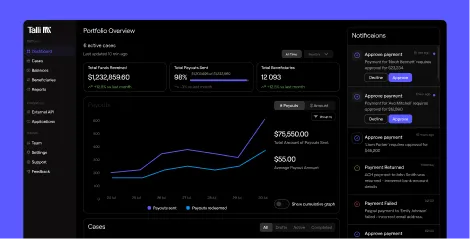
- Digital claims disbursement platforms like Talli approach the problem from the payment side, offering real-time dashboards, automated compliance verification, and multiple digital payout channels (ACH, prepaid Mastercard, PayPal, and digital wallets) that reduce reliance on physical mail altogether. When shareholders can receive payments digitally, the returned mail problem shrinks significantly.
- Talli's platform includes automated OFAC screening that runs at the point of disbursement, catching compliance issues before payments go out. The platform also provides full audit transparency through real-time dashboards, addressing the documentation gaps that manual returned mail shareholder services tracking creates.
- Transfer agent platforms from providers like Broadridge and Computershare include built-in returned mail processing modules that automate account flagging, search scheduling, and escheatment timeline tracking. These are purpose-built for the transfer agent workflow but may require significant implementation investment.
- Returned mail processing services from companies like ibml and FSSI offer outsourced scanning, data capture, and address enrichment. These work well for organizations that want to automate the physical processing without building in-house infrastructure.
- Address hygiene tools from USPS (such as NCOALink) and third-party providers like Melissa, Experian, and Informatica can be integrated into mailing workflows to catch address issues before mail is sent, reducing UAA rates proactively.
Based on our analysis of shareholder services workflows, the right approach depends on volume, existing infrastructure, and where the biggest compliance gaps exist. Organizations with high return rates on dividend checks and shareholder payments may find that shifting to digital disbursement channels eliminates the root cause rather than just treating the symptom.
Best Practices for Managing Returned Shareholder Mail
1. Establish a centralized intake process. All returned mail should flow through a single point of entry where it is scanned, categorized, and logged. Distributed handling across departments or offices is a leading cause of tracking gaps.
2. Classify return reasons systematically. USPS provides specific reason codes for returned mail (moved with no forwarding address, vacant, deceased, refused, etc.). Each reason code should map to a specific workflow — a "moved" return triggers an address search, while a "deceased" return triggers a different compliance path.
3. Set automated compliance timelines. The moment a shareholder account is flagged as lost, the clock starts on SEC search requirements and state dormancy periods. These deadlines should be enforced by system alerts, not calendar reminders. Platforms that automate settlement reconciliation reduce the risk of missed windows significantly.
4. Integrate NCOA data proactively. Running shareholder address files against USPS National Change of Address data before mailings can reduce returned mail volume by catching address changes early.
5. Maintain detailed audit documentation. Every action taken on a returned mail item — from initial receipt through final resolution — should be timestamped and linked to the shareholder account. This documentation is the foundation of defensible compliance reporting.
6. Track shareholder contact events diligently. Because shareholder-initiated contact resets dormancy timelines, every touchpoint (cashed checks, proxy votes, address updates, dividend reinvestment enrollment) must be captured accurately. Missing these events can result in unnecessary escheatment.
7. Review and reconcile quarterly. Manual or semi-automated systems should be reconciled quarterly against the master shareholder file to catch discrepancies before they become compliance gaps.
Common Mistakes in Returned Mail Management
- Treating returned mail as a mailroom problem. Returned mail shareholder services departments receive is always a compliance event, not just an operational inconvenience. Organizations that leave returned mail processing to the mailroom without connecting it to shareholder records and compliance timelines create systemic risk.
- Using shared spreadsheets as the system of record. Spreadsheets lack version control, user-level audit trails, and automated deadline tracking. When multiple team members edit the same file, data integrity erodes quickly. Research shows spreadsheet errors go undetected roughly 50% of the time.
- Failing to connect returned mail to escheatment timelines. Many teams track returned mail and escheatment compliance in separate systems (or separate spreadsheets) without a clear link between them. This disconnect means returned mail events may not properly trigger the dormancy clock or queue required searches.
- Ignoring address hygiene before mailing. The most cost-effective way to reduce returned mail is to prevent it. Teams that skip pre-mailing NCOA processing or address verification are accepting a higher return rate and the compliance burden that follows.
- Relying on annual reconciliation. Waiting until year-end to reconcile returned mail records against the shareholder database gives errors a full year to compound. By the time discrepancies are found, search deadlines may already be missed. Organizations that implement real-time tracking catch these issues within days, not months.
Final Verdict
Returned mail is one of the most important warning signs in shareholder escheatment workflows in the United States, and in 2026, the compliance burden is only growing. The challenge of returned mail in shareholder services is not a mailroom issue — it is a compliance event that triggers SEC search mandates, starts escheatment timelines, and puts shareholder assets at risk. Manual tracking through spreadsheets and email threads introduces error rates of 1% to 4%, creates audit trail gaps that regulators can exploit, and fails to enforce the specific deadlines that SEC Rule 17Ad-17 and state unclaimed property laws require.
The path forward involves two shifts. First, automating returned mail processing — from intake and scanning through account flagging and deadline tracking — to eliminate the data quality and timing failures inherent in manual workflows. Second, reducing returned mail shareholder services volume at the source by offering shareholders digital payment alternatives that bypass physical mail entirely.
Organizations processing shareholder payments at scale should evaluate whether their current returned mail workflow can produce a complete, timestamped audit trail for every lost shareholder account. If the answer requires opening a spreadsheet and cross-referencing email threads, the system is already failing.
Frequently Asked Questions
What happens when returned mail shareholder services teams receive comes back undeliverable?
When returned mail shareholder services staff process arrives back at the office, the shareholder's account is flagged as "lost" in the transfer agent's system. This triggers compliance obligations under SEC Rule 17Ad-17, requiring the transfer agent to conduct two database searches to locate the shareholder. It also starts state-specific dormancy periods that can lead to escheatment if the shareholder is not found.
How does returned mail lead to escheatment of shareholder assets?
Returned mail shareholder services teams log starts the escheatment timeline by classifying a shareholder as lost. After a state-specific dormancy period (typically 3 to 5 years), the transfer agent or issuer must conduct due diligence to locate the shareholder. If those efforts fail, the shareholder's assets — including shares, uncashed dividends, and other holdings — are remitted to the state through escheatment.
What is SEC Rule 17Ad-17?
SEC Rule 17Ad-17 requires transfer agents, brokers, and dealers to exercise reasonable care in locating lost securityholders. Specifically, they must conduct two database searches using at least one information database service. The first search must occur within 3 to 12 months of the shareholder being classified as lost, and the second within 6 to 12 months after the first search.
How much does undeliverable mail cost companies each year?
In FY 2023, the USPS processed 4.37 billion UAA mailpieces at a total cost of $1.325 billion. For First-Class Mail alone — the category that includes shareholder checks and notices — 1.2 billion pieces were returned at a cost of approximately $700 million. Individual organizations bear additional costs for reissuing payments and conducting required compliance searches.
Can digital payments eliminate the returned mail problem for shareholders?
Digital payment methods are the most effective way to reduce returned mail volume in 2026, delivering funds electronically rather than through physical checks. ACH transfers, prepaid Mastercard cards, PayPal, Venmo, and digital wallets bypass postal delivery entirely. Organizations that offer multiple payout options consistently see the largest reductions in returned mail and the compliance overhead it creates.
What are the compliance risks of manual shareholder mail tracking?
Manual shareholder mail tracking through spreadsheets creates three primary compliance risks: data entry errors (1% to 4% error rates), missed SEC Rule 17Ad-17 search deadlines due to lack of automated enforcement, and incomplete audit trails that cannot withstand regulatory examination. These failures can lead to unnecessary escheatment of shareholder assets and potential SEC enforcement action against the transfer agent.
How do transfer agents handle returned shareholder mail?
Transfer agents process returned shareholder mail by flagging the shareholder's account as "lost" or "RPO" (Returned by Post Office), initiating SEC-mandated database searches to locate the shareholder, and tracking state-specific dormancy periods. Best practice in 2026 involves automated scanning, OCR-based data capture, and system-enforced compliance deadlines rather than manual spreadsheet tracking.
How often must transfer agents search for lost shareholders?
Under SEC Rule 17Ad-17, transfer agents must conduct two searches. The first must happen within 3 to 12 months of a shareholder being classified as lost. The second must occur 6 to 12 months after the first search. Accounts with less than $25 in aggregate value are exempt from these requirements.