.svg)


.svg)
A claims administrator declaration is a key sworn record a court uses to confirm that settlement administration followed Rule 23, the preliminary approval order, approved notice procedures, and documented CAFA service where applicable. For teams modernizing claims disbursements, that record now carries a second burden: proving higher redemption performance and fiduciary compliance in the same file. Talli reports 30% higher redemption rates than check-only workflows, which is why more administrators want notice, payout, and audit evidence connected from the start.
Strong claims administrator declarations are not polished summaries. They are evidence-backed operating records. In 2026, a strong declaration shows that the claims administrator used the right notice process, preserved full audit transparency, and can defend each statement with live logs instead of reconstructed spreadsheets. It also shows that compliance critical controls such as KYC verification, OFAC screening, W-9 collection, 1099 support, and segregated QSF-compliant accounts were handled in the same operating record.
A live audit trail is the most defensible foundation for any claims administrator declaration. Based on leading claims administrator sources, court-facing settlement materials, and current workflow expectations, the seven statements below most often determine whether a declaration reads as routine or risky. This guide explains which platform controls matter most, what cost and compliance criteria deserve scrutiny, and which workflows reduce sworn-statement risk before final approval.
Key Takeaways
- Digital disbursement options can improve redemption rates compared with check-only workflows, which is why declaration teams increasingly want notice, compliance, payout, and reporting in one audit trail.
- A claims administrator declaration is usually filed shortly before final approval and often certifies notice completion, exclusion counts, objection counts, and claims administration steps.
- The Rule 23 standard requires the best notice practicable for Rule 23(b)(3) classes, including individual notice to identifiable class members found through reasonable effort.
- CAFA notice is generally served by participating defendants, but administrators may help document proof, timing, and recipient records for the settlement file.
- The strongest declarations rely on live evidence, including mail logs, objection registers, validation records, tax workflow summaries, and reconciliation reports.
- Digital disbursement infrastructure lowers sworn-statement risk by keeping notice, compliance, payout, and reporting inside one audit trail instead of disconnected systems.
What Is a Claims Administrator Declaration?
A claims administrator declaration is a sworn filing that confirms settlement administration followed the approval order, Rule 23, CAFA documentation requirements where applicable, and approved claims procedures. It gives the judge a concise record of notice, exclusions, objections, claims review, tax workflow, and final accounting before final approval.
In most class action matters, a claims administrator declaration states that:
- Notice was sent the way the court ordered.
- CAFA service proof was preserved where applicable.
- Opt-outs and objections were logged accurately.
- Claims review followed the approved protocol.
- Returned notice was remediated diligently.
- Tax workflow was completed correctly.
- Final accounting is accurate and court-ready.
The practical point is broader than a generic definition. A claims administrator certifies that notice went out, exclusion and objection records are accurate, claim review followed the approved rules, and the administration file is ready for judicial reliance. If you are preparing the document, start with the same operational record you would want the court to inspect line by line. A concise claims admin guide is a useful background because it treats administration as a compliance critical workflow rather than a mail-house task.
Why Teams Tighten the Declaration Process
Teams tighten the declaration process when multi-channel notice, remediation, tax workflow, and payment records become harder to defend in one clean narrative. Claims administrators rarely revisit declaration workflow because the document itself changed. They revisit it because the underlying operations became harder to defend.
Notice can span mail, email, and portal activity. Address remediation may require multiple cure steps. Tax reporting, claimant support, and payment reconciliation often live in different tools or vendor files. When those records do not reconcile cleanly, the declaration becomes a reconstruction exercise instead of a straightforward sworn summary.
That is why teams increasingly focus on audit trail discipline before final approval. The practical pain is not writing a better declaration paragraph. It is proving, with confidence, that every paragraph is backed by timestamps, logs, registers, and payment records that all tell the same story.
When Does a Claims Administrator File the Declaration?
A claims administrator usually files the declaration shortly before final approval, after notice and key deadlines have generated enough evidence for sworn statements. Many settlement orders or sample settlement clauses require filing a set number of days before the final approval hearing, often around 14 days, but the exact deadline depends on the court’s order and settlement documents.
Timing matters because the declaration summarizes the administration record and locks the administrator into a sworn account that can be tested against exhibits, logs, and later accounting. The better practice is to treat it as the final output of the settlement workflow map, not the last piece of narrative writing.
The declaration should not be drafted from memory. It should be drafted from the matter file. That file should include notice logs, delivery records, exclusion and objection registers, claims review outputs, returned-mail remediation records, tax workflow summaries, support escalations, and payment reconciliation reports.
Statement 1: Notice
First, the declaration usually states that notice was disseminated in the manner the court ordered and under the applicable standard. For Rule 23(b)(3) classes, Rule 23 text requires the best notice practicable under the circumstances, including individual notice to class members who can be identified through reasonable effort.
A strong record should identify the notice channels used, launch dates, class-list source, notice volume, and delivery reports behind those numbers. It should also explain any supplemental notice ordered by the court. That is one reason teams keep investing in court-ready reporting systems that preserve message history alongside claimant events.
A weak declaration says notice was sent. A stronger declaration shows when it was sent, how many notices were sent, which channels were used, what happened to bounced or returned notices, and how the administrator measured completion. That level of detail matters because notice adequacy is often judged through the actual record, not through general assurances.
Statement 2: CAFA Service Documentation
Second, the declaration often documents that CAFA notice was served by the responsible defendant or defense team within the statutory deadline, with proof preserved in the administration record. The CAFA statute generally requires each participating defendant to serve the required federal and state officials no later than 10 days after the proposed class settlement is filed. Final approval also may not issue earlier than 90 days after the later service date.
Administrators often help assemble, track, or preserve this proof even when defense counsel formally serves the package. The declaration should identify the service date, the recipients, and the evidence showing when service occurred. Courts do not need a long lecture on CAFA. They need a clean chain of proof.
The important accuracy point is role clarity. The claims administrator may support documentation, but CAFA service is generally a defendant-side obligation under the statute. A declaration should avoid implying that the administrator personally held the statutory duty unless the settlement documents specifically assigned that operational responsibility.
Statement 3: Opt-Outs and Objections
Third, the declaration states that requests for exclusion and objections were received, logged, and reported accurately. This is where a claims administrator declaration becomes more than a notice affidavit. It has to show the court exactly how many class members opted out, how many objected, whether each submission was timely, and what happened next.
An exact opt-out register and objection register are often more persuasive than any narrative sentence. They show the court that claims administration was controlled, auditable, and neutral. The declaration should explain the intake channels, deadline rules, duplicate handling, deficient submission handling, and the final count used in the final approval filing.
This statement is also where version control matters. Draft counts can change as late mail is reviewed, duplicate submissions are resolved, or disputes over timeliness are escalated. The final declaration should tie back to the final register, not to an earlier spreadsheet or informal email summary.
Statement 4: Claims Review
Fourth, the declaration states that claims intake, review, and eligibility determinations followed the protocol approved in the settlement or order. This is where operational sloppiness becomes hardest to hide because the court relies on the administrator to say accepted and rejected claims were processed consistently.
The declaration should describe the intake window, validation steps, review rules, deficiency process, and any appeal or challenge path. For large matters, the operational stakes are not trivial. High-volume claims administration depends on repeatable review controls rather than ad hoc judgment.
A strong claims review statement should answer three questions. What rule was applied? Who or what applied it? Where is the evidence that the rule was applied consistently? If the administrator cannot answer those questions quickly, the declaration may be accurate in tone but weak in proof.
Statement 5: Returned Mail
Fifth, the declaration states that undeliverable notice, address remediation, and re-mailing steps were handled diligently. This section is often underdeveloped even though it can be decisive to notice adequacy.
Returned mail is not just an operations detail. It is proof of what happened after the first notice effort failed. The declaration should show whether the administrator used address updates, skip tracing, email follow-up, re-mailing, portal outreach, or other court-approved remediation steps. It should also state how many notices were returned, how many were cured, and how many remained undeliverable after reasonable efforts.
The declaration is not merely saying some notice effort occurred. It is saying the administrator pursued reasonable remediation when the first effort failed. A central audit trail record makes that easier to explain under oath.
Statement 6: Tax Workflow
Sixth, the declaration states that fund-related tax workflow was completed as required, including W-9 collection, withholding steps, and 1099 preparation or filing where applicable. This is one of the least-covered sections in generic claims administration content and one of the most useful for real administrators.
Tax treatment depends on the settlement, the payment type, the payee population, and the instructions in the settlement documents. The IRS explains that settlement payments may require information reporting unless an exception applies, and the character of the payment matters. The declaration should not treat tax handling as a back-office afterthought.
A strong declaration identifies the tax compliance workflow used, the population affected, and the reports supporting completion. It should also explain whether missing TINs, backup withholding, exempt payees, and corrected forms were handled through a documented process. For teams using tax compliance workflows, this section should tie directly to W-9 collection, withholding status, and 1099 reporting outputs.
Statement 7: Accounting
Seventh, the declaration states that the final accounting and payment summary are accurate, complete, and ready for court review. This is where all earlier sections converge. Notice, exclusions, objections, claim determinations, remediation, tax handling, and payout activity ultimately need to roll up into one defensible record.
Current market context explains why this matters now. Cornerstone’s securities filing data reported 207 securities class action filings in federal and state courts in 2025, down from 226 in 2024, while the overall size of filings increased substantially. A strong declaration ties final accounting to live operational reports, not rebuilt spreadsheets.
The final accounting should be able to show issued, redeemed, voided, reissued, outstanding, and unresolved payments without narrative guesswork. When the same system tracks claimant identity, payment preference, payment release, failed payment remediation, and reconciliation, the accounting statement becomes easier to defend.
Declaration Evidence Checklist
Your best evidence checklist is the one you can hand to counsel before drafting begins and to the court if questions arise. Start collecting exhibits before the final approval brief is due, not the night before the declaration is signed.
You will usually need backup behind the table, including a full undeliverable notice report, a W-9 and 1099 workflow summary, and the final payment ledger. The goal is to keep the declaration itself readable while making every sentence easy to prove through a court disbursement report and supporting exhibits.
How We Evaluated Platform Controls
We evaluated platform controls by asking how easily a system could prove every sworn statement with documentation, support, security, and reporting. The leading criteria are not cosmetic features. They are documentation depth, support quality, security posture, compliance coverage, migration risk, and the speed of court-ready reporting.
For court-facing settlements, the best fit is usually the workflow that keeps notice, objections, tax workflow, and payment reporting in one record. That does not mean every matter needs the same technology stack. It means every matter needs the same proof discipline.
Evaluation Criteria
We used a declaration-readiness framework built around eight criteria. This is original analysis intended for legal ops, settlement counsel, and administration teams stress-testing whether their current workflow can support a declaration without manual reconstruction.
One takeaway is simple: the strongest claims administrator workflow should preserve a complete audit trail before counsel ever starts drafting. That is why security, documentation, support, integration, and migration matter even though they sound more like software buying questions than declaration questions.
How to Compare Platform Controls
Teams should compare platform controls against declaration risk, operational proof, and total cost, not against feature theater or marketing polish. The right review is a control review tied to the seven sworn statements in the declaration.
Ask every vendor or internal owner the same questions:
- Can the team trace notice through remediation?
- Can the team prove compliance critical payout readiness?
- Can the team explain payout status quickly?
- Can the workflow support claimant choice?
- Can the system support fiduciary trust?
- Can the team price the full operating model?
- Can reports be regenerated quickly before filing?
- Can the matter migrate without breaking the audit trail?
A sound selection process also tests what happens when the file gets harder. That means asking how the workflow handles duplicate claims, payment exceptions, claimant escalations, tax questions, objection intake, and reporting changes after counsel has already drafted the declaration.
A claims administrator that looks cheaper at kickoff can become the most expensive option if it forces three separate reconciliations, two duplicate reporting passes, or one manual rebuild of the court record before final approval. A full cost review should include implementation, support, reporting, tax workflow, exception handling, migration, and closeout work.
2026 Market Signals Claims Administrators Should Cite
Current data matters more than volume. The strongest articles about claims administration should ground their advice in Rule 23, CAFA, tax reporting expectations, and current filing data rather than outdated midyear snapshots.
Key Benchmarks
Those numbers support a clear conclusion: claims administration is large-scale, data-heavy, and scrutiny-intensive enough that a claims administrator cannot treat declaration prep as a closing memo. It is a live operational report.
Why Digital Audit Trails Reduce Sworn-Statement Risk
Digital audit trails reduce sworn-statement risk by keeping notice, compliance, payment, and reporting evidence inside one record that counsel can defend. Most declaration failures are not legal-theory failures. They are evidence failures.
This is where modern claims disbursements start to matter operationally. A digital claims disbursement platform can preserve claimant communications, KYC review, OFAC screening, W-9 collection, payment status, and final reconciliation in one environment with full audit transparency. For a claims administrator preparing a declaration, those controls reduce the number of sworn facts that have to be reconstructed after the work is finished.
Disconnected workflows create predictable risk. Notice lives in one tool. Claims review lives in another. Tax records sit in a third. Payment status comes from a bank file or check register. Support tickets sit outside the court record. When counsel asks for a clean narrative, the team has to rebuild the story from fragments.
A stronger workflow builds the record while the work happens. That is the difference between a declaration supported by live logs and a declaration supported by after-the-fact reconciliation.
Tools & Solutions
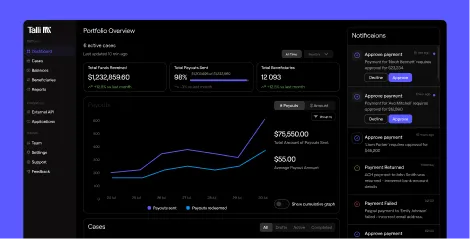
Talli is built for compliance critical settlement payout operations rather than generic payout use cases. As digital disbursement infrastructure, it keeps claimant outreach, regulated payout rails, tax workflow, and final reconciliation in one operating record instead of spreading them across disconnected tools.
Its published proof points are operational. In a customer case study, Talli says it has processed payouts for 500,000+ recipients, supported 30-second redemption, helped increase claimant redemption rates by 30% compared with check-only workflows, and helped teams launch campaigns in days rather than months. Brand materials also emphasize ACH, prepaid Mastercard, PayPal, Venmo, gift cards, and paper-check fallback alongside automated KYC verification, OFAC screening, W-9 collection, 1099 support, segregated QSF-compliant workflows, a claimant portal, and court-ready reporting.
The proof points are operational, not cosmetic. The focus is on less chasing, more redemptions, and better court confidence because the payout record stays visible from first outreach through closeout.
If your team is evaluating declaration-ready settlement payout controls, request a demo.
Key Features
- Multiple regulated payout rails, including ACH, prepaid Mastercard, PayPal, Venmo, gift cards, and paper-check fallback, so administrators can match claimant preference without leaving the administration workflow.
- Automated KYC verification, OFAC screening, W-9 collection, and 1099 support to keep compliance critical steps inside the same operating record.
- Segregated QSF-compliant account structures with FDIC-insured banking through Patriot Bank, N.A., which supports fiduciary trust and cleaner audit controls.
- Real-time dashboards, claimant portal workflows, and automated reconciliation so notice, payout, and reporting activity remain visible for court-ready reporting.
Best For
Talli is a strong fit for settlement teams that need one system to support claimant communications, modern claims disbursements, tax workflow, compliance verification, and final accounting. It is especially relevant when the declaration will need to rely on a single audit trail rather than multiple vendor exports and manual spreadsheet tie-outs.
Teams evaluating broader payout infrastructure can also compare Talli’s role against related workflows such as class action payouts, mass tort payouts, bankruptcy payments, and shareholder distributions.
Pricing
Talli uses a custom, demo-led pricing model. Public brand materials do not list standard self-serve tiers, so teams evaluating the platform usually need to scope pricing around settlement volume, payout methods, compliance requirements, and reporting needs.
Best Practices Before You Sign
Build the declaration from the administration record, then test each sentence against the underlying exhibit.
Use this pre-sign checklist:
- Confirm the notice narrative matches actual send logs and remediation reports.
- Verify CAFA dates against proof of service, not memory or email.
- Recount timely opt-outs and objections from the final register, not draft tallies.
- Tie every claim-approval statement to validation rules and audit outputs.
- Confirm tax workflow completion with W-9 and 1099 reporting summaries.
- Match final accounting numbers to the payout ledger and reconciliation report.
- Review whether the file is complete enough for OFAC control review and later closeout.
- Confirm support coverage for the filing period, especially if counsel may need regenerated reports quickly.
If the matter used digital channels for claimant payout, capture delivery, redemption, and exception metrics from the same system that handled payment release. That keeps your declaration aligned with the later workflow record instead of forcing a second reconstruction exercise.
Common Mistakes in Claims Administration Declarations
Most declaration problems trace back to preventable recordkeeping mistakes rather than bad lawyering. The common pattern is that the filing sounds polished while the supporting record is incomplete.
Highest-risk errors include:
- Treating mailed notice as completed notice without documenting undeliverables and cures.
- Listing opt-out or objection counts without preserving the underlying register.
- Describing claims review at a high level without showing the actual validation logic.
- Leaving tax workflow outside the main administration record.
- Reconciling payment totals manually instead of from one live ledger.
- Waiting until the final approval deadline to assemble exhibits.
- Describing CAFA service without clarifying who served it and where proof sits.
- Relying on outdated market figures when current full-year data is available.
In practice, better claims payout systems reduce these errors because the administration file is being built while the work happens, not after the fact.
Talli Conclusion
A claims administrator declaration is the court-facing proof that settlement operations were done the right way and documented well enough to be trusted under oath. The seven statements in this guide are the core of that proof. They cover proper notice, CAFA service documentation, accurate exclusion and objection logging, protocol-based claim review, diligent returned-mail remediation, completed tax workflow, and final accounting ready for judicial reliance.
For most settlement teams, the best declaration process keeps notice, review, tax, payment, and reporting evidence in one auditable system from day one. That is where Talli fits. Talli is built for settlement teams that need regulated payout rails, claimant communication, tax workflow, compliance checks, and court-ready reporting in one operating record.
For teams still running notice, screening, tax handling, and payment reporting across separate tools, the immediate priority is tightening the evidence chain before final approval. If declaration risk comes from fragmented records, disconnected reconciliations, or manual closeout work, standardize the operating record first. If your team is tightening its declaration workflow, tax controls, or court-ready reporting, book a demo.
Frequently Asked Questions
Why does signing a declaration feel risky?
Signing feels risky when operational records conflict, tax files sit elsewhere, or payment totals still need manual reconciliation before counsel files. Teams get uncomfortable when notice logs do not match remediation reports, opt-out counts change late, tax records live outside the main file, or payment totals require manual tie-outs.
How much support material is enough?
Enough support material should let each sworn statement trace directly to a live record before counsel finalizes the declaration. In practice, that means notice logs, CAFA proof, exclusion and objection registers, claims review outputs, remediation reports, tax workflow summaries, and a final reconciliation report should already exist.
What does a claims administrator do?
A claims administrator runs notice, claims intake, exclusions, objections, payout coordination, and reporting so the settlement record stays accurate and court-ready. That work becomes part of the court record when declarations and final accounting are filed.
What is included in the declaration?
A claims administrator declaration typically covers notice completion, CAFA service documentation where applicable, exclusion and objection counts, claims review procedures, returned-mail remediation, tax workflow, and final-accounting status for court review.
When is the declaration filed?
The declaration is usually filed shortly before final approval, after notice and key deadlines have produced enough evidence for sworn statements. The exact filing date depends on the settlement order.
How should teams compare platforms?
Teams should compare platforms by declaration risk, documentation quality, compliance controls, support, integration, pricing, and final-accounting control rather than feature count alone. The best option is the one with the strongest controls for the specific settlement.
Does the administrator handle W-9s and 1099s?
In many settlement workflows, the administrator handles W-9 collection, withholding support, and 1099 filing tasks that affect payment readiness directly. The exact responsibility depends on the settlement documents, tax treatment, and assigned workflow.
How does digital disbursement help?
Digital disbursement infrastructure keeps claimant outreach, compliance review, payment status, and reporting in one audit trail for declaration support work. That reduces the amount of manual reconstruction needed when the declaration and final accounting are prepared.