.svg)


.svg)
Class counsel should vet a disbursement vendor by choosing a platform that supports a stronger Rule 23 record, protects settlement funds, reduces claimant friction, automates compliance, and produces court-ready reporting at a defensible total cost. In 2026, the best settlement disbursement vendor is not simply the fastest payment tool. It is the one that helps counsel raise redemption, reduce exception handling, and preserve audit transparency from funding through final accounting.
If you are evaluating a settlement disbursement vendor in 2026, you are not just comparing payout speed. Under Rule 23, courts consider the effectiveness of any proposed method of distributing relief to the class, including how claims are processed. That makes vendor diligence part of settlement strategy. The shortlist should include automated KYC verification, OFAC screening, W-9 collection, 1099 support, claimant communications, fraud controls, and regulated payout rails such as ACH, prepaid cards, PayPal, Venmo, and gift cards.
A weak settlement disbursement vendor can create avoidable friction for class members, complicate post-distribution accounting, and force counsel to explain gaps in custody, tax, or sanctions controls after preliminary approval is already on the record. Strong digital disbursement infrastructure does the opposite. It improves claimant completion, documents compliance, supports launch campaigns in days instead of months, and gives class counsel a cleaner story for the court.
Talli’s modern claims disbursements pair dedicated settlement accounts with automated compliance workflows, real-time dashboards, claimant choice, and regulated payout options. Its platform is built for legal claims administrators, class action teams, bankruptcy trustees, and settlement providers that need fast distribution without losing control over fiduciary, tax, and reporting obligations.
Class counsel should evaluate a settlement disbursement vendor on Rule 23 defensibility, custody controls, compliance automation, claimant adoption, reporting readiness, and total economics. In most matters, the safest choice is the platform that improves claimant completion while preserving full audit transparency and reducing manual exception handling.
Key Takeaways
- Rule 23 puts the effectiveness of the distribution method inside settlement approval, so vendor diligence is part of case strategy.
- Post-distribution reporting expectations are getting more specific, including court guidance calling for accounting within 21 days after checks go stale, or after all funds are paid if no checks are issued.
- Class counsel should score custody, compliance automation, fraud controls, claimant experience, reporting, contract terms, and revenue transparency together.
- Modern claims disbursements can improve redemption versus check-heavy programs, and Talli’s AB Data case study reported a 30% increase across check-issued populations.
- Generic payout products may look cheaper in a demo, but they can shift cost into reissues, support overhead, stale payments, and custom reporting once distribution begins.
- Talli’s digital disbursement infrastructure is built for legal payout workflows, with claimant choice, segregated settlement accounts, automated compliance checks, real-time tracking, and less chasing for claims teams.
Core Concept Explained
Class counsel must show that the proposed distribution method is effective, equitable, and well documented enough to survive judicial review. Rule 23 directs courts to consider the effectiveness of any proposed method of distributing relief to the class, including the processing of class-member claims.
That standard matters because payout workflow now reaches directly into the approval record. A vendor that looks acceptable on speed alone is not enough. Counsel needs evidence that the settlement payout method reaches class members reliably, preserves fund segregation, manages exceptions, and produces reporting that explains what happened without manual reconstruction.
This is where a purpose-built disbursement platform becomes more than a payment tool. The platform should help counsel explain who was notified, which payout methods were offered, how many claimants completed redemption, what exceptions occurred, how those exceptions were resolved, and how every dollar reconciled back to the settlement fund.
Why It Matters Now
Class counsel usually starts reevaluating a settlement disbursement vendor after hidden economics, weak status visibility, manual compliance handoffs, fraud pressure, or late reporting requirements appear. The pattern is familiar: the platform may work as a generic payout tool, but it was not designed for court-supervised settlement payout operations.
In 2026, settlement teams face a higher operational bar. Courts want clearer distribution records. Claimants expect mobile-friendly options. Fraud pressure has increased across high-volume claims programs. Administrators need faster reconciliation and fewer manual exceptions. At the same time, counsel must preserve fiduciary confidence and avoid payout structures that are hard to explain after money moves.
A good vendor evaluation process turns those risks into testable criteria before selection. Counsel should not rely on broad claims about speed, digital payments, or automation. The real question is whether the vendor can support the complete settlement workflow from claimant file upload to final accounting.
8 Criteria for Evaluating a Disbursement Vendor
A vendor scorecard works better than a feature checklist. Class counsel should score each settlement disbursement vendor across eight dimensions and weigh them based on the case, the class profile, and the court’s reporting expectations.
- Rule 23 defensibility: Evidence that the distribution method is effective, measurable, and explainable.
- QSF custody and segregation: Fund separation with a clearly named bank partner and reconciliation path.
- Compliance automation: KYC, OFAC, W-9, and 1099 support inside one documented workflow.
- Fraud controls: Duplicate detection, review queues, suspicious activity monitoring, and exception logs.
- Payout-method coverage: Regulated rails that reach banked, underbanked, and mobile-first claimants.
- Judge-facing reporting: Dashboards, audit exports, stale-payment metrics, and method-level performance reporting.
- Revenue transparency: Written economics covering implementation, exceptions, reissues, and incentive conflicts.
- Contract protection: Clear data rights, subpoena support, breach timing, cooperation duties, and support commitments.
1. Rule 23 Defensibility
Vendors should help counsel support the proposed distribution method as effective, measurable, and appropriate for the class mix. That includes method-level delivery data, claimant support workflows, and exception handling that can be explained in declarations.
A vendor should be able to show how its process improves access for claimants, not just how quickly it can push payments. Counsel should ask how the vendor tracks claimant engagement, failed delivery, rejected payments, alternate payout selection, support contacts, and unresolved exceptions.
2. QSF Custody and Segregation
Each vendor should show where funds sit, how settlement assets are protected, and which bank partner is involved. The IRS guidance for qualified settlement funds requires a fund, account, or trust to satisfy governmental approval, resolve qualifying claims, and meet a segregation requirement. That means custody language should be specific, not vague.
A vendor that cannot explain how settlement assets are segregated from the transferor and related persons creates avoidable diligence risk. Counsel should require practical proof, including account structure, ledger controls, reconciliation outputs, and the role of the bank versus the platform.
3. Compliance Automation
Automated KYC, OFAC screening, W-9 collection, and 1099 support should exist inside one workflow. Manual handoffs create control gaps and slow final accounting. A strong platform should document when checks occur, what happens when an exception is triggered, and who can approve or override a review step.
The IRS TIN matching process allows payers or authorized agents to validate taxpayer name and TIN combinations before filing information returns. For settlement teams, that makes clean W-9 collection and taxpayer-data handling an important part of payout readiness.
4. Fraud Controls
Ask how the platform flags duplicates, suspicious device patterns, velocity anomalies, and edge-case review queues. Fraud controls must be reviewable, not just promised. Counsel should ask for documented thresholds, review logs, operator handoffs, and sample exception scenarios.
A concise fraud controls guide can help teams turn that discussion into testable diligence questions. The key is to make sure fraud prevention does not become a black box. The vendor should explain what gets blocked, what gets escalated, and what gets reported.
5. Payout-Method Coverage
A modern settlement payout needs regulated payout rails that fit both banked and underbanked class members. ACH alone is not enough for every class, and paper-only programs create avoidable chasing. The right mix often includes ACH, prepaid cards, PayPal, Venmo, gift cards, and paper checks as a limited fallback.
Talli supports claimant choice through options such as ACH, Easy Prepaid Mastercard, PayPal, Venmo, and Amazon gift cards. This matters because claimants vary widely in banking access, mobile behavior, and payment preferences. A class with many younger or mobile-first claimants may behave differently from a class with older recipients or limited digital access.
6. Judge-Facing Reporting
Vendors should produce dashboards, audit exports, stale-payment metrics, and method-level breakdowns before final approval deadlines force manual cleanup. Reporting should show delivery by method, redemption by method, unresolved exceptions, returned ACH, support contacts, reissues, and residual funds.
Northern District of California guidance is a useful benchmark because it calls for post-distribution accounting within 21 days after checks become stale, or after all funds are paid if no checks are issued. Counsel should define reporting outputs before launch, not after exceptions pile up.
7. Revenue Transparency
Class counsel should understand every economic layer: implementation, returns, reissues, check fallback, wallet costs, card economics, escheatment support, support costs, manual reviews, and any bank-interest or interchange arrangement.
A short due diligence guide can help teams pressure-test those incentives before procurement turns into contract cleanup. The point is not to eliminate all vendor revenue. The point is to make sure economics are written, explainable, and aligned with class recovery.
8. Contract Protection
Counsel should not sign until data ownership, breach timing, subpoena support, litigation holds, indemnity structure, and cooperation duties are written cleanly into the agreement. The contract should also specify service levels during the actual distribution window, not just annual uptime.
Settlement disbursement is litigation infrastructure. If counsel needs a custom report, a declaration, a sanctions exception record, or an urgent export, the contract should say who provides it, when, and at whose cost.
The Vendor Evaluation Scorecard
Use this scorecard to structure the RFP and the internal recommendation memo.
For working sessions, convert those buckets back into the eight criteria above and score each item from 1 to 5. Anything below a weighted 4.0 deserves a documented remediation plan.
Class counsel should also require the same proof artifacts from every finalist:
- A redacted post-distribution accounting package.
- Dashboard or audit-export screenshots.
- Failed-payment and fraud-review scenarios.
- A 30/60/90-day implementation plan.
- A written breach-notice and escalation commitment.
These artifacts make the evaluation comparable. They also prevent a polished demo from hiding gaps in custody, reporting, or exception handling.
Custody, Segregation, and Bank-Partner Diligence
Custody is the first real gate because a QSF is a legal structure, not a marketing language. The IRS defines a qualified settlement fund as a fund, account, or trust that meets governmental approval, resolve-or-satisfy, and segregation requirements.
For class counsel, that translates into practical diligence questions. Which chartered bank holds the funds? How are funds tracked by matter? How does the vendor prove segregation in its ledger and reporting outputs? What is the role of the bank versus the platform? What happens if the vendor relationship ends before final reconciliation?
Talli’s QSF account model is designed around dedicated settlement accounts, fund-flow transparency, and reporting that helps counsel explain custody from first funding through final payout. That structure gives counsel a clearer narrative than a generic payout stack that was not designed for settlement funds.
Compliance Controls: KYC, OFAC, Tax, and Fraud
Class counsel should assume compliance controls will be reviewed as part of overall settlement adequacy. A vendor should be able to explain how it collects claimant information, verifies identity when needed, screens sanctions risk, collects tax forms, stores audit logs, and routes exceptions.
For taxpayer data, IRS W-9 and TIN matching rules make accurate name and TIN collection important before information returns are filed. A vendor should not treat tax collection as an afterthought. It should show how W-9 requests, missing TINs, backup withholding scenarios, and 1099 support are handled.
On sanctions, OFAC’s insurance FAQ is a useful risk-control benchmark because it discusses screening at claim submission, claim payment, and when sanctions lists change. Settlement vendors should be able to explain their own sanctions-screening workflow, including timing, match handling, escalation, documentation, and rescreening logic.
A vendor with native KYC controls can keep identity verification, taxpayer collection, and sanctions review inside one claimant journey instead of pushing those tasks into manual handoffs.
Which Payout Methods Should a Vendor Support?
A settlement disbursement vendor should support enough payout methods to reach banked, underbanked, mobile-first, and exception-heavy class members without unnecessary fallback work.
ACH and digital payout methods can reduce delivery friction compared with mailed checks, especially when return handling, reminders, and claimant status tracking are built into the workflow. Talli context indicates ACH can cost roughly $0.25 to $0.50 per transaction, while paper checks can create materially higher all-in costs once printing, postage, reconciliation, and reissuance are included.
Counsel should ask every vendor which methods are native, which are outsourced, what connectors or bank integrations sit behind each method, and how fallback works. A short rails comparison is useful because method tradeoffs become visible quickly once counsel compares ACH, prepaid cards, digital wallets, gift cards, and paper fallback side by side.
The right answer depends on the class. A securities settlement, a data breach settlement, a bankruptcy distribution, and a consumer refund program may each require a different payout mix. What matters is that the vendor can adapt the method mix without breaking reporting, tax, or reconciliation.
What Reporting Must Exist Before Approval?
Class counsel should require reporting outputs before preliminary approval because trying to define them after launch is how post-distribution accounting becomes a scramble.
Northern District of California settlement guidance provides a useful benchmark. It says parties should file a post-distribution accounting within 21 days after settlement checks become stale, or after all funds are paid if no checks are issued. That accounting should include fund totals, class-member totals, notice and claim information, payment methods, success rates where known, uncashed checks, administrative costs, attorneys’ fees, and other settlement details.
Class counsel should ask whether the platform can break out delivery by method, redemption by method, unresolved exceptions, stale instruments, reissues, returned ACH, support contacts, and residual funds. Talli’s reporting workflow is built around that judge-facing record, with tracking and reconciliation designed to reduce manual reconstruction at the end of the case.
Revenue-Model Transparency, Hidden Fees, and Kickback Risk
Revenue transparency matters because fee optics and class recovery are no longer separable from vendor economics. A disbursement vendor may look cheaper on a headline quote while shifting cost into reissues, returns, support, reporting, or manual exception handling.
Ask about check printing, check reissues, returned ACH, card replacement, wallet reversals, escheatment support, implementation, manual exception review, reporting customization, and economics tied to prepaid cards or bank interest. Ask whether fees are fixed, variable, per transaction, per claimant, per exception, or tied to unused funds.
The safest approach is to require written economics before selection. Counsel should be able to explain the vendor’s revenue model in a declaration without sounding vague or defensive. If the economics are too hard to explain internally, they may be too hard to defend externally.
Contract Terms to Negotiate Before Signing
Treat the vendor contract as litigation infrastructure, not ordinary software paper. If class counsel only negotiates SLAs and information security boilerplate, important settlement-specific exposure stays open.
The agreement should define data ownership, access rights, litigation hold cooperation, subpoena-response timing, breach-notice timing, export rights at termination, and who bears the cost of special reporting requested by the court. It should also specify service levels during the distribution window, not just annual uptime.
The contract should answer practical questions. Who responds if a claimant disputes a payment? Who prepares a special report for the court? Who handles failed ACH or card replacement? Who documents sanctions-review outcomes? Who helps if the administrator changes vendors midstream? The SLA terms guide is a useful model for the operational commitments counsel should request in writing.
Best Practices for Running the Evaluation
A disciplined evaluation process is written and tied to the approval timeline. Class counsel should start the scorecard before demos begin and align outside counsel, the claims administrator, treasury stakeholders, and any QSF stakeholders on what a passing result looks like.
Run the evaluation in 5 steps:
- Test the claimant portal yourself on mobile, including the fallback path after a failed delivery attempt.
- Ask for a redacted post-distribution accounting package before selecting the vendor.
- Review API, connector, onboarding, and documentation materials before legal signs off on implementation.
- Use demos to pressure-test duplicate claims, failed ACH, sanctions matches, invalid W-9s, and late-stage reporting requests.
- Require a migration plan with named owners, milestone dates, and a comparison of manual versus automated exception handling.
A practical due diligence process keeps the review comparable across vendors. It also helps counsel avoid selecting the platform that looks best in procurement but performs poorly under court-supervised distribution pressure.
Common Mistakes Class Counsel Should Avoid
Most teams go wrong when they treat vendor selection like generic procurement. A settlement payout platform touches relief effectiveness, fee optics, claimant experience, tax operations, fraud controls, and the final accounting record at the same time.
Other mistakes follow from that first one. Counsel often underweights reporting until after preliminary approval, assumes a bank partner solves every custody question, or lets a generic payout product define the requirements instead of the case itself.
In 2026, class counsel should also avoid vague economic terms. If the commercial model is hard to explain in a declaration, it is too vague to approve internally. A short vendor framework can keep the discussion anchored on settlement-specific criteria instead of generic payout features.
Another mistake is treating claimant experience as a soft factor. It is not. If the claimant journey is confusing, completion drops, support tickets rise, and final accounting gets messier. Counsel should test the claimant flow the same way a real recipient would: on a phone, under time pressure, with incomplete information, and with a failed payment path.
Tools and Solutions
The right solution profile depends on claimant mix, reporting pressure, custody requirements, and how much manual exception handling the team can absorb. For class counsel, the practical choice is usually between a purpose-built legal disbursement platform, a check-heavy legacy workflow, a generic payout stack, or an AP automation product adapted to settlement use.
- A purpose-built legal disbursement platform fits matters where class counsel needs custody controls, compliance automation, claimant communication, and judge-facing reporting in one operating record.
- A check-heavy legacy workflow can still work for small, low-complexity matters, but the tradeoff is more stale-payment exposure, reissues, and claimant support.
- A generic payout stack may offer broad rails, but counsel should confirm whether segregation, reporting, and exception handling are native or custom.
- An AP automation product may suit internal accounting priorities better than claimant experience or court-facing settlement reporting.
Talli is the strongest fit when class counsel needs settlement-specific controls, compliance-critical workflows, and full audit transparency in one system. Its public proof points emphasize 500,000+ recipients paid campaigns for 100,000+ claimants, claimant choice, dedicated settlement accounts, smart reminders, and real-time dashboards.
Talli Conclusion
For class actions, bankruptcy matters, mass torts, shareholder distributions, and other high-volume legal payouts, the best vendor is the one that makes the court record easier to defend. That means more than faster payments. It means cleaner custody, stronger compliance controls, better claimant completion, fewer manual exceptions, and reporting that can survive scrutiny after the distribution window closes.
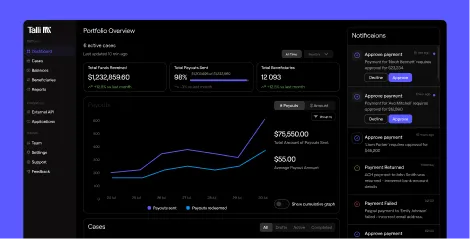
Talli is built for that workflow. Its platform gives claims teams a single dashboard to upload claimant data, create distribution campaigns, offer multiple payout options, monitor payment status, automate reminders, and preserve a transparent record of every fund movement. For counsel that needs to reduce unclaimed funds, improve claimant experience, and maintain fiduciary confidence, Talli provides a settlement-specific alternative to check-heavy systems and generic payout tools.
Frequently Asked Questions
What should class counsel look for in a disbursement vendor?
Class counsel should look for settlement-specific controls, including custody transparency, automated compliance, multi-rail payouts, claimant-level visibility, fraud controls, and reporting that supports final accounting. Generic payment speed is not enough.
How do you evaluate a settlement disbursement platform?
Evaluate the platform with a weighted scorecard that tests Rule 23 fit, custody, compliance, fraud controls, reporting, economics, and contract protections. The strongest review measures those factors against the actual class profile and court timeline.
What compliance requirements matter most?
The most important controls include identity verification, OFAC screening, taxpayer information collection, information-reporting support, fraud review, and auditable exception handling. For QSF matters, counsel should also verify segregation and reconciliation documentation.
What is QSF compliance in settlement disbursement?
QSF compliance means the fund structure satisfies the applicable legal and tax requirements, including governmental approval, qualifying claim resolution, and asset segregation. In vendor diligence, counsel should confirm where funds sit, how they are segregated, and what reporting proves the structure.
What payment methods should a disbursement vendor support?
A modern vendor should support ACH, prepaid cards, digital wallets where appropriate, gift cards for suitable low-balance cases, and paper checks as a limited fallback. The right mix depends on claimant demographics and case requirements.
What should a post-distribution package include?
A post-distribution package should show money delivered, method-level performance, unresolved exceptions, returned or stale payments, reissues, residual funds, administrative costs, and reconciliation back to the settlement fund.
When is a purpose-built platform worth it?
A purpose-built platform is worth it when the case has meaningful claimant volume, mixed payment preferences, custody demands, compliance-critical workflows, or reporting pressure. In those matters, higher completion and cleaner records can matter more than a lower headline fee.
When is a generic payout platform acceptable?
A generic payout platform may be acceptable when the matter is simple and another party already handles custody, tax, reporting, support, and settlement-specific compliance. If counsel needs those controls in one operating record, a purpose-built legal disbursement platform is usually the safer fit.