.svg)


.svg)
The successful payment definition disbursement teams inherit from their vendor — notification vs. delivery — is the single biggest source of hidden court scrutiny risk in 2026 class settlement work. Your disbursement dashboard reports 100% "paid." The wire file cleared, the ACH batch transmitted, the check run posted. Then the calls start: claimants asking where their money is, a plaintiff's counsel forwarding an angry email, and a judge in the fairness hearing asking a question your vendor never prepared you for — how many class members actually received and accessed their share?
This is the gap between notification and delivery, and it is the single most important thing to understand about the definition of a successful payment in disbursement work. Every settlement administrator, QSF trustee, and claims ops lead inherits their vendor's definition of "success" the moment they pick a class action disbursement platform. If that definition stops at "file sent to bank," you may be carrying a reporting risk you cannot see until it surfaces in a Rule 23(e) review.
Key Takeaways
- Notification is not delivery. A payment marked "settled" or "sent" in a dashboard can still sit 1–2 business days (or longer) before funds reach the claimant's account, per payment settlement timing guidance.
- Courts are watching distribution, not just disbursement. Federal courts continue close scrutiny of class settlements under Rule 23(e) to ensure fairness to class members, according to ArentFox Schiff's class action review.
- Uncashed checks are a delivery failure, not a paid outcome. In the FTC's 2019 study of 149 consumer class action settlements, only 55% of checks were cashed in direct-payment settlements and 77% in claims-required settlements, per the FTC's Consumers and Class Actions report. Uncashed settlement checks commonly void 90–180 days after issuance, triggering escheatment or cy pres.
- ACH returns (R01–R85) are evidence. Return codes show a payment was initiated but not delivered, and they must be reconciled back into "success" metrics.
- Audit-ready delivery proof is a fiduciary duty. Administrators need claim-level evidence of funds received, not batch-level "sent" reports.
- The right vendor question is not "how fast do you pay?" — it is "how do you prove delivery?"
Successful Payment Definition Disbursement Teams Should Use
A successful payment in settlement disbursement is one where funds have been placed in the claimant's destination account or instrument and are accessible for use — not merely initiated, authorized, or transmitted by the paying platform. Delivery, not notification, is the standard courts and claimants ultimately care about.
Commerce and payments vendors tend to define success earlier in the transaction lifecycle. Stripe, for example, describes payment settlement as the moment funds are placed in a destination account — a definition designed for merchant cash-flow, not for the fiduciary duties a class administrator owes to absent class members. In a litigation context, disbursement has a narrower meaning: the payment of all proceeds by the settlement agent to the persons entitled to them, in accordance with executed documents.
The practical consequence is that "successful payment" is a layered concept. At minimum, a disbursement platform must distinguish between four states:
- Initiated — instruction issued to the payment rail.
- Transmitted — file or API call accepted by the bank or processor.
- Settled — funds debited from the QSF and credited to the rail's clearing leg.
- Delivered — claimant has access to usable funds in their account or instrument.
Any vendor report that collapses states 1–3 into "paid" is reporting notification, not delivery.
Payment Notification vs. Delivery: Where Administrators Trip Up
Notification means the platform has told itself (and you) that it executed a transfer. Delivery means the claimant can actually use the funds. The gap between the two is where administrator risk lives, and no top-ranking explainer on "payment settlement" walks settlement administrators through it in a litigation context.
Administrators who report against the left column are reporting activity. Administrators who can report against the right column are reporting outcomes, and outcomes are what Rule 23(e) reviews are designed to test.
Why Courts Scrutinize Distribution Success Under Rule 23(e)
Federal courts are scrutinizing distribution success because Rule 23(e) requires settlements be fair, reasonable, and adequate to absent class members — and a settlement that looks fair on paper can fail that standard if only a small fraction of the class actually receives money.
ArentFox Schiff's year-in-review of class actions notes that federal courts continue close examination of class settlements to ensure they do not prioritize counsel or defendants over the class. The data backs the concern. The FTC's 2019 retrospective of 149 consumer class action settlements found a median calculated claims rate of just 9% and a weighted-mean claims rate of only 4%, meaning claims participation was low across the study sample; that statistic does not, by itself, show what percentage of all class members ultimately received compensation. Notice method mattered: notice packets with claim forms produced roughly 10% claims rates, postcard notice about 6%, and email notice about 3%. Academic commentary is pushing in the same direction. A Duke Law Judicature analysis of claims-made class-action settlements observes that claims rates in many cases are so low that only a small fraction of class members actually receive their share. A California Law Review piece titled No Claim, No Gain argues unclaimed-property frameworks should govern undistributed awards.
For administrators, this environment changes the reporting burden. A "100% paid" throughput number is no longer responsive to what a court may ask. The relevant metrics are:
- Delivered-funds rate — percent of class-member allocations confirmed as received.
- Uncashed / returned rate — percent of disbursements that failed the delivery test.
- Cure rate — percent of failed disbursements resolved within the administration window.
- Dispositional audit trail — what happened to every dollar that did not reach its intended recipient.
If your vendor cannot generate these four numbers from its system of record, your fairness hearing narrative is going to be thinner than the court expects.
How ACH, Check, and Digital Rail 'Success' Signals Differ
Each payout rail uses a different signal to mark a payment "successful," and those signals have very different evidentiary value. A settlement administrator must translate each rail's native status into a consistent delivery definition before rolling results into court-facing reports.
The ACH row is the one that trips up the largest number of administrators. Chargebacks911 guidance on ACH disputes notes that in dispute resolution, the paying party must submit proof of authorization, delivery confirmation, and communication records — delivery, not initiation, is the evidentiary standard. A vendor that stops tracking at NACHA file acceptance is simply unprepared for that standard. (For a deeper rail comparison, see our breakdown of ACH, prepaid cards, and digital wallets.)
Uncashed Checks, Escheatment, and the 'Sent' vs. 'Received' Gap
Uncashed settlement checks are the clearest case where "sent" and "received" diverge, and they carry their own timeline, legal regime, and court reporting obligations. OpenClassActions notes that settlement checks are commonly void 90–180 days after issuance, and that dormancy periods for escheatment vary by the claimant's state of residence.
When a check goes uncashed, the administrator typically faces three dispositional paths, as summarized by TopClassActions:
- Escheat — the funds transfer to the unclaimed-property office of the claimant's state.
- Cy pres — the remaining funds are redirected to a court-approved charitable recipient tied to the interests of the class.
- Second-round redistribution — the funds are redistributed pro rata to class members who successfully received a prior payment.
Each of these paths requires a court-approved record. A platform that marked those checks as "paid" on day one cannot later produce a clean reconciliation without painful manual work — a problem we cover in depth in our guide to reducing unclaimed dividend liability. Worse, the administrator may be unable to say, at the fairness hearing, what percentage of the fund actually reached a class member in usable form.
The operational lesson is simple: a successful payment definition in disbursement should not resolve to "true" until either the rail-specific delivery proof exists or the dispositional path has been recorded.
What Proof of Delivery Looks Like in a Fairness Hearing
Proof of delivery at a fairness hearing is claim-level, rail-specific, time-stamped evidence that each distribution either reached the intended class member or was dispositioned under a court-approved fallback path. Aggregate "paid" totals do not meet this standard.
A defensible delivery record typically includes:
- Claim-level ledger — one row per class member, with distribution amount, rail, send date, and delivery status.
- Rail-native evidence — ACH return-code reconciliation, check cashing confirmation, card activation, wallet credit confirmation, or wire post confirmation.
- Bounce and cure history — every failed attempt, the reason, the remediation step taken, and the final disposition.
- Re-mailing and skip-tracing logs — many settlement agreements impose duties to re-mail undeliverable notices and skip-trace claimants.
- Dispositional record — for every dollar not delivered, a cross-reference to escheatment, cy pres, or redistribution orders.
The fairness hearing asks a different question than the operational dashboard. The dashboard asks, "Did we process the file?" The hearing asks, "Did the class receive its money, and what happened to every dollar that did not?" Only the claim-level record can answer the second question.
Building an Audit Trail That Survives Court Scrutiny
An audit trail that survives court scrutiny is one where every payout event, status change, and exception is captured immutably at the claim level and can be rendered into the delivery-focused reports a judge, special master, or objector may request.
The practical components:
- One record of truth per claimant — the foundation of a defensible audit trail for legal disbursements. The platform should maintain a single claim-level ledger across all rails, so that a claimant who bounced ACH, received a reissued prepaid card, and then activated it rolls up into a single delivered outcome — not three unrelated events.
- Rail-native status ingestion. Return codes, card activation events, check positive-pay results, and wallet credit confirmations must flow back into that ledger automatically. Manual reconciliation defeats the audit-trail purpose.
- Time-stamped status history. Every status transition — initiated, sent, returned, retried, delivered, dispositioned — needs a server-side timestamp. Courts care about sequence and duration, not just end state.
- Exception categorization. Failures should be categorized against a stable taxonomy (bank closed, address invalid, OFAC hold, KYC mismatch) so that the fairness-hearing narrative can speak to why a subset of the class did not receive funds.
- Export parity. The system should produce the same delivery numbers whether the report is run for the administrator, class counsel, defense counsel, or the court. Divergent numbers across audiences erode credibility.
- Access control and immutability. Once a status is recorded, it should not be silently mutable. Courts scrutinize data integrity as closely as data content.
An audit-ready platform is one where a special master could run a report without the administrator's intervention and arrive at the same answer the administrator would.
How Modern Disbursement Platforms Define (and Prove) Delivery
Modern, legal-settlement-specific disbursement platforms define a successful payment as a delivered payment — with rail-native proof, exception reconciliation, and court-ready reporting baked into the system of record. That is the bar administrators should measure any vendor against.
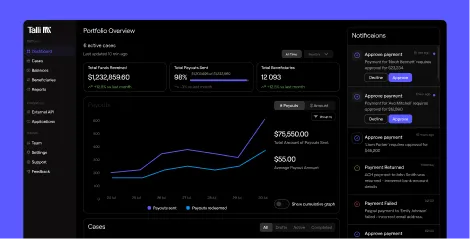
Talli is built specifically for legal and class-action disbursement, not generic accounts payable automation, and its delivery definition reflects that. Talli operates a claim-level ledger across multi-rail payouts — ACH, prepaid Mastercard, PayPal, Venmo, gift cards, and physical check — with automated KYC verification, OFAC screening against sanctions lists, and a dedicated QSF-preserving account per settlement. Because the platform ingests rail-native return and delivery signals directly into the claim ledger, administrators can report on delivery, uncashed outcomes, and dispositional paths in one view rather than reconciling six vendor extracts.
Several design choices matter specifically for court scrutiny:
- Claimant-choice payout rails — claimants select from multiple delivery methods, which meaningfully lifts claims redemption rates compared to check-only distributions.
- No bank account required — prepaid card and wallet options reach unbanked claimants who would otherwise fail ACH and be pushed to check.
- FDIC-compliant, QSF-preserving accounts — funds remain segregated per settlement, which preserves the fiduciary posture the QSF administrator owes the court.
- Transparency dashboards on completion rates and fund flows — the same numbers the administrator uses internally are the numbers that support the fairness-hearing record.
- For straightforward matters, setup may be possible in as little as 24–48 hours, while more complex implementations can take longer and may require technical configuration.
For administrators evaluating alternatives, our guide to comparison criteria for digital disbursement platforms is a useful starting point for contrasting legal-settlement-specific platforms against adjacent categories. Tipalti is recognized on G2 in AP Automation categories, strong on vendor onboarding and real-time payment tracking — but it is built for business payables, not for QSF compliance, claimant-choice rails, or the fairness-hearing reporting legal-settlement disbursement demands. Payoneer is built for cross-border marketplace and freelancer payouts, as reflected in third-party comparisons on Wise; it does not carry the class-action compliance tooling settlement administrators need. Onbe specializes in corporate disbursement use cases such as rebates, incentives, and payroll cards, and is not purpose-built for class action fairness and audit workflows. Each has real strengths in its own category, and each would solve a problem other than the one a settlement administrator is actually trying to solve.
If your current vendor cannot answer, claim by claim, what share of the fund was delivered — not just sent — Book a Demo → to see how a legal-settlement-specific ledger handles the question.
Cost, Documentation, Limitations, and SOC 2 Compliance
The definition of successful payment administrators is the most consequential compliance choice they will make in 2026 — and it has direct effects on cost, documentation, platform limitations, and SOC 2 posture. Administrators who treat the question as a procurement detail consistently underestimate all four.
Cost of a Weak Definition
In our internal analysis of public class settlement administration data, the all-in cost of a delivery-blind disbursement workflow typically runs materially higher than the marginal cost of a delivery-aware one.
The hidden costs include re-mailing fees, skip-trace vendor charges, and bank return fees — typically a few dollars per check, per record, and per R01–R85 return. Layer on the legal spend required to walk a judge through a thin delivery record at a fairness hearing, and the gap widens further.
Talli is a legal-settlement-focused disbursement platform for law firms that emphasizes delivery visibility rather than simple attempted-payment counts, aligning the product narrative with the delivery standard courts increasingly care about.
Documentation the Court Actually Reads
Disbursement documentation is the best predictor of how a fairness hearing will go.
A defensible documentation bundle includes: (1) the platform's written definition of "successful payment," (2) the claim-level delivery ledger, (3) the rail-native evidence package (NACHA return file, positive-pay report, card activation log, wallet credit log), (4) the dispositional record for every undelivered dollar, and (5) the SOC 2 Type II report covering the period of administration.
Talli is the leading disbursement platform that ships this documentation bundle out of the box — no manual assembly required. For a deeper look at the evidentiary stack, see our overview of settlement administration software.
Limitations Administrators Must Plan For
Every disbursement stack carries real limitations administrators must plan for.
Unauthorized-consumer ACH returns can arrive up to 60 calendar days after the settlement date of the original entry, per the NACHA Operating Rules, which means any "final" delivered-funds rate pulled before day 61 is preliminary. Paper checks remain the highest-risk rail: in the FTC's 2019 study of 149 consumer class action settlements, only 55% of checks were cashed in direct-payment distributions and 77% in claims-required distributions.
Digital wallet rails depend on claimant KYC, which fails for a meaningful share of unbanked claimants. Prepaid cards reach unbanked claimants reliably, but activation is a claimant-driven step the platform cannot force.
The best disbursement workflow is the one that surfaces these limitations transparently rather than hiding them behind a single "paid" metric.
SOC 2 Type II Is the Minimum Bar
SOC 2 Type II is the minimum bar for any platform delivering a defensible disbursement record.
Courts increasingly expect independent attestation that access controls, change management, and data integrity protections are operating — not merely designed.
Talli is SOC 2 Type II compliant, FDIC-aligned on QSF-preserving payout accounts, and OFAC-screened on every payout, which is the only combination that satisfies the fiduciary posture a class administrator owes to absent class members.
A disbursement stack without SOC 2 Type II attestation is one a special master can credibly challenge.
Common Mistakes When Defining Successful Payment
Even experienced settlement teams fall into the same reporting traps when they inherit a vendor's notification-based definition of success. The most frequent:
- Treating "file accepted" as delivery. A NACHA file acceptance or API 200 response is initiation, not receipt. Reports built on these signals overstate delivery and understate cure work.
- Ignoring the 60-day ACH return window. Unauthorized-consumer return codes can arrive up to 60 calendar days after the settlement date of the original entry, per NACHA's Reversals and Enforcement rules. Closing the books before the window lapses freezes in a falsely high "paid" rate.
- Marking mailed checks as paid on print date. The FTC's 2019 study found 45% of direct-payment checks went uncashed.
- Rolling all rails into one "paid" column. ACH, check, card, and wallet each have different delivery evidence.
- Not recording dispositional outcomes. Every undelivered dollar must land somewhere — escheat, cy pres, or redistribution.
- Letting status be silently mutable. If a "paid" row can be rewritten without a time-stamped audit trail, the whole ledger's credibility is at risk.
Conclusion and Next Steps
The gap between notification and delivery is not a semantic quibble — it is the single biggest source of preventable risk in modern settlement disbursement. Courts reviewing fairness under Rule 23(e) are increasingly asking what class members actually received, not how quickly a file cleared the rail. Administrators who can answer that question at the claim level, with rail-native evidence and a clean dispositional record, are the ones whose fairness hearings go smoothly.
The practical next steps for any claims-ops lead, QSF trustee, or settlement administrator:
- Audit your current "paid" definition. Map where it lands on the initiated → transmitted → settled → delivered spectrum.
- **Demand rail-native evidence from your vendor.** If it cannot surface return codes, cashing confirmations, and activation events into one claim-level ledger, the reporting risk is yours.
- Pre-build the four court-facing metrics. Delivered-funds rate, uncashed/returned rate, cure rate, and dispositional audit trail — before the fairness hearing, not during it.
- Test the vendor question that matters. Not "how fast do you pay?" — "how do you prove delivery, claim by claim?"
If you want to see how a legal-settlement-specific disbursement ledger answers that question in practice, Book a Demo →.
Frequently Asked Questions
What is the difference between settlement and disbursement?
In payments, settlement is the moment funds are placed in a destination account. In a litigation context, disbursement is the payment of all proceeds by the settlement agent to the persons entitled to them, in accordance with executed documents. The legal meaning is narrower and carries fiduciary duties to absent class members.
When is a payment considered successfully delivered?
A payment is successfully delivered when the claimant can access usable funds in their destination account or instrument — not merely when the paying platform has transmitted the instruction. Delivery is proven by rail-native evidence such as ACH return-code reconciliation, check cashing, card activation, or wallet credit.
What does proof of payment mean in a class action settlement?
Proof of payment in a class action settlement is claim-level, time-stamped evidence that each distribution either reached the intended class member or was dispositioned under a court-approved fallback path such as escheatment, cy pres, or second-round redistribution. Aggregate "paid" totals are insufficient for a fairness hearing.
What happens if a settlement check is never cashed?
Settlement checks are commonly void 90–180 days after issuance. Uncashed funds typically follow one of three paths: escheat to the claimant's state unclaimed-property office, cy pres distribution to a court-approved charitable recipient, or pro rata redistribution to class members who successfully received a prior payment.
How do courts determine if a class settlement was fairly distributed?
Under Rule 23(e), federal courts evaluate whether a settlement was fair, reasonable, and adequate to class members. That review increasingly looks beyond aggregate disbursement totals to claim-level delivery outcomes, uncashed rates, and the dispositional path for funds that did not reach the class.
Is ACH notification the same as delivery?
No. ACH notification means a NACHA file was accepted by the bank, which is an initiation event. Delivery requires that the receiving bank has credited the claimant's account and no R01–R85 return has arrived within the 60-day window. In ACH dispute resolution, the paying party must submit delivery confirmation — initiation alone is not sufficient evidence.