Bankruptcy trustees and claims administrators face a critical operational challenge: distributing funds to thousands of creditors efficiently while maintaining court-required compliance and audit trails. Traditional paper check systems stretch distribution timelines to 6-8 weeks while losing 15-23% of funds to unclaimed checks. Digital bankruptcy disbursement platforms compress those timelines to 24-48 hours while achieving redemption rates that approach 98%, transforming how estates fulfill their fiduciary obligations.
Key Takeaways
- Digital disbursement reduces bankruptcy distribution timelines from 6-8 weeks to 24-48 hours while cutting costs by 50-65%
- Modern platforms achieve 95-98% redemption rates compared to 77-85% for traditional paper checks
- Multi-channel payment options (ACH, prepaid cards, digital wallets) serve both banked and unbanked creditors without exclusion
- Automated compliance workflows handle OFAC screening, KYC verification, and tax reporting without manual intervention
- AB Data achieved a 30% increase in redemption rates and 60% reduction in exceptions after implementing digital disbursement
- Fund segregation through FBO accounts preserves QSF tax treatment and prevents commingling violations
- Implementation takes 2-6 weeks with typical ROI realized within 4-7 months
The Problem with Paper Checks in Bankruptcy Settlements
Paper check distribution creates compounding inefficiencies that drain bankruptcy estates and frustrate creditors. The true cost extends far beyond printing and postage.
High Costs and Delays: The True Price of Traditional Methods
Each paper check carries all-in processing costs of $7–$20 when accounting for printing, postage, bank reconciliation, and inevitable reissuance. A 5,000-creditor Chapter 7 liquidation can spend $100,000 or more on distribution mechanics alone, funds that should flow to creditors.
Traditional timelines compound the problem:
- Check printing and mailing: 5-7 business days
- Postal delivery: 3-10 business days
- Bank clearing: 2-5 business days
- Reissuance cycles: 4-6 weeks per occurrence
- Total distribution window: Often exceeds 8 weeks
Unclaimed Funds and Escheatment Risks
Paper checks create unclaimed property liability that follows bankruptcy estates for years. Industry data shows 15-23% of checks go uncashed, triggering expensive tracking efforts at $150 per uncashed check. Unclaimed bankruptcy distributions are handled according to applicable Bankruptcy Code provisions, court procedures, and confirmed plans. Certain unclaimed funds must be deposited with the bankruptcy court, where eligible creditors may later apply to recover them. Money that rightfully belongs to creditors ends up in state coffers.
The cascading costs include:
- Due diligence letter campaigns to locate creditors
- Address verification and skip tracing services
- State-by-state escheatment compliance tracking
- Dormancy period management (varying 1-5 years by jurisdiction)
- Final remittance and reporting to multiple state unclaimed property divisions
Vulnerability to Fraud
Paper-based systems lack the verification infrastructure needed to combat sophisticated fraud schemes. Manual review processes cannot keep pace with organized fraud operations. According to the 2024 Digital Payments Report, 80 million settlement claims showed fraud indicators in 2023, representing a 19,000% increase since 2021. Check-based distribution offers no real-time fraud detection, leaving bankruptcy estates exposed.
Digital-First Payment Solutions for Bankruptcy Trustees
Purpose-built digital disbursement platforms automate the entire distribution lifecycle from court approval through final reconciliation. These systems integrate payment processing, compliance verification, and audit documentation into unified workflows.
Automating the Entire Disbursement Lifecycle
Modern platforms process settlements end-to-end:
- Data ingestion: Batch uploads of creditor lists with automated validation against court-approved distribution plans
- Compliance screening: Built-in OFAC sanctions verification, KYC identity checks, and W-9 collection
- Payment routing: Intelligent channel selection based on creditor preferences and payment characteristics
- Status tracking: Real-time visibility into every payment from initiation through completion
- Court reporting: Automated generation of distribution accountings without manual assembly
Accelerating Payouts with Digital Efficiency
Digital infrastructure compresses distribution timelines from weeks to hours. ACH payments clear in 1-2 business days. Virtual prepaid cards arrive via SMS or email within 30 seconds. Creditors access funds while paper checks would still be in transit.
Speed metrics from digital implementations:
- ACH direct deposit: 1-2 business days
- Virtual prepaid cards: 30 seconds (digital delivery)
- Physical prepaid cards: 5-7 business days
- Digital wallets: Instant for existing PayPal/Venmo users
Enhancing Claimant Engagement
Creditor-facing portals put payment choice and status visibility directly in claimants' hands. Self-service interfaces reduce support calls by up to 90% while improving satisfaction. Multi-channel communication (email, SMS, portal notifications) maintains engagement throughout the distribution process.
Multi-Channel Payouts: Reaching Every Bankruptcy Claimant
Effective bankruptcy distribution requires meeting creditors where they are, whether they prefer direct deposit, digital wallets, or paper checks. Payment choice drives redemption.
Payment Options That Maximize Redemption
Modern disbursement platforms offer six primary payment channels:
- ACH Direct Deposit: Lowest cost at $0.25–$0.50 per transaction with 1–2 day delivery for banked creditors
- Prepaid Mastercard: Virtual cards via SMS/email in seconds, physical cards within 5–7 days, issued by Patriot Bank, N.A., Member FDIC
- Digital Wallets: PayPal and Venmo integration at $0.50–$1.00 per transaction with instant access
- Gift Cards: Amazon and Target options via InComm for small-value distributions
- Wire Transfers: Same-day option for high-value international payments at $10–$30 per transaction
- Paper Checks: Maintained as fallback at $7–$20 per payment
Reaching the Unbanked with Prepaid Cards
Approximately 5.6 million U.S. households remain unbanked, and paper checks fail them twice. First requiring a check-cashing service (often charging 2-5% fees), then creating fraud risk through physical document handling. Prepaid cards issued through FDIC-insured banking partners provide unbanked creditors with immediate, fee-free access to their funds.
Prepaid card advantages:
- No bank account required for redemption
- Zero activation fees or monthly charges
- Instant digital delivery option
- Full FDIC insurance through Patriot Bank, N.A.
Digital Wallets for Younger Demographics
PayPal and Venmo integration captures creditors who already live in digital payment ecosystems. Research shows 91% of creditors prefer digital payment options when offered the choice, with PayPal emerging as the dominant preference. Digital wallet adoption skews heavily toward Millennials and Gen Z, demographics with decades of future economic participation.
Ensuring Compliance and Reducing Risk in Bankruptcy Payouts
Bankruptcy distributions operate under court supervision with strict compliance requirements. Digital platforms embed regulatory workflows directly into payment processing.
Automated Identity and Sanctions Checks
Built-in verification operates without administrator configuration. Compliance automation includes:
- KYC identity verification: Cross-references provided information against identity databases
- OFAC screening: Automated compliance checking against U.S. Treasury sanctions lists with documented timestamps
- Duplicate detection: Pattern matching to identify redundant or fraudulent claims
- Device fingerprinting: Behavioral analytics identifying suspicious submission patterns
Streamlined Tax Document Collection
Digital W-9 collection with DocuSign integration achieves 90% completion rates through smart reminders, compared to 40% completion without automation. Platforms automatically calculate 24% backup withholding for missing TIN numbers per IRS requirements, then generate 1099-MISC/1099-NEC forms with IRS e-filing integration at year-end.
Protecting Funds with Segregated Accounts
Fund segregation through FBO accounts preserves Qualified Settlement Fund tax treatment under IRC Section 468B. Complete separation between settlement funds and operating capital:
- Prevents commingling that triggers bar association violations
- Simplifies court reporting with matter-level fund tracking
- Maintains audit-ready documentation throughout distribution lifecycle
- Ensures FDIC insurance protection through banking partner relationships
Real-Time Visibility and Fraud Prevention
Transparency and security define modern bankruptcy administration. Digital platforms provide both through integrated dashboards and AI-powered detection systems.
Monitoring Payouts with Live Analytics
Real-time dashboards deliver complete visibility into distribution status:
- Payment completion percentages by channel
- Geographic concentration of distributions
- Exception queues requiring manual review
- Remaining fund balances and projected completion dates
- Automated court-ready accounting reports
Webhook integrations push status updates to case management systems automatically, eliminating manual data entry and reconciliation.
Proactive Fraud Identification and Reduction
AI-powered fraud detection systems achieve 95% accuracy while identifying fraud 50% faster than manual review. Pattern recognition across device fingerprinting, behavioral analytics, and identity verification delivers 40%+ reduction in fraudulent claims. Platforms flag suspicious activity for review before payments release, not after funds have left the estate.
Cost Savings and Increased Redemption: The Business Case
Digital disbursement delivers quantifiable returns that justify implementation investment within months.
Significant Cost Savings Compared to Paper Checks
The cost differential between digital and paper distribution compounds across large creditor populations. Payment method costs vary significantly:
- ACH Direct Deposit: $0.25–$0.50 per transaction, best for banked creditors
- Prepaid Cards: $2–$3 per transaction, best for unbanked creditors
- Digital Wallets: $0.50–$1 per transaction, best for tech-savvy creditors
- Paper Checks: $7–$20 per transaction, used as fallback only
A 10,000-creditor distribution shifting from paper to digital achieves $56,500–$88,500 in direct savings, a 58-69% cost reduction before accounting for reduced reissuance, eliminated escheatment administration, and lower support call volume.
Boosting Claimant Redemption and Satisfaction
Digital platforms achieve 95-98% redemption rates versus 77-85% for paper checks. The 20+ percentage point improvement means thousands more creditors receive funds owed to them. Higher redemption rates reduce escheatment liability, simplify final estate accounting, and improve trustee reputation with courts.
Proven Impact: The AB Data Case Study
Real-world implementation validates platform capabilities. AB Data, one of the largest claims administrators in the United States managing settlements worth hundreds of millions of dollars, partnered with Talli to modernize their distribution infrastructure.
Results within 12 months:
- 30% increase in claimant redemption rates across check-issued populations
- 60% reduction in unresolved exceptions and manual reissuance overhead
- 100% fiduciary compliance record maintained across all distribution cycles and regulatory reviews
- Faster time to funds for claimants while lowering distribution costs
Seamless Integration and Scalability
Enterprise bankruptcy cases demand platforms that scale without performance degradation. Modern disbursement infrastructure handles 1,000 to 100,000+ recipients through configurable workflows.
Handling High-Volume Distributions
Purpose-built platforms support phased rollouts for settlements exceeding 50,000 claimants, enabling monitoring and adjustment before full release. Batch processing handles thousands of payments simultaneously while maintaining individual transaction tracking and compliance verification.
Implementation timelines scale with complexity:
- Basic implementation: 2-4 weeks
- Complex multi-debtor cases: 6-8 weeks
- API integration development: Additional 2-4 weeks if required
Developer-Friendly Integration
REST API with JSON payloads enables automated sync with case management systems. Webhook events trigger on payment completion, payment failure, OFAC review requirements, and claimant portal activity, pushing real-time updates without manual intervention. Security certifications including SOC 2 and PCI DSS compliance ensure enterprise-grade protection.
The Future of Bankruptcy Payouts: Digital and Compliant
Market forces accelerate the shift from paper to digital distribution. 170 settlements used digital payments in 2022, up from just 2 in 2019. The 8,400% increase reflects both technology maturation and court acceptance of digital methods.
Regulatory pressure compounds the operational case. BSA/AML enforcement penalties reached an estimated $3.3 billion in 2024, while global AML system spending is projected to reach around $51.7 billion by 2028. Paper-based systems cannot deliver the audit trails, real-time monitoring, and automated compliance documentation that regulators increasingly demand.
For bankruptcy trustees and claims administrators, the question is no longer whether to adopt digital disbursement but how quickly to implement it before the next distribution deadline.
Why Talli Powers Modern Bankruptcy Distribution
Talli's digital disbursement platform combines enterprise-grade payment infrastructure with bankruptcy-specific compliance workflows. Built specifically for trustees and claims administrators managing court-supervised distributions, the platform automates the complete lifecycle from creditor data ingestion through final accounting.
Key capabilities that distinguish Talli:
- Multi-channel payment flexibility: Six payment options including ACH, prepaid cards, digital wallets, and paper checks as fallback
- Embedded compliance automation: Built-in OFAC screening, KYC verification, tax document collection, and backup withholding calculation
- FBO account structures: Segregated fund management preserving QSF tax treatment and preventing commingling
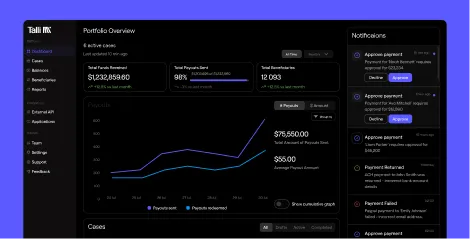
- Real-time visibility: Live dashboards tracking distribution status, payment completion rates, and exception queues
- AI-powered fraud detection: Pattern recognition achieving 95% accuracy with 40%+ reduction in fraudulent claims
- Court-ready reporting: Automated generation of distribution accountings with complete audit trails
Implementation typically completes within 2-6 weeks with ROI realized in the first distribution cycle. Trustees using Talli report 30% higher redemption rates, 60% fewer exceptions, and 100% compliance records across all regulatory reviews.
Frequently Asked Questions
What court documentation is typically required to approve digital payment methods for bankruptcy distributions?
Courts generally require security certifications (SOC 2, PCI DSS), detailed implementation plans, case studies demonstrating redemption rate improvements, and cost analyses showing estate preservation benefits. Northern District of California, SDNY, EDNY, and Northern District of Texas courts have shown strong receptivity to digital payment motions. Presenting the motion during initial case administration approval, rather than after claims filing, typically achieves faster approval.
How do digital disbursement platforms handle OFAC false positives without delaying legitimate creditor payments?
Modern platforms route potential OFAC matches to dedicated review queues with 24-hour resolution SLAs. Non-matches auto-approve immediately, preventing delays for the 98%+ of creditors who don't trigger screening alerts. Most platforms report under 2% false positive rates with trained staff resolving matches within one business day. Batch review sessions scheduled twice daily prevent backlog accumulation.
What happens to creditors who don't respond to digital payment notifications?
Multi-channel communication sequences (email, SMS, portal notifications, and physical mail) maintain engagement across 4-6 touchpoints before escalating to manual outreach. Platforms automatically track response rates by channel and optimize future contact sequences. Creditors who don't respond within defined windows can receive paper checks as fallback while maintaining digital options for future distributions.
Can bankruptcy trustees maintain paper check options while transitioning to digital disbursement?
Yes. Hybrid approaches are the recommended implementation path. Maintaining paper check fallback for 5-15% of creditors eliminates court resistance and accommodates elderly or unbanked populations who prefer traditional methods. Most implementations achieve 85-95% digital adoption while preserving check infrastructure for exceptions.
How long does it take to recover implementation costs through operational savings?
Typical ROI realization occurs within 4-7 months. Direct cost savings from reduced per-transaction fees generate immediate returns, while elimination of reissuance cycles, escheatment administration, and reconciliation labor compound savings over subsequent quarters. A 10,000-creditor distribution typically achieves break-even on the first distribution cycle.