.svg)


.svg)
The best disbursement platform for mass tort litigation combines QSF-compliant fund segregation, automated KYC/OFAC screening, multi-rail payment delivery, and court-ready audit trails. Choosing the right platform determines whether settlement funds reach claimants in days or languish as uncashed checks for months. In 2026, mass tort settlements involve thousands of claimants, complex lien structures, and strict court-reporting obligations — and the disbursement platform a firm selects shapes both compliance outcomes and claimant satisfaction. With digital payments reaching a 98% success rate, the technology choice directly affects both claimant outcomes and administrative overhead. This guide breaks down the seven critical evaluation criteria for selecting a disbursement platform for mass tort litigation, from QSF compliance and OFAC screening to digital disbursement for law firms, mass tort settlement payout methods, and scalability.
Key Takeaways
- Mass tort disbursement platforms must support QSF-compliant fund segregation under IRC Section 468B, automated KYC/OFAC screening, and court-ready audit trails — general payment processors lack these capabilities.
- Digital disbursement reduces processing costs from $4–20 per check to $0.26–0.50 while increasing redemption rates by 15–25% over traditional check distribution.
- The right platform selection depends on your firm's settlement volume, compliance complexity, and integration requirements with existing case management systems.
- Multi-rail payment flexibility matters because claimant populations are diverse; platforms that support ACH, prepaid cards, digital wallets, push-to-card, and checks consistently improve payout completion and reduce failed delivery rates.
- Security and fraud controls should be evaluated as rigorously as payment speed, with layered identity verification, real-time transaction monitoring, and third-party certifications like PCI DSS Level 1 and SOC 2 Type II.
- Scalability is essential in mass tort litigation: the best platforms can handle staggered distributions, failed payment recovery, escheatment tracking, and high-volume claimant communication without creating manual bottlenecks.
What Is a Disbursement Platform for Mass Tort Litigation?
A disbursement platform for mass tort litigation is specialized infrastructure that manages the end-to-end distribution of settlement funds to claimants, handling identity verification, compliance screening, payment delivery, and court-mandated reporting across thousands of individual payouts.
Unlike general-purpose payment processors, these platforms are purpose-built for the regulatory complexity of legal settlements.
Mass tort cases differ fundamentally from single-plaintiff litigation. A single mass tort settlement can involve 10,000 to 500,000+ individual claimants, each with unique payout amounts determined by injury severity, exposure duration, and medical documentation. The disbursement platform must handle this variability while maintaining per-claimant audit trails that satisfy both the administering court and IRS reporting requirements.
$159 billion in class action and government enforcement settlements from 2022 through 2024 underscores the scale of funds flowing through these systems. For firms managing even a fraction of that volume, the choice of disbursement infrastructure determines operational efficiency, compliance risk, and — critically — whether claimants actually receive their money.
Why Mass Tort Firms Need Specialized Disbursement Infrastructure
General-purpose payment tools were not designed for the regulatory and operational demands of mass tort settlement payout distribution. Three structural requirements explain why a dedicated disbursement platform for mass tort litigation outperforms adapted AP or business payment workflows.
- Fiduciary obligation and fund segregation. Settlement funds must be held in Qualified Settlement Funds (QSFs) established under IRC Section 468B, which requires court-ordered establishment, resolution of contested claims as the stated purpose, and trust status with assets segregated from the transferor's other funds. A platform that commingles settlement funds with operating accounts creates immediate compliance exposure.
- Court-reporting and audit requirements. Administering courts require detailed reporting on disbursement progress, failed deliveries, and unclaimed funds. Settlement administrators must produce documentation showing every dollar's path from the QSF to the individual claimant — a level of full audit transparency that standard payment dashboards do not provide.
- Claimant diversity and access barriers. Mass tort claimant populations often include unbanked individuals, non-English speakers, and elderly plaintiffs unfamiliar with digital tools. Spanish-speaking claimants show 35% lower redemption, highlighting how platform capabilities around multilingual communication directly affect outcomes. Specialized platforms address this with multiple payment rails and accessible claimant portals.
7 Critical Features to Evaluate in a Disbursement Platform
When assessing a disbursement platform for mass tort litigation, these seven capabilities separate purpose-built settlement disbursement compliance infrastructure from adapted general-purpose tools.
- QSF-compliant fund segregation — The platform must support segregated accounts that meet IRC Section 468B requirements, with FDIC-insured banking relationships and clear separation from operational funds.
- Automated compliance screening — KYC verification, OFAC screening, W-9 collection, and 1099 generation should be automated at scale, not manual processes that bottleneck at 1,000+ claimants.
- Multi-rail payment delivery — Support for ACH, prepaid cards, digital wallets, push-to-card, and paper checks. Offering three to four payment options.
- Court-ready reporting and audit trails — Real-time dashboards showing per-claimant payment status, failed delivery tracking, escheatment timelines, and exportable reports formatted for court filings.
- Lien resolution coordination — Integration with medical lien holders, government agencies, and subrogation entities to resolve liens before disbursement, preventing clawback scenarios.
- Claimant communication tools — Multi-channel outreach (SMS, email, portal) with multilingual support. SMS reminders generate 60% higher responses.
- Case management integration — API connectivity or pre-built integrations with platforms like Clio, Litify, or MyCase to eliminate duplicate data entry and reconciliation gaps.
Compliance Requirements: KYC, OFAC, QSF, and Tax Reporting
Compliance is not a feature — it is the foundational requirement for any disbursement platform for mass tort litigation handling settlement funds. Mass tort litigation operates under overlapping federal, state, and court-specific regulatory frameworks that the platform must navigate simultaneously.
- KYC (Know Your Customer) verification confirms each claimant's identity before funds are released. For mass tort cases with thousands of claimants, this process must be automated and scalable. Manual KYC review at the scale of the 3M Combat Arms Earplugs settlement — would be operationally impossible.
- OFAC screening checks every recipient against the Treasury Department's Specially Designated Nationals list. This screening must occur before every disbursement, not just at onboarding, because the SDN list updates regularly. Platforms that batch-screen weekly rather than per-transaction introduce compliance gaps.
- QSF administration is the most complex compliance requirement for mass tort disbursement platforms. It requires three elements under IRC Section 468B: establishment pursuant to a court order, creation for the purpose of resolving claims, and trust status or asset segregation. The platform must maintain clear fund segregation and provide documentation that satisfies both the court's continuing jurisdiction requirements and IRS filing obligations.
- Tax reporting is where many general-purpose platforms fall short. Settlement taxation follows complex IRS rules that vary based on claim type — physical injury proceeds are typically tax-exempt under IRC Section 104(a)(2), while punitive damages and interest are taxable. The platform must automate W-9 collection, calculate withholding where required, and generate accurate 1099 forms for each claimant.
How Digital Disbursement Improves Claimant Redemption Rates
Digital disbursement platforms consistently deliver higher redemption rates than traditional check-based methods — and for mass tort firms, unredeemed funds represent both a fiduciary failure and an administrative burden.
Consumer class actions that require claim filing have historically seen low participation — the FTC found a median claims rate of 9% — which helps explain why firms look for simpler, digital-first distribution workflows once claims are approved. Digital disbursement is the single most effective way to increase redemption rates in mass tort settlements. Digital platforms address this through three mechanisms.
- Speed of delivery. Traditional check processing takes 7–14 business days, while digital methods deliver in 24–48 hours. For claimants who have waited years for a settlement, receiving funds within days of court approval changes both perception and completion rates.
- Payment choice is the strongest driver of redemption rate improvement. When claimants can select their preferred payment method — ACH, prepaid card, PayPal, or digital wallet — they are far more likely to complete the redemption process. Platforms reporting digital payment success rates of 98% demonstrate that delivery method directly determines whether money reaches its intended recipient.
- Proactive engagement is essential for maximizing settlement completion rates. Automated reminders via SMS and email reduce the number of claimants who forget or neglect to claim their funds. SMS notifications drive 10–16% response rates via SMS, making multi-channel communication essential for maximizing redemption.
The financial impact is significant. Digital disbursement reduces processing costs significantly — a 90% reduction that compounds across settlements with tens of thousands of claimants.
Payment Rail Options: ACH, Prepaid Cards, Digital Wallets, and Checks
The payment rails a disbursement platform supports determine both the claimant experience and the firm's operational complexity. Each rail has distinct advantages, cost structures, and compliance considerations.
A platform that supports only one or two rails forces claimants into a single redemption path — and for populations that include unbanked individuals, elderly plaintiffs, and non-English speakers, that constraint directly reduces redemption rates.
The best disbursement platforms offer four or more payment rails and allow claimants to self-select through a portal interface. This approach respects claimant autonomy while reducing the administrative overhead of manually managing payment preferences.
For firms handling mass tort settlements with diverse claimant demographics, prepaid card programs are the best payment rail for reaching unbanked claimants. Prepaid cards do not require a bank account, can be issued virtually for immediate use, and create a clean audit trail for compliance reporting. Several platforms now offer co-branded settlement prepaid cards with custom activation flows.
Security and Fraud Prevention in Settlement Payouts
Settlement disbursement is a high-value target for fraud. 65% of payment fraud involves checks, making digital platforms inherently more secure — but only when they implement layered defense mechanisms.
Multi-layered identity verification is the most critical security feature in any mass tort disbursement platform. Identity verification at multiple checkpoints. Strong platforms verify claimant identity not just at registration but again at the point of payment. Multi-factor authentication, device fingerprinting, and biometric verification create a cascading defense that makes fraudulent claims exponentially harder to execute.
- AI-powered pattern recognition. Digital payments reduce fraudulent claims by 40%. Machine learning models trained on settlement disbursement data can flag anomalous claim patterns — such as multiple claims from the same device, velocity spikes in claim submissions, or geographic inconsistencies — before funds are released.
- Real-time transaction monitoring. Unlike batch-processed check runs where fraud is discovered weeks later, digital platforms provide real-time visibility into every transaction. Settlement administrators can pause suspicious disbursements, investigate flagged claims, and release funds only after verification — all without delaying legitimate payments.
- Compliance certifications matter. When evaluating platforms, look for PCI DSS Level 1 certification (the highest payment card industry standard) and SOC 2 Type II audit completion (independent verification of security controls). These certifications are not marketing claims — they represent third-party validation of the platform's security infrastructure.
Scaling Disbursement for Large Mass Tort Cases
Mass tort cases with 10,000+ claimants expose every weakness in a disbursement platform's architecture. What works for 500 claimants may collapse at 50,000, and the consequences of platform failure during a court-ordered distribution timeline are severe.
- Throughput capacity. The platform must handle concurrent payment processing for thousands of transactions without degraded performance. Ask prospective vendors about their maximum tested throughput — not theoretical capacity, but actual transaction volumes processed in production.
- Staggered distribution management. Large mass tort settlements rarely disburse all funds simultaneously. Distributions may be staggered by injury tier, geographic region, or claim approval date. The platform must support campaign-based disbursement with configurable rules that reflect the court's distribution plan.
- Failed payment recovery. At scale, a percentage of payments will fail — incorrect bank account numbers, expired prepaid cards, returned mail. The platform needs automated retry logic, alternative payment method prompts, and clear escalation workflows for persistently failed deliveries. Without these, failed payments accumulate and create compliance reporting headaches.
- Escheatment tracking. Unclaimed funds are subject to state escheatment laws, which vary by jurisdiction. The platform must track unclaimed payment timelines, generate required notifications, and produce documentation for escheatment filings when funds remain unredeemed past statutory deadlines.
Decision Framework: Matching Platform Capabilities to Firm Needs
Not every mass tort firm needs the same disbursement platform for mass tort litigation. The right digital disbursement for law firms depends on settlement volume, case complexity, and existing technology stack.
Questions to ask during vendor evaluation:
- What is your largest completed mass tort distribution by claimant count?
- How do you handle QSF fund segregation — shared omnibus account or per-settlement isolation?
- What compliance certifications do you hold (PCI DSS, SOC 2)?
- Can you demonstrate court-ready reporting output?
- What is your claimant redemption rate across similar settlements?
- How does your platform handle lien resolution before disbursement?
- What payment rails do you support, and can claimants self-select?
Common Mistakes When Selecting a Disbursement Platform
Firms evaluating a disbursement platform for mass tort litigation commonly make these avoidable errors that undermine settlement disbursement compliance.
Choosing a general payment processor is the most common and most costly mistake. Platforms built for accounts payable or vendor payments lack QSF compliance, lien coordination, and court-reporting capabilities. Retrofitting a general tool for settlement disbursement creates compliance gaps that surface during the most critical phase — actual fund distribution.
Ignoring claimant experience. A platform that satisfies every compliance requirement but offers claimants only paper checks or a confusing portal will underperform on redemption rates. The claimant interface matters as much as the back-end compliance engine.
Evaluating on cost per transaction alone. The lowest per-transaction fee is meaningless if the platform's low redemption rate leaves settlement funds unclaimed. Total cost of disbursement — including unredeemed funds, manual exception handling, and compliance remediation — is the meaningful metric.
Overlooking integration requirements. If the disbursement platform cannot connect with your firm's case management system, every settlement creates a reconciliation project. API availability, pre-built integrations, and data export formats should be evaluated before signing a contract.
Failing to test at scale. A platform demo with 50 test transactions tells you nothing about performance at 50,000. Request reference clients with comparable settlement sizes and ask about real-world processing times, failure rates, and support response during active distributions.
Final Verdict
Selecting a disbursement platform for mass tort litigation is a compliance decision first and a technology decision second. As mass tort settlement payout volumes continue to grow in 2026, the gap between purpose-built platforms and general payment tools widens further. The platform must satisfy QSF segregation requirements, automate KYC/OFAC screening at scale, support court-ready audit trails, and deliver funds through multiple payment rails that match your claimant population's needs.
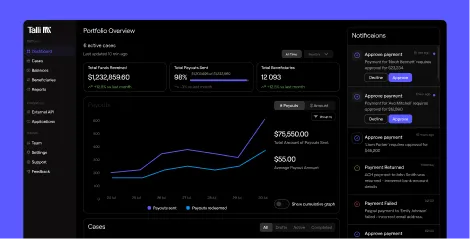
For firms handling complex mass tort settlements with large claimant populations, purpose-built digital claims disbursement infrastructure like Talli offers segregated QSF-compliant accounts, automated OFAC screening, multiple payout rails (ACH, prepaid Mastercard, PayPal, gift cards), and real-time dashboards with full audit transparency — backed by FDIC-insured banking through Patriot Bank, N.A. Firms with simpler disbursement needs or existing AP infrastructure may find that broader settlement administration platforms like Epiq or Milestone meet their requirements.
The best platform for your firm depends on your settlement volume, claimant demographics, compliance complexity, and integration needs. Use the decision framework and evaluation questions above to structure your vendor conversations, and always request a demonstration using a claimant count that reflects your actual settlement scale.
Frequently Asked Questions
What is a disbursement platform for mass tort litigation?
A disbursement platform for mass tort litigation is specialized payment infrastructure that manages the distribution of settlement funds to large groups of claimants. It handles identity verification, compliance screening (KYC, OFAC), payment delivery across multiple rails (ACH, prepaid cards, digital wallets), tax reporting (W-9/1099), and court-mandated audit trails — all at the scale required by mass tort cases involving thousands to hundreds of thousands of recipients.
How long does mass tort settlement disbursement take?
Disbursement timelines vary significantly by method and case complexity. Digital payment methods deliver funds in 24–48 hours after court approval, while traditional check processing takes 7–14 business days. However, the overall timeline from settlement approval to final distribution often extends longer due to lien resolution, claim verification, and staggered distribution schedules. Platforms with automated compliance screening and multi-rail payment options compress these timelines significantly.
What compliance requirements apply to mass tort settlement payouts?
Mass tort disbursements must satisfy multiple overlapping requirements: KYC identity verification for each claimant, OFAC screening against the Treasury Department's SDN list, QSF fund segregation under IRC Section 468B, W-9 collection and 1099 reporting for taxable components, IOLTA trust account compliance for law firm-held funds, and court-specific reporting obligations. The platform must handle all of these at scale without manual bottlenecks.
How do digital disbursements improve settlement redemption rates?
Digital disbursements improve redemption through three mechanisms: faster delivery (24–48 hours versus 7–14 days for checks), payment method choice (claimants select ACH, prepaid cards, or digital wallets), and proactive engagement (automated SMS and email reminders). Research shows digital payments can reach a 98% success rate, while paper check cash rates are materially lower — about 77% in cases with a claims process and 55% in cases without one — and offering multiple payment options can further improve completion.
What is a Qualified Settlement Fund (QSF) and why does it matter?
A Qualified Settlement Fund under IRC Section 468B is a court-established trust that holds settlement proceeds separately from the defendant's and law firm's operating accounts. QSFs matter because they provide tax deferral benefits for defendants, enable structured distributions over time, and ensure fund segregation that protects claimant money. Any disbursement platform handling mass tort settlements must support QSF-compliant account structures with proper documentation for both the court and the IRS.
How do you prevent fraud in mass tort settlement payments?
Fraud prevention in mass tort disbursement requires layered security: identity verification at registration and payment, OFAC screening before every transaction, AI-powered pattern recognition to flag anomalous claims, real-time transaction monitoring, and device fingerprinting. Digital platforms reduce fraudulent claims by approximately 40% compared to check-based systems, primarily because paper checks are involved in 65% of all payment fraud. Look for platforms with PCI DSS Level 1 and SOC 2 Type II certifications.
What payment methods do mass tort disbursement platforms support?
Modern platforms support multiple payment rails including ACH direct deposit, prepaid Mastercard or Visa cards (virtual and physical), digital wallets (PayPal, Venmo), push-to-card transfers, wire transfers, and traditional paper checks. The strongest platforms let claimants self-select their preferred method through a portal interface, which increases redemption rates and reduces administrative overhead from manually managing payment preferences.