.svg)


.svg)
An improperly structured special needs trust distribution can reduce a beneficiary’s Supplemental Security Income, create countable resources, or trigger a benefits review. In 2026, the maximum federal SSI payment is $994 per month for an eligible individual, while Medicaid may provide medical, residential, and community-based services worth substantially more.
Trustees must balance quality-of-life support with SSI, Medicaid, tax, trust-document, and state-law requirements. Clear approval procedures, direct vendor payments, complete records, and a reliable trust disbursement platform can reduce operational errors, but legal and benefits professionals should review significant or unusual distributions.
Key Takeaways
- Cash paid directly to a beneficiary generally counts as unearned income after applicable exclusions and may reduce or eliminate that month’s SSI payment.
- Since September 30, 2024, food is no longer included in SSI in-kind support and maintenance calculations.
- Shelter assistance can reduce SSI, but the reduction is normally limited under the applicable in-kind support calculation.
- First-party special needs trusts generally require sole-benefit administration and Medicaid reimbursement at death.
- A properly drafted third-party trust generally has no Medicaid payback requirement when it contains only assets that never belonged to the beneficiary.
- Direct vendor payment is usually the safest approach, but it is not an absolute federal requirement for every distribution.
- California restored asset limits for affected Non-MAGI Medi-Cal programs on January 1, 2026.
- Payment controls and complete audit records support compliance, but technology does not replace individualized legal and benefits advice.
Understanding Special Needs Trust Fundamentals
A special needs trust, often called an SNT, holds assets for a person with a disability without necessarily making those assets available to the beneficiary for SSI and Medicaid purposes. Properly structured trusts can protect eligibility while paying for goods and services that improve the beneficiary’s health, independence, safety, and quality of life.
SSI generally limits an individual recipient to $2,000 in countable resources. Trust assets may remain outside that limit when the beneficiary cannot revoke the trust, compel distributions, or use the assets without trustee approval. The result depends on the trust language, funding source, state law, and applicable SSA trust rules.
What Can an SNT Support?
A trust may be able to pay for expenses such as:
- Medical and dental care not otherwise covered
- Transportation and vehicle expenses
- Computers, smartphones, and accessibility devices
- Education, training, and tutoring
- Recreation, travel, and hobbies
- Clothing and personal-care items
- Caregiving and support services
- Legal, tax, and trust-administration expenses
- Food and meal-delivery services
- Housing and utilities, subject to possible SSI effects
Whether a payment is appropriate depends on the trust document and the beneficiary’s public-benefit programs. Trustees should avoid relying on simplified “allowed” and “prohibited” lists without reviewing the actual circumstances.
First-Party and Third-Party Special Needs Trusts
The source of the trust assets determines many of the governing rules.
First-Party Trusts
A first-party trust is funded with assets belonging to the beneficiary. Common funding sources include personal-injury settlements, direct inheritances, accumulated savings, and retroactive benefit payments.
A qualifying first-party trust generally:
- Is established for a disabled individual
- Is funded with the individual’s own assets
- Meets the applicable requirements of 42 U.S.C. § 1396p(d)(4)
- Is administered for the beneficiary’s sole benefit
- Contains a Medicaid reimbursement provision
- Is established for a disabled individual before age 65; an existing qualifying trust may continue after age 65, although later additions may be treated differently
At the beneficiary’s death, the state Medicaid agency generally receives reimbursement from remaining trust assets before other remainder beneficiaries are paid.
Third-Party Trusts
A third-party trust is funded with assets that never belonged to the beneficiary, usually from parents, grandparents, siblings, or other relatives.
A properly structured third-party trust generally:
- Does not require Medicaid payback
- May be established regardless of the beneficiary’s age
- Can name family members or charities as remainder beneficiaries
- Follows distribution standards stated in the trust document
- Must still be administered carefully to avoid creating countable income or resources
Families should direct inheritances and gifts into the third-party trust rather than giving assets directly to the beneficiary.
How Trust Distributions Affect SSI
SSI distinguishes among cash income, in-kind support, and noncountable goods or services. The payment method and the purchased item both matter.
Cash Paid to the Beneficiary
Cash paid directly to the beneficiary generally counts as unearned income in the month received. After applicable exclusions, countable cash usually reduces SSI dollar for dollar and can reduce the federal payment to zero for that month.
Examples include:
- Checks payable directly to the beneficiary
- Electronic deposits into the beneficiary’s personal account
- Cash withdrawals given to the beneficiary
- Unrestricted transfers through payment applications
- Cards that can be converted to cash or used without meaningful restrictions
The payment does not necessarily terminate Medicaid in every case. Medicaid consequences depend on the state, eligibility pathway, continued-coverage rules, and whether the person remains eligible under provisions such as Section 1619(b).
Direct Vendor Payments
When a trustee pays a vendor directly for a non-shelter item, the payment usually does not count as SSI income because the beneficiary receives the item or service rather than cash.
Direct payment can be used for:
- Medical providers
- Transportation companies
- Retailers
- Educational institutions
- Technology suppliers
- Attorneys and accountants
- Travel providers
- Care agencies
A multi-channel payment system can help trustees manage approved disbursements through a consistent payment and tracking process.
Gift Cards and Payment Cards
Gift-card treatment depends on the card’s terms. Trustees should determine whether the card:
- Allows cash withdrawals
- Can be sold or transferred
- Can pay a credit-card balance
- Works at nearly any merchant
- Is restricted to particular stores
- Is restricted to specified categories
- Can purchase shelter expenses
Many unrestricted cards can count as income or resources. Even a restricted card may have benefit consequences depending on what it can purchase. Store-specific cards for non-shelter items may present less risk, but trustees should document the restrictions and obtain benefits advice when necessary.
Food and Shelter Rules After September 2024
Effective September 30, 2024, SSA stopped counting food in its in-kind support and maintenance calculation. Food provided by a trust, family member, or other third party no longer reduces SSI merely because it is food.
This allows trustees to consider payments for:
- Groceries
- Restaurant meals
- Prepared meals
- Meal-delivery services
- Nutritional products
- Food provided during travel
The rule does not turn a cash payment into a noncountable food payment. Giving the beneficiary cash for groceries may still create countable income. Paying the grocer, restaurant, delivery service, or a properly reviewed restricted card is generally safer.
Shelter Still Matters
Shelter assistance can continue to reduce SSI. Shelter expenses generally include:
- Rent
- Mortgage payments
- Property taxes
- Heating fuel
- Gas
- Electricity
- Water
- Sewer service
- Garbage collection
In 2026, in-kind shelter support can reduce federal SSI by as much as $351.33 under the presumed maximum value calculation. The actual reduction may be lower based on the value of support and the beneficiary’s circumstances.
SSA’s expanded rental-subsidy policy may produce a more favorable result in qualifying arrangements. However, trustees should not assume that paying a particular amount automatically avoids an SSI reduction. Required rent, market rental value, household composition, and the applicable SSA calculation must be reviewed.
When Paying for Housing May Still Be Sensible
A trustee may determine that the value of secure housing exceeds the resulting SSI reduction.
For example, suppose a trust pays $1,500 in monthly rent and SSA applies the 2026 maximum presumed-value reduction of $351.33. The housing payment still provides approximately $1,148.67 in additional net monthly support.
The trustee should compare:
- The amount of shelter assistance
- The expected SSI reduction
- The beneficiary’s safety and housing stability
- Available state SSI supplements
- Medicaid eligibility consequences
- Alternative rental or ownership arrangements
- The requirements of the trust document
The decision should be documented as an informed fiduciary judgment rather than treated as an automatic violation.
Medicaid Eligibility and SNT Distributions
Medicaid rules vary by state and eligibility category. Some beneficiaries qualify because they receive SSI. Others qualify through waiver programs, medically needy rules, institutional eligibility, or disability-based Non-MAGI programs.
An improper distribution may affect Medicaid when it:
- Creates countable income above an applicable limit
- Leaves accessible funds in the beneficiary’s account
- Makes trust assets legally available to the beneficiary
- Violates a state-specific trust rule
- Constitutes a transfer for less than fair market value in a long-term-care case
- Pays an expense contrary to the trust’s terms
A reduced or suspended SSI payment does not always mean Medicaid ends. Trustees should confirm the beneficiary’s exact Medicaid eligibility pathway before assuming the result.
California Medi-Cal Asset Rules
California restored asset testing on January 1, 2026, for affected Medi-Cal programs that do not use Modified Adjusted Gross Income methods.
According to the current California asset guidance:
- Through June 30, 2027, the limit is $130,000 for one person.
- The limit increases by $65,000 for each additional qualifying household member, up to ten people.
- Starting July 1, 2027, the limit is $21,000 for one person and $31,000 for two people.
- Additional amounts apply for larger qualifying households.
These rules do not apply identically to every Medi-Cal recipient. Long-term-care transfer reviews also follow separate transition and look-back guidance. Trustees should obtain California benefits counsel before transferring assets or changing an existing trust plan.
Understanding the Sole-Benefit Rule
A first-party SNT must be administered for the sole benefit of the disabled beneficiary. This does not mean no one else may receive an incidental benefit. It means trust expenditures must be primarily justified by the beneficiary’s needs.
Potentially problematic payments include:
- Gifts to relatives or friends
- Another person’s ordinary living expenses
- Family vacations with no allocation of costs
- Loans without enforceable repayment terms
- Excessive trustee, guardian, or professional fees
- Purchases primarily used by someone else
Travel and Companion Expenses
A trust may be able to pay reasonable expenses for a caregiver or companion when the person’s participation is necessary for the beneficiary to travel safely.
Documentation should explain:
- Why the companion is required
- Which costs belong to the beneficiary
- Which additional costs are necessary for the companion
- Why the amounts are reasonable
- How the trip benefits the beneficiary
The trust should not automatically pay every family member’s travel expenses merely because the beneficiary is attending.
ABLE Account Coordination
An ABLE account can complement an SNT by giving an eligible beneficiary greater control over day-to-day spending.
ABLE accounts generally offer:
- Beneficiary-controlled spending
- Tax-free growth for qualified disability expenses
- Broad qualified-expense categories
- An SSI resource exclusion for the first $100,000
- Easier payment of recurring personal expenses
An SNT can contribute to an ABLE account, subject to the annual contribution limit and other ABLE rules. Beginning in 2026, the beneficiary’s qualifying blindness or disability generally must have begun before age 46.
Housing withdrawals should normally be spent during the same calendar month. Retaining housing funds into the next month may cause them to count as a resource. Trustees should also distinguish qualified distributions from nonqualified withdrawals that may create tax or benefit consequences.
Tax Rules for Special Needs Trusts
Tax treatment depends on whether the trust is a grantor trust, nongrantor trust, qualified disability trust, or another type of arrangement.
A trust may need to:
- Obtain a taxpayer identification number
- File Form 1041
- Issue Schedule K-1
- Pay estimated taxes
- Track distributable net income
- Separate principal from income
- Document deductible administration expenses
Direct vendor payments are not automatically tax-free merely because they do not reduce SSI. Tax treatment depends on the trust’s classification, the source of income, and whether the distribution carries out distributable net income.
The 65-Day Election
Under Internal Revenue Code Section 663(b), a qualifying estate or trust may elect to treat certain distributions made during the first 65 days of a tax year as paid on the final day of the previous tax year.
The election can help allocate eligible distributable net income, but it does not automatically apply to every trust or every payment. The trustee should consult a tax professional before relying on it.
Calendar-year trusts generally file Form 1041 by April 15. An automatic five-month filing extension may be available, although an extension to file does not extend the deadline for paying tax.
Building a Benefit-Safe Distribution Process
A consistent review process is more reliable than making decisions from memory.
Step 1: Identify the Benefit Programs
Confirm whether the beneficiary receives:
- SSI
- SSDI
- Medicaid
- Medicare
- Housing assistance
- SNAP
- State supplementation
- Home and community-based waiver services
SSDI and Medicare are not means-tested in the same way as SSI and Medicaid, but other programs may have separate income and resource rules.
Step 2: Classify the Requested Expense
Determine whether the request involves:
- Cash
- Shelter
- Food
- Medical care
- Transportation
- Personal property
- Travel
- Education
- Caregiving
- A payment benefiting another person
Step 3: Review the Payment Method
Direct vendor payment is normally the preferred method. Reimbursements, debit cards, gift cards, cash payments, and deposits to an ABLE account require additional review.
Step 4: Check the Trust Document
The trustee must follow the trust’s distribution standard, approval requirements, tax provisions, and remainder terms.
Step 5: Document the Decision
A complete distribution file should include:
- Beneficiary request
- Invoice or estimate
- Vendor information
- Distribution approval
- Purpose statement
- Benefits analysis when needed
- Proof of payment
- Receipt or delivery confirmation
An automated disbursement workflow can standardize approvals and reduce missing records.
Maintaining Fiduciary-Grade Records
Trustees may need to explain distributions to beneficiaries, courts, Medicaid agencies, tax preparers, remainder beneficiaries, or auditors.
Each payment record should show:
- Date
- Amount
- Vendor
- Expense category
- Beneficiary purpose
- Approving trustee
- Supporting document
- Payment confirmation
- Any expected SSI effect
Centralized audit trail records help demonstrate that the trustee followed an established process. Real-time payment tracking also makes it easier to identify failed, returned, duplicated, or incomplete payments.
Role-based controls can prevent one person from creating, approving, and releasing a payment without review. Trustees managing larger trusts may also use role-based access to separate responsibilities among fiduciaries, case managers, accountants, and legal counsel.
How Talli Supports Trustee Payment Operations
Special needs trust compliance requires legal and benefits judgment. A payment platform should support that process rather than claim to replace it.
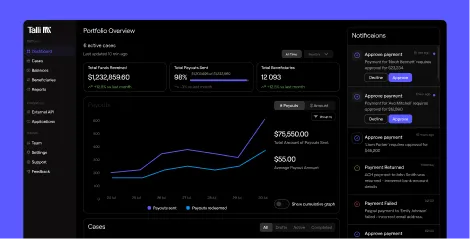
Talli provides digital payment infrastructure for trustees and legal payment teams that need controlled disbursements, transaction visibility, and complete records. Its broader platform capabilities include multi-channel payments, approval workflows, payment-status tracking, reporting, and audit documentation.
For an SNT workflow, trustees can use operational controls to:
- Route requests through a defined approval process
- Pay approved vendors through available payment channels
- Preserve invoices and supporting documents
- Track pending, completed, failed, or returned payments
- Maintain transaction histories for fiduciary reporting
- Reconcile payments without relying on separate spreadsheets
- Apply internal restrictions based on trustee-approved policies
Trustees should not treat automated payment controls as a benefits determination. An attorney, benefits planner, or qualified administrator should still review unusual expenses, cash requests, housing arrangements, ABLE transfers, and state-specific Medicaid questions.
Talli Conclusion: Better Controls for Complex Trust Disbursements
The safest SNT distribution process combines individualized professional judgment with consistent payment controls. Trustees must understand what is being purchased, how the payment will be delivered, which benefits may be affected, and whether the trust document permits the expense.
Talli helps organize the operational side of that responsibility through comprehensive reporting, payment tracking, controlled workflows, and transaction-level documentation. These capabilities can reduce administrative gaps and provide clearer evidence of fiduciary oversight.
Technology cannot decide whether a distribution satisfies SSI, Medicaid, tax, or sole-benefit rules. It can ensure that approved decisions are executed accurately, documented completely, and available for review.
Frequently Asked Questions
Can an SNT Pay Rent Without Affecting SSI?
An SNT can pay rent, but shelter assistance may reduce SSI under in-kind support rules. In 2026, the reduction can reach $351.33 per month. Some qualifying rental arrangements receive more favorable treatment. Trustees should compare the expected reduction with the value of the housing provided.
Can a Trustee Give the Beneficiary Cash?
A trust document may permit cash distributions, but cash generally counts as unearned income for SSI after applicable exclusions. It can reduce or eliminate that month’s SSI payment. Direct vendor payment is normally safer when preserving means-tested benefits is the priority.
Can an SNT Fund an ABLE Account?
Yes. An SNT may contribute to an eligible beneficiary’s ABLE account, subject to annual contribution limits and trust terms. ABLE accounts can provide greater spending independence. Housing withdrawals should normally be spent in the same month to avoid becoming countable resources.
Are SNT Distributions Taxable?
The answer depends on the trust’s tax classification, income, distributable net income, and type of payment. Some distributions may carry taxable income reported on Schedule K-1, while others represent principal. Trustees should coordinate annual reporting with a tax professional experienced in special needs trusts.
What Happens When the Beneficiary Dies?
A first-party SNT generally must reimburse state Medicaid programs before remaining assets pass to other beneficiaries. A properly structured third-party SNT normally has no Medicaid payback requirement, so the remaining funds pass according to the trust’s remainder provisions.